
BuddhistCatholicContemplativeEvangelicalGeneral ChristianHinduJewishLatter-day SaintMuslimNew VisionsProgressive Christian
Beliefs
- Buddhist
- Catholic
- Contemplative
- Evangelical
- General Christian
- Hindu
- Jewish
- Latter-day Saint
- More Voices
- Muslim
- New Visions
- Pagan
- Progressive Christian
Topics
- Religion News
- Food and Religion
- Sports and Religion
- Religious Art
- Religious Music and Entertainment
- Religious Events
- History and Religion
- Style and Religion
- Politics and Religion
- Women in Religion
- Recreation Outdoors and Religion
- Business Finance and Religion
- Careers Workplace and Religion
- Education and Religion
- Family Parenting and Religion
- Health Fitness and Religion
- Home and Religion
- Relationships and Religion
- Technology and Religion
- Travel and Religion
Columnists
- Buddhist Columnists
- Business Finance and Religion Columnists
- Careers Workplace and Religion Columnists
- Catholic Columnists
- Contemplative Columnists
- Education and Religion Columnists
- Evangelists Columnists
- Family Parenting and Religion Columnists
- General Christian Columnists
- Health Fitness and Religion Columnists
- Hindu Columnists
- History and Religion Columnists
- Home and Religion Columnists
- Jewish Columnists
- More Voices Columnists
- Latter Day Columnists
- Muslim Columnists
- New Visions Columnists
- Nonreligious Columnists
- Pagan Columnists
- Politics and Religion Columnists
- Progressive Columnists
- Recreation Outdoors and Religion Columnists
- Relationships and Religion Columnists
- Religion News Columnists
- Religious Art Columnists
- Religious Events Columnists
- Religious Music and Entertainment Columnists
- Sports and Religion Columnists
- Style and Religion Columnists
- Technology and Religion Columnists
- Travel and Religion Columnists
- Women in Religion Columnists
Resource Library
- 2026 Calendar
- Library of World Religions
- The 100 Most Holy Places on Earth
- Patheos Answers
- Podcasts
- Videos
- Faith Leaders Database
- Anglican Episcopalian
- Bahai
- Baptist
- Buddhism
- Christianity
- Confucianism
- Eastern Orthodoxy
- Hinduism
- Holiness and Pentecostal
- ISKCON
- Islam
- Judaism
- Lutheran
- Methodist
- The Church of Jesus Christ of Latter-day Saints
- New Age
- Paganism
- Presbytarian and Reformed
- Protestantism
- Religion Behind the Scenes
- Roman Catholic
- Scientology
- Shia Islam
- Sikhism
- Sufism
- Sunni Islam
- Taoism
- Zen
- See all religions
Research Tools
 Ad-Free & Subscriber Log-In Subscription Support
Ad-Free & Subscriber Log-In Subscription Support
Follow Patheos 

- Trending:
- Forgiveness
- |
- Marriage
- |
- Consciousness
- |
- Death Penalty
- |
- Election
- |
- Halloween

- Home
- Pagan
- Irish-American Witchcraft: Fae in the City
Irish-American Witchcraft: Fae in the City
Last updated on: February 18, 2020 at 4:09 pm by Morgan Daimler
Irish-American Witchcraft: Fae in the City 2020-02-18T16:09:48+00:00 Morgan Daimler
Patheos Explore the world's faith through different perspectives on religion and spirituality! Patheos has the views of the prevalent religions and spiritualities of the world.
Articles on fairies often, consciously or unconsciously, tend to focus on fairies and fairy encounters in wild or rural settings but this is only part of the picture. Across the breadth of the material – past and present – we see a wide range of Otherworldly beings including those that are found in human habitations and cities.
While it’s true that some fairies do avoid humans or prefer to live in more desolate areas, many of the Good Folk are inextricably intertwined in human lives. I think it’s important to understand this and to avoid an overly narrow view or understanding of these beings, so today I’d like to talk a bit about why we tend to exclude cities from our understandings of fairies, the folklore that can tie them to cities, modern anecdotes, and examples of cities in Fairy itself. Hopefully this will give people some food for thought on the subject.
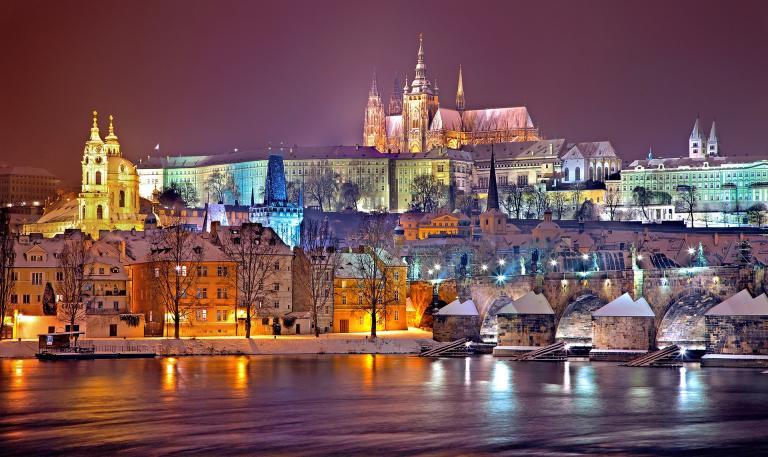
Could there be fairies in the beautiful city of Prague? Likely! Photo by Julius Silver via Pixabay.
Misunderstanding Cities
First off I think we need to talk a common misperception: that you can’t find fairies in cities or that they wouldn’t want to be there. This seems to be rooted in the common idea that fairies are entirely or only nature spirits, which is itself a misunderstanding of the taxonomy of fairies. Even if we accept that viewpoint, however, that should not limit the presence of fairies in human cities. Cities still have plants, trees, insects, wildlife, and even pockets of natural spaces in which one might find nature spirits or land spirits if one believed those were the sum total of fairies. As much as we may sometimes prefer to see cities in contrast to rural or wild spaces the truth is that cities are merely adapted from those spaces and still hold a bit of wildness and nature within them. The energy is different, of course, but it is still there. When you get down to it all of the world is natural and so nature spirits can and will exist everywhere.
Another argument hinges on the idea that fairies are averse to iron and human cities have a lot of that. It is true that modern cities tend to be built with a lot of steel and iron and that many types of fairies are warded off by this material. However, not all fairies are sensitive to iron and even those who are may not avoid a place where iron has been used for building if the iron is covered by other materials.
In folklore, for iron to be effective as a deterrent or protection it often (not always) has to be bare; for example in British Goblins there is a story of a man in Wales who is being harassed by fairies as he travels and they only flee when he pulls his dagger. The dagger in the sheath wasn’t enough to ward them off, but the bared metal was. There is another story of fairies who would visit a man working in a kitchen, without seeming to be bothered by the iron cutlery or cookware, but would flee if a knife was held in their direction. From this we can, hopefully, see that the presence of iron building material by itself wouldn’t keep fairies out of a city.

Not all fairies are sensitive to iron. Photo by Lynn Greyling via Pixabay.
Folklore
There is folklore of fairies to be found in cities, castles, and other human places. In Sussex, for example, a goblin was said to guard treasure in a hall at Herstmonceux (Fairy Folklore, 2020). There are also fairies like the Abbey Lubbers and Buttery Spirits which lurk in the food storage areas of abbeys, inns, taverns, or generally dishonest households, stealing the value from the food if the humans are greedy or fail to protect it with proper blessings (Briggs, 1976). And of course the famous MacLeod fairy flag was by some accounts given to the family by a fairy woman in the MacLeod’s castle. All of these are examples of fairies that are or were associated with places with larger human populations or activity and demonstrate that fairy folk are not put off by human activity or settled areas.
Modern Anecdotes
One of the most intense personal experiences I have had happened in a city of 27,000 people. It was around 4 in the morning and I saw a white fairy hound crossing an empty field; it disappeared about 2/3rds of the way across moving towards me. My other experience with fairy hounds – or at least black dogs – happened in a slightly larger city when a friend and I saw two black fairy dogs. As with my sighting of the white hound the two black dogs disappeared afterwards, were unaccompanied, and were moving directly towards us. In the case of the two dogs they also seemed to respond to things we were saying (we hoped they wouldn’t cross the street and they immediately did) and somehow crossed in front of us without being seen, which should have been impossible. In both instances I was in the middle of a human city with the usual city activity although I will note that during the experience there was a notable lack of human presence around.
Beyond my own personal experiences other people have also encountered fairies in modern cities. A great resource for such modern encounters, of all varieties, is the 2018 ‘Fairy Census‘ which is available free online and which has gathered an array of anecdotal accounts including some from cities. For an example, from that source, #8 is a woman in Birmingham England in the 1990’s who described seeing a 6-foot tall elf lying across a tree branch in a city park (Young, 2018, page 29-30). In the same source, account #10 also takes place in a city, this time inside a store. These modern encounters are in the same spirit as older ones and continue a long tradition of people having personal experiences of fairies in various ways and places, including cities.

I’ve had experiences with fairy hounds in cities. Photo by Madeleine Lewander via Pixabay.
Fairy Cities
On a related note it is worth remembering that we have stories of fairies having their own cities in the Otherworld as well, showing that they are not inherently averse to cities as a concept. These cities are described as contemporaneous or only slightly antiquated by the humans who experienced them and seem to be very similar to their human counterparts at the time. Certainly enough so that the observer recognizes the place as a city and describes it as such. Briggs mentions one story of a shepherd who joined a fairy dance and was taken to a large palace, and there are similar accounts of large fairy habitations or cities in mythology and ballad material. There are specific types of fairies that are solitary beings, in folklore, but there are also many that are not – what Briggs calls ‘trooping fairies’ – and it seems logical that some of the social fairies would live together in towns and cities just as humans do.
There have also been accounts of people today experiencing or seeing cities in Fairy, in dreams or visionary experiences. These accounts like the older folkloric ones describe places that are contemporary or only slightly out of date to what we have today. Several of us have also experienced, separately, something like a train station that seems to allow people to go to different destinations in the Otherworld. So at the least I think we can safely say that not all fairies are technophobes or luddites and that cities in Fairy make as much sense as they do in the human world, and probably exist for the same reasons.
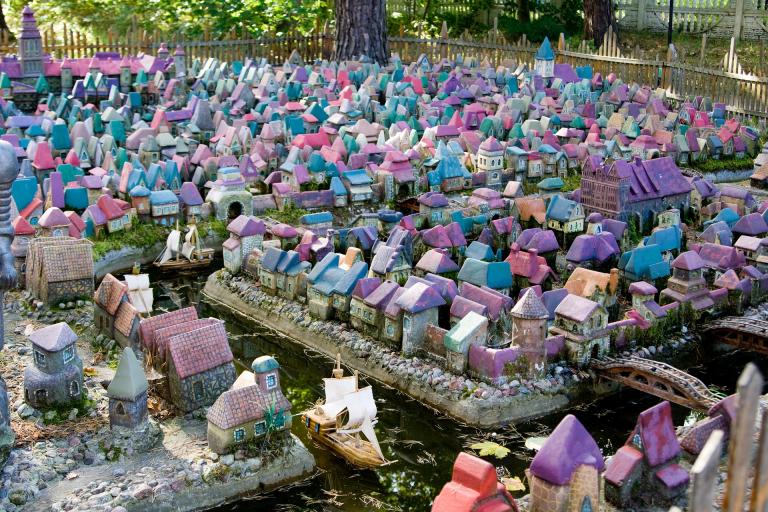
Cities in Fairy make as much sense as they do in the human world. Image by vektator via Pixabay.
Final Thoughts
There is a tendency to view fairies as limited to the realm of gardens and wilderness but I urge people to rethink this. We have abundant evidence both in the older material and in modern accounts of fairies in human cities and of cities existing in the world of Fairy. We need to be willing to consider the entirety of the evidence and to take it for what it is rather than try to overlay our own opinions and biases onto it. The idea that fairies would only be found in wilderness, in my opinion, reflects a romanticism of those beings that lessens who and what they are rather than adding to our understanding of them.
References
Fairy Folklore (2020) Sussex Archaeology and Folklore
Briggs, K., (1976) A Dictionary of Fairies
Wirt, S., (1880) British Goblins
Young, S., (2018) Fairy Census
Previous Post

February 13, 2020
Simple Witchery: A Time For Anger
Next Post

February 18, 2020 The Corner Crone: Personal Agency, Healthy Boundaries & Saying “No”
Browse Our Archives
Select a Category A Lakeside Hearth Adventures in Wortcunning Alone In Her Presence Arts, Crafts & Cooking Birthing Hereditary Witchcraft Book of Blackbirds Book Reviews Born-Again Witch Cauldron, Sword, Spear, & Stone Cermony and Liturgy Columns Community Dandelion Seeds Dear Jasmine Druid Thoughts Editor's Picks Everyday Pagan Family & Household Practice Family Traditions Full Frontal Magic Gateway Goddess Guest Articles Happily Heathen Health and Wellness Hearth of Hellenism Heathen Woman Hills of the Horizon History Holidays Horse Goddesses Interfaith Interviews Irish-American Witchcraft Jewish Witch Lamp & Labyrinth Letters from Midgard Literature, Media, Film, Music Loop of Brighid Love, Sex & Relationships Magic or Magick Making Light Naturalistic Traditions Nature News Outside The Circle Pantheisticon Politics Prayers, Poems, Blessings & Stories Queer Femme Mystic Queer of Swords Recipes Ritual and Practice Science and Research Seekers and Guides Seeking the Grail Socially Responsible Magic Spear of Athena Star Made Witch Syncretic Electric Technology The Blooming Staff The Busy Witch The Cartomancer The Crow's Nest The Dance of Pagan Recovery The Hearth of Hellenism The Lady's Quill The Other Side of the Hedge The Path of She The Rantin' Raven The Witches Next Door The Zen Pagan Theology, Ethics, Philosophy Tree City Witch Urban Earthwitch Wayfaring Woman Witch on Fire Wyrd Words
Select a Month January 2026 March 2025 December 2024 June 2024 April 2024 March 2024 January 2024 December 2023 November 2023 October 2023 August 2023 July 2023 May 2023 April 2023 March 2023 February 2023 January 2023 December 2022 November 2022 October 2022 September 2022 August 2022 July 2022 June 2022 May 2022 March 2022 February 2022 January 2022 December 2021 November 2021 October 2021 September 2021 August 2021 July 2021 June 2021 May 2021 April 2021 March 2021 February 2021 January 2021 December 2020 November 2020 October 2020 September 2020 August 2020 July 2020 June 2020 May 2020 April 2020 March 2020 February 2020 January 2020 December 2019 November 2019 October 2019 September 2019 August 2019 July 2019 June 2019 May 2019 April 2019 March 2019 February 2019 January 2019 December 2018 November 2018 October 2018 September 2018 August 2018 July 2018 June 2018 May 2018 April 2018 March 2018 February 2018 January 2018 December 2017 November 2017 October 2017 September 2017 August 2017 July 2017 June 2017 May 2017 April 2017 March 2017 February 2017 January 2017 December 2016 November 2016 October 2016 September 2016 August 2016 July 2016 June 2016 May 2016 April 2016 March 2016 February 2016 January 2016 December 2015 November 2015 October 2015 September 2015 August 2015 July 2015 June 2015 May 2015 April 2015 March 2015 February 2015 January 2015 December 2014 November 2014 October 2014 September 2014 August 2014 July 2014 June 2014 May 2014 April 2014 March 2014 February 2014 January 2014 December 2013 November 2013 October 2013 September 2013 August 2013 July 2013 June 2013 May 2013 April 2013 March 2013 February 2013 January 2013 December 2012 November 2012 October 2012 September 2012 August 2012 July 2012 June 2012 May 2012 April 2012 March 2012 February 2012 January 2012
Follow Us!
TAKE THE
Religious Wisdom Quiz
How many books does the Old Testament have?
Select your answer to see how you score.
39 41 50 51
Related posts from Agora

Simple Witchery: To Keep Silent

Simple Witchery: Leaning On The Four Pillars


Simple Witchery: Resistance and Resilience in Hard Times
TRENDING AT PATHEOS Pagan

I was recently chatting with someone on Instagram. She asked me what...

While there are many people who share their results, the end of...

On July 23, I saw Christopher Nolan's The Odyssey which is Homer’s...

As I write this two big events have just finished up. One...

Restoring the Watershed of Divine Love
Perhaps cooperation is not something we manufacture through legislation, ideology, or moral...

Many UUs don’t pray because of bad experiences in a previous religion,...
view all Pagan blogs
Ad-Free & Subscriber Log-In Subscription Support
- About Us
- 2026 Calendar
- Videos
- Podcasts
- Library of World Religions
- Faith In Media Tracker
- Advertise With Us
- Write for Us
- Privacy Policy
- Terms of Service
- Do Not Sell My Data
- Contact Us
- Radiant Digital
- Manage Newsletter Subscriptions
- Unsubscribe From Notifications
- Sitemap
Copyright 2008-2026, Patheos. All rights reserved.
Subscription Support Ad-Free & Subscriber Log-In
Follow Patheos