
BuddhistCatholicContemplativeEvangelicalGeneral ChristianHinduJewishLatter-day SaintMuslimNew VisionsProgressive Christian
Beliefs
- Buddhist
- Catholic
- Contemplative
- Evangelical
- General Christian
- Hindu
- Jewish
- Latter-day Saint
- More Voices
- Muslim
- New Visions
- Pagan
- Progressive Christian
Topics
- Religion News
- Food and Religion
- Sports and Religion
- Religious Art
- Religious Music and Entertainment
- Religious Events
- History and Religion
- Style and Religion
- Politics and Religion
- Women in Religion
- Recreation Outdoors and Religion
- Business Finance and Religion
- Careers Workplace and Religion
- Education and Religion
- Family Parenting and Religion
- Health Fitness and Religion
- Home and Religion
- Relationships and Religion
- Technology and Religion
- Travel and Religion
Columnists
- Buddhist Columnists
- Business Finance and Religion Columnists
- Careers Workplace and Religion Columnists
- Catholic Columnists
- Contemplative Columnists
- Education and Religion Columnists
- Evangelists Columnists
- Family Parenting and Religion Columnists
- General Christian Columnists
- Health Fitness and Religion Columnists
- Hindu Columnists
- History and Religion Columnists
- Home and Religion Columnists
- Jewish Columnists
- More Voices Columnists
- Latter Day Columnists
- Muslim Columnists
- New Visions Columnists
- Nonreligious Columnists
- Pagan Columnists
- Politics and Religion Columnists
- Progressive Columnists
- Recreation Outdoors and Religion Columnists
- Relationships and Religion Columnists
- Religion News Columnists
- Religious Art Columnists
- Religious Events Columnists
- Religious Music and Entertainment Columnists
- Sports and Religion Columnists
- Style and Religion Columnists
- Technology and Religion Columnists
- Travel and Religion Columnists
- Women in Religion Columnists
Resource Library
- 2026 Calendar
- Library of World Religions
- The 100 Most Holy Places on Earth
- Patheos Answers
- Podcasts
- Videos
- Faith Leaders Database
- Anglican Episcopalian
- Bahai
- Baptist
- Buddhism
- Christianity
- Confucianism
- Eastern Orthodoxy
- Hinduism
- Holiness and Pentecostal
- ISKCON
- Islam
- Judaism
- Lutheran
- Methodist
- The Church of Jesus Christ of Latter-day Saints
- New Age
- Paganism
- Presbytarian and Reformed
- Protestantism
- Religion Behind the Scenes
- Roman Catholic
- Scientology
- Shia Islam
- Sikhism
- Sufism
- Sunni Islam
- Taoism
- Zen
- See all religions
Research Tools
 Ad-Free & Subscriber Log-In Subscription Support
Ad-Free & Subscriber Log-In Subscription Support
Follow Patheos 

- Trending:
- Forgiveness
- |
- Marriage
- |
- Consciousness
- |
- Death Penalty
- |
- Election
- |
- Halloween

- Home
- Pagan
- Pan-Celtic Hoofbeats: Think Before You Appropriate
Pan-Celtic Hoofbeats: Think Before You Appropriate
Last updated on: August 29, 2019 at 6:14 pm by Kris Hughes
Pan-Celtic Hoofbeats: Think Before You Appropriate 2019-08-29T18:14:18+00:00 Kris Hughes
Patheos Explore the world's faith through different perspectives on religion and spirituality! Patheos has the views of the prevalent religions and spiritualities of the world.
Scenario 1*: A group I belong to have a long and probing discussion about our use of a couple of Welsh words to describe what we do. Some of the members are native Welsh speakers living in Wales, most are not. We talk about things like cultural appropriation, the paralysing dangers of call-out culture, and about unintended consequences. The Welsh speakers in the group say they don’t have a problem with the rest of us using these words.*
Scenario 2: I attend a workshop in which a man splices “Celtic” onto another spiritual practice. I am genuinely curious and go along hoping to learn. He begins to tell a story from the Mabinogi. He is not struggling to pronounce the Welsh names he’s using, because he isn’t even trying to say them right, and his frequent repetition of names of deities in this disrespectful way causes my anger to rise and rise. His telling of the story is garbled and lacks understanding. I walk out quietly, rather than confront him there and then, but wonder whether I should have spoken up.
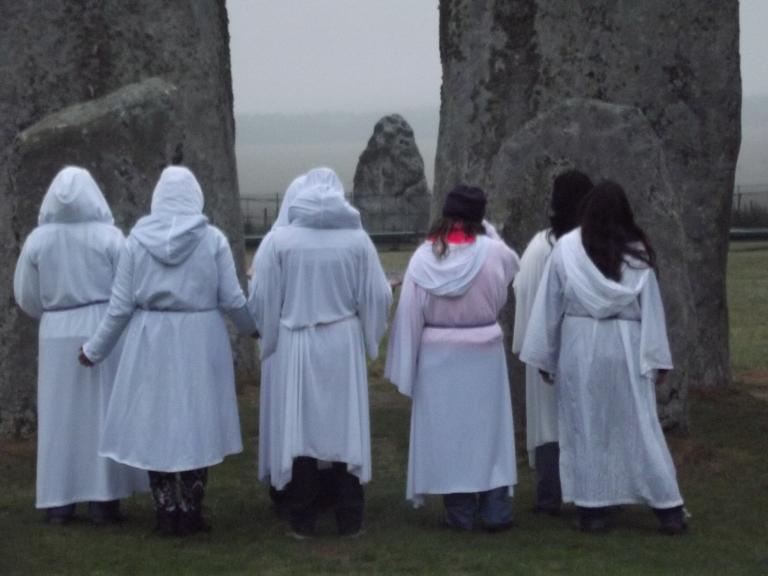
Neopagan Druids at Stonehenge in 2013. Borrowing ideas? Yes. Cultural appropriation? You decide. Photo by Stonehenge Stone Circle (CC BY 2.0)
I often see appropriation of Celtic culture and language among Pagans, and I usually keep my thoughts to myself. However, in the past week I’ve been assailed by the question from several different directions so I’m going to delicately wade in. My purpose here is to make people think, and to encourage calm, fearless discussion. I’m not going to call anyone out.
What Business is This of Mine?
I was born in the US, but lived in Scotland for 25 years of my adult life, and consider myself to be an adopted Scot. What I was doing there is a strange tale, as I made my living playing traditional Scottish music and I made most of my money teaching it — to Scots. I didn’t always get things right, especially in the early years. It took a huge amount of work and a lot of humility. I have also been a Celtic Polytheist for almost forty years.
When you grow up in a culture, you naturally take it for granted. When you assimilate into a culture, you notice everything. As a result, I’m aware of some nuances that many Scots don’t think about. I have an insider’s knowledge, but an outsider’s objectivity. I also grew up in an area of the US where two distinct cultures and languages competed and intermingled. Where identities could get blurred and justice, particularly language justice, was sorely needed.
Presumptive Co-option?
A friend of mine coined that phrase when we were looking for a milder, less accusing one than “cultural appropriation”. Let’s say your neighbour leaves her rake leaning against your mutual fence. You’re on good terms with her, so you presume to borrow the rake. It’s no big deal but it still isn’t your rake. If you start acting like the rake is yours, your neighbour might reasonably be annoyed. If you take her favourite skirt off the washing line, wear it to town, and mimic her mannerisms because you think she’s cool, you’ve overstepped the mark!
There are lots of grey areas in this discussion. At one extreme are the, “You’re not the boss of me,” crowd, and those who think saying, “We’re all children of the earth and everything belongs to everyone,” excuses them teaching a workshop on the Celtic uses of Voodoo in Heathenism. At the other end, we have people who stop and ask whether what they’re doing is respectful. They carefully consider their actions. In the grey area there’s casual thieving and unintentional gaffes, a lot of good will, a large dose of naivety, and some pretty entitled behaviour.
If you are at the soul-searching end of the spectrum, you’re not likely to be the part of problem. If you think there’s no such thing as cultural appropriation, you are the problem.

St. Patrick’s Day parade, Albany, NY. Some Irish people consider US-style St. Patrick’s Day celebrations to be offensive racial stereotyping. Others don’t care. Do you see this as problematic? Photo by Sébastien Barré (CC BY-NC-SA 2.0)
Whose Culture Is It Anyway?
Even if all sixteen of your great-grandparents were born in County Cork, if you and your parents have always lived in North America, your culture is North American. Culturally, you are a lot more like the other people in your street, than like your distant cousins back in Cork. If by some miracle your family is still bi-lingual in English and Irish, well done. But your culture is still North American. If you live in a deep diaspora – your culture is diasporic. If you don’t believe me, try going to live in the old country.
Genetics and family heritage aren’t meaningless. It’s great to honour this stuff, and it’s understandable that we may feel pulled to worship the gods of our distant ancestors or learn the language of our more recent ones. I get it. Just don’t tell modern Scots they’re doing it wrong if they don’t act like they just stepped out of an episode of Outlander and be ready for them to laugh if that’s how you act.

Scene from the 1954 film Brigadoon. Considered by many Scottish commentators to be offensive, it gave rise to the term “Brigadoonism” (to trivialise or romanticise Scottish culture). Wikimedia Public Domain.

Aren’t They My Gods, Too?
You have every right to honour Celtic gods, speak a Celtic language, and all the rest. Just leave the posturing out. You are not more Welsh than the Welsh. You don’t live in the Iron Age, either. Maybe ease up on the Celtic cosplay.
If you are more on the eclectic side, please remember that you are borrowing things that may hold a deeper or different meaning for some of your fellow Pagans. Be respectful of their beliefs and hard-won knowledge, too. Learn to pronounce things like names of deities correctly, if you’re going to use them. Have enough respect not to tell made-up versions of Celtic myths that you got from a low-quality book or website.
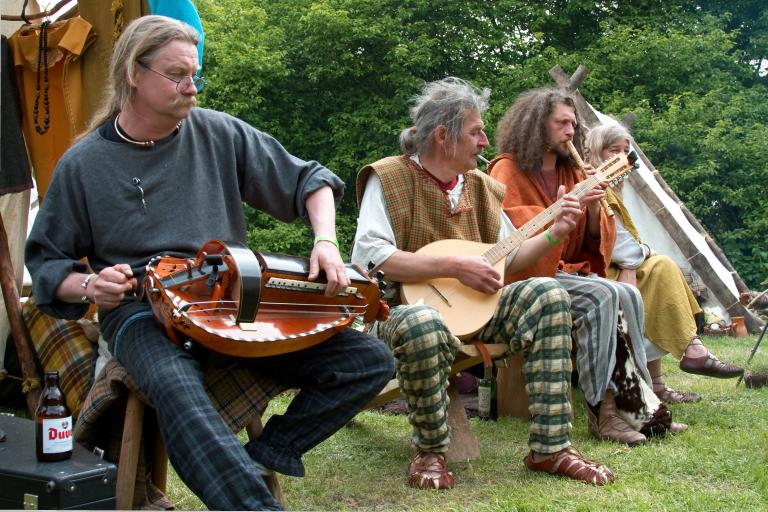
Friends enjoy a tune together at Keltfest, in the Netherlands. Does this hurt anyone? I don’t know! Photo by Sander van der Wel Wikimedia (CC BY-SA 2.0)

Am I Really Hurting Natives of Celtic Countries?
Most people living in modern Celtic countries are polite and hospitable. These things are deeply ingrained in our culture. But centuries of colonisation, oppression, and cultural theft have left many of us unsure exactly which parts of our own culture we identify with, while suppression of our languages has, literally, taken the words from our mouths.
Dependence on tourism has often required us to present ourselves as quaint, as colourful, as noble savages. The result has sometimes been embarrassment and doubt about parts of our own heritage. It’s hard to call someone out for cultural appropriation when you’re already conflicted about your culture. Just because no one tells you they are offended; it doesn’t mean you are not adding to the damage.
You can follow Kris at her blog Go Deeper and support her work on Patreon.
About Kris Hughes
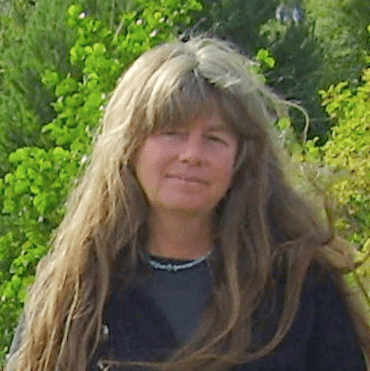
Kris Hughes is a nice, older Pagan woman who loves the gods of the Celts. She doesn't claim to be anything in particular, but she might possibly be described as a hedge teacher, a writer, a part time Druid, an exiled Scot, a poet, cartomancer, ritualist, storyteller, or just someone with a lot to say about a lot of things. In the past she has been a professional musician, a farmer, and a horsewoman. She is currently writing a book, working title The Celtic Horse Goddesses: Myth, History and Personal Reflection. Her interests include herbalism, mythology, and British native ponies. She also blogs at her own website Go Deeper. You can read more about the author here.
Previous Post
August 27, 2019
Of Light & Shadow: Epithets of Anubis
Next Post

August 31, 2019 Druid in the City: Offerings Without Spending
Browse Our Archives
Select a Category A Lakeside Hearth Adventures in Wortcunning Alone In Her Presence Arts, Crafts & Cooking Birthing Hereditary Witchcraft Book of Blackbirds Book Reviews Born-Again Witch Cauldron, Sword, Spear, & Stone Cermony and Liturgy Columns Community Dandelion Seeds Dear Jasmine Druid Thoughts Editor's Picks Everyday Pagan Family & Household Practice Family Traditions Full Frontal Magic Gateway Goddess Guest Articles Happily Heathen Health and Wellness Hearth of Hellenism Heathen Woman Hills of the Horizon History Holidays Horse Goddesses Interfaith Interviews Irish-American Witchcraft Jewish Witch Lamp & Labyrinth Letters from Midgard Literature, Media, Film, Music Loop of Brighid Love, Sex & Relationships Magic or Magick Making Light Naturalistic Traditions Nature News Outside The Circle Pantheisticon Politics Prayers, Poems, Blessings & Stories Queer Femme Mystic Queer of Swords Recipes Ritual and Practice Science and Research Seekers and Guides Seeking the Grail Socially Responsible Magic Spear of Athena Star Made Witch Syncretic Electric Technology The Blooming Staff The Busy Witch The Cartomancer The Crow's Nest The Dance of Pagan Recovery The Hearth of Hellenism The Lady's Quill The Other Side of the Hedge The Path of She The Rantin' Raven The Witches Next Door The Zen Pagan Theology, Ethics, Philosophy Tree City Witch Urban Earthwitch Wayfaring Woman Witch on Fire Wyrd Words
Select a Month January 2026 March 2025 December 2024 June 2024 April 2024 March 2024 January 2024 December 2023 November 2023 October 2023 August 2023 July 2023 May 2023 April 2023 March 2023 February 2023 January 2023 December 2022 November 2022 October 2022 September 2022 August 2022 July 2022 June 2022 May 2022 March 2022 February 2022 January 2022 December 2021 November 2021 October 2021 September 2021 August 2021 July 2021 June 2021 May 2021 April 2021 March 2021 February 2021 January 2021 December 2020 November 2020 October 2020 September 2020 August 2020 July 2020 June 2020 May 2020 April 2020 March 2020 February 2020 January 2020 December 2019 November 2019 October 2019 September 2019 August 2019 July 2019 June 2019 May 2019 April 2019 March 2019 February 2019 January 2019 December 2018 November 2018 October 2018 September 2018 August 2018 July 2018 June 2018 May 2018 April 2018 March 2018 February 2018 January 2018 December 2017 November 2017 October 2017 September 2017 August 2017 July 2017 June 2017 May 2017 April 2017 March 2017 February 2017 January 2017 December 2016 November 2016 October 2016 September 2016 August 2016 July 2016 June 2016 May 2016 April 2016 March 2016 February 2016 January 2016 December 2015 November 2015 October 2015 September 2015 August 2015 July 2015 June 2015 May 2015 April 2015 March 2015 February 2015 January 2015 December 2014 November 2014 October 2014 September 2014 August 2014 July 2014 June 2014 May 2014 April 2014 March 2014 February 2014 January 2014 December 2013 November 2013 October 2013 September 2013 August 2013 July 2013 June 2013 May 2013 April 2013 March 2013 February 2013 January 2013 December 2012 November 2012 October 2012 September 2012 August 2012 July 2012 June 2012 May 2012 April 2012 March 2012 February 2012 January 2012
Follow Us!
TAKE THE
Religious Wisdom Quiz
According to Hebrews, who serves as a copy and shadow of what is in heaven?
Select your answer to see how you score.
The priests in the earthly sanctuary The angels The prophets The apostles
Related posts from Agora

Simple Witchery: To Keep Silent

Simple Witchery: Leaning On The Four Pillars


TRENDING AT PATHEOS Pagan

I was recently chatting with someone on Instagram. She asked me what...

While there are many people who share their results, the end of...

On July 23, I saw Christopher Nolan's The Odyssey which is Homer’s...

As I write this two big events have just finished up. One...

Restoring the Watershed of Divine Love
Perhaps cooperation is not something we manufacture through legislation, ideology, or moral...

Many UUs don’t pray because of bad experiences in a previous religion,...
view all Pagan blogs
Ad-Free & Subscriber Log-In Subscription Support
- About Us
- 2026 Calendar
- Videos
- Podcasts
- Library of World Religions
- Faith In Media Tracker
- Advertise With Us
- Write for Us
- Privacy Policy
- Terms of Service
- Do Not Sell My Data
- Contact Us
- Radiant Digital
- Manage Newsletter Subscriptions
- Unsubscribe From Notifications
- Sitemap
Copyright 2008-2026, Patheos. All rights reserved.
Subscription Support Ad-Free & Subscriber Log-In
Follow Patheos