
BuddhistCatholicContemplativeEvangelicalGeneral ChristianHinduJewishLatter-day SaintMuslimNew VisionsProgressive Christian
Beliefs
- Buddhist
- Catholic
- Contemplative
- Evangelical
- General Christian
- Hindu
- Jewish
- Latter-day Saint
- More Voices
- Muslim
- New Visions
- Pagan
- Progressive Christian
Topics
- Religion News
- Food and Religion
- Sports and Religion
- Religious Art
- Religious Music and Entertainment
- Religious Events
- History and Religion
- Style and Religion
- Politics and Religion
- Women in Religion
- Recreation Outdoors and Religion
- Business Finance and Religion
- Careers Workplace and Religion
- Education and Religion
- Family Parenting and Religion
- Health Fitness and Religion
- Home and Religion
- Relationships and Religion
- Technology and Religion
- Travel and Religion
Columnists
- Buddhist Columnists
- Business Finance and Religion Columnists
- Careers Workplace and Religion Columnists
- Catholic Columnists
- Contemplative Columnists
- Education and Religion Columnists
- Evangelists Columnists
- Family Parenting and Religion Columnists
- General Christian Columnists
- Health Fitness and Religion Columnists
- Hindu Columnists
- History and Religion Columnists
- Home and Religion Columnists
- Jewish Columnists
- More Voices Columnists
- Latter Day Columnists
- Muslim Columnists
- New Visions Columnists
- Nonreligious Columnists
- Pagan Columnists
- Politics and Religion Columnists
- Progressive Columnists
- Recreation Outdoors and Religion Columnists
- Relationships and Religion Columnists
- Religion News Columnists
- Religious Art Columnists
- Religious Events Columnists
- Religious Music and Entertainment Columnists
- Sports and Religion Columnists
- Style and Religion Columnists
- Technology and Religion Columnists
- Travel and Religion Columnists
- Women in Religion Columnists
Resource Library
- 2026 Calendar
- Library of World Religions
- The 100 Most Holy Places on Earth
- Patheos Answers
- Podcasts
- Videos
- Faith Leaders Database
- Anglican Episcopalian
- Bahai
- Baptist
- Buddhism
- Christianity
- Confucianism
- Eastern Orthodoxy
- Hinduism
- Holiness and Pentecostal
- ISKCON
- Islam
- Judaism
- Lutheran
- Methodist
- The Church of Jesus Christ of Latter-day Saints
- New Age
- Paganism
- Presbytarian and Reformed
- Protestantism
- Religion Behind the Scenes
- Roman Catholic
- Scientology
- Shia Islam
- Sikhism
- Sufism
- Sunni Islam
- Taoism
- Zen
- See all religions
Research Tools
 Ad-Free & Subscriber Log-In Subscription Support
Follow Patheos 

- Trending:
- Advent
- |
- Forgiveness
- |
- Thanksgiving
- |
- Election
- |
- Seasonal Holidays
- |
- Marriage

- Home
- Pagan
- Of Light & Shadow: Establishing a Daily Practice
Of Light & Shadow: Establishing a Daily Practice
Last updated on: June 11, 2019 at 8:22 pm by Charlie Larson
Of Light & Shadow: Establishing a Daily Practice 2019-06-11T20:22:41+00:00 Charlie Larson
Patheos Explore the world's faith through different perspectives on religion and spirituality! Patheos has the views of the prevalent religions and spiritualities of the world.
I get a lot of questions from people who want to know what to do once they’ve received some kind of message or communication from a deity; in this case, it’s Anubis. Where do you take that initial connection further? How do you begin to deepen a relationship? What does it even mean to embark on a relationship with a deity? I’ve talked previously on various ways to connect with Anubis. My suggestion, as I hinted in my previous article, is to establish a daily practice.
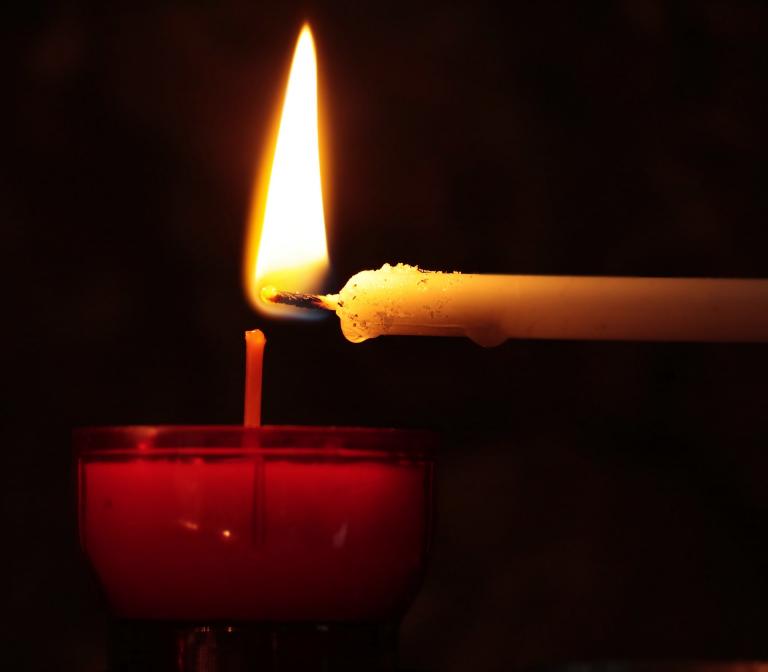
Establish a daily practice to deepen relationship. Photo by pixel2013 via Pixabay.
A daily practice doesn’t necessarily have to be in devotion to the gods. It can be a devotion to healing, to working on a specific practice, to connecting with the elements, or anything that is meaningful to you and something you wish to devote to deepening. Some people go so far as to make an unwritten (or sometimes written, even) contract to hold themselves accountable and commit to it. Finding a way to hold yourself accountable is important, and there have been plenty of articles, and even books, written on this topic, so what I’m going to say is neither new, nor is it an all-inclusive list of the possibilities. The possibilities are, as the saying goes, endless!
Why?
Establishing a daily practice is a way to honor the gods and goddesses to which you feel closest. In essence, you are devoting yourself to deepening your connection with the gods, to building a relationship. Not only this, but for me personally, it gives me something to look forward to each day. I look forward to those morning hours when I am communing with the deities and spirits with whom I’ve built a relationship.
Why would you do this? It honors and gives thanks for their presence in your life, whatever that might look like. It gives you a sense of purpose and direction in your practice. It also strengthens your relationship with them. Building a relationship with a deity isn’t a one-way street. They aren’t pawns to come when beckoned. The gods are independent, sovereign beings with their own ideas, desires, and goals. Asking something of them requires something in return. You can’t expect them to always come when called and do what you ask (or demand) of them. It doesn’t work that way.
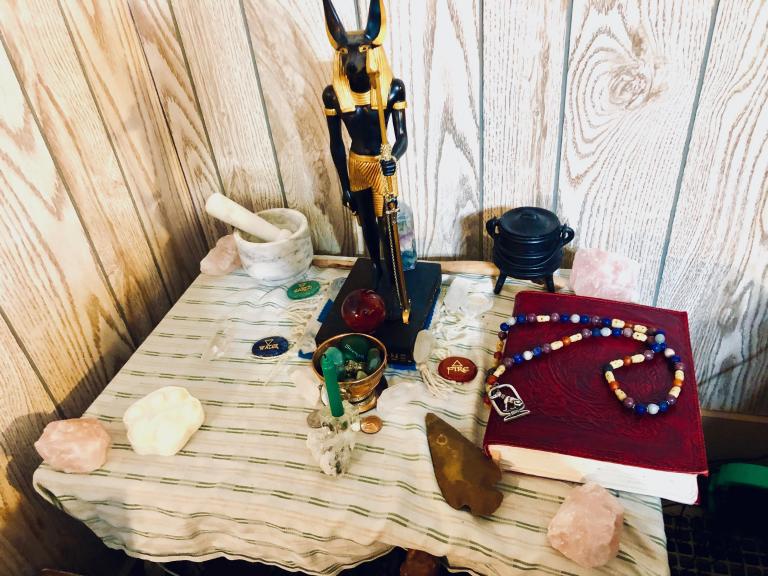
Having an altar is a great way to commune with your chosen deity. Photo by the author.
Altar
Having an altar is a great way to establish a place within your home where you can commune with your chosen deity. I talked more extensively on this in my last article, Creating a Sacred Space for Anubis. Common altar items include statues, candles, symbols, stones, plants, etc., but these aren’t the only things you can add to your altar. Make it purposeful and meaningful to you and your deity.
Not everyone is open with their path, especially when surrounded by family members who may not understand. There’s nothing wrong with that. That’s a personal choice. There are alternative ways to establish some kind of personal, sacred space where you can honor the gods in a less conspicuous way. Find a table, shelf, or small space to set up a candle and a statue of a related animal (for Anubis, perhaps a wolf or coyote), for example. Or maybe a simple photo or piece of artwork (make it extra meaningful by drawing or painting it yourself!). Having something meaningful is the key. So long as it’s meaningful to you and dedicated to your deity or spirit, that’s the important thing.
On my altar dedicated to Anubis, I’ve included a statue of him along with a couple candles, a few stones (labradorite, black onyx, and smoky quartz), and an incense burner.
Words
I personally love words – spoken and written, but especially written. I always have. I have always been a writer since I was old enough to hold a pen. I loved words so much I got both my Bachelor’s and Master’s degrees in Linguistics.
Writing is my preferred method of communication. I write as a devotional act. It could be a prayer, a poem, or perhaps just freewriting my thoughts on a particular subject. I have lots of notebooks, and even digital platforms, where I can write wherever I happen to be whenever the desire strikes to write.
Spoken word is another form of communication that can be a devotional act. You could call it prayer, but not all pagans like that word, perhaps because they feel it has too many associations with mainstream religions that they don’t wish to be associated with. I’m not too keen on the particulars of what you choose to call it. I don’t necessarily always call it ‘prayer’, but I do have conversations with my deities. I talk to them openly and honestly. For me, it’s not formal. I don’t sit down and write out word-for-word what I want to say to them, though sometimes I do if I am looking to present it in a formal ritual, but I feel that is a separate topic in itself.
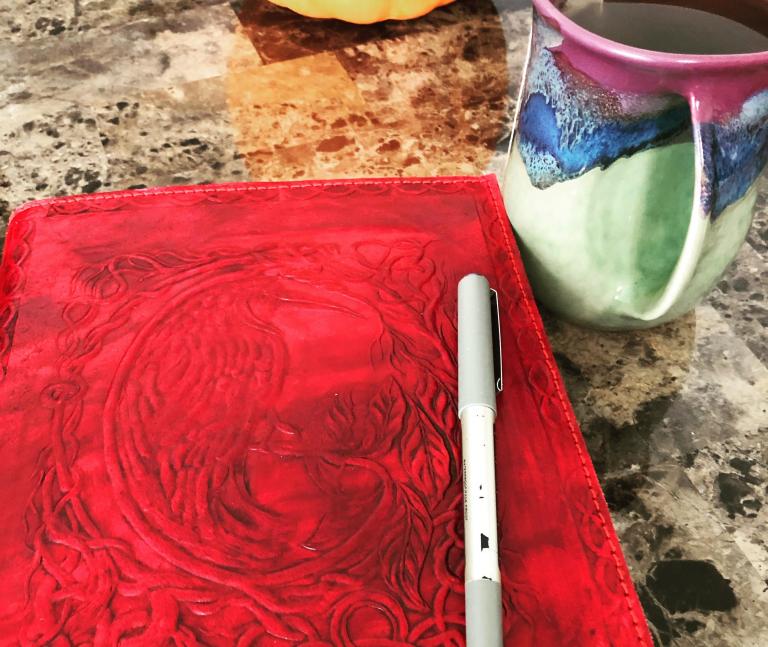
Writing can be an act of devotion. Photo by the author.
Music
Not everyone is big on music, but for me, music is a core part of my life. I have music playing throughout my day, practically every single day. Personally, I have a wide-reaching taste in music that really depends on what mood I am in. I have music for various moods.
I feel that music can really set the mood. Listening to a sad song can really connect you to those emotions presented in those songs. Listening to an upbeat, happy song can bring those emotions out of you, too. A dear friend of mine once said “listen to music for the mood you want, not the mood you are in”. I feel this also applies to your devotion to the gods. Find something that really gets you in that feeling – perhaps with a good drum beat that you can focus on. I’ve found particular songs on Spotify that really make me feel connected to Anubis and Hekate.
I am all for making things personal to you and taking off with your creative side. Make your own music! Drum, sing, play an instrument. You don’t have to be an excellent musician to do something in devotion to your gods and goddesses. You don’t even have to go out and buy something. Find a makeshift drum from items around your house. What matters more is that you are doing it as a devotional act and that it comes from a place of meaning and purpose.
Learning
I feel that there is a bit of devotion in taking the time to learn something. I have always been a firm believer that you never really stop learning. No matter how much you may think yourself knowledgeable in an area, there is always room to learn more and/or to deepen that knowledge.
Take the time to find a book or article and read. Watch videos. Whatever you feel is your preferred method of absorbing information. In this case, perhaps you can read some of the myths and stories centered around your deity. I am currently working my way through the Book of the Dead, which is rather dense, but I personally enjoy reading it as a learning tool to learn more about how ancient Egyptians may have lived their lives in preparation for the afterlife.
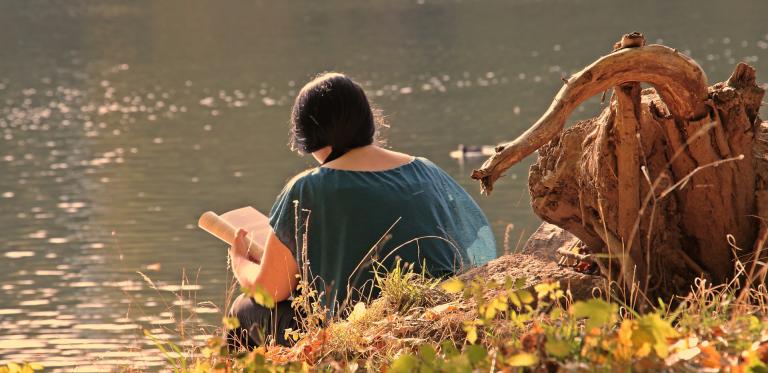
There is a bit of devotion in taking the time to learn. Photo by pixel2013 via Pixabay.
Witchcraft
Not every pagan is a witch, and not every witch is a pagan, but for me personally, I am both, and I incorporate both into my daily practice. If you choose to incorporate witchcraft into your life, either inclusively or exclusively, the idea of the Witches’ Hour of Power, as described by Cyndi Brannen, is a great way to devote your time to yourself and to your witchcraft.
In short, it’s basically the idea of dedicating an hour of your time every day towards your own personal development and possibly spiritual development, if witchcraft is a part of that for you. It isn’t necessarily in devotion to a particular god or goddess. Anubis is a part of my daily practice, and I often incorporate witchcraft there as well. For me, my daily practice is blended into my witches’ hour of power.
Putting It All Together
Now, how does this all fit together? I can hear people saying, ‘ok – this sounds great, but I am so busy, I don’t know that I have time to commit to all of this’. That’s certainly understandable, so if all you can devote time to is 15 minutes a day, then go with that. But I feel that there is value in devoting a time in your day to your growth. I should preface by saying that my daily practice shifts and changes over time, depending on my life circumstances and my own personal needs.
The first suggestion I have is stick to it! Neglecting to maintain a daily practice that you have promised to upkeep can have consequences. For me, I end up with broken statues of Anubis. I know that sounds odd, and perhaps a little woowoo-y, but each time in my life where I’ve neglected to keep my promises to Anubis, I end up with one of my statues of him broken, either partially or completely shattered. I’ve had them mysteriously fall off of the shelf or table where they were sitting while no one was around. Also, one time during a move across the country (2,500 miles, to be exact), the one and only thing that broke out of my truck full of stuff was a small statue of Anubis, and I realized that there was a reason behind that. It’s happened enough times (at least 5) that I find it to be more than sheer coincidence. Maybe I’m wrong. Maybe it was just a coincidence, but I can look at it now with a bit of humor, and in all seriousness, it has been a great reminder to maintain my commitment to a daily practice.

“Sounds great, but I’m too busy for a daily practice!” Photo by Brian Merrill via Pixabay.
Pick something that you know you will do. Meditations, prayers, writing, drumming, dancing…whatever it might be. Start with something you know that you’ll stick to and do continuously. It’s better to do something that you know for sure you’ll do daily than to try to do whatever you feel like each day and always change it up. You can add things, remove things, change things, sure, but just be sure that whatever it is that you choose to do, that you make the commitment to continuing it for as long as you and your deity have agreed to doing.
You’re going to find that there is no right or wrong way to honor your gods and goddesses. I can’t sit here and tell you what to do or how to do it. Like I’ve said again and again, a daily practice is, and should be, highly personal. I can, however, give you at least a small portion of ideas that can be utilized in your own daily practice. From there, it’s up to you. Find something that you can do and that you can stick to.

About Charlie Larson
Charlie Larson has been a practicing eclectic pagan and witch since 2001. He is a linguist, a teacher, teacher trainer, and a writer within the field of international education, and he holds a Master’s degree in Applied Linguistics. He has also studied psychology and is trained by Mental Health First Aid USA. He has been a writer of poetry and fiction for most of his life and is currently working on non-fictional works under the umbrella of paganism and witchcraft. He works a lot with energy healing (including reiki), shadow work, devotional paganism, animal spirits, crystals, divination, and candle magic. He currently resides in the heart of Silicon Valley in California with his menagerie of furbabies and enjoys reading, writing, hiking, gaming, and learning languages. You can read more about the author here.
Previous Post

June 11, 2019
3 Pagans & A Cat: The Nothing I Know About Hekate
Next Post

June 15, 2019 Babalon’s Cloister: “I’m not a Magician, I’m a Priestess.”
Browse Our Archives
Select a Category A Lakeside Hearth Adventures in Wortcunning Alone In Her Presence Arts, Crafts & Cooking Birthing Hereditary Witchcraft Book of Blackbirds Book Reviews Born-Again Witch Cauldron, Sword, Spear, & Stone Cermony and Liturgy Columns Community Dandelion Seeds Dear Jasmine Druid Thoughts Editor's Picks Everyday Pagan Family & Household Practice Family Traditions Full Frontal Magic Gateway Goddess Guest Articles Happily Heathen Health and Wellness Hearth of Hellenism Heathen Woman Hills of the Horizon History Holidays Horse Goddesses Interfaith Interviews Irish-American Witchcraft Jewish Witch Lamp & Labyrinth Letters from Midgard Literature, Media, Film, Music Loop of Brighid Love, Sex & Relationships Magic or Magick Making Light Naturalistic Traditions Nature News Outside The Circle Pantheisticon Politics Prayers, Poems, Blessings & Stories Queer Femme Mystic Queer of Swords Recipes Ritual and Practice Science and Research Seekers and Guides Seeking the Grail Socially Responsible Magic Spear of Athena Star Made Witch Syncretic Electric Technology The Blooming Staff The Busy Witch The Cartomancer The Crow's Nest The Dance of Pagan Recovery The Hearth of Hellenism The Lady's Quill The Other Side of the Hedge The Path of She The Rantin' Raven The Witches Next Door The Zen Pagan Theology, Ethics, Philosophy Tree City Witch Urban Earthwitch Wayfaring Woman Witch on Fire Wyrd Words
Select a Month January 2026 March 2025 December 2024 June 2024 April 2024 March 2024 January 2024 December 2023 November 2023 October 2023 August 2023 July 2023 May 2023 April 2023 March 2023 February 2023 January 2023 December 2022 November 2022 October 2022 September 2022 August 2022 July 2022 June 2022 May 2022 March 2022 February 2022 January 2022 December 2021 November 2021 October 2021 September 2021 August 2021 July 2021 June 2021 May 2021 April 2021 March 2021 February 2021 January 2021 December 2020 November 2020 October 2020 September 2020 August 2020 July 2020 June 2020 May 2020 April 2020 March 2020 February 2020 January 2020 December 2019 November 2019 October 2019 September 2019 August 2019 July 2019 June 2019 May 2019 April 2019 March 2019 February 2019 January 2019 December 2018 November 2018 October 2018 September 2018 August 2018 July 2018 June 2018 May 2018 April 2018 March 2018 February 2018 January 2018 December 2017 November 2017 October 2017 September 2017 August 2017 July 2017 June 2017 May 2017 April 2017 March 2017 February 2017 January 2017 December 2016 November 2016 October 2016 September 2016 August 2016 July 2016 June 2016 May 2016 April 2016 March 2016 February 2016 January 2016 December 2015 November 2015 October 2015 September 2015 August 2015 July 2015 June 2015 May 2015 April 2015 March 2015 February 2015 January 2015 December 2014 November 2014 October 2014 September 2014 August 2014 July 2014 June 2014 May 2014 April 2014 March 2014 February 2014 January 2014 December 2013 November 2013 October 2013 September 2013 August 2013 July 2013 June 2013 May 2013 April 2013 March 2013 February 2013 January 2013 December 2012 November 2012 October 2012 September 2012 August 2012 July 2012 June 2012 May 2012 April 2012 March 2012 February 2012 January 2012
Follow Us!
TAKE THE
Religious Wisdom Quiz
What does "Golgotha" literally mean?
Select your answer to see how you score.
Suffering ground Skull place Crucifixion hill Place of death
Related posts from Agora
Simple Witchery: To Keep Silent

Simple Witchery: Leaning On The Four Pillars
Pergamum Unfurled: Magic with the Greek Gods (Book...
TRENDING AT PATHEOS Pagan

To help with the upcoming holiday season, I'm introducing the Holiday Helper...

10 years of the Power Sigil & Moving...
Last week while reorganizing my studio space, I found the sketchbook that...

Why are younger seekers drawn to Paganism and...
One of the things I've noticed the most is that I'm far...

When we talk about Greek religion, we often begin with the dodekatheion—the...

I was recently chatting with someone on Instagram. She asked me what...

On July 23, I saw Christopher Nolan's The Odyssey which is Homer’s...
view all Pagan blogs
Ad-Free & Subscriber Log-In Subscription Support
- About Us
- 2026 Calendar
- Videos
- Podcasts
- Library of World Religions
- Faith In Media Tracker
- Advertise With Us
- Write for Us
- Privacy Policy
- Terms of Service
- Do Not Sell My Data
- Contact Us
- Radiant Digital
- Manage Newsletter Subscriptions
- Unsubscribe From Notifications
- Sitemap
Copyright 2008-2026, Patheos, part of the Radiant Digital network of media brands. All rights reserved.
Subscription Support Ad-Free & Subscriber Log-In
Follow Patheos