
BuddhistCatholicContemplativeEvangelicalGeneral ChristianHinduJewishLatter-day SaintMuslimNew VisionsProgressive Christian
Beliefs
- Buddhist
- Catholic
- Contemplative
- Evangelical
- General Christian
- Hindu
- Jewish
- Latter-day Saint
- More Voices
- Muslim
- New Visions
- Pagan
- Progressive Christian
Topics
- Religion News
- Food and Religion
- Sports and Religion
- Religious Art
- Religious Music and Entertainment
- Religious Events
- History and Religion
- Style and Religion
- Politics and Religion
- Women in Religion
- Recreation Outdoors and Religion
- Business Finance and Religion
- Careers Workplace and Religion
- Education and Religion
- Family Parenting and Religion
- Health Fitness and Religion
- Home and Religion
- Relationships and Religion
- Technology and Religion
- Travel and Religion
Columnists
- Buddhist Columnists
- Business Finance and Religion Columnists
- Careers Workplace and Religion Columnists
- Catholic Columnists
- Contemplative Columnists
- Education and Religion Columnists
- Evangelists Columnists
- Family Parenting and Religion Columnists
- General Christian Columnists
- Health Fitness and Religion Columnists
- Hindu Columnists
- History and Religion Columnists
- Home and Religion Columnists
- Jewish Columnists
- More Voices Columnists
- Latter Day Columnists
- Muslim Columnists
- New Visions Columnists
- Nonreligious Columnists
- Pagan Columnists
- Politics and Religion Columnists
- Progressive Columnists
- Recreation Outdoors and Religion Columnists
- Relationships and Religion Columnists
- Religion News Columnists
- Religious Art Columnists
- Religious Events Columnists
- Religious Music and Entertainment Columnists
- Sports and Religion Columnists
- Style and Religion Columnists
- Technology and Religion Columnists
- Travel and Religion Columnists
- Women in Religion Columnists
Resource Library
- 2026 Calendar
- Library of World Religions
- The 100 Most Holy Places on Earth
- Patheos Answers
- Podcasts
- Videos
- Faith Leaders Database
- Anglican Episcopalian
- Bahai
- Baptist
- Buddhism
- Christianity
- Confucianism
- Eastern Orthodoxy
- Hinduism
- Holiness and Pentecostal
- ISKCON
- Islam
- Judaism
- Lutheran
- Methodist
- The Church of Jesus Christ of Latter-day Saints
- New Age
- Paganism
- Presbytarian and Reformed
- Protestantism
- Religion Behind the Scenes
- Roman Catholic
- Scientology
- Shia Islam
- Sikhism
- Sufism
- Sunni Islam
- Taoism
- Zen
- See all religions
Research Tools
 Ad-Free & Subscriber Log-In Subscription Support
Ad-Free & Subscriber Log-In Subscription Support
Follow Patheos 

- Trending:
- Forgiveness
- |
- Marriage
- |
- Consciousness
- |
- Death Penalty
- |
- Election
- |
- Halloween

- Home
- Pagan
- Hearth of Hellenism: The One Book You Should Read Right Now
Hearth of Hellenism: The One Book You Should Read Right Now
Last updated on: June 7, 2019 at 3:55 pm by Angelo Nasios
Hearth of Hellenism: The One Book You Should Read Right Now 2019-06-07T15:55:21+00:00 Angelo Nasios
Patheos Explore the world's faith through different perspectives on religion and spirituality! Patheos has the views of the prevalent religions and spiritualities of the world.
Books, you can’t have enough of them I say! With endless books to read, where does one begin in their study of Hellenism? So far, the one book I recommend people to put at the top of their list is Sallustius’ On the Gods and The World.
Written in the 4th century of the Common Era, a time when the traditional ways of life in the Roman empire were increasingly being encroached upon by Christians, Greeks and Romans found themselves in a defensive position, having to ‘explain’ themselves and their way of life for the first time in history against Christian critiques. Sallustius’ On the Gods and The World is a small but deeply philosophical work. I think it was written as a short educational guide, an ancient ‘dummy guide to’ if you will, that spelled out the Greek tradition for the reader.

Begin your study of Hellenism with “On the Gods and the World”. Photo by Michal Jarmoluk via Pixabay.
Sallustius (or Sallust) was a close friend of Emperor Julian who in 361 appointed him to be Praetorian Prefect of Oriens, becoming the second most powerful person in the eastern half of the empire after the emperor himself. After the untimely death of Julian, the military nominated Sallustius to become the next emperor but the offer was declined. On the Gods was dedicated to the emperor.
There are twenty-one chapters, which in the paperback edition runs a total of 45 pages. It is a quick read but is very informative. You can read the text online here. I would like to highlight just a few passages I think are crucial for the pagan community to familiarize themselves with, especially folks inspired by Hellenism.
Chapter One “What the Requisites are which an Auditor concerning the Gods ought to possess: and of common Conceptions”:
“It is requisite that those who are willing to hear concerning the gods should have been well informed from their childhood, and not nourished with foolish opinions. It is likewise necessary that they should be naturally prudent and good, that they may receive, and properly understand, the discourses which they hear. The knowledge likewise of common conceptions is necessary; but common conceptions are such things as all men, when interrogated, acknowledge to be indubitably certain; such as, that every god is good, without passivity, and free from all mutation; for every thing which is changed, is either changed into something better or into something worse: and if into something worse, it will become depraved, but if into something better, it must have been evil in the beginning.”
I find it no coincidence that that Chapter One begins with the requirement that “those who are willing to hear concerning the gods should have been well informed from their childhood, and not nourished with foolish opinions.” Sadly, it is these “foolish opinions” that run wild today nurtured largely by pop culture’s representation of the Gods. My post Why Is Mythology Mocked highlights this and cites Chapters Three and Four, so read that post as well. Let it be stressed at this point that pop culture shouldn’t be your reference point for theology-building; go to the ancient sources like Sallustius which provide a proper authentic theology.
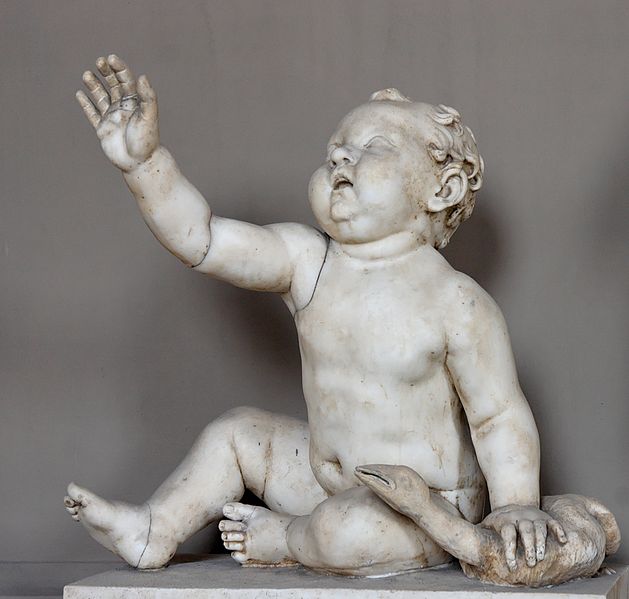
Learn of the gods from childhood. Public domain photo by Jastrow via Wikimedia Commons.

Additionally, in Chapter One we are taught that “every god is good, without passivity, and free from all mutation” another important teaching. Today there is too much fear around Gods and avoidance of worship of certain Gods, thinking that the Gods may harm you somehow – they won’t hurt you.
Concerning functions of the Gods, Chapter Six “Concerning the super-mundane and mundane Gods” has some wonderful insights on the Gods and how you could conceptualize their activities on the world:
“But of the gods some are mundane and others super-mundane. I call those mundane who fabricate the world: but of the super-mundane, some produce essences, others intellect, and others soul; and on this account they are distinguished into three orders, in discourses concerning which orders, it is easy to discover all the gods. But of the mundane gods, some are the causes of the world’s existence, other animate the world; others again harmonize it, thus composed from different natures; and others, lastly, guard and preserve it when harmonically arranged. And since these orders are four, and each consists from things first, middle, and last, it is necessary that the disposers of these should be twelve: hence [Zeus], [Poseidon], and [Hephaestus], fabricate the world; [Demeter], [Hera], and [Artemis], animate it; [Hermes], [Aphrodite], and Apollo, harmonize it; and, lastly, [Hestia], [Athena], and [Ares], preside over it with a guardian power.”
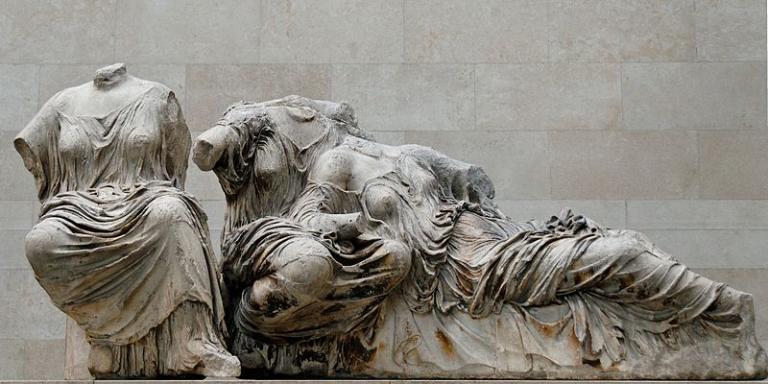
East Pediment of the Parthenon, Hestia, Dione and Aphrodite, public domain photo via Wikimedia Commons.

Lastly Chapter Fourteen “How the Gods who are immutable are said to be angry and appeased” deals with another popular misconception that Gods are swayed by gifts or can be moved to anger or other passions:
“But if any one thinking agreeable to reason and truth, that the gods are immutable, doubts how they rejoice in the good, but are averse from the evil; and how they become angry with the guilty, but are rendered propitious by proper cultivation; we reply, that divinity neither rejoices; for that which rejoices is also influenced by sorrow: nor is angry; for anger is a passion: nor is appeased with gifts; for then he would be influenced by delight. Nor is it lawful that a divine nature should be well or ill affected from human concerns; for the divinities are perpetually good and profitable, but are never noxious, and ever subsist in the same uniform mode of being.
“But we, when we are good, are conjoined with the gods through similitude; but when evil, we are separated from them through dissimilitude. And while we live according to virtue, we partake of the gods, but when we become evil we cause them to become our enemies; not that they are angry, but because guilt prevents us from receiving the illuminations of the gods, and subjects us to the power of avenging dæmons. But if we obtain pardon of our guilt through prayers and sacrifices, we neither appease nor cause any mutation to take place in the gods; but by methods of this kind, and by our conversion to a divine nature, we apply a remedy to our vices, and again become partakers of the goodness of the gods. So that it is the same thing to assert that divinity is turned from the evil, as to say that the sum is concealed from those who are deprived of sight.”

You cannot be a horrible person and expect union with the Gods. Photo by Gerd Altmann via Pixabay.
The one line that stands out the most for me, “when we are good, are conjoined with the gods through similitude; but when evil, we are separated from them through dissimilitude.” Union with the Gods occurs through “similitude” – you cannot be a horrible person and expect union with the Gods. You cannot force union with the Gods through magical invocations. You need to become like them through virtue. This has been a powerful lesson that I put into practice and have seen the results.
There is so much more to be learned from Sallustius, these are just a few highlights. I encourage you to read the book and allow it to prompt you to further research and investigation. As I have said, it is a fast read, but it is not always easy to understand. This is the thing with philosophy; it requires some hard work to uncover the gold of the wisdom locked inside.

About Angelo Nasios
Angelo Nasios (New York) is an author and educator of the Hellenic tradition. He received his B.A in religion and is currently earning his M.A in ancient and classical history. You can read more about the author here.
Previous Post

June 5, 2019
Irish-American Witchcraft: Connecting to House Spirits and Land Spirits
Next Post

June 7, 2019 3 Pagans & A Cat: An Emergency Outsourced Stand-In
Browse Our Archives
Select a Category A Lakeside Hearth Adventures in Wortcunning Alone In Her Presence Arts, Crafts & Cooking Birthing Hereditary Witchcraft Book of Blackbirds Book Reviews Born-Again Witch Cauldron, Sword, Spear, & Stone Cermony and Liturgy Columns Community Dandelion Seeds Dear Jasmine Druid Thoughts Editor's Picks Everyday Pagan Family & Household Practice Family Traditions Full Frontal Magic Gateway Goddess Guest Articles Happily Heathen Health and Wellness Hearth of Hellenism Heathen Woman Hills of the Horizon History Holidays Horse Goddesses Interfaith Interviews Irish-American Witchcraft Jewish Witch Lamp & Labyrinth Letters from Midgard Literature, Media, Film, Music Loop of Brighid Love, Sex & Relationships Magic or Magick Making Light Naturalistic Traditions Nature News Outside The Circle Pantheisticon Politics Prayers, Poems, Blessings & Stories Queer Femme Mystic Queer of Swords Recipes Ritual and Practice Science and Research Seekers and Guides Seeking the Grail Socially Responsible Magic Spear of Athena Star Made Witch Syncretic Electric Technology The Blooming Staff The Busy Witch The Cartomancer The Crow's Nest The Dance of Pagan Recovery The Hearth of Hellenism The Lady's Quill The Other Side of the Hedge The Path of She The Rantin' Raven The Witches Next Door The Zen Pagan Theology, Ethics, Philosophy Tree City Witch Urban Earthwitch Wayfaring Woman Witch on Fire Wyrd Words
Select a Month January 2026 March 2025 December 2024 June 2024 April 2024 March 2024 January 2024 December 2023 November 2023 October 2023 August 2023 July 2023 May 2023 April 2023 March 2023 February 2023 January 2023 December 2022 November 2022 October 2022 September 2022 August 2022 July 2022 June 2022 May 2022 March 2022 February 2022 January 2022 December 2021 November 2021 October 2021 September 2021 August 2021 July 2021 June 2021 May 2021 April 2021 March 2021 February 2021 January 2021 December 2020 November 2020 October 2020 September 2020 August 2020 July 2020 June 2020 May 2020 April 2020 March 2020 February 2020 January 2020 December 2019 November 2019 October 2019 September 2019 August 2019 July 2019 June 2019 May 2019 April 2019 March 2019 February 2019 January 2019 December 2018 November 2018 October 2018 September 2018 August 2018 July 2018 June 2018 May 2018 April 2018 March 2018 February 2018 January 2018 December 2017 November 2017 October 2017 September 2017 August 2017 July 2017 June 2017 May 2017 April 2017 March 2017 February 2017 January 2017 December 2016 November 2016 October 2016 September 2016 August 2016 July 2016 June 2016 May 2016 April 2016 March 2016 February 2016 January 2016 December 2015 November 2015 October 2015 September 2015 August 2015 July 2015 June 2015 May 2015 April 2015 March 2015 February 2015 January 2015 December 2014 November 2014 October 2014 September 2014 August 2014 July 2014 June 2014 May 2014 April 2014 March 2014 February 2014 January 2014 December 2013 November 2013 October 2013 September 2013 August 2013 July 2013 June 2013 May 2013 April 2013 March 2013 February 2013 January 2013 December 2012 November 2012 October 2012 September 2012 August 2012 July 2012 June 2012 May 2012 April 2012 March 2012 February 2012 January 2012
Follow Us!
TAKE THE
Religious Wisdom Quiz
Who was Noah's father?
Select your answer to see how you score.
Abel Seth Lamech Enoch
Related posts from Agora

Simple Witchery: To Keep Silent

Simple Witchery: Leaning On The Four Pillars

Pergamum Unfurled: Magic with the Greek Gods (Book...

Pergamum Unfurled: Cunning Words (Review)
TRENDING AT PATHEOS Pagan

I was recently chatting with someone on Instagram. She asked me what...

While there are many people who share their results, the end of...

On July 23, I saw Christopher Nolan's The Odyssey which is Homer’s...

As I write this two big events have just finished up. One...

Restoring the Watershed of Divine Love
Perhaps cooperation is not something we manufacture through legislation, ideology, or moral...

Many UUs don’t pray because of bad experiences in a previous religion,...
view all Pagan blogs
Ad-Free & Subscriber Log-In Subscription Support
- About Us
- 2026 Calendar
- Videos
- Podcasts
- Library of World Religions
- Faith In Media Tracker
- Advertise With Us
- Write for Us
- Privacy Policy
- Terms of Service
- Do Not Sell My Data
- Contact Us
- Radiant Digital
- Manage Newsletter Subscriptions
- Unsubscribe From Notifications
- Sitemap
Copyright 2008-2026, Patheos. All rights reserved.
Subscription Support Ad-Free & Subscriber Log-In
Follow Patheos