
BuddhistCatholicContemplativeEvangelicalGeneral ChristianHinduJewishLatter-day SaintMuslimNew VisionsProgressive Christian
Beliefs
- Buddhist
- Catholic
- Contemplative
- Evangelical
- General Christian
- Hindu
- Jewish
- Latter-day Saint
- More Voices
- Muslim
- New Visions
- Pagan
- Progressive Christian
Topics
- Religion News
- Food and Religion
- Sports and Religion
- Religious Art
- Religious Music and Entertainment
- Religious Events
- History and Religion
- Style and Religion
- Politics and Religion
- Women in Religion
- Recreation Outdoors and Religion
- Business Finance and Religion
- Careers Workplace and Religion
- Education and Religion
- Family Parenting and Religion
- Health Fitness and Religion
- Home and Religion
- Relationships and Religion
- Technology and Religion
- Travel and Religion
Columnists
- Buddhist Columnists
- Business Finance and Religion Columnists
- Careers Workplace and Religion Columnists
- Catholic Columnists
- Contemplative Columnists
- Education and Religion Columnists
- Evangelists Columnists
- Family Parenting and Religion Columnists
- General Christian Columnists
- Health Fitness and Religion Columnists
- Hindu Columnists
- History and Religion Columnists
- Home and Religion Columnists
- Jewish Columnists
- More Voices Columnists
- Latter Day Columnists
- Muslim Columnists
- New Visions Columnists
- Nonreligious Columnists
- Pagan Columnists
- Politics and Religion Columnists
- Progressive Columnists
- Recreation Outdoors and Religion Columnists
- Relationships and Religion Columnists
- Religion News Columnists
- Religious Art Columnists
- Religious Events Columnists
- Religious Music and Entertainment Columnists
- Sports and Religion Columnists
- Style and Religion Columnists
- Technology and Religion Columnists
- Travel and Religion Columnists
- Women in Religion Columnists
Resource Library
- 2026 Calendar
- Library of World Religions
- The 100 Most Holy Places on Earth
- Patheos Answers
- Podcasts
- Videos
- Faith Leaders Database
- Anglican Episcopalian
- Bahai
- Baptist
- Buddhism
- Christianity
- Confucianism
- Eastern Orthodoxy
- Hinduism
- Holiness and Pentecostal
- ISKCON
- Islam
- Judaism
- Lutheran
- Methodist
- The Church of Jesus Christ of Latter-day Saints
- New Age
- Paganism
- Presbytarian and Reformed
- Protestantism
- Religion Behind the Scenes
- Roman Catholic
- Scientology
- Shia Islam
- Sikhism
- Sufism
- Sunni Islam
- Taoism
- Zen
- See all religions
Research Tools
 Ad-Free & Subscriber Log-In Subscription Support
Ad-Free & Subscriber Log-In Subscription Support
Follow Patheos 

- Trending:
- Forgiveness
- |
- Marriage
- |
- Consciousness
- |
- Death Penalty
- |
- Election
- |
- Halloween

- Home
- Pagan
- Pan-Celtic Hoofbeats: Rhiannon. Queen of the May?
Pan-Celtic Hoofbeats: Rhiannon. Queen of the May?
Last updated on: April 27, 2019 at 8:49 pm by Kris Hughes
Pan-Celtic Hoofbeats: Rhiannon. Queen of the May? 2019-04-27T20:49:59+00:00 Kris Hughes
Patheos Explore the world's faith through different perspectives on religion and spirituality! Patheos has the views of the prevalent religions and spiritualities of the world.
In my study of the four branches of the Mabinogi one of the things that fascinates me is the repeated measuring of time by years in the story of Pywll and Rhiannon in the first branch.
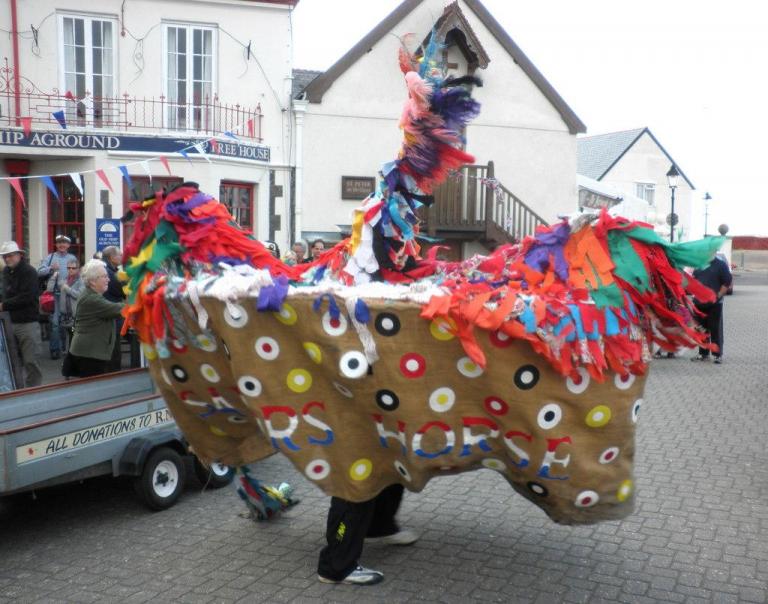
Hobby Horse, Minehead, Somerset. Photo by Roger Cornfoot CC 2.0
This story begins with Pwyll, Prince of Dyfed, and his courtiers going to the mysterious hill, or gorsedd, of Arberth, where legend has it that they are likely to see a wonder. The wonder they see is a woman riding sedately past, but who proves impossible to overtake. They try on three successive days to catch up with her, and even the great Pwyll, himself, is unable to do so. He finally manages to persuade her to stop and talk to him by shouting after her, and in the conversation which ensues, she proposes marriage to him, and invites him to come to her father’s kingdom “one year from now” for their marriage feast.
At the feast, things go terribly wrong when a previous suitor of Rhiannon’s turns up during the feast and manages to claim her. However, Rhiannon manages to put him off until “one year from now”. She and Pwyll then hatch a plan to trick the unwanted suitor, and at the second wedding feast their plan succeeds, and they are finally wed.
The couple then return to Pwyll’s kingdom of Dyfed, where they reign “that year and the next” but “in the third year” Pwyll’s advisors begin to complain that Rhiannon has not produced an heir. They want Pwyll to choose another wife, but he persuades them to meet him again “a year from now”, and if Rhiannon has not produced a child, then he will consider it. However, before the end of that year Rhiannon bears a son, who then mysteriously disappears on the night of his birth.
The action of the story then shifts from Dyfed to Gwent, where a landholder called Teyrnon has a fine mare which foals every May eve, but the next day the foal has always mysteriously disappeared. This time Teyrnon vows to keep watch, so he takes the mare into his house for the night, arms himself, and sits up with her. The mare gives birth and soon a great clawed arm reaches through the window and grabs the foal, but Teyrnon manages to draw his sword and sever it, saving the foal. He runs outside to see what monster the arm belongs to but can find nothing. However, when he returns to the house, he finds that an infant has been left in the doorway.

Teyrnon and the Claw, Project Gutenburg, Public Domain.
Teyrnon and his wife decide to raise this child as their own, and in a familiar formula for young heroes the child grows at a prodigious rate. At a year old he is like a child of three, at two he is like a child of six, and so on. At four years of age, he is given the colt to ride, and it is at this time that Teyrnon hears of all that has happened in Dyfed, and realises that the boy is Pwyll’s son, and returns him to his parents.
While May-eve is only mentioned once in the story, at the foaling of Teyrnon’s mare, I feel that there is a strong implication that other major events in the story also take place at Calan Mai. This time of the thinning veil would make sense for Pwyll to go out with the hope of “seeing a wonder”. It is at the beginning of the tale that the language is most explicit that the timings of the wedding feasts are at intervals of exactly one year from the meeting of Pwyll and Rhiannon. This establishes a rhythm of exact years for the subsequent parts of the tale, even though the timing of events might be a little less definite. Perhaps we are expected to get the idea after the first few times.
It seems likely that the birth of Rhiannon’s child happens on May eve, the same night that he is delivered to Teyrnon. If we work back, then we have Rhiannon’s first appearance on the May eve five years earlier, and the return of the child four years later, possibly also at Calan Mai. This motif of years isn’t pronounced in the rest of the Mabinogi, suggesting that it is being emphasised intentionally.
The character of the youthful goddess Rhiannon arriving on her magical white horse is certainly one which feels like spring or early summer, and I don’t think it is hard to envision Her as a May Queen, come to bring good things to the land. It feels very appropriate to me to honour Rhiannon, and Teyrnon as well, at this time of year.

Padstow May Day, photo by Bryan Ledgard via Wikimedia.

Maybe, (or maybe not) connected, are three May horse mumming traditions from southwest England, which once had a language and culture strongly connected to the Welsh-speaking home of the Mabinogi. You may be aware of the famous celebrations at Padstow, where the town has a long history of an all-day festival of stylised singing and dancing, involving their unique ‘obby ‘oss, pictured above. The tradition is at least two hundred years old, but like so many folk customs is likely much older, although we lack proof. At Minehead, in Somerset, there is also a hobby horse tradition, with some similarities and some notable differences to the one in Padstow. In Combe Martin, North Devon, a little later in May comes a festival called “Hunting the Earl of Rone”, which involves another hobby horse of the Padstow type, as well as a live donkey (which seems to be treated very well).
All three of these events are community festivals involving hundreds of local people as active participants, supporters, and spectators. Like the winter horse mumming customs, I wrote about here, here, and here, these customs went through a period of being considered survivals from pre-Christian times, but this certainly can’t be proven, however much it feels like it. One thing I find beautiful and wonderful about these traditions is their tenacity. The people within these small towns seem driven to keep the customs alive and to participate in them. They allow things to morph and grow to suit the times, yet still manage to treat them with a certain reverence. Alongside that respect, however, exists a certain wildness of spirit which can’t be denied when the horses take to the streets, accompanied by ranks of drummers and musicians. Could this be the wild ebullience of a horse goddess?
You can follow Kris at her blog Go Deeper and support her work on Patreon.
About Kris Hughes
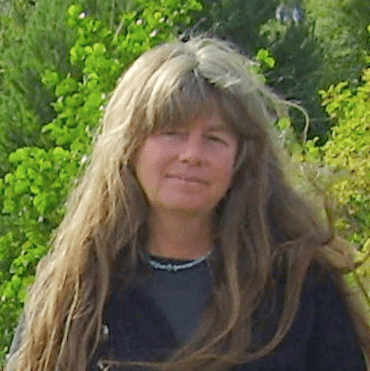
Kris Hughes is a nice, older Pagan woman who loves the gods of the Celts. She doesn't claim to be anything in particular, but she might possibly be described as a hedge teacher, a writer, a part time Druid, an exiled Scot, a poet, cartomancer, ritualist, storyteller, or just someone with a lot to say about a lot of things. In the past she has been a professional musician, a farmer, and a horsewoman. She is currently writing a book, working title The Celtic Horse Goddesses: Myth, History and Personal Reflection. Her interests include herbalism, mythology, and British native ponies. She also blogs at her own website Go Deeper. You can read more about the author here.
Previous Post
April 24, 2019
Of Light & Shadow: Beginning Emotional Healing with Anubis
Next Post

April 27, 2019 3 Pagans & A Cat: Ode Speaks on Monsters, Monstrousness, and Love
Browse Our Archives
Select a Category A Lakeside Hearth Adventures in Wortcunning Alone In Her Presence Arts, Crafts & Cooking Birthing Hereditary Witchcraft Book of Blackbirds Book Reviews Born-Again Witch Cauldron, Sword, Spear, & Stone Cermony and Liturgy Columns Community Dandelion Seeds Dear Jasmine Druid Thoughts Editor's Picks Everyday Pagan Family & Household Practice Family Traditions Full Frontal Magic Gateway Goddess Guest Articles Happily Heathen Health and Wellness Hearth of Hellenism Heathen Woman Hills of the Horizon History Holidays Horse Goddesses Interfaith Interviews Irish-American Witchcraft Jewish Witch Lamp & Labyrinth Letters from Midgard Literature, Media, Film, Music Loop of Brighid Love, Sex & Relationships Magic or Magick Making Light Naturalistic Traditions Nature News Outside The Circle Pantheisticon Politics Prayers, Poems, Blessings & Stories Queer Femme Mystic Queer of Swords Recipes Ritual and Practice Science and Research Seekers and Guides Seeking the Grail Socially Responsible Magic Spear of Athena Star Made Witch Syncretic Electric Technology The Blooming Staff The Busy Witch The Cartomancer The Crow's Nest The Dance of Pagan Recovery The Hearth of Hellenism The Lady's Quill The Other Side of the Hedge The Path of She The Rantin' Raven The Witches Next Door The Zen Pagan Theology, Ethics, Philosophy Tree City Witch Urban Earthwitch Wayfaring Woman Witch on Fire Wyrd Words
Select a Month January 2026 March 2025 December 2024 June 2024 April 2024 March 2024 January 2024 December 2023 November 2023 October 2023 August 2023 July 2023 May 2023 April 2023 March 2023 February 2023 January 2023 December 2022 November 2022 October 2022 September 2022 August 2022 July 2022 June 2022 May 2022 March 2022 February 2022 January 2022 December 2021 November 2021 October 2021 September 2021 August 2021 July 2021 June 2021 May 2021 April 2021 March 2021 February 2021 January 2021 December 2020 November 2020 October 2020 September 2020 August 2020 July 2020 June 2020 May 2020 April 2020 March 2020 February 2020 January 2020 December 2019 November 2019 October 2019 September 2019 August 2019 July 2019 June 2019 May 2019 April 2019 March 2019 February 2019 January 2019 December 2018 November 2018 October 2018 September 2018 August 2018 July 2018 June 2018 May 2018 April 2018 March 2018 February 2018 January 2018 December 2017 November 2017 October 2017 September 2017 August 2017 July 2017 June 2017 May 2017 April 2017 March 2017 February 2017 January 2017 December 2016 November 2016 October 2016 September 2016 August 2016 July 2016 June 2016 May 2016 April 2016 March 2016 February 2016 January 2016 December 2015 November 2015 October 2015 September 2015 August 2015 July 2015 June 2015 May 2015 April 2015 March 2015 February 2015 January 2015 December 2014 November 2014 October 2014 September 2014 August 2014 July 2014 June 2014 May 2014 April 2014 March 2014 February 2014 January 2014 December 2013 November 2013 October 2013 September 2013 August 2013 July 2013 June 2013 May 2013 April 2013 March 2013 February 2013 January 2013 December 2012 November 2012 October 2012 September 2012 August 2012 July 2012 June 2012 May 2012 April 2012 March 2012 February 2012 January 2012
Follow Us!
TAKE THE
Religious Wisdom Quiz
What is the main theme of the Parable of the Two Sons?
Select your answer to see how you score.
Obedience is proved by actions Firstborns are favored Repentance is easy Honesty is best
Related posts from Agora

Simple Witchery: To Keep Silent

Pergamum Unfurled: Magic with the Greek Gods (Book...

Pergamum Unfurled: Cunning Words (Review)
The Corner Crone: Creating Your Own Tarot Spreads
TRENDING AT PATHEOS Pagan

I was recently chatting with someone on Instagram. She asked me what...

While there are many people who share their results, the end of...

On July 23, I saw Christopher Nolan's The Odyssey which is Homer’s...

As I write this two big events have just finished up. One...

Restoring the Watershed of Divine Love
Perhaps cooperation is not something we manufacture through legislation, ideology, or moral...

Many UUs don’t pray because of bad experiences in a previous religion,...
view all Pagan blogs
Ad-Free & Subscriber Log-In Subscription Support
- About Us
- 2026 Calendar
- Videos
- Podcasts
- Library of World Religions
- Faith In Media Tracker
- Advertise With Us
- Write for Us
- Privacy Policy
- Terms of Service
- Do Not Sell My Data
- Contact Us
- Radiant Digital
- Manage Newsletter Subscriptions
- Unsubscribe From Notifications
- Sitemap
Copyright 2008-2026, Patheos. All rights reserved.
Subscription Support Ad-Free & Subscriber Log-In
Follow Patheos