
BuddhistCatholicContemplativeEvangelicalGeneral ChristianHinduJewishLatter-day SaintMuslimNew VisionsProgressive Christian
Beliefs
- Buddhist
- Catholic
- Contemplative
- Evangelical
- General Christian
- Hindu
- Jewish
- Latter-day Saint
- More Voices
- Muslim
- New Visions
- Pagan
- Progressive Christian
Topics
- Religion News
- Food and Religion
- Sports and Religion
- Religious Art
- Religious Music and Entertainment
- Religious Events
- History and Religion
- Style and Religion
- Politics and Religion
- Women in Religion
- Recreation Outdoors and Religion
- Business Finance and Religion
- Careers Workplace and Religion
- Education and Religion
- Family Parenting and Religion
- Health Fitness and Religion
- Home and Religion
- Relationships and Religion
- Technology and Religion
- Travel and Religion
Columnists
- Buddhist Columnists
- Business Finance and Religion Columnists
- Careers Workplace and Religion Columnists
- Catholic Columnists
- Contemplative Columnists
- Education and Religion Columnists
- Evangelists Columnists
- Family Parenting and Religion Columnists
- General Christian Columnists
- Health Fitness and Religion Columnists
- Hindu Columnists
- History and Religion Columnists
- Home and Religion Columnists
- Jewish Columnists
- More Voices Columnists
- Latter Day Columnists
- Muslim Columnists
- New Visions Columnists
- Nonreligious Columnists
- Pagan Columnists
- Politics and Religion Columnists
- Progressive Columnists
- Recreation Outdoors and Religion Columnists
- Relationships and Religion Columnists
- Religion News Columnists
- Religious Art Columnists
- Religious Events Columnists
- Religious Music and Entertainment Columnists
- Sports and Religion Columnists
- Style and Religion Columnists
- Technology and Religion Columnists
- Travel and Religion Columnists
- Women in Religion Columnists
Resource Library
- 2026 Calendar
- Library of World Religions
- The 100 Most Holy Places on Earth
- Patheos Answers
- Podcasts
- Videos
- Faith Leaders Database
- Anglican Episcopalian
- Bahai
- Baptist
- Buddhism
- Christianity
- Confucianism
- Eastern Orthodoxy
- Hinduism
- Holiness and Pentecostal
- ISKCON
- Islam
- Judaism
- Lutheran
- Methodist
- The Church of Jesus Christ of Latter-day Saints
- New Age
- Paganism
- Presbytarian and Reformed
- Protestantism
- Religion Behind the Scenes
- Roman Catholic
- Scientology
- Shia Islam
- Sikhism
- Sufism
- Sunni Islam
- Taoism
- Zen
- See all religions
Research Tools
 Ad-Free & Subscriber Log-In Subscription Support
Ad-Free & Subscriber Log-In Subscription Support
Follow Patheos 

- Trending:
- Forgiveness
- |
- Marriage
- |
- Consciousness
- |
- Death Penalty
- |
- Election
- |
- Halloween

- Home
- Pagan
- Parenting the Divine: Your Pagan Kids’ Egg Hunt
Parenting the Divine: Your Pagan Kids’ Egg Hunt
Last updated on: March 18, 2019 at 9:10 pm by Florence Edwards-Miller
Parenting the Divine: Your Pagan Kids’ Egg Hunt 2019-03-18T21:10:47+00:00 Florence Edwards-Miller
Patheos Explore the world's faith through different perspectives on religion and spirituality! Patheos has the views of the prevalent religions and spiritualities of the world.
From Chaos to Connection – making the most of your Pagan kids’ egg hunt.
It’s that time again when colorful eggs fill stores, and parents brace for the next sugar high. Regardless of origins or absorption into the wider culture, hunting for eggs at the Spring Equinox is a delightful tradition that many Pagan parents feel no guilt about adopting and incorporating into our own celebrations.
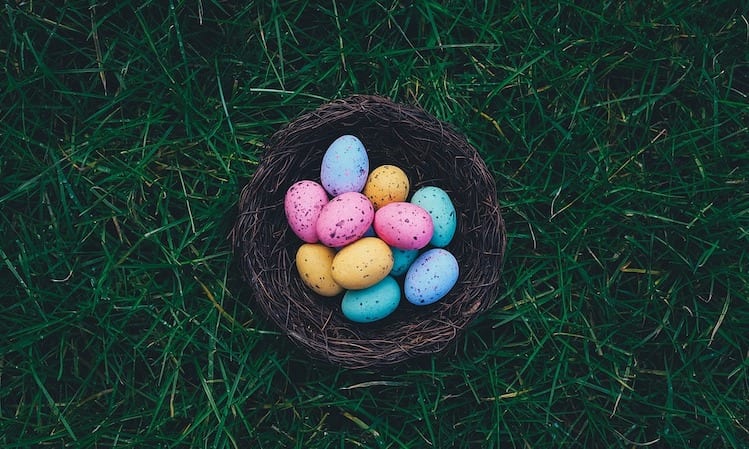
Image by Annie Spratt via PixaBay. Public Domain Image.
Egg hunts are a fantastic activity for families and groups of all sizes. I’ve been in charge of several of Circle Sanctuary’s recent Welcome Spring egg hunts, and I’ve learned a few tricks of the trade. I’ve also developed a few ideas for how we can use the eggs we’re hunting as part of lessons that teach Pagan ritual in kid-friendly ways.
Leading No-Tears Egg Hunts
Some people have sad memories of childhood egg hunts that more closely resemble Black Friday stampedes. If you’re incorporating an egg hunt into your group or community Equinox celebration, there are a few things you can do to make it fun for all, and less likely to end in tears.
First, separate the ages. At Circle Sanctuary I organize the groups into:
babies and toddlers, defined as any child who is too young to move quickly and understand the concept of “hiding”
older toddlers & pre-school, including those who are big enough to understand what an egg hunt is, but small enough not to be able to compete with older kids
kids, which includes anyone over five until they’re old enough to be offended by being called a kid,
teens and adults. I encourage you to have an adult hunt, if it’s logistically possible, both because the adults will enjoy it and also because many teens really want to keep hunting eggs but feel self-conscious doing so unless the adults are in on it as well.
If possible, give each group a separate zone to hunt in, or run them sequentially, getting the kids and teens to re-hide the same eggs. For the youngest babies and toddlers, putting the eggs in plain sight is fine. (Think the “oh, look! Shells!” moment from Finding Dory). The pre-school group also needs the eggs to be fairly visible, but if you have edges of things, like flower beds or paths, that’s a great place to put them.
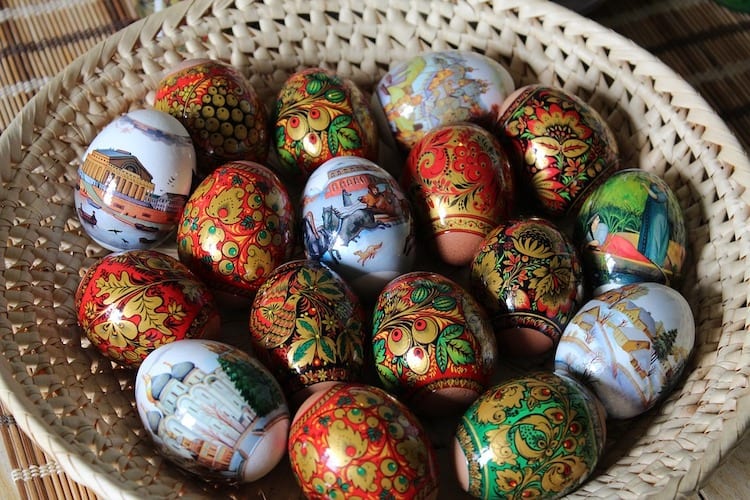
Image via MaxPixel. Public Domain Image.
For the older kids, include a mixture of obvious and hidden eggs. For the adults and teens, give the egg hiding to those who will get as devious as possible, but with the caveat that no egg should be put in an unsafe location. It’s important to have clearly delineated boundaries for each egg-hunting zone, so no one wanders off on a wild goose-egg chase.
“Oh look, eggs!” Egg-hunting for five and under
For the toddlers and preschoolers, the hunt process can be fairly simple. Yell “go” and let them find eggs. Have parents or teen volunteers accompany the little ones, to help them hunt and avoid conflict. If you have a few kids who are visibly struggling to get eggs, you can usually recruit a few older teens to discreetly plant eggs ahead of where they’re looking. The teens are usually gratified to be given the responsibility and the younger kids are too focused on looking to notice.
Better Egg-Hunting Through Algebra
For the kids, though, some more structure is needed. There is a huge difference in the running and finding ability of a first-grader and a fifth-grader. Some children may have mechanical or cognitive disabilities which might also make them slower to find eggs. Without some structure, what often ends up happening is that the oldest kids end up with overflowing baskets, while others end up in tears as one or two eggs rattle around in an otherwise empty basket.
The solution I’ve found is to impose an initial “bag limit” on eggs. Divide the number of eggs (E) by the number of kids (k), and subtract three or so, and you’ll have a good bag limit (B). So the formula for a successful egg hunt is (E/k)-3=B . Release the kids, but say they have to return to you once they have their bag limit.
Let them line up as soon as they return and pick a small prize. Try to have the prizes be mostly similar, so it doesn’t matter much who goes first. They’ll still care, but being last won’t have major consequences. Let each child show you their eggs and pick a prize before releasing them back out to get the rest of the eggs, with no bag limit. If you award prizes again at the end, give them out by age, not by number of eggs, with the youngest going first.
Image via Max Pixel. Public Domain Image.
Prizes for Kids or Adults
If you’re going to use prizes for kids, have them all be similar so no kid feels like they missed out. For prizes for adults, consider making it a “potluck” with everyone bringing a book or small spiritual item they liked but that no longer “sparks joy.” Pretty much every Pagan I know has a collection of random items and semi-precious stones that they’re not actively using but can’t discard. Have everyone clean the item ahead of time, and give them out at random to those who turn in their eggs.
Beyond the Hunt – An Egg-Centric Ritual for Kids
Once the eggs are hunted, you can do more than eat their contents. You can use the eggs in activities like egg divination or egg races or incorporate them into a teaching ritual, like the one below.
Whether you’re dyeing or buying your eggs, consider selecting the colors carefully. Try to select for colors that are associated with the elements or another similar concept in your tradition. For the sake of this example, we’ll use the four elements in green, yellow, red, blue, plus purple for center. Define the circumference of your circle, maybe by having the kids hold hands and stretch out as far as they can go. Put a basket or bowl at the cardinal points of the circle, and in the center.
Bring out a compass if you have it, and have the kids find North. Explain that this is North, and generally what North means in your tradition (i.e. “North is the color of Earth. When we think about Earth we think about things that are strong like rocks, that are solid like mountains, and that help support us like how our bones support our body.) As everyone with a green egg in their basket to raise their hands, and when you point to them have them put their egg in the basket in the North, or if you have a smaller group you can ask them to come up with an animal, plant, or other thing that reminds them of the north for each egg they add. Pick older or more experienced kids first, so the others can see what kind of animals or examples they come up with. Continue until all the green eggs are in the North basket.
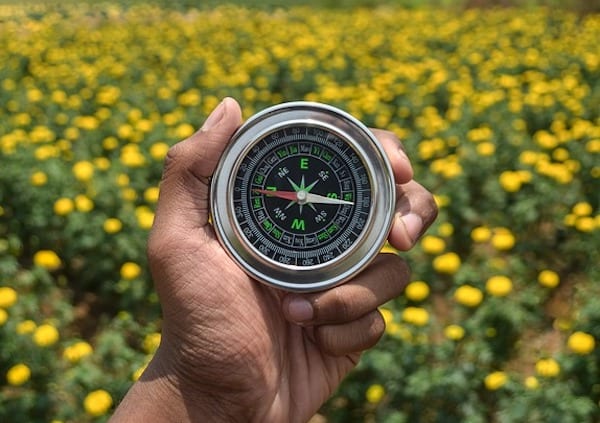
Image by diwatrance_shot, via Pixabay. Public Domain Image
Repeat this with each of the other directions, letting the group populate each basket, ending in the center. You can then form a circle inside of the baskets, or if you only are a few people, move back to your starting position, in this example North. You can give the kids egg shakers, or use clapping.
Model raising your hands toward the basket of eggs, and give a short invocation to the element, connecting it with the celebration. “Element of North and Earth, thank you for supporting our bodies and being the strong ground under our feet. Please be with us this spring and give us strong bodies. Welcome Earth, Welcome, Earth, Welcome Earth!” On each “Welcome Earth” clap your hands or shake a rattle in time to the chant. Feel free to let it go longer than three repetitions to give the kids time to get into it.
Repeat the invocation to each of the directions, ending in the center. Facing the center call upon the spring. “As we stand here together, with the spirit of North, East, South, West, and Center all around us, we call in the spirits of Spring. Fill us with your energy for fun and joyful months to come. Welcome Spring! Welcome Spring! Welcome Spring!” Repeat “welcome spring” with clapping or rattling, getting louder and faster as you go. Kids are fantastic at raising energy with speed and volume! If you’ve got a group of 3-6 kids of about the same sizes and comparable physical abilities you can also try getting them to join hands and skip, ring-around-the-rosy style—just don’t crush the eggs when you inevitably topple to the floor!
At the end, you can have the kids take one egg from each of the directions home with them, or pick one direction they really like and take one egg from there. Or if you need to get rid of the eggs they can take as many as they want!
Other ideas:
If you’re hiding a smaller number of eggs, use a sticker on plastic eggs or a marker on real eggs to draw elemental or spiritual symbols on the eggs, one symbol per egg. Get the kids to trade until they all have one of each symbol.
Hide “special” eggs, one for each kid, with a symbol or tag with special job to do during your group or family’s ritual. Trade eggs till every kid has one job.
For a small group including older kids and teens, spell out words like OSTARA, SPRING, EQUINOX, or the names of the elements, one letter per egg. Have them trade until each person can make a word.
There really is no wrong way to do a ritual like this for children. If the energy that gets raised is minimal, that’s ok. If they just like the clapping or rattling, that’s ok. When we do rituals for children we’re familiarizing them with the basic structure and concepts that will come up in more formal rituals, but we’re letting them participate in a hands-on, playful way. Kids “learn through play,” so if we want to teach them about our traditions we need to find a way to make them play-accessible.
About Florence Edwards-Miller
Florence is a Pagan and mom living in Wisconsin. She is a longtime member of the Circle Sanctuary Community and an advanced student in the Ministry Training Program. She frequently coordinates youth and family programming for events at Circle Sanctuary and is the coordinator for the Family Center at Pagan Spirit Gathering. You can read more about the author here.
Previous Post

March 18, 2019
Of Light & Shadow: Nephthys, Lady of the House
Next Post

March 19, 2019 Hearth of Hellenism: Discreet Devotion
Browse Our Archives
Select a Category A Lakeside Hearth Adventures in Wortcunning Alone In Her Presence Arts, Crafts & Cooking Birthing Hereditary Witchcraft Book of Blackbirds Book Reviews Born-Again Witch Cauldron, Sword, Spear, & Stone Cermony and Liturgy Columns Community Dandelion Seeds Dear Jasmine Druid Thoughts Editor's Picks Everyday Pagan Family & Household Practice Family Traditions Full Frontal Magic Gateway Goddess Guest Articles Happily Heathen Health and Wellness Hearth of Hellenism Heathen Woman Hills of the Horizon History Holidays Horse Goddesses Interfaith Interviews Irish-American Witchcraft Jewish Witch Lamp & Labyrinth Letters from Midgard Literature, Media, Film, Music Loop of Brighid Love, Sex & Relationships Magic or Magick Making Light Naturalistic Traditions Nature News Outside The Circle Pantheisticon Politics Prayers, Poems, Blessings & Stories Queer Femme Mystic Queer of Swords Recipes Ritual and Practice Science and Research Seekers and Guides Seeking the Grail Socially Responsible Magic Spear of Athena Star Made Witch Syncretic Electric Technology The Blooming Staff The Busy Witch The Cartomancer The Crow's Nest The Dance of Pagan Recovery The Hearth of Hellenism The Lady's Quill The Other Side of the Hedge The Path of She The Rantin' Raven The Witches Next Door The Zen Pagan Theology, Ethics, Philosophy Tree City Witch Urban Earthwitch Wayfaring Woman Witch on Fire Wyrd Words
Select a Month January 2026 March 2025 December 2024 June 2024 April 2024 March 2024 January 2024 December 2023 November 2023 October 2023 August 2023 July 2023 May 2023 April 2023 March 2023 February 2023 January 2023 December 2022 November 2022 October 2022 September 2022 August 2022 July 2022 June 2022 May 2022 March 2022 February 2022 January 2022 December 2021 November 2021 October 2021 September 2021 August 2021 July 2021 June 2021 May 2021 April 2021 March 2021 February 2021 January 2021 December 2020 November 2020 October 2020 September 2020 August 2020 July 2020 June 2020 May 2020 April 2020 March 2020 February 2020 January 2020 December 2019 November 2019 October 2019 September 2019 August 2019 July 2019 June 2019 May 2019 April 2019 March 2019 February 2019 January 2019 December 2018 November 2018 October 2018 September 2018 August 2018 July 2018 June 2018 May 2018 April 2018 March 2018 February 2018 January 2018 December 2017 November 2017 October 2017 September 2017 August 2017 July 2017 June 2017 May 2017 April 2017 March 2017 February 2017 January 2017 December 2016 November 2016 October 2016 September 2016 August 2016 July 2016 June 2016 May 2016 April 2016 March 2016 February 2016 January 2016 December 2015 November 2015 October 2015 September 2015 August 2015 July 2015 June 2015 May 2015 April 2015 March 2015 February 2015 January 2015 December 2014 November 2014 October 2014 September 2014 August 2014 July 2014 June 2014 May 2014 April 2014 March 2014 February 2014 January 2014 December 2013 November 2013 October 2013 September 2013 August 2013 July 2013 June 2013 May 2013 April 2013 March 2013 February 2013 January 2013 December 2012 November 2012 October 2012 September 2012 August 2012 July 2012 June 2012 May 2012 April 2012 March 2012 February 2012 January 2012
Follow Us!
TAKE THE
Religious Wisdom Quiz
Who was Noah's father?
Select your answer to see how you score.
Abel Seth Lamech Enoch
Related posts from Agora
The Corner Crone: Ready or Not, Here Comes...
Parenting the Divine: Teaching the Joy of Lammas
The Balancing Path: Including Queer and Genderqueer Fertility
Parenting the Divine: Practically Perfect Parent Emergency Button
TRENDING AT PATHEOS Pagan

I was recently chatting with someone on Instagram. She asked me what...

While there are many people who share their results, the end of...

On July 23, I saw Christopher Nolan's The Odyssey which is Homer’s...

As I write this two big events have just finished up. One...

Restoring the Watershed of Divine Love
Perhaps cooperation is not something we manufacture through legislation, ideology, or moral...

Many UUs don’t pray because of bad experiences in a previous religion,...
view all Pagan blogs
Ad-Free & Subscriber Log-In Subscription Support
- About Us
- 2026 Calendar
- Videos
- Podcasts
- Library of World Religions
- Faith In Media Tracker
- Advertise With Us
- Write for Us
- Privacy Policy
- Terms of Service
- Do Not Sell My Data
- Contact Us
- Radiant Digital
- Manage Newsletter Subscriptions
- Unsubscribe From Notifications
- Sitemap
Copyright 2008-2026, Patheos. All rights reserved.
Subscription Support Ad-Free & Subscriber Log-In
Follow Patheos