
BuddhistCatholicContemplativeEvangelicalGeneral ChristianHinduJewishLatter-day SaintMuslimNew VisionsProgressive Christian
Beliefs
- Buddhist
- Catholic
- Contemplative
- Evangelical
- General Christian
- Hindu
- Jewish
- Latter-day Saint
- More Voices
- Muslim
- New Visions
- Pagan
- Progressive Christian
Topics
- Religion News
- Food and Religion
- Sports and Religion
- Religious Art
- Religious Music and Entertainment
- Religious Events
- History and Religion
- Style and Religion
- Politics and Religion
- Women in Religion
- Recreation Outdoors and Religion
- Business Finance and Religion
- Careers Workplace and Religion
- Education and Religion
- Family Parenting and Religion
- Health Fitness and Religion
- Home and Religion
- Relationships and Religion
- Technology and Religion
- Travel and Religion
Columnists
- Buddhist Columnists
- Business Finance and Religion Columnists
- Careers Workplace and Religion Columnists
- Catholic Columnists
- Contemplative Columnists
- Education and Religion Columnists
- Evangelists Columnists
- Family Parenting and Religion Columnists
- General Christian Columnists
- Health Fitness and Religion Columnists
- Hindu Columnists
- History and Religion Columnists
- Home and Religion Columnists
- Jewish Columnists
- More Voices Columnists
- Latter Day Columnists
- Muslim Columnists
- New Visions Columnists
- Nonreligious Columnists
- Pagan Columnists
- Politics and Religion Columnists
- Progressive Columnists
- Recreation Outdoors and Religion Columnists
- Relationships and Religion Columnists
- Religion News Columnists
- Religious Art Columnists
- Religious Events Columnists
- Religious Music and Entertainment Columnists
- Sports and Religion Columnists
- Style and Religion Columnists
- Technology and Religion Columnists
- Travel and Religion Columnists
- Women in Religion Columnists
Resource Library
- 2026 Calendar
- Library of World Religions
- The 100 Most Holy Places on Earth
- Patheos Answers
- Podcasts
- Videos
- Faith Leaders Database
- Anglican Episcopalian
- Bahai
- Baptist
- Buddhism
- Christianity
- Confucianism
- Eastern Orthodoxy
- Hinduism
- Holiness and Pentecostal
- ISKCON
- Islam
- Judaism
- Lutheran
- Methodist
- The Church of Jesus Christ of Latter-day Saints
- New Age
- Paganism
- Presbytarian and Reformed
- Protestantism
- Religion Behind the Scenes
- Roman Catholic
- Scientology
- Shia Islam
- Sikhism
- Sufism
- Sunni Islam
- Taoism
- Zen
- See all religions
Research Tools
 Ad-Free & Subscriber Log-In Subscription Support
Ad-Free & Subscriber Log-In Subscription Support
Follow Patheos 

- Trending:
- Forgiveness
- |
- Marriage
- |
- Consciousness
- |
- Death Penalty
- |
- Election
- |
- Halloween

- Home
- Pagan
- Irish-American Witchcraft: The Right and Wrong of Fictional Fairies
Irish-American Witchcraft: The Right and Wrong of Fictional Fairies
Last updated on: March 20, 2019 at 12:02 am by Morgan Daimler
Irish-American Witchcraft: The Right and Wrong of Fictional Fairies 2019-03-20T00:02:46+00:00 Morgan Daimler
Patheos Explore the world's faith through different perspectives on religion and spirituality! Patheos has the views of the prevalent religions and spiritualities of the world.
This is a question that I was asked to look at on social media and I thought here was probably the best venue. Fairies are a hot topic in fantasy and urban fantasy and have been for decades, so what are novels getting right and where are they going wrong? It’s a good question and also an important one I think as I see more and more pagans adopting beliefs from fiction rather than folklore.
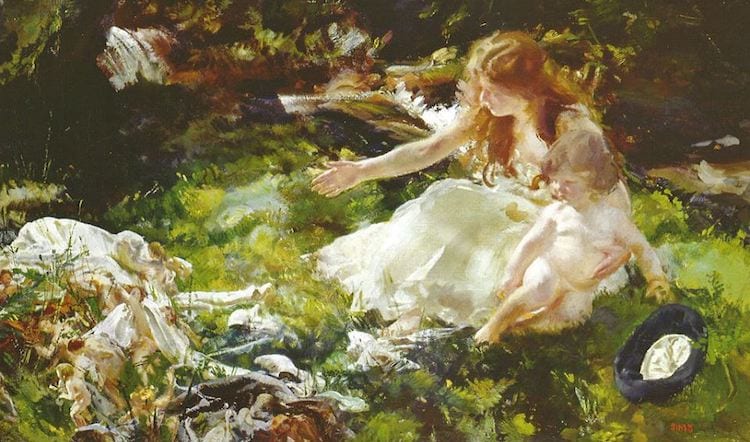
“And the Fairies Ran Away” by Charles Sims. From the Leeds Art Gallery via WikiMedia.
In and of itself its fine to have beliefs from odd sources – entire religions are founded on fiction and there’s nothing wrong with deciding to go with a belief you gleaned from a novel – it only becomes a problem when its put forward as genuinely older folk belief and becomes mainstream. Because when that happens, when it becomes popular under the guise of genuine traditional folklore, it actively erases the older cultural folklore which in many places is already struggling.
When a dominant culture starts to rewrite minority folklore not from a place of belief but for entertainment, even if those rewritten ideas are then absorbed again as beliefs, it’s a big problem. Not only because it accelerates the decline of the original culture but also because it raises the question of how much depth these new beliefs actually have to them.
Where Fiction Gets it Right
Fiction does get fairy folklore right, although some books are definitely closer to the mark than others. What follows will of course be generalizations based on a variety of different books and series, so even though I’m saying fiction gets these details right there will always be examples of books that get these bits wrong as well. Such is the risk with a diverse market.
Iron – most books I’ve seen do correctly make iron a substance fairies avoid or are harmed by. Different authors handle this a variety of ways because folklore is vague on the how and why of iron’s apotropaic qualities. It is widespread and well known and something that is found in many books in a way that is either true to folklore or fairly close.
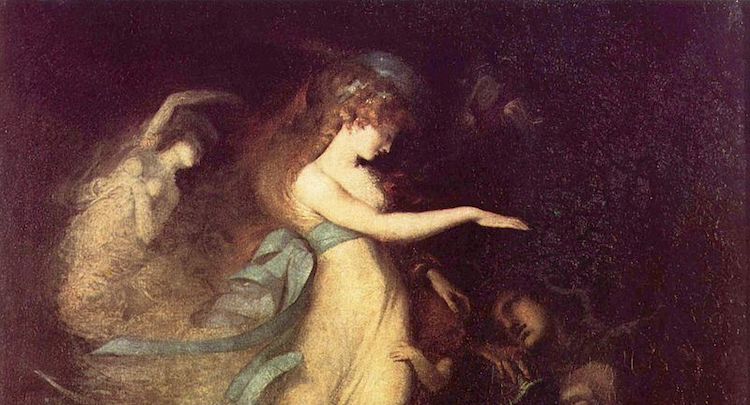
“Prince Arthur and the Fairy Queen” by Johann Heinrich Füssli. From WikiMedia.
‘Good’ and ‘Bad’ – although it’s often played as a trope, and sometimes terribly mauled especially in young adult novels, many authors do follow the Scottish folklore of there being two groups of fairies, one of which is more positively inclined towards humans the other being more malevolent. While this isn’t a universal concept it is from Scottish folklore specifically and has gained wider popularity.
Human-sized Fairies – a bit more hit or miss but increasingly more common in books to see fairies being depicted in a range of human sizes rather than as tiny. In folklore its clear that fairies appeared in many different forms and could be tall or short. While we do see some very tiny fairies those are actually rare in folklore and very specific in location and backstory. Most fairies are described as being between 4 and 6 feet tall, occasionally a bit shorter or taller.
Variety – Fiction is usually pretty good about breaking out of the idea that fairies are all tiny winged sprite-like beings and instead including a selection of different beings. This is true to folklore, where the word fairy is a generic term for an Otherworldly being. Also fiction recently seems to be doing well using synonymous terms like fae along with various spellings of fairy, all of which are inline with folklore (fun fact there’s something like 90 different recorded spellings for the word ‘fairy’ in writing since the term first appeared.)
Time Shift Between Worlds – The fiction I’ve read does a good job of staying true to the idea that there is a time shift between our world and Fairy, which is very accurate to folklore.
Where Fiction Gets It Wrong
While there are a few points of actual folklore that make it into books there’s also a wide array of misinformation and plain nonsense that shows up as well usually not intended to be framed as folklore at all but simply the author’s storytelling and imagination at play. Honestly this is the bulk of most mainstream popular fairy books (and rpgs). Plotlines take precedence over folklore and the result is a good story that is disconnected from any actual folklore. I could easily have a dozen items on this list but I’ll stick to the most common ones I see that are both side spread and crossing over into pagan spiritual belief.
Multiple Named Courts – In Scottish folklore there are two courts of Fairy, the Seelie and the Unseelie; in other folklore there aren’t named courts at all. But its become popular in fiction over the last 20 years or so to expand the Scottish system, first including a third ‘wyld’ court then going further. One series has 7, while a popular RPG has more than a dozen. This is something I know for a fact is finding its way into paganism because I am often asked about it and run across people referring to ‘courts’ I recognize from specific books or games.

“Hylas and the Nymphs” by John Waterhouse. From WikiMedia.
Whose In Charge? – Modern fiction has not only created new named courts but has also given new Queens to the existing Seelie and Unseelie courts of Scottish lore. These range depending on the story but Shakespeare’s fairy queens, Mab and Titania, often put in appearances. This is also highly problematic from the perspective of actual folklore where the Queen of the Unseelie court is usually understood to be Nicnevin and the Seelie queen is never named; putting English fairy Queens on Scottish fairy thrones is a lot of politics that are painful to even consider and speak of authors choosing names out of convenience rather than doing research. Some books choose random deities to head a known fairy court – usually the traditional Seelie and Unseelie – while in other cases entirely new beings have been invented.
Unseelie Emo Love Interests – Super popular trope in young adult urban fantasy and also edging into adult genres. The idea that the Unseelie aka the ‘Bad’ fairies, are actually the good guys and just need the right person to show them their good guy potential/save them/motivate them/whatever. Cue My Chemical Romance playlist here. The reality is that while the Unseelie are certainly more nuanced than straight up evil they certainly aren’t a bunch of eternal teenage boys looking for the love of a good misfit.
Important Humans – This one makes complete sense in a novel, because obviously in most stories the main character (MC) is going to be human and therefore obviously special and significant and get into magical adventures. So we see lots of stories where the human MC is absolutely pivotal to the local fairies, meets the Queen, marries the prince, saves the world, etc., The reality in folklore is that when fairies take an interest in humans its always for a reason and that reason is always to the fairies’ advantage. In some cases they would connect to human witches and teach them, true, but the witch always had reciprocal obligations. In most stories the human ended up as a servant, entertainment, or breeding stock. Basically in folklore (and reality) humans aren’t the center of very much.
Over Anthropomorphizing – Not physically but emotionally and mentally. In folklore it’s clear that fairies are very alien in their motivation and actions to human beings yet in fiction they often act pretty much like humans. This lends itself to an increasing idea that fairies are kinder and nicer than they often appear in folklore and also changes the way people approach interacting with them. In folklore they often seem cruel and it may not be that they are but that we are unable to understand their motivations most of the time. Like mice trying to understand house cats.
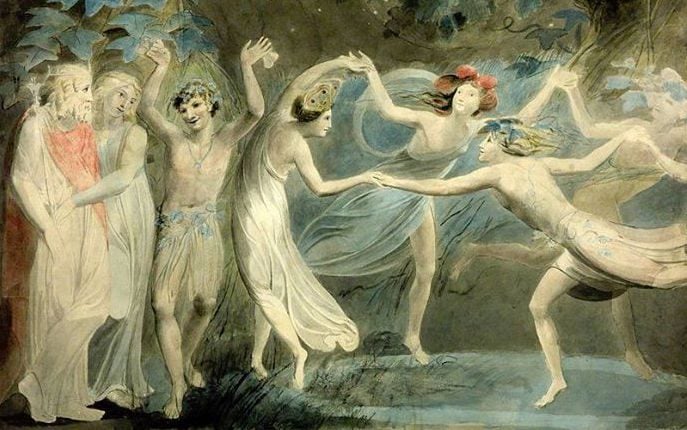
“Oberon, Titania and Puck with Fairies Dancing” by William Blake. From WikiMedia.
Final Thoughts
I do think there are examples of good fiction that includes fairies which are truer to folklore. I’ve written previously about some of my personal favorites in a blog titled ‘Good Fairy Fiction‘ and people added more suggestions in the comments on that one. I would still however note that the best fairy fiction must always make some slight concessions for plot and characterization so that nothing is ever aligned completely with folklore; what we want in a good story and what we get in fairy anecdotes don’t mesh perfectly.
People often question why any of this matters, why we should care whether a belief is genuinely folkloric or pulled from modern fiction or invention. There is of course a fluidity to folklore that means today’s urban legend is tomorrow’s folk belief and sometimes today’s fiction becomes the folk belief of the next century. This is a particularly touchy question in modern paganism where people are often looking for any and all sources on a subject like fairies. But I think Nimue Brown sums it well in a recent blog, saying that there is a difference between being part of a culture and its evolution and being outside of it and taking material from it to use outside its context. Too often what’s being taken as belief from modern fiction is the latter, material that is disconnected from actual cultural belief and born simply as a plot device.
If you are seeking to incorporate belief in fairies into your spirituality, to approach belief in them the way the modern living cultures that believe in them do, I suggest treating them as you would a foreign human culture you are interested in learning about. And I would sincerely hope, to forward that analogy, if you want to learn about Ireland you would look to solid non-fiction sources and accounts written by people with first hand experience, rather than fiction. In the same way with fairies while fiction can be fun and entertaining we need to be careful not to blur that line and start seeing it as depicting actual folklore, because most of the time it isn’t.
Previous Post
March 19, 2019
Dance of the Maenad: Bacchus- Liberator of Outsiders
Next Post
March 21, 2019 3 Pagans & A Cat: Feeling and Talking to Spirits
Browse Our Archives
Select a Category A Lakeside Hearth Adventures in Wortcunning Alone In Her Presence Arts, Crafts & Cooking Birthing Hereditary Witchcraft Book of Blackbirds Book Reviews Born-Again Witch Cauldron, Sword, Spear, & Stone Cermony and Liturgy Columns Community Dandelion Seeds Dear Jasmine Druid Thoughts Editor's Picks Everyday Pagan Family & Household Practice Family Traditions Full Frontal Magic Gateway Goddess Guest Articles Happily Heathen Health and Wellness Hearth of Hellenism Heathen Woman Hills of the Horizon History Holidays Horse Goddesses Interfaith Interviews Irish-American Witchcraft Jewish Witch Lamp & Labyrinth Letters from Midgard Literature, Media, Film, Music Loop of Brighid Love, Sex & Relationships Magic or Magick Making Light Naturalistic Traditions Nature News Outside The Circle Pantheisticon Politics Prayers, Poems, Blessings & Stories Queer Femme Mystic Queer of Swords Recipes Ritual and Practice Science and Research Seekers and Guides Seeking the Grail Socially Responsible Magic Spear of Athena Star Made Witch Syncretic Electric Technology The Blooming Staff The Busy Witch The Cartomancer The Crow's Nest The Dance of Pagan Recovery The Hearth of Hellenism The Lady's Quill The Other Side of the Hedge The Path of She The Rantin' Raven The Witches Next Door The Zen Pagan Theology, Ethics, Philosophy Tree City Witch Urban Earthwitch Wayfaring Woman Witch on Fire Wyrd Words
Select a Month January 2026 March 2025 December 2024 June 2024 April 2024 March 2024 January 2024 December 2023 November 2023 October 2023 August 2023 July 2023 May 2023 April 2023 March 2023 February 2023 January 2023 December 2022 November 2022 October 2022 September 2022 August 2022 July 2022 June 2022 May 2022 March 2022 February 2022 January 2022 December 2021 November 2021 October 2021 September 2021 August 2021 July 2021 June 2021 May 2021 April 2021 March 2021 February 2021 January 2021 December 2020 November 2020 October 2020 September 2020 August 2020 July 2020 June 2020 May 2020 April 2020 March 2020 February 2020 January 2020 December 2019 November 2019 October 2019 September 2019 August 2019 July 2019 June 2019 May 2019 April 2019 March 2019 February 2019 January 2019 December 2018 November 2018 October 2018 September 2018 August 2018 July 2018 June 2018 May 2018 April 2018 March 2018 February 2018 January 2018 December 2017 November 2017 October 2017 September 2017 August 2017 July 2017 June 2017 May 2017 April 2017 March 2017 February 2017 January 2017 December 2016 November 2016 October 2016 September 2016 August 2016 July 2016 June 2016 May 2016 April 2016 March 2016 February 2016 January 2016 December 2015 November 2015 October 2015 September 2015 August 2015 July 2015 June 2015 May 2015 April 2015 March 2015 February 2015 January 2015 December 2014 November 2014 October 2014 September 2014 August 2014 July 2014 June 2014 May 2014 April 2014 March 2014 February 2014 January 2014 December 2013 November 2013 October 2013 September 2013 August 2013 July 2013 June 2013 May 2013 April 2013 March 2013 February 2013 January 2013 December 2012 November 2012 October 2012 September 2012 August 2012 July 2012 June 2012 May 2012 April 2012 March 2012 February 2012 January 2012
Follow Us!
TAKE THE
Religious Wisdom Quiz
What did Jesus cast into a herd of pigs?
Select your answer to see how you score.
Demons Coins Water Leprosy
Related posts from Agora

Irish-American Witchcraft: Top 5 Favourite Fairy Fiction Series

Irish-American Witchcraft: Why the Roots of Your Fairy...
Irish-American Witchcraft: Fairies, Hoaxes, Gaffs, and Quest for...

Irish-American Witchcraft: Fairies and Modern Technology
TRENDING AT PATHEOS Pagan

I was recently chatting with someone on Instagram. She asked me what...

While there are many people who share their results, the end of...

On July 23, I saw Christopher Nolan's The Odyssey which is Homer’s...

As I write this two big events have just finished up. One...

Restoring the Watershed of Divine Love
Perhaps cooperation is not something we manufacture through legislation, ideology, or moral...

Many UUs don’t pray because of bad experiences in a previous religion,...
view all Pagan blogs
Ad-Free & Subscriber Log-In Subscription Support
- About Us
- 2026 Calendar
- Videos
- Podcasts
- Library of World Religions
- Faith In Media Tracker
- Advertise With Us
- Write for Us
- Privacy Policy
- Terms of Service
- Do Not Sell My Data
- Contact Us
- Radiant Digital
- Manage Newsletter Subscriptions
- Unsubscribe From Notifications
- Sitemap
Copyright 2008-2026, Patheos. All rights reserved.
Subscription Support Ad-Free & Subscriber Log-In
Follow Patheos