
BuddhistCatholicContemplativeEvangelicalGeneral ChristianHinduJewishLatter-day SaintMuslimNew VisionsProgressive Christian
Beliefs
- Buddhist
- Catholic
- Contemplative
- Evangelical
- General Christian
- Hindu
- Jewish
- Latter-day Saint
- More Voices
- Muslim
- New Visions
- Pagan
- Progressive Christian
Topics
- Religion News
- Food and Religion
- Sports and Religion
- Religious Art
- Religious Music and Entertainment
- Religious Events
- History and Religion
- Style and Religion
- Politics and Religion
- Women in Religion
- Recreation Outdoors and Religion
- Business Finance and Religion
- Careers Workplace and Religion
- Education and Religion
- Family Parenting and Religion
- Health Fitness and Religion
- Home and Religion
- Relationships and Religion
- Technology and Religion
- Travel and Religion
Columnists
- Buddhist Columnists
- Business Finance and Religion Columnists
- Careers Workplace and Religion Columnists
- Catholic Columnists
- Contemplative Columnists
- Education and Religion Columnists
- Evangelists Columnists
- Family Parenting and Religion Columnists
- General Christian Columnists
- Health Fitness and Religion Columnists
- Hindu Columnists
- History and Religion Columnists
- Home and Religion Columnists
- Jewish Columnists
- More Voices Columnists
- Latter Day Columnists
- Muslim Columnists
- New Visions Columnists
- Nonreligious Columnists
- Pagan Columnists
- Politics and Religion Columnists
- Progressive Columnists
- Recreation Outdoors and Religion Columnists
- Relationships and Religion Columnists
- Religion News Columnists
- Religious Art Columnists
- Religious Events Columnists
- Religious Music and Entertainment Columnists
- Sports and Religion Columnists
- Style and Religion Columnists
- Technology and Religion Columnists
- Travel and Religion Columnists
- Women in Religion Columnists
Resource Library
- 2026 Calendar
- Library of World Religions
- The 100 Most Holy Places on Earth
- Patheos Answers
- Podcasts
- Videos
- Faith Leaders Database
- Anglican Episcopalian
- Bahai
- Baptist
- Buddhism
- Christianity
- Confucianism
- Eastern Orthodoxy
- Hinduism
- Holiness and Pentecostal
- ISKCON
- Islam
- Judaism
- Lutheran
- Methodist
- The Church of Jesus Christ of Latter-day Saints
- New Age
- Paganism
- Presbytarian and Reformed
- Protestantism
- Religion Behind the Scenes
- Roman Catholic
- Scientology
- Shia Islam
- Sikhism
- Sufism
- Sunni Islam
- Taoism
- Zen
- See all religions
Research Tools
 Ad-Free & Subscriber Log-In Subscription Support
Ad-Free & Subscriber Log-In Subscription Support
Follow Patheos 

- Trending:
- Forgiveness
- |
- Marriage
- |
- Consciousness
- |
- Death Penalty
- |
- Election
- |
- Halloween

- Home
- Pagan
- Pan-Celtic Hoofbeats: The Horse, Nature, and Sovereignty
Pan-Celtic Hoofbeats: The Horse, Nature, and Sovereignty
Last updated on: February 20, 2019 at 10:25 pm by Kris Hughes
Pan-Celtic Hoofbeats: The Horse, Nature, and Sovereignty 2019-02-20T22:25:48+00:00 Kris Hughes
Patheos Explore the world's faith through different perspectives on religion and spirituality! Patheos has the views of the prevalent religions and spiritualities of the world.
We all know that horse goddesses are sovereignty goddesses, right? And that sovereignty is an important concept in Celtic belief. It’s said so often that newcomers probably feel like they just have to swallow the idea whole without asking questions. Here are a few answers, some fairly standard, and others which are more my opinion, based of years of reading myth and history, and living in relationship with the horse goddesses.
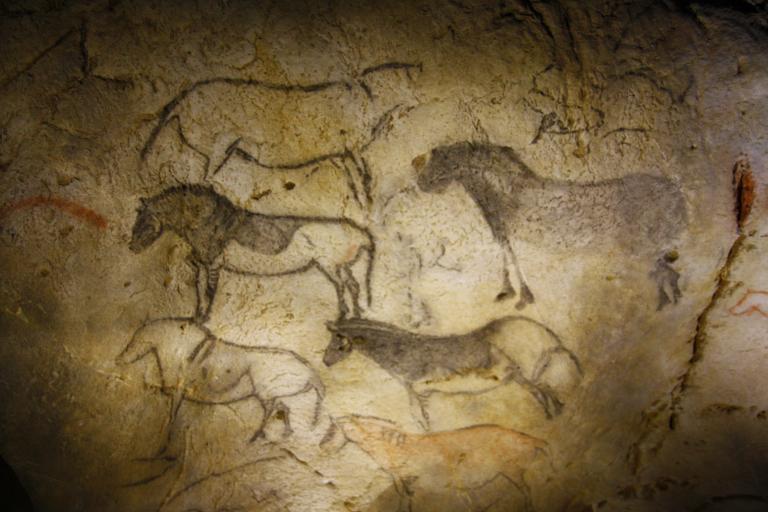
Paleolithic Horse Paintings by Gipuzkoa Kultura, CC 2.0 Wikimedia
Sovereignty is the right of an entity to control its own destiny and make its own decisions. That entity might be a country. National sovereignty is a country’s right to make its own rules without outside interference. Ideas about who holds that right, the people, the government, or a monarch, vary. When it is a monarch, theoretically or symbolically the power of that nation, and over that nation, resides in them. There is also personal sovereignty, or the right of an individual to determine their own course of action, not to have their body messed with against their will, and so on.
Why do we think that horse goddesses and sovereignty are connected? The idea of sovereignty over territory residing in a woman, who then confers it on a ruler, is laid out in some Irish myths. The most obvious of these is when Conn of the Hundred Battles is brought to a hall and shown Lugh and a woman called The Sovereignty of Ireland seated on thrones. The woman offers him a cup of red ale from a vat, as well as food, and the names of the kings who will come after him, are recited.
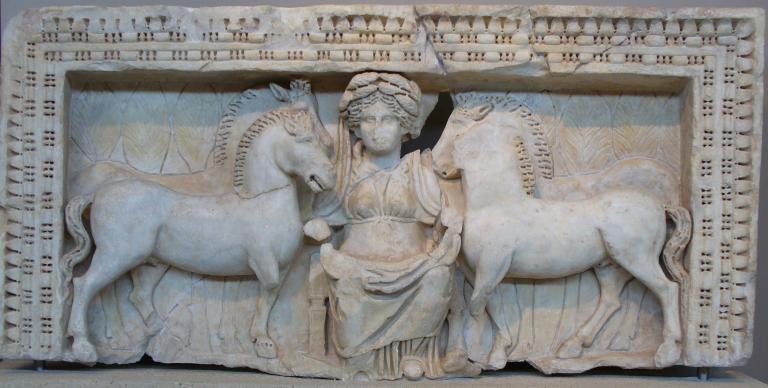
Epona Salonica by QuartierLatin1968, CC 1.0 Wikimedia
Another strand of sovereignty lore includes stories like The Loathly Lady or Lady Ragnell, in which a knight or king must marry a hideous hag who then turns into a beautiful woman and becomes his queen. In the Lady Ragnell stories, it is stated outright that what a woman most desires is sovereignty over herself, as if this is the whole point of the tale.
It is from stories like this that we gain clues that the tale of Rhiannon, or of Macha the wife of Cruinniuc, both of which have strong associations with horses, are also sovereignty stories. And it is interesting that both goddesses have difficulty maintaining their personal sovereignty. Another clue is an account given by Gerald of Wales in his 12th century propaganda piece The Topography of Ireland. The book itself is little more than a hatchet job on the Irish as ignorant savages who live on some wild real estate with good potential for redevelopment. However, it contains a description of the coronation of an Irish king which emphasises the importance of the horse in the concept of sovereignty.
“When the whole people of that land has been gathered together in one place, a white mare is brought forward into the middle of the assembly. He who is to be inaugurated, not as a chief, but as an outlaw, has bestial intercourse with her before all, professing himself to be a beast also. The mare is then killed immediately, cut up in pieces, and boiled in water. A bath is prepared for the man afterwards in the same water. He sits in the bath surrounded by all his people, and all, he and they, eat of the meat of the mare which is brought to them. He quaffs and drinks of the broth in which he is bathed, not in any cup, or using his hand, but just dipping his mouth into it round about him. When this unrighteous rite has been carried out, his kingship and dominion have been conferred.”
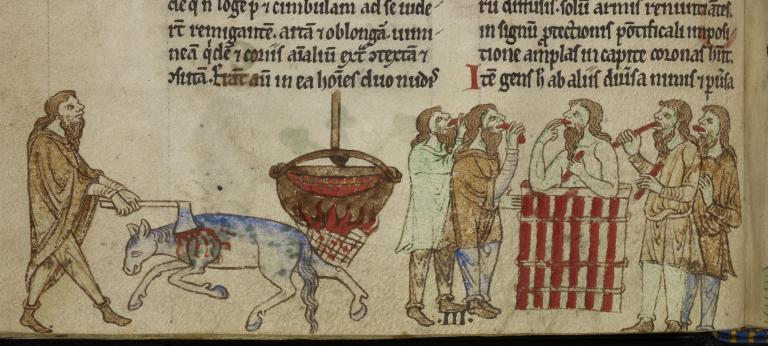
Irish Kingship Ritual, British Library Public Domain, Wikimeida
Gerald’s account is both judgemental and sensational in tone. It has been cast into doubt many times, and certainly may not be accurate, but it is also likely to contains a grain of truth. Not only are there stories like Rhiannon and Macha, there is an Indo-European parallel in the ancient Vedic asvamedha ritual, which involved the sacrifice of a sacred stallion, with which the queen simulated copulation before her husband was crowned king.
Rhiannon’s association with horses is obvious, as they crop up frequently in Her story, usually in important and magical ways. For example: when her child is stolen from her bed, it turns up at the home of Teyrnon who is waiting up at night for his mare to foal; and after she has been imprisoned in a magical house, she reports that she was made to wear an ass’s collar while she was there. Equally, it seems that she marries Pwyll in order to confirm his kingship.
In a story about Macha, she appears at Cruinniuc’s farm and simply begins to act as his wife, without explanation. We are told that her presence brings him prosperity, which is one of the key pieces of evidence of fitness to hold territory, and of right relationship with the land and the bringer of sovereignty. Cruinniuc may only hold a small piece of land, but the parallel is clear. Then we come to the centrepiece of the tale, when Macha is forced to race against the king’s horses while about to give birth to twins. This brings into focus the king’s disregard for the bringer of sovereignty, since he mistreats Macha in this way, and she puts a powerful curse on his kingdom as a result.
How did horses get into the sovereignty mix? There are certainly sovereignty tales which don’t involve horses, and sovereignty goddesses who are not associated with horses. Based on paleolithic art in Europe, we know that horses were held in high regard long before they were domesticated. They were an important food source, particularly on the steppes. Other prey animals also appear in art, so this doesn’t make the horse unique, but they feature very prominently. We can only guess at what kind of religious or magical ideas people at this time had about the animals they hunted and coexisted with, but it seems that they did have such ideas.
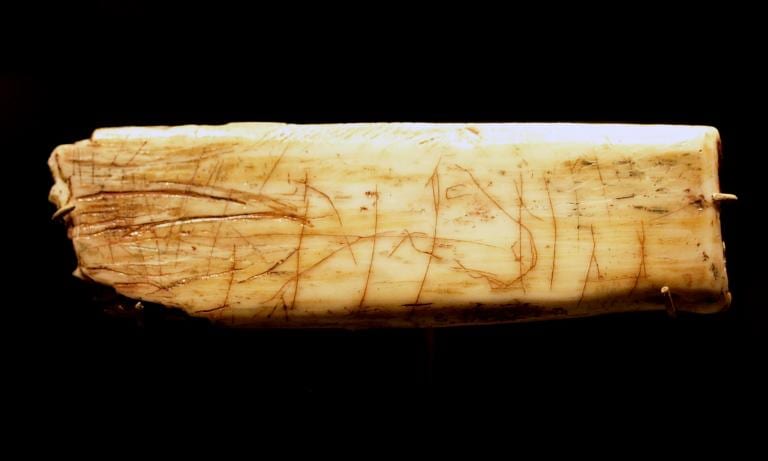
Paleolithic carving from Creswell Crags, England, by Dave CC 2.0, Wikimendia
Horses continued to be wild and were hunted for meat for centuries after agriculture and the domestication of other livestock was underway. Perhaps this gave them a new special status in the minds of humans. Along with deer, they were the wild ones. When humans did get around to domesticating horses, at first it was for meat and milk, but when people figured out riding, and having horses pull things, it caused a complete cultural revolution, which must have once again given horses a special place in their minds and their religious ideas.
But how do we get from special to sovereignty? (Again, these are my own theories.) After the agrarian revolution, holding territory became much more important than it had been to hunter-gatherers, and this was exacerbated by the population explosion which followed in the wake of farming, because the need for territory kept increasing. The ridden horse was the perfect vehicle for checking boundaries, and probably for defining territory. Distances might be measured in “a day’s ride at midsummer” for example, or area as “grazing for a hundred horses”. Even now, in the Scottish Borders, we still see a yearly ritual riding of boundaries around long-established townships, which are accompanied by enormous ceremony and celebration.
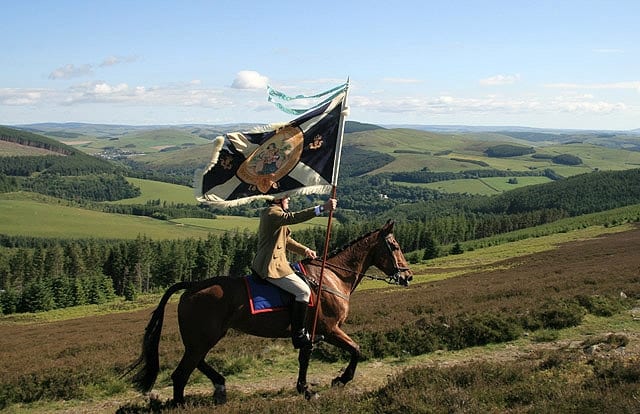
Selkirk, Scotland Common Riding, by Walter Baxter, CC 2.0 Wikimedia
However, I suspect the specialness of the horse must have also played a part, since they had their own protector-goddesses, like Epona. If humans considered the horse a symbol of the wild, and perhaps of tribal identity, it’s easy to see how the pact made with the wild land, Mother Nature as it were, might be made with a horse goddess. The move to farming was gradual, but as each community undertook it, it must have seemed like breaking a taboo the first time they cut into the earth to plant grain. What religious or magical ideas accompanied this? I would guess that the need to explain why this kind of violation was now acceptable would have been part of it. Maybe the perception was that some female nature deity came to them and offered this new idea or at least condoned it. Maybe it was a form of marriage between the people, or their leader, and that deity. If certain communities already had a strong relationship with a horse goddess, then she would be a natural choice to confer these new rights.
What good is this knowledge to us now? There are two important strands for me. The first is that by being in a good relationship with these goddesses, I open myself to their help and support in strengthening the way I wear my personal sovereignty. Second, the most important message they have for us today, is that we must find ways to restore nature’s sovereignty. Our anthropocentric approach, our desire to own the earth, is a failed experiment. Like Lady Ragnell, nature just wants to be sovereign over herself. It’s time for us to let go of the damage we are doing, and let nature be wild again.
Further reading:
Macha, Sovereignty and Horses – Morgan Daimler http://www.academia.edu/24377398/Macha_Sovereignty_and_Horses
Archaeology and Celtic Myth – John Waddell – Four Courts Press 2014
Rhiannon: Divine Queen of the Celtic Britons – Jhenah Telynfru – Moon Books 2018
You can follow Kris at her blog Go Deeper and support her work on Patreon.
About Kris Hughes
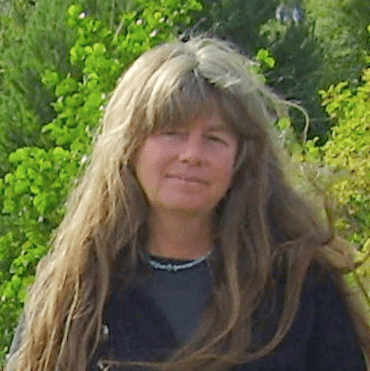
Kris Hughes is a nice, older Pagan woman who loves the gods of the Celts. She doesn't claim to be anything in particular, but she might possibly be described as a hedge teacher, a writer, a part time Druid, an exiled Scot, a poet, cartomancer, ritualist, storyteller, or just someone with a lot to say about a lot of things. In the past she has been a professional musician, a farmer, and a horsewoman. She is currently writing a book, working title The Celtic Horse Goddesses: Myth, History and Personal Reflection. Her interests include herbalism, mythology, and British native ponies. She also blogs at her own website Go Deeper. You can read more about the author here.
Previous Post

February 19, 2019
Irish-American Witchcraft: Fairies, Tradition & Popculture
Next Post
February 24, 2019 Pergamum Unfurled: When Gods Come Knocking
Browse Our Archives
Select a Category A Lakeside Hearth Adventures in Wortcunning Alone In Her Presence Arts, Crafts & Cooking Birthing Hereditary Witchcraft Book of Blackbirds Book Reviews Born-Again Witch Cauldron, Sword, Spear, & Stone Cermony and Liturgy Columns Community Dandelion Seeds Dear Jasmine Druid Thoughts Editor's Picks Everyday Pagan Family & Household Practice Family Traditions Full Frontal Magic Gateway Goddess Guest Articles Happily Heathen Health and Wellness Hearth of Hellenism Heathen Woman Hills of the Horizon History Holidays Horse Goddesses Interfaith Interviews Irish-American Witchcraft Jewish Witch Lamp & Labyrinth Letters from Midgard Literature, Media, Film, Music Loop of Brighid Love, Sex & Relationships Magic or Magick Making Light Naturalistic Traditions Nature News Outside The Circle Pantheisticon Politics Prayers, Poems, Blessings & Stories Queer Femme Mystic Queer of Swords Recipes Ritual and Practice Science and Research Seekers and Guides Seeking the Grail Socially Responsible Magic Spear of Athena Star Made Witch Syncretic Electric Technology The Blooming Staff The Busy Witch The Cartomancer The Crow's Nest The Dance of Pagan Recovery The Hearth of Hellenism The Lady's Quill The Other Side of the Hedge The Path of She The Rantin' Raven The Witches Next Door The Zen Pagan Theology, Ethics, Philosophy Tree City Witch Urban Earthwitch Wayfaring Woman Witch on Fire Wyrd Words
Select a Month January 2026 March 2025 December 2024 June 2024 April 2024 March 2024 January 2024 December 2023 November 2023 October 2023 August 2023 July 2023 May 2023 April 2023 March 2023 February 2023 January 2023 December 2022 November 2022 October 2022 September 2022 August 2022 July 2022 June 2022 May 2022 March 2022 February 2022 January 2022 December 2021 November 2021 October 2021 September 2021 August 2021 July 2021 June 2021 May 2021 April 2021 March 2021 February 2021 January 2021 December 2020 November 2020 October 2020 September 2020 August 2020 July 2020 June 2020 May 2020 April 2020 March 2020 February 2020 January 2020 December 2019 November 2019 October 2019 September 2019 August 2019 July 2019 June 2019 May 2019 April 2019 March 2019 February 2019 January 2019 December 2018 November 2018 October 2018 September 2018 August 2018 July 2018 June 2018 May 2018 April 2018 March 2018 February 2018 January 2018 December 2017 November 2017 October 2017 September 2017 August 2017 July 2017 June 2017 May 2017 April 2017 March 2017 February 2017 January 2017 December 2016 November 2016 October 2016 September 2016 August 2016 July 2016 June 2016 May 2016 April 2016 March 2016 February 2016 January 2016 December 2015 November 2015 October 2015 September 2015 August 2015 July 2015 June 2015 May 2015 April 2015 March 2015 February 2015 January 2015 December 2014 November 2014 October 2014 September 2014 August 2014 July 2014 June 2014 May 2014 April 2014 March 2014 February 2014 January 2014 December 2013 November 2013 October 2013 September 2013 August 2013 July 2013 June 2013 May 2013 April 2013 March 2013 February 2013 January 2013 December 2012 November 2012 October 2012 September 2012 August 2012 July 2012 June 2012 May 2012 April 2012 March 2012 February 2012 January 2012
Follow Us!
TAKE THE
Religious Wisdom Quiz
Who was the first disciple to be martyred?
Select your answer to see how you score.
Andrew Thomas Peter James
Related posts from Agora

Simple Witchery: To Keep Silent

Simple Witchery: Leaning On The Four Pillars


Simple Witchery: Resistance and Resilience in Hard Times
TRENDING AT PATHEOS Pagan

I was recently chatting with someone on Instagram. She asked me what...

While there are many people who share their results, the end of...

On July 23, I saw Christopher Nolan's The Odyssey which is Homer’s...

As I write this two big events have just finished up. One...

Restoring the Watershed of Divine Love
Perhaps cooperation is not something we manufacture through legislation, ideology, or moral...

Many UUs don’t pray because of bad experiences in a previous religion,...
view all Pagan blogs
Ad-Free & Subscriber Log-In Subscription Support
- About Us
- 2026 Calendar
- Videos
- Podcasts
- Library of World Religions
- Faith In Media Tracker
- Advertise With Us
- Write for Us
- Privacy Policy
- Terms of Service
- Do Not Sell My Data
- Contact Us
- Radiant Digital
- Manage Newsletter Subscriptions
- Unsubscribe From Notifications
- Sitemap
Copyright 2008-2026, Patheos. All rights reserved.
Subscription Support Ad-Free & Subscriber Log-In
Follow Patheos