
BuddhistCatholicContemplativeEvangelicalGeneral ChristianHinduJewishLatter-day SaintMuslimNew VisionsProgressive Christian
Beliefs
- Buddhist
- Catholic
- Contemplative
- Evangelical
- General Christian
- Hindu
- Jewish
- Latter-day Saint
- More Voices
- Muslim
- New Visions
- Pagan
- Progressive Christian
Topics
- Religion News
- Food and Religion
- Sports and Religion
- Religious Art
- Religious Music and Entertainment
- Religious Events
- History and Religion
- Style and Religion
- Politics and Religion
- Women in Religion
- Recreation Outdoors and Religion
- Business Finance and Religion
- Careers Workplace and Religion
- Education and Religion
- Family Parenting and Religion
- Health Fitness and Religion
- Home and Religion
- Relationships and Religion
- Technology and Religion
- Travel and Religion
Columnists
- Buddhist Columnists
- Business Finance and Religion Columnists
- Careers Workplace and Religion Columnists
- Catholic Columnists
- Contemplative Columnists
- Education and Religion Columnists
- Evangelists Columnists
- Family Parenting and Religion Columnists
- General Christian Columnists
- Health Fitness and Religion Columnists
- Hindu Columnists
- History and Religion Columnists
- Home and Religion Columnists
- Jewish Columnists
- More Voices Columnists
- Latter Day Columnists
- Muslim Columnists
- New Visions Columnists
- Nonreligious Columnists
- Pagan Columnists
- Politics and Religion Columnists
- Progressive Columnists
- Recreation Outdoors and Religion Columnists
- Relationships and Religion Columnists
- Religion News Columnists
- Religious Art Columnists
- Religious Events Columnists
- Religious Music and Entertainment Columnists
- Sports and Religion Columnists
- Style and Religion Columnists
- Technology and Religion Columnists
- Travel and Religion Columnists
- Women in Religion Columnists
Resource Library
- 2026 Calendar
- Library of World Religions
- The 100 Most Holy Places on Earth
- Patheos Answers
- Podcasts
- Videos
- Faith Leaders Database
- Anglican Episcopalian
- Bahai
- Baptist
- Buddhism
- Christianity
- Confucianism
- Eastern Orthodoxy
- Hinduism
- Holiness and Pentecostal
- ISKCON
- Islam
- Judaism
- Lutheran
- Methodist
- The Church of Jesus Christ of Latter-day Saints
- New Age
- Paganism
- Presbytarian and Reformed
- Protestantism
- Religion Behind the Scenes
- Roman Catholic
- Scientology
- Shia Islam
- Sikhism
- Sufism
- Sunni Islam
- Taoism
- Zen
- See all religions
Research Tools
 Ad-Free & Subscriber Log-In Subscription Support
Ad-Free & Subscriber Log-In Subscription Support
Follow Patheos 

- Trending:
- Forgiveness
- |
- Marriage
- |
- Consciousness
- |
- Death Penalty
- |
- Election
- |
- Halloween

- Home
- Pagan
- Irish-American Witchcraft: Fairies, Tradition & Popculture
Irish-American Witchcraft: Fairies, Tradition & Popculture
Last updated on: February 19, 2019 at 6:27 am by Morgan Daimler
Irish-American Witchcraft: Fairies, Tradition & Popculture 2019-02-19T06:27:40+00:00 Morgan Daimler
Patheos Explore the world's faith through different perspectives on religion and spirituality! Patheos has the views of the prevalent religions and spiritualities of the world.
I’m getting ready to head off for Ohio State University’s ‘Popular Culture and the Deep Past: Fairies and the Fantastic‘ conference where I’m presenting a paper on the evolution of the fairy courts from Scottish ballads to popculture. It’s looking to be a great conference and I’m excited to attend the other presentations and broaden my view and understanding of the subject as much as possible. Getting ready for the conference also has me thinking, inevitably, about the wider topic of fairies in popculture and my own feelings on it.
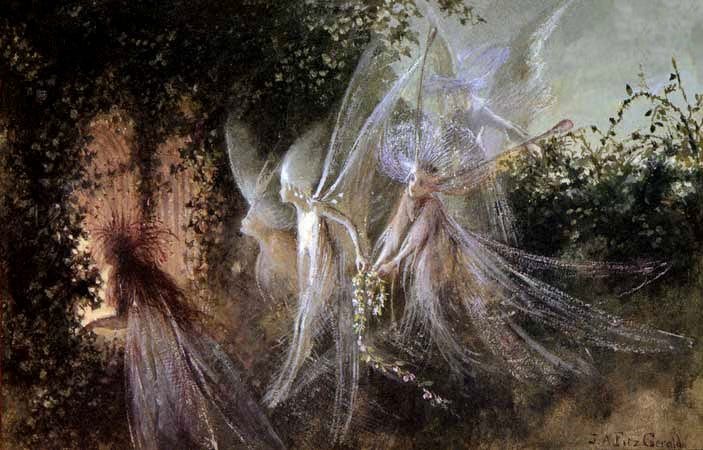
“Fairies Looking Through a Gothic Arch” by John Fitzgerald. From WikiMedia.
It’s not something new for me to contemplate, by any means. I have often, over the last few years especially, found myself looking around the pagan community at the way that fiction and gaming are influencing spiritual beliefs and found myself wondering what road that leads us collectively down. American pagans are by and large people disconnected from traditional cultures and to fill in those gaps sometimes they look back at the traditional cultures but other times they seek these connections in the more readily available fiction found in mass media.
This creates a constant tension between beliefs rooted in longstanding cultural beliefs and beliefs coming from newer sources but often blended in or taken as older ones. What separates the two, ultimately, isn’t whether the people repeating the idea believe them but whether the source of the idea believed them, and in that aspect the two sources are vastly different.
What we see then in the modern world is two distinct strains of fairy belief. One strain relies on the foundation of older folk belief as it still lives in the modern world. The other strain is created and recreated constantly from the chimera of fiction and gaming lore which is itself in constant flux.
Following the Footsteps of the Past
Traditional fairy beliefs come to us across generations, reinforced by belief and practice. What makes these beliefs traditional is two main factors, I think: that they exist within a cultural framework and are passed down through successive generations, and that they represent genuine beliefs that people adhered to. Even today when we talk about beliefs in cultures like Iceland or Ireland while contemporary people might deny that they themselves believe in the stories and folk practices they pass on they do not question that their predecessors and other people do.
It is these layers of past belief that build on each other and form the foundation of traditional belief. When a story is shared of someone experiencing being fairy-led or hearing a Bean Sidhe it is unquestioned that the person who had the experience genuinely believed it occured and passed it on the same way they would have a story of seeing a rare bird or meeting a famous human.
Finding Fairies in Fiction
For those seeking fairy beliefs today the sources are often confusing and convoluted. The traditional fairy beliefs are certainly still there and are easier to find than they ever have been, but the exact same thing that makes them more readily available to a wider audience are the same things that muddy the waters and add to the confusion. Fairy fiction is more popular than ever and far more detached from older beliefs; some storytellers take pride in overturning what they consider to be tropes by going against the older fairy beliefs* while others take only the name of a being or concept and then reinvent it.
For people disconnected from the cultures who still actively have these beliefs this mix of traditional beliefs and new creations can be confusing, especially when spirituality is added to the mix. People seeking fairies today, if they want to rely on the older beliefs, have to be cautious then to filter out the pop-fiction and gaming pieces or to be clear about the sources they are pulling from.
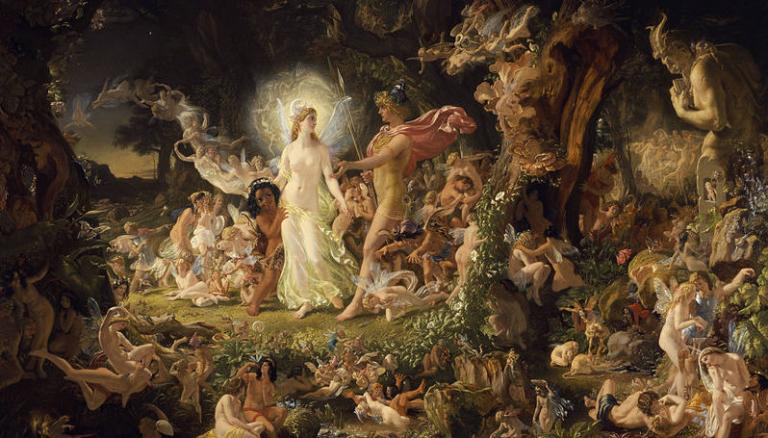
“The Quarrel of Oberon and Titania” by Noel Paton from WikiMedia.
It’s easy to think that what’s found in fiction and in gaming is inline with older beliefs, but often it isn’t. In some cases the newer ideas directly contradict the older ones and in others they may play off the traditional beliefs but with major creative liberties based on the needs of the author. It’s important to remember this rather than to take what’s found in books, games, tv shows, and movies as reflective of the Otherworld and the beings within it from either the corpus of folklore or their actual reality from an animistic view**.
Do Fairies Evolve?
A related question to the wider subject of fairies in popculture is whether fairies evolve or remain as older stories would have them. I think this at least we can answer fairly directly – yes they do. In the 20th century we have at least one example of a new fairy emerging into folklore that fits the hallmarks of traditional belief but emerged as something unique, possibly developing out of older lore. This of course would be the World War I era Gremlins which were seen and experienced by RAF fighters and whose stories spread from there. We also see evidence in anecdotal accounts of fairies changing as human culture changed, so that a couple centuries after art and theater start to depict fairies with wings we see anecdotal accounts of fairies seen with wings.
Clearly then they do change, not immediately or even perhaps on pace with human culture, but they are not static beings. And what evidence we have does point to a deep connection between humans, human belief or expectation, and fairies although it may perhaps be safer to say that humans may get what they expect in some cases rather than that human belief directly and profoundly shapes the Good People themselves^.

Fairy Image by John Bauer. From WikiMedia.
Final Thoughts
This is by no means a clear cut subject. What starts out as fiction can and sometimes does eventually become belief something that we see in relation to the 18th and early 19th century attempts at fairylore, often more fiction than actual preserved folk belief. The modern ideas for Leprechauns, for example, which are found even within the living traditional cultures can’t be traced back further than the mid-1800’s (to an Irish American author); prior to that the evidence we have for those beings paints a different picture of who and what they were.
The ideas of the Unseelie and Seelie fairy courts are originally found in Scotland but have slowly spread and are now seen across an array of fairylore. Understanding these sources and threads is important as we move forward into a multimedia future which is only going to see this confusion increasing.
Some people may argue that popculture beliefs about fairies are just as valuable as traditional ones, and certainly there’s a strong indication that they can be as widespread and powerful to the people who adopt them. I’m not going to waste effort arguing against that, but I do tend to urge caution when we are incorporating fiction into spirituality. For me at least there is a sharp dividing line between the animism that underlies my spirituality – and hence my fairy faith – and the creative world of fiction and gaming.
Just because a belief is new doesn’t mean it’s wrong anymore than a belief being old makes it more correct but beliefs culled from fiction require a lot more discernment if you are going to incorporate them into your spirituality. I have found that having that base in traditional fairylore from the living cultures is really essential to understanding what can and can’t be valuable in modern fiction and why some things work and some really don’t when applied to spirituality.
*for example the idea of re-casting the Unseelie fairies – those who are most inimical to humans – into the anti-heros or protagonists has become almost its own trope particularly in young adult fiction and some urban fantasy. This concept from fiction has definitely found its way into some corners of pagan spirituality.
**by animistic view I mean the viewpoint that would say these beings exist as independent, living beings separate from human creation. This is my own viewpoint, but is supported by wider animist thought which establishes that spirit beings form their own ecology of which humans are a part but not essential. I might suggest that humans and fairies have a highly symbiotic relationship but I do not think that fairies existence is dependant on human belief (sorry Tinkerbell).
^This topic however would need a whole article of its own to unpack – I am massively simplifying it here. Suffice to say there is no easy answer and human belief does influence them, based on the wider arch of anecdotal and folkloric material but the influence isn’t as simple as belief=reality
Previous Post

February 17, 2019
The Corner Crone: From Tomb to Womb to Bloom
Next Post
February 20, 2019 Pan-Celtic Hoofbeats: The Horse, Nature, and Sovereignty
Browse Our Archives
Select a Category A Lakeside Hearth Adventures in Wortcunning Alone In Her Presence Arts, Crafts & Cooking Birthing Hereditary Witchcraft Book of Blackbirds Book Reviews Born-Again Witch Cauldron, Sword, Spear, & Stone Cermony and Liturgy Columns Community Dandelion Seeds Dear Jasmine Druid Thoughts Editor's Picks Everyday Pagan Family & Household Practice Family Traditions Full Frontal Magic Gateway Goddess Guest Articles Happily Heathen Health and Wellness Hearth of Hellenism Heathen Woman Hills of the Horizon History Holidays Horse Goddesses Interfaith Interviews Irish-American Witchcraft Jewish Witch Lamp & Labyrinth Letters from Midgard Literature, Media, Film, Music Loop of Brighid Love, Sex & Relationships Magic or Magick Making Light Naturalistic Traditions Nature News Outside The Circle Pantheisticon Politics Prayers, Poems, Blessings & Stories Queer Femme Mystic Queer of Swords Recipes Ritual and Practice Science and Research Seekers and Guides Seeking the Grail Socially Responsible Magic Spear of Athena Star Made Witch Syncretic Electric Technology The Blooming Staff The Busy Witch The Cartomancer The Crow's Nest The Dance of Pagan Recovery The Hearth of Hellenism The Lady's Quill The Other Side of the Hedge The Path of She The Rantin' Raven The Witches Next Door The Zen Pagan Theology, Ethics, Philosophy Tree City Witch Urban Earthwitch Wayfaring Woman Witch on Fire Wyrd Words
Select a Month January 2026 March 2025 December 2024 June 2024 April 2024 March 2024 January 2024 December 2023 November 2023 October 2023 August 2023 July 2023 May 2023 April 2023 March 2023 February 2023 January 2023 December 2022 November 2022 October 2022 September 2022 August 2022 July 2022 June 2022 May 2022 March 2022 February 2022 January 2022 December 2021 November 2021 October 2021 September 2021 August 2021 July 2021 June 2021 May 2021 April 2021 March 2021 February 2021 January 2021 December 2020 November 2020 October 2020 September 2020 August 2020 July 2020 June 2020 May 2020 April 2020 March 2020 February 2020 January 2020 December 2019 November 2019 October 2019 September 2019 August 2019 July 2019 June 2019 May 2019 April 2019 March 2019 February 2019 January 2019 December 2018 November 2018 October 2018 September 2018 August 2018 July 2018 June 2018 May 2018 April 2018 March 2018 February 2018 January 2018 December 2017 November 2017 October 2017 September 2017 August 2017 July 2017 June 2017 May 2017 April 2017 March 2017 February 2017 January 2017 December 2016 November 2016 October 2016 September 2016 August 2016 July 2016 June 2016 May 2016 April 2016 March 2016 February 2016 January 2016 December 2015 November 2015 October 2015 September 2015 August 2015 July 2015 June 2015 May 2015 April 2015 March 2015 February 2015 January 2015 December 2014 November 2014 October 2014 September 2014 August 2014 July 2014 June 2014 May 2014 April 2014 March 2014 February 2014 January 2014 December 2013 November 2013 October 2013 September 2013 August 2013 July 2013 June 2013 May 2013 April 2013 March 2013 February 2013 January 2013 December 2012 November 2012 October 2012 September 2012 August 2012 July 2012 June 2012 May 2012 April 2012 March 2012 February 2012 January 2012
Follow Us!
TAKE THE
Religious Wisdom Quiz
Who said, "I am doing a great work, so that I cannot come down"?
Select your answer to see how you score.
Joshua Elijah Nehemiah Solomon
Related posts from Agora

Simple Witchery: To Keep Silent

Simple Witchery: Leaning On The Four Pillars

Pergamum Unfurled: Magic with the Greek Gods (Book...

Pergamum Unfurled: Cunning Words (Review)
TRENDING AT PATHEOS Pagan

I was recently chatting with someone on Instagram. She asked me what...

While there are many people who share their results, the end of...

On July 23, I saw Christopher Nolan's The Odyssey which is Homer’s...

As I write this two big events have just finished up. One...

Restoring the Watershed of Divine Love
Perhaps cooperation is not something we manufacture through legislation, ideology, or moral...

Many UUs don’t pray because of bad experiences in a previous religion,...
view all Pagan blogs
Ad-Free & Subscriber Log-In Subscription Support
- About Us
- 2026 Calendar
- Videos
- Podcasts
- Library of World Religions
- Faith In Media Tracker
- Advertise With Us
- Write for Us
- Privacy Policy
- Terms of Service
- Do Not Sell My Data
- Contact Us
- Radiant Digital
- Manage Newsletter Subscriptions
- Unsubscribe From Notifications
- Sitemap
Copyright 2008-2026, Patheos. All rights reserved.
Subscription Support Ad-Free & Subscriber Log-In
Follow Patheos