
BuddhistCatholicContemplativeEvangelicalGeneral ChristianHinduJewishLatter-day SaintMuslimNew VisionsProgressive Christian
Beliefs
- Buddhist
- Catholic
- Contemplative
- Evangelical
- General Christian
- Hindu
- Jewish
- Latter-day Saint
- More Voices
- Muslim
- New Visions
- Pagan
- Progressive Christian
Topics
- Religion News
- Food and Religion
- Sports and Religion
- Religious Art
- Religious Music and Entertainment
- Religious Events
- History and Religion
- Style and Religion
- Politics and Religion
- Women in Religion
- Recreation Outdoors and Religion
- Business Finance and Religion
- Careers Workplace and Religion
- Education and Religion
- Family Parenting and Religion
- Health Fitness and Religion
- Home and Religion
- Relationships and Religion
- Technology and Religion
- Travel and Religion
Columnists
- Buddhist Columnists
- Business Finance and Religion Columnists
- Careers Workplace and Religion Columnists
- Catholic Columnists
- Contemplative Columnists
- Education and Religion Columnists
- Evangelists Columnists
- Family Parenting and Religion Columnists
- General Christian Columnists
- Health Fitness and Religion Columnists
- Hindu Columnists
- History and Religion Columnists
- Home and Religion Columnists
- Jewish Columnists
- More Voices Columnists
- Latter Day Columnists
- Muslim Columnists
- New Visions Columnists
- Nonreligious Columnists
- Pagan Columnists
- Politics and Religion Columnists
- Progressive Columnists
- Recreation Outdoors and Religion Columnists
- Relationships and Religion Columnists
- Religion News Columnists
- Religious Art Columnists
- Religious Events Columnists
- Religious Music and Entertainment Columnists
- Sports and Religion Columnists
- Style and Religion Columnists
- Technology and Religion Columnists
- Travel and Religion Columnists
- Women in Religion Columnists
Resource Library
- 2026 Calendar
- Library of World Religions
- The 100 Most Holy Places on Earth
- Patheos Answers
- Podcasts
- Videos
- Faith Leaders Database
- Anglican Episcopalian
- Bahai
- Baptist
- Buddhism
- Christianity
- Confucianism
- Eastern Orthodoxy
- Hinduism
- Holiness and Pentecostal
- ISKCON
- Islam
- Judaism
- Lutheran
- Methodist
- The Church of Jesus Christ of Latter-day Saints
- New Age
- Paganism
- Presbytarian and Reformed
- Protestantism
- Religion Behind the Scenes
- Roman Catholic
- Scientology
- Shia Islam
- Sikhism
- Sufism
- Sunni Islam
- Taoism
- Zen
- See all religions
Research Tools
 Ad-Free & Subscriber Log-In Subscription Support
Ad-Free & Subscriber Log-In Subscription Support
Follow Patheos 

- Trending:
- Forgiveness
- |
- Marriage
- |
- Consciousness
- |
- Death Penalty
- |
- Election
- |
- Halloween

- Home
- Pagan
- The Purple Spiral Turns: Mindfulness and the Hippocratic Oath
The Purple Spiral Turns: Mindfulness and the Hippocratic Oath
Last updated on: February 11, 2019 at 6:58 pm by Ayliah Cannon
The Purple Spiral Turns: Mindfulness and the Hippocratic Oath 2019-02-11T18:58:34+00:00 Ayliah Cannon
Patheos Explore the world's faith through different perspectives on religion and spirituality! Patheos has the views of the prevalent religions and spiritualities of the world.
Building Inclusive Communities Part Two
Before there were the sacred waters, there was sacred air. This Druid could not be truly fascinated with nature work, without having a fascination for the origins of nature, the cosmogony of our solar system. In the aftermath of the Big Bang, imagine the scene as clouds of gases swirled about and bits of space dust and star stone merged together. Millions of years later, a primordial atmosphere appeared and it was filled with greenhouse gases.

Photo credit: geralt, via Pixabay
One component of this primordial atmosphere was argon, an inert gas that is taken into the lungs in each breath, and then exhaled. Because it is an inert gas, it doesn’t get absorbed and within moments of exhalation, it has already traveled out into the air of your neighborhood to be inhaled by someone else. Harvard astronomer Harlow Shapley is quoted as saying:
“Your next breath will contain more than 400,000 of the argon atoms that Ghandi breathed in his long life. Argon atoms are here from the conversations at the Last Supper, from the diplomats at Yalta, and from the recitations of classic poets. We have argon from the sighs and pledges of ancient lovers, from the battle cries at Waterloo….”
Imagine this air that leaves our noses goes right to our neighbors’ noses. And the longer we live, the more likely we are to share argon atoms that were breathed by actual ancestors, and ancestral nature entities like woolly mammoths as well. Imagine sacred air. This concept would then make every breath magical in nature, and symbolically connect us with others. Imagine with each breath, we may connect with not only the nature spirits, the ancestors, but also each other without regard for personal differences.
How aware of your breath are you? Do you feel the rise of your diaphragm? Your abdomen as it expands? This type of feeling is at the core of mindfulness training. It’s important to mention that there are at least two more types of sensing beyond the typical five senses, and these are proprioception and interoception. The first of these is the awareness of your body position and includes equilibrium. We know posture certainly affects breathing awareness. Interoceptive awareness is feeling your lungs expand, regulation of your breath, and other internal functions of your body.
The practice of MBSP (mindfulness-based stress reduction) has been around the medical community since at least 1979 when it was introduced at the stress reduction clinic of the University of Massachusetts Medical Center. It has been used to help people process difficult emotions and experiences. It can be used to help trauma survivors begin to reclaim their lives by working through difficult emotions without reacting to them as strongly.
The skill of MBSP is not automatic, however, and does require discipline to learn. Read that again; mindfulness is a learnable skill. When someone learns to control their breathing, and ultimately reduce their reaction to stress, they gain control over their narrative. When we gain control over our narrative, we gain influence on how we react to our past and how we can add new shape to our future. We also increase our ability to deal with interpersonal stress.
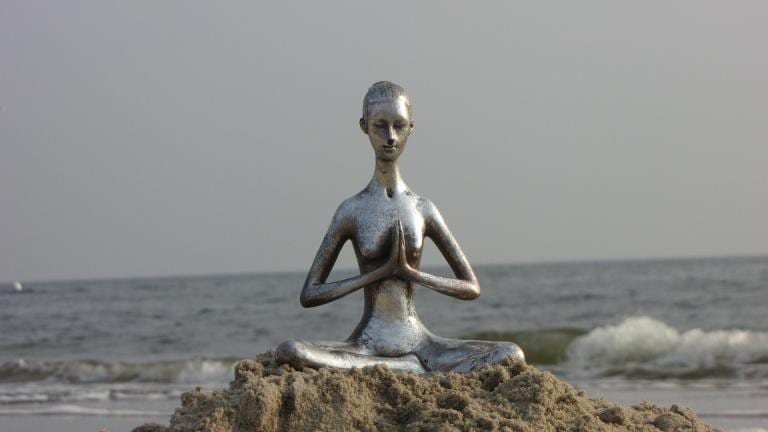
Photo credit: dolvita108, via Pixabay
There is an important Buddhist belief that nothing is permanent. Everything changes. Just like the Goddess chant, “everything she touches changes” (insert appropriate pronoun she/he/they). Therefore, mindfulness can change how we react and respond to others in our community. If we consider the idea of marginalized people, then we can utilize mindfulness to help us control how we respond to their situation. If we ARE the marginalized people, it begins to help us comprehend why we may have been marginalized and perhaps open a dialogue to reduce divisions. This idea takes us to another aspect of the mindfulness training – deep listening. Sometimes this is referred to as active listening.
Deep listening may start with listening to your breath as it passes out your nose, but as a discipline it extends to listening without judgment, involving patience, and releasing your mind from personal goals underlying your listening. It involves seeing another person without also seeing the stereotypes or archetypes, and listening with compassion. If we can learn to show empathy for someone reeling from loss, then we can learn to show empathy for someone exploring their gender expression, or coming to terms with out of the ordinary emotional and/or health obstacles.
Mindfulness training, as well as further increasing our awareness through deep listening, re-creates an intimate connection to the world and the environment surrounding us. This includes our social environment as well as the natural. This training can also help transform limiting thoughts and feelings. When we open ourselves to an understanding of others’ experiences, we are doing the work to decrease divisions among us.
Community and Communitas
A community describes a broad generalization of people gathering together, and there is usually some structure but not necessarily a common purpose. Communitas typically begins without structure but the people involved have closer connections or shared purpose. In some definitions, communitas is the next level which a community can aspire to. If we look at the attributes of community, one of the first characteristics we encounter is social status. Status is created when there are differences including but not limited to, available resources, ideology, ability, and likely includes social culture as well. Far too often, when conflict in life is being discussed, it involves differences of social status.
Marginality, as a common ground for many, creates communitas. People who exist at the fringes of different forms of social status also may share a bond of being marginalized through their restriction of status. Just one example of this is the LGBTQIA community. This commonality originates as something called spontaneous communitas. This is term deeply explored by anthropologist Victor Turner. If communitas gains some structure, whether it is to mobilize resources or gain social control, it then becomes a form of “normative” communitas, and may loosely resemble a tribal society without the familial ties. Some attributes of the normative communitas include a more equal division of labor and responsibilities, moral density, and placement of value on personal dignity.
Emile Durkheim, pioneer in sociology, focused a portion of his work on the things that hold society together, such as laws, division of labor, religion and lifestyle. He expressed concern that when modern society failed to bond people together on topics like these, that which we now call liminality or “marginality”, would be manifested.
Durkheim is credited with coining the term “collective consciousness” which is defined as a set of shared beliefs, ideas and moral attitudes which hold a society together. Ironically, when liminal conditions create the spontaneous communitas, a “new” collective consciousness is formed of shared beliefs, ideas and moral attitudes, over time. A normative communitas of bonded yet theoretically marginalized people is born. As the new structure gains strength, new cracks of liminality will appear in this and the process repeats itself. As one group of people rise in status or rank, another will appear on a lower rung.

Photo credit: NevPaddy, via Pixabay
When we gain awareness of how marginalized communities are created, we are beginning the important discussion of limiting the expansion of division between people which leaves many of us with feelings of exclusion and isolation. Marginalized people may belong to their own sub community but the division that is created weakens the “whole” of community. The larger community may or may not be aware of limiting thoughts as well as unintentionally creating “myths” and inaccurate stereotypes of marginalized people such as the LGBTQIA community. A connection is thus lost.
Redefining the Pronouns “We, Us and Them”
The first step to having a constructive discussion about resolving division starts with simply having some kind of discussion period. When we stop communicating with each other, nothing is gained. Fences only make great fences; a wall is just a wall. Bridges, doors, windows, and open discussion are what connect the microcosm and the macrocosm, thereby bridging the smaller, insulated or isolated world to the outside world.
When group dynamics become oppressive or challenging, people affected are more likely to become reactive. Feelings of superiority and inferiority fluctuate. When one group starts to feel inferior, or superior, there is likely a group that feels the opposite. This is when judgments may occur. Patience becomes depleted. People could start to dismiss others, or themselves. As status shifts, feelings of being intimidated, or unkind intimidating of others, begins to occur. Even if opinions aren’t voiced there may still be silent labeling that goes on. Passive aggression appears in avoiding eye contact, and ignoring people when they speak up or show up.
Remember the MSRB we discussed? No one is immune to loss in their lives, though some handle it better than others. No one is invulnerable to needs of self-identity and self-acceptance. Everyone struggles with some thing. Some of us cope with different kinds of stress more efficiently, but that doesn’t mean the stress isn’t there. When we begin to identify the challenges that others face, we have taken an important step in mindfulness training by being open to the emotional experiences of others. Our situations of stress don’t have to be identical to realize a struggle of some nature exists, and in that common struggle, regardless of the outcome, we develop a common ground, a spontaneous liminality where we can connect. A doorway through the wall.
Far too often, marginalized people have learned to cope with the unkindness in their lives by using a mechanism of repression. Repression is a learned form of apathy that involves fleeing or detaching from the current situation emotionally. This is why starting a discussion is so valuable as an action to decrease division. If we are to heal the separation in society, we need to stop thinking in terms of “us and them” because “we” all share the same planet, the same sacred air, the same argon which our Ancestors shared.
Setting the Table
In the past couple years, this writer has heard this phrase used often in the media, but no one ever really mentions what the table looks like? So I have decided to “set my own table” and this is what that process looks like to me.
First off, what is the purpose of our shared meal? If the table is a vision of a more united community working towards the spirit of communitas, then we can not bring judgment to the table. We can not set a place for assumptions and labels. We can not invite elevated social status to share our meal.
Mindfulness aids us in accepting people just as they are, as a whole person whether that person may feel whole inside or not. It assists us in leading with compassion. This not only heals what occurs between us but within us as well. Looking within ourselves, it is far easier to see our strengths than it is to witness strengths in people we have given silent labels to. If we can let go of these assumptions, we can learn to see the value that everyone brings to the table.
To use a term from Carl Rogers, a pioneer in the field of psychotherapy, when we see people as equally worthy of support and respect regardless of where they are in their lives, we are offering them “unconditional positive regard”. This doesn’t mean we have to agree with them, or like them, but we do have to respect their right to dignity, and this lack of criticism at the table will bring more potentiality for a constructive outcome.
There are many people in our various, shared communities that suffer from feelings of marginalization. One method of allaying these feelings is to connect with nature. This next method involves connecting with others. It will take an investment of work and time from both sides of the threshold. We already have much in common whether we acknowledge it or not, and we all breathe the same sacred air.
Before we can accomplish that vital work, we must learn to stop further harm and unkindness to ourselves. The process must start at home before it is extended outward. Just as the Hippocratic oath states, “Primum non nocere,” First, do no harm. We must become our own healers in tune with our own bodies, thoughts and feelings, and perception of others. Then we must expand our awareness outward.

About Ayliah Cannon
Rev. Ayliah Cannon is a Senior Priest with ADF, an international druid fellowship that focuses on excellence in scholarship, building inclusivity, and fulfilling service to the land, Gods and Ancestral Spirits. More information on who they are can be found at www.ADF.org . Representation Matters! Ayliah is an intersex, pansexual woman who is very active in supporting the LGBTQIA communities and attempts to build bridges through the use of open, honest communication and education. She actively works to build intersex awareness and strongly encourages people to add the “Q-I-A” to their lgbt vocabulary. The “Q” is for queer or questioning. The “A” may represent asexual, agendered, or allies. The “I” is for the intersex community often forgotten and wrongfully conflated with being transgender. Ayliah works with many different deities from various pantheons, though she maintains close relationships with Frey and Freyja, Morrigan, Hecate, Aphrodite, Persephone and Astarte. Her work as a priest is part of her devotion to Brighid. She has identified as pagan for nearly thirty years and provides readings, rituals and classes for others, as often as she is able. She lives in sunny Florida with her partner and their two cats, and enjoys writing, singing, being outdoors, and competitive ballroom dancing. In the absence of an active druid grove, she is active in a local Unitarian Universalist congregation as a worship associate. You can read more about the author here.
Previous Post

February 5, 2019
Irish-American Witchcraft: Irish Pagan Resources
Next Post

February 12, 2019 Between Two Worlds: Spirits, Ghosts, and Hekate
Browse Our Archives
Select a Category A Lakeside Hearth Adventures in Wortcunning Alone In Her Presence Arts, Crafts & Cooking Birthing Hereditary Witchcraft Book of Blackbirds Book Reviews Born-Again Witch Cauldron, Sword, Spear, & Stone Cermony and Liturgy Columns Community Dandelion Seeds Dear Jasmine Druid Thoughts Editor's Picks Everyday Pagan Family & Household Practice Family Traditions Full Frontal Magic Gateway Goddess Guest Articles Happily Heathen Health and Wellness Hearth of Hellenism Heathen Woman Hills of the Horizon History Holidays Horse Goddesses Interfaith Interviews Irish-American Witchcraft Jewish Witch Lamp & Labyrinth Letters from Midgard Literature, Media, Film, Music Loop of Brighid Love, Sex & Relationships Magic or Magick Making Light Naturalistic Traditions Nature News Outside The Circle Pantheisticon Politics Prayers, Poems, Blessings & Stories Queer Femme Mystic Queer of Swords Recipes Ritual and Practice Science and Research Seekers and Guides Seeking the Grail Socially Responsible Magic Spear of Athena Star Made Witch Syncretic Electric Technology The Blooming Staff The Busy Witch The Cartomancer The Crow's Nest The Dance of Pagan Recovery The Hearth of Hellenism The Lady's Quill The Other Side of the Hedge The Path of She The Rantin' Raven The Witches Next Door The Zen Pagan Theology, Ethics, Philosophy Tree City Witch Urban Earthwitch Wayfaring Woman Witch on Fire Wyrd Words
Select a Month January 2026 March 2025 December 2024 June 2024 April 2024 March 2024 January 2024 December 2023 November 2023 October 2023 August 2023 July 2023 May 2023 April 2023 March 2023 February 2023 January 2023 December 2022 November 2022 October 2022 September 2022 August 2022 July 2022 June 2022 May 2022 March 2022 February 2022 January 2022 December 2021 November 2021 October 2021 September 2021 August 2021 July 2021 June 2021 May 2021 April 2021 March 2021 February 2021 January 2021 December 2020 November 2020 October 2020 September 2020 August 2020 July 2020 June 2020 May 2020 April 2020 March 2020 February 2020 January 2020 December 2019 November 2019 October 2019 September 2019 August 2019 July 2019 June 2019 May 2019 April 2019 March 2019 February 2019 January 2019 December 2018 November 2018 October 2018 September 2018 August 2018 July 2018 June 2018 May 2018 April 2018 March 2018 February 2018 January 2018 December 2017 November 2017 October 2017 September 2017 August 2017 July 2017 June 2017 May 2017 April 2017 March 2017 February 2017 January 2017 December 2016 November 2016 October 2016 September 2016 August 2016 July 2016 June 2016 May 2016 April 2016 March 2016 February 2016 January 2016 December 2015 November 2015 October 2015 September 2015 August 2015 July 2015 June 2015 May 2015 April 2015 March 2015 February 2015 January 2015 December 2014 November 2014 October 2014 September 2014 August 2014 July 2014 June 2014 May 2014 April 2014 March 2014 February 2014 January 2014 December 2013 November 2013 October 2013 September 2013 August 2013 July 2013 June 2013 May 2013 April 2013 March 2013 February 2013 January 2013 December 2012 November 2012 October 2012 September 2012 August 2012 July 2012 June 2012 May 2012 April 2012 March 2012 February 2012 January 2012
Follow Us!
TAKE THE
Religious Wisdom Quiz
What did God command Job to do after his friends were rebuked?
Select your answer to see how you score.
Offer more sacrifices Fast for 40 days Go to Uz Pray for his friends
Related posts from Agora

Simple Witchery: To Keep Silent

Simple Witchery: Leaning On The Four Pillars


Pergamum Unfurled: Magic with the Greek Gods (Book...
TRENDING AT PATHEOS Pagan

I was recently chatting with someone on Instagram. She asked me what...

While there are many people who share their results, the end of...

On July 23, I saw Christopher Nolan's The Odyssey which is Homer’s...

As I write this two big events have just finished up. One...

Restoring the Watershed of Divine Love
Perhaps cooperation is not something we manufacture through legislation, ideology, or moral...

Many UUs don’t pray because of bad experiences in a previous religion,...
view all Pagan blogs
Ad-Free & Subscriber Log-In Subscription Support
- About Us
- 2026 Calendar
- Videos
- Podcasts
- Library of World Religions
- Faith In Media Tracker
- Advertise With Us
- Write for Us
- Privacy Policy
- Terms of Service
- Do Not Sell My Data
- Contact Us
- Radiant Digital
- Manage Newsletter Subscriptions
- Unsubscribe From Notifications
- Sitemap
Copyright 2008-2026, Patheos. All rights reserved.
Subscription Support Ad-Free & Subscriber Log-In
Follow Patheos