
BuddhistCatholicContemplativeEvangelicalGeneral ChristianHinduJewishLatter-day SaintMuslimNew VisionsProgressive Christian
Beliefs
- Buddhist
- Catholic
- Contemplative
- Evangelical
- General Christian
- Hindu
- Jewish
- Latter-day Saint
- More Voices
- Muslim
- New Visions
- Pagan
- Progressive Christian
Topics
- Religion News
- Food and Religion
- Sports and Religion
- Religious Art
- Religious Music and Entertainment
- Religious Events
- History and Religion
- Style and Religion
- Politics and Religion
- Women in Religion
- Recreation Outdoors and Religion
- Business Finance and Religion
- Careers Workplace and Religion
- Education and Religion
- Family Parenting and Religion
- Health Fitness and Religion
- Home and Religion
- Relationships and Religion
- Technology and Religion
- Travel and Religion
Columnists
- Buddhist Columnists
- Business Finance and Religion Columnists
- Careers Workplace and Religion Columnists
- Catholic Columnists
- Contemplative Columnists
- Education and Religion Columnists
- Evangelists Columnists
- Family Parenting and Religion Columnists
- General Christian Columnists
- Health Fitness and Religion Columnists
- Hindu Columnists
- History and Religion Columnists
- Home and Religion Columnists
- Jewish Columnists
- More Voices Columnists
- Latter Day Columnists
- Muslim Columnists
- New Visions Columnists
- Nonreligious Columnists
- Pagan Columnists
- Politics and Religion Columnists
- Progressive Columnists
- Recreation Outdoors and Religion Columnists
- Relationships and Religion Columnists
- Religion News Columnists
- Religious Art Columnists
- Religious Events Columnists
- Religious Music and Entertainment Columnists
- Sports and Religion Columnists
- Style and Religion Columnists
- Technology and Religion Columnists
- Travel and Religion Columnists
- Women in Religion Columnists
Resource Library
- 2026 Calendar
- Library of World Religions
- The 100 Most Holy Places on Earth
- Patheos Answers
- Podcasts
- Videos
- Faith Leaders Database
- Anglican Episcopalian
- Bahai
- Baptist
- Buddhism
- Christianity
- Confucianism
- Eastern Orthodoxy
- Hinduism
- Holiness and Pentecostal
- ISKCON
- Islam
- Judaism
- Lutheran
- Methodist
- The Church of Jesus Christ of Latter-day Saints
- New Age
- Paganism
- Presbytarian and Reformed
- Protestantism
- Religion Behind the Scenes
- Roman Catholic
- Scientology
- Shia Islam
- Sikhism
- Sufism
- Sunni Islam
- Taoism
- Zen
- See all religions
Research Tools
 Ad-Free & Subscriber Log-In Subscription Support
Ad-Free & Subscriber Log-In Subscription Support
Follow Patheos 

- Trending:
- Forgiveness
- |
- Marriage
- |
- Consciousness
- |
- Death Penalty
- |
- Election
- |
- Halloween

- Home
- Pagan
- Hearth of Hellenism: Hekate in the Greek Tradition
Hearth of Hellenism: Hekate in the Greek Tradition
Last updated on: February 6, 2019 at 6:02 pm by Angelo Nasios
Hearth of Hellenism: Hekate in the Greek Tradition 2019-02-06T18:02:03+00:00 Angelo Nasios
Patheos Explore the world's faith through different perspectives on religion and spirituality! Patheos has the views of the prevalent religions and spiritualities of the world.
Hekate is a deeply important goddess in the Greek tradition and in other paths that honor her. For this reason, I have translated the entry on Hekate from the rare Greek collection from the 19th century titled Gr. Ὠγυγία ἤ Ἀρχαιολογία (En. Ogygia or Archeology). Written in 1815 by the Greek scholar Athanasios Stagiritis (1780 – 1840). The five-volume set contains the religious history, mythology, and customs of the ancient Greek tradition. The original editions are rare to find. After nearly two hundred years Ogygia was made available once again along with a demotic version that updates the text from the original Katharevousa.[1] Ogygia, to this day, remains untranslated
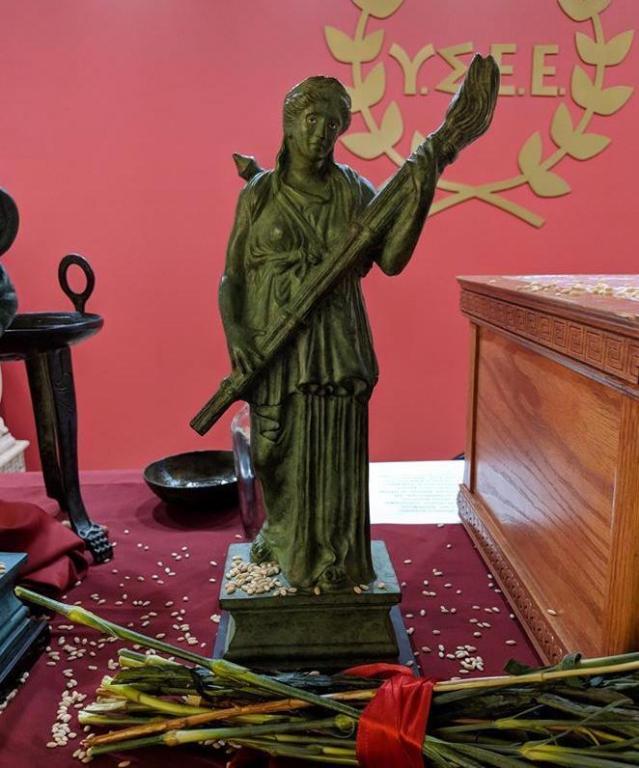
Photo by the author.
The text that follows is my translation of Hekate’s entry from the second volume of Ogygia or Archeology. Stagiritis gives a concise summary of the goddess; her genealogies, symbols, qualities, etc. Please excuse any awkwardness in the translation; I aimed to translate the Greek word for word with minimal changes to the Greek text.
Hekate, according to many writers, was the daughter of Zeus and Asterias. Asterias was impregnated by Zeus when she married Perses and gave birth to Hekate; though Perses was her husband. Of some of these [writers] they say Hekate was the daughter of Perses and Asterias. Some say [she was conceived] from Zeus and Demeter, or from Hera, or the daughter of the Aeolus [Melanippe?]. To others, from Aristaios or Tartaros or from Nyx. Others say she was [conceived] from Perses and a local woman or Nymph.
Those who say that she was the daughter of Zeus and Hera, give her the name aggelo[2] and was given to the Nymphs to be nurtured. When she grew older, she stole her mother’s box of blush and perfumes. Her face glowed, she gave the box to Zeus’ mistress Europa. When Hera learned about this she was outraged and wanted to reprimand[3] her. Hekate left and hid in the house of a woman who had recently given birth.[4] From there through contact with men who were transporting the dead to their tombs, Hera stopped her pursuit because she [Hekate] had approached the dead and was polluted. Zeus ordered the Kabeiri[5] to cleanse Hekate. They descended to Hades and [Hekate] was bathed in the river Acheron. That is how she was cleansed. This is how Hekate remained in Hades and became [the] goddess governing the dead.
Of those that say she was the daughter of Zeus and Demeter, they say she was very brave and tall. Zeus sent her to Hades to ask for Persephone’s return. Instead, Hekate remained there with Persephone and was named Artemis, Guardian, Torchbearer, Lightbringer, Kathonia.[6]
According to some, she was the daughter of Zeus and Pharaea. She gave birth to Hekate in secret because she was a child of an affair. She was left at the crossroads. There she was found by the shepherds of Pheres; they took her and raised her. Therefore, the crossroads where dedicated to her.
According to some that she was the daughter of Perses and Asterias or a local woman or Nymph, they say like Hesiod, that she was allied with Zeus in the Τitanomachy. For this she was given large glory by Zeus and gave her power over the sky, earth, sea and in Hades. Whoever honors and invokes her enjoy whatever they ask for: riches, glory, honor, victory, etc.
Others write that Aetis and Perses were siblings, sons of Helios, heirs to the paternal kingdom and reigned. Aetis was ruler from Colchis to the Mastitis lake. Perses was ruler of Hersonissos of Taurica and married Asterias or some other local woman or Hekate was born of a Nymph. Hekate is brave, barbarous, and possessed with hunting, that if she could not find animals to hunt, she would shoot people.
She enjoyed tricks, and after researching the influences of botanicals she found the combination of deadly poison, she discovered wolf’s bane. She mixed the poison in food and offered it to foreigners ignorant of her cunning, they ate it. Gaining experience, she poisoned her father [Perses] and took over his kingdom. After this she built a temple to Artemis and sacrificed foreigners to Artemis. Her cruelty became well known everywhere. She married her uncle Aetis and gave birth to Circe, Medea, and a son Aigalea. From all of this she became the goddess of magic and poisons.
In Hades, she protects the dead that are waiting 100 years outside of the underworld because they were not properly buried. Also, she sends dreams and makes ghosts and sends them to people dreams and ghosts, wild and scary.[7] Theses dreams are called Hekatia. Odysseus built her a temple in Sicily to be freed of such dreams and ghosts.
On Earth, she was protector of kingdoms, councils, courts, wars, assemblies, fishermen, horse riders, and all human activities, above all magic and goetia. She is also protector of houses, and nurturer of children. That’s why each house had a statue of her outside the front door. She was involved with all sacrifices to gods because she was so powerful. It was believed that Hekate, Selene, Artemis, and Persephone were the same. She was called Selene when she was in the sky, Artemis on earth, Hecate and Persephone in Hades. That is why she had so much power. She was called Brimo[8] ‘the terrible one’ because one time she argued with Hermes and exchanged harsh words when he competed with her on a hunt.
They drew her three headed with the right head as a dog and the left head a horse and the middle a wild boar. Sometimes as a one headed woman with a crown of oak branches. She wore black or white clothing, holding a spear or a staff in her hand. In other drawings, she was followed by black dogs and in others with a lit torch. Others drew her with three faces and six hands holding torches, keys, or baskets. In others, three headed with a crescent moon on one head, on the other a ‘hat’, and on the third a crown of Daphne. Some say that her body was so tall she was half a stadium and her hair was of snakes. Some of the snakes were coiled around her body, others around her shoulders, others on her feet. Therefore, she appeared like a freakish monster. They never drew her in this form.
She was three headed because she had trice power, in the sky, earth and underworld. Or from the three phases of moon. Her clothing holds similar meaning, she has trice power over humans, as Selene, patroness of pregnancy, as Artemis patroness of life and as Hekate or Persephone patroness of death. For that reason, the ‘protectors of birth’ are torchbearers signifying how they bring the born into the light. The dragons and those monsters symbolize the Hekatia. The spear symbolizes the protection of houses, the staff symbolizes magic. It is believed she rose from Hades riding on dogs. In practicality the protectors of the houses are the dogs.
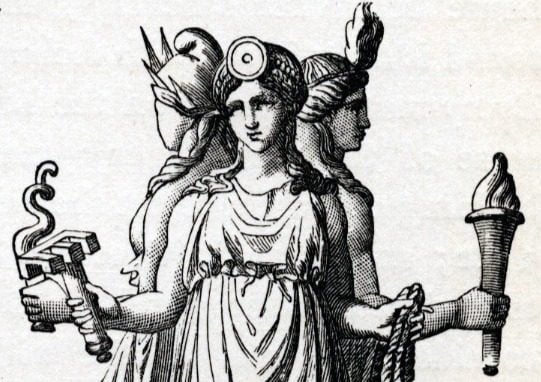
“Hecate” by Stéphane Mallarmé. From WIkiMedia.
Commentary
Hekate and Magic
Hekate is called “goddess of magic and poisons.” This requires explanation as magic appears after Hekate had “researched” the influences of botanicals and ‘discovered’ wolf’s bane. What is magic and why is it appearing here? Etymology will help to clarify.
Magic comes from the Greek μαγεια (mageia). As per, Liddell-Scott-Jones, μαγεια is, according to Plato:
· Theology of the Magians.
Magians were the Persian Magis. Magi, Greek Μάγος (Magos) meanings:
· Magian, one of a Median tribe: hence, as belonging to this tribe.
· One of the priests and wise men in Persia who interpreted dreams.
· Enchanter, wizard, esp. in bad sense, impostor, charlatan.
Additionally, Magos can derived from Old Iranian, possibly Old Median/Old Persian maγu- and Avestan moġu, but both are of uncertain meaning. It is also traced back to the Proto-Indo-European *magh (capable, skillful, powerful, mighty, helpful).
These definitions and etymologies give us a clearer understanding of magic and the magi. The Magi were Zoroastrian wise men/sages who studied the natural world (astrology/astronomy). The etymology indicates that the Magi were more likely originally seen as powerful and great. Their power and greatness were due to their great knowledge in theology and science. It does not indicate supernatural powers; the attempt to control and or manipulate nature or spirits through incantations.
For these reasons, in the Greek tradition, when Hekate is called ‘goddess of magic’ it describes her greatness of knowledge and capabilities. In myth, this is expressed by her ‘discovery’ through ‘researching’ botanicals. Hekate’s great knowledge is also alluded to when she takes over her father’s kingdom. Perses, her father, is described by Hesiod as “conspicuous among all for his intelligence.”[9] In the myth, Hekate behaves in a scientific manner. This is why in ignorant times, science is demonized as magic because science seeks to explain the unexplainable and bring to us knowledge from the hidden and unseen. As such, it is my opinion that there is nothing supernatural implied here with Hekate as ‘goddess of magic’ as popularly understood today. It is perfectly fine that Hekate has taken on new significances in other paths, and represents something different in other paths. All I wish to communicate is that the understanding from the Greek tradition does not resonate with later changes. I hope these insights are useful for those who desire to activate it in their path only if they see it as beneficial.
FOOTNOTES
1 Katharevousa is a 18th century conservative form of Greek that is a compromise between Ancient Greek and the Demotic Greek of the time.
2 ἄγγελος, messenger, envoy (2) Title of Artemis at Syracuse. LSJ: The Online Liddell-Scott-Jones Greek-English Lexicon.
3 The Greek word used here is Βασανίσει meaning to torture/ investigate/ examine. LSJ: The Online Liddell-Scott-Jones Greek-English Lexicon. We should not think Hera meant to harm Hekate by torture – Hera probably wanted to punish her in the manner a mother does to a child. I translated the word as “reprimand” as it feels appropriate for the context in English.
4 Within the last forty days.
5 Οι Κάβειροι (the Kabeiri) divinities worshipped especially in Lemnos, Samothrace, and Boeotia. LSJ: The Online Liddell-Scott-Jones Greek-English Lexicon.
6 Άρτεμις, Φύλαξ, Δαδούχος, Φωσφόρος και Χθόνια.
7 Once such type of ghost that are sent by Hekate is the Empousa (Ἔμπουσα) which appear to the ill-fated and can change shape between human and animal.
8 Βριμώ is an epithet shared by Hekate and Persephone.
9 Hesiod, Theogony (Loeb Translation)

About Angelo Nasios
Angelo Nasios (New York) is an author and educator of the Hellenic tradition. He received his B.A in religion and is currently earning his M.A in ancient and classical history. You can read more about the author here. You can read more about the author here.
Previous Post
January 25, 2019
Of Light & Shadow: Offerings to Anubis
Next Post
January 31, 2019 Pan-Celtic Hoofbeats: Brigid, History & Mystery
Browse Our Archives
Select a Category A Lakeside Hearth Adventures in Wortcunning Alone In Her Presence Arts, Crafts & Cooking Birthing Hereditary Witchcraft Book of Blackbirds Book Reviews Born-Again Witch Cauldron, Sword, Spear, & Stone Cermony and Liturgy Columns Community Dandelion Seeds Dear Jasmine Druid Thoughts Editor's Picks Everyday Pagan Family & Household Practice Family Traditions Full Frontal Magic Gateway Goddess Guest Articles Happily Heathen Health and Wellness Hearth of Hellenism Heathen Woman Hills of the Horizon History Holidays Horse Goddesses Interfaith Interviews Irish-American Witchcraft Jewish Witch Lamp & Labyrinth Letters from Midgard Literature, Media, Film, Music Loop of Brighid Love, Sex & Relationships Magic or Magick Making Light Naturalistic Traditions Nature News Outside The Circle Pantheisticon Politics Prayers, Poems, Blessings & Stories Queer Femme Mystic Queer of Swords Recipes Ritual and Practice Science and Research Seekers and Guides Seeking the Grail Socially Responsible Magic Spear of Athena Star Made Witch Syncretic Electric Technology The Blooming Staff The Busy Witch The Cartomancer The Crow's Nest The Dance of Pagan Recovery The Hearth of Hellenism The Lady's Quill The Other Side of the Hedge The Path of She The Rantin' Raven The Witches Next Door The Zen Pagan Theology, Ethics, Philosophy Tree City Witch Urban Earthwitch Wayfaring Woman Witch on Fire Wyrd Words
Select a Month January 2026 March 2025 December 2024 June 2024 April 2024 March 2024 January 2024 December 2023 November 2023 October 2023 August 2023 July 2023 May 2023 April 2023 March 2023 February 2023 January 2023 December 2022 November 2022 October 2022 September 2022 August 2022 July 2022 June 2022 May 2022 March 2022 February 2022 January 2022 December 2021 November 2021 October 2021 September 2021 August 2021 July 2021 June 2021 May 2021 April 2021 March 2021 February 2021 January 2021 December 2020 November 2020 October 2020 September 2020 August 2020 July 2020 June 2020 May 2020 April 2020 March 2020 February 2020 January 2020 December 2019 November 2019 October 2019 September 2019 August 2019 July 2019 June 2019 May 2019 April 2019 March 2019 February 2019 January 2019 December 2018 November 2018 October 2018 September 2018 August 2018 July 2018 June 2018 May 2018 April 2018 March 2018 February 2018 January 2018 December 2017 November 2017 October 2017 September 2017 August 2017 July 2017 June 2017 May 2017 April 2017 March 2017 February 2017 January 2017 December 2016 November 2016 October 2016 September 2016 August 2016 July 2016 June 2016 May 2016 April 2016 March 2016 February 2016 January 2016 December 2015 November 2015 October 2015 September 2015 August 2015 July 2015 June 2015 May 2015 April 2015 March 2015 February 2015 January 2015 December 2014 November 2014 October 2014 September 2014 August 2014 July 2014 June 2014 May 2014 April 2014 March 2014 February 2014 January 2014 December 2013 November 2013 October 2013 September 2013 August 2013 July 2013 June 2013 May 2013 April 2013 March 2013 February 2013 January 2013 December 2012 November 2012 October 2012 September 2012 August 2012 July 2012 June 2012 May 2012 April 2012 March 2012 February 2012 January 2012
Follow Us!
TAKE THE
Religious Wisdom Quiz
Who said, "For me to live is Christ, and to die is gain"?
Select your answer to see how you score.
John Paul James Peter
Related posts from Agora

Simple Witchery: To Keep Silent

Simple Witchery: Leaning On The Four Pillars

Pergamum Unfurled: Magic with the Greek Gods (Book...

Pergamum Unfurled: Cunning Words (Review)
TRENDING AT PATHEOS Pagan

I was recently chatting with someone on Instagram. She asked me what...

While there are many people who share their results, the end of...

On July 23, I saw Christopher Nolan's The Odyssey which is Homer’s...

As I write this two big events have just finished up. One...

Restoring the Watershed of Divine Love
Perhaps cooperation is not something we manufacture through legislation, ideology, or moral...

Many UUs don’t pray because of bad experiences in a previous religion,...
view all Pagan blogs
Ad-Free & Subscriber Log-In Subscription Support
- About Us
- 2026 Calendar
- Videos
- Podcasts
- Library of World Religions
- Faith In Media Tracker
- Advertise With Us
- Write for Us
- Privacy Policy
- Terms of Service
- Do Not Sell My Data
- Contact Us
- Radiant Digital
- Manage Newsletter Subscriptions
- Unsubscribe From Notifications
- Sitemap
Copyright 2008-2026, Patheos. All rights reserved.
Subscription Support Ad-Free & Subscriber Log-In
Follow Patheos