
BuddhistCatholicContemplativeEvangelicalGeneral ChristianHinduJewishLatter-day SaintMuslimNew VisionsProgressive Christian
Beliefs
- Buddhist
- Catholic
- Contemplative
- Evangelical
- General Christian
- Hindu
- Jewish
- Latter-day Saint
- More Voices
- Muslim
- New Visions
- Pagan
- Progressive Christian
Topics
- Religion News
- Food and Religion
- Sports and Religion
- Religious Art
- Religious Music and Entertainment
- Religious Events
- History and Religion
- Style and Religion
- Politics and Religion
- Women in Religion
- Recreation Outdoors and Religion
- Business Finance and Religion
- Careers Workplace and Religion
- Education and Religion
- Family Parenting and Religion
- Health Fitness and Religion
- Home and Religion
- Relationships and Religion
- Technology and Religion
- Travel and Religion
Columnists
- Buddhist Columnists
- Business Finance and Religion Columnists
- Careers Workplace and Religion Columnists
- Catholic Columnists
- Contemplative Columnists
- Education and Religion Columnists
- Evangelists Columnists
- Family Parenting and Religion Columnists
- General Christian Columnists
- Health Fitness and Religion Columnists
- Hindu Columnists
- History and Religion Columnists
- Home and Religion Columnists
- Jewish Columnists
- More Voices Columnists
- Latter Day Columnists
- Muslim Columnists
- New Visions Columnists
- Nonreligious Columnists
- Pagan Columnists
- Politics and Religion Columnists
- Progressive Columnists
- Recreation Outdoors and Religion Columnists
- Relationships and Religion Columnists
- Religion News Columnists
- Religious Art Columnists
- Religious Events Columnists
- Religious Music and Entertainment Columnists
- Sports and Religion Columnists
- Style and Religion Columnists
- Technology and Religion Columnists
- Travel and Religion Columnists
- Women in Religion Columnists
Resource Library
- 2026 Calendar
- Library of World Religions
- The 100 Most Holy Places on Earth
- Patheos Answers
- Podcasts
- Videos
- Faith Leaders Database
- Anglican Episcopalian
- Bahai
- Baptist
- Buddhism
- Christianity
- Confucianism
- Eastern Orthodoxy
- Hinduism
- Holiness and Pentecostal
- ISKCON
- Islam
- Judaism
- Lutheran
- Methodist
- The Church of Jesus Christ of Latter-day Saints
- New Age
- Paganism
- Presbytarian and Reformed
- Protestantism
- Religion Behind the Scenes
- Roman Catholic
- Scientology
- Shia Islam
- Sikhism
- Sufism
- Sunni Islam
- Taoism
- Zen
- See all religions
Research Tools
 Ad-Free & Subscriber Log-In Subscription Support
Ad-Free & Subscriber Log-In Subscription Support
Follow Patheos 

- Trending:
- Forgiveness
- |
- Marriage
- |
- Consciousness
- |
- Death Penalty
- |
- Election
- |
- Halloween

- Home
- Pagan
- Pan-Celtic Hoofbeats: Brigid, History & Mystery
Pan-Celtic Hoofbeats: Brigid, History & Mystery
Last updated on: January 31, 2019 at 2:43 am by Kris Hughes
Pan-Celtic Hoofbeats: Brigid, History & Mystery 2019-01-31T02:43:40+00:00 Kris Hughes
Patheos Explore the world's faith through different perspectives on religion and spirituality! Patheos has the views of the prevalent religions and spiritualities of the world.
Bride, Brigit, Brigid, Brighid, Bríd etc. all mean high or exalted one. Because Her name is so widely known, there are many different ways to say it. Pronunciations and spellings vary due to different Gaelic languages and periods, don’t get hung up on it. Certain versions are more correct in certain contexts, that’s all. The name occurs in Sanskrit as Brihati, later we find it in Gaul as Brigindo, and still later in Britain as Briganti, and Ireland as Brigid.
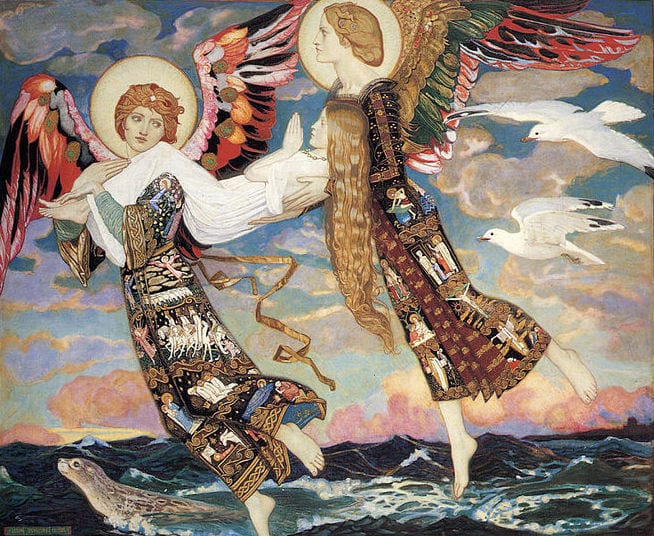
St. Bride by John Duncan – Wikimedia commons
There is a suggestion that the root name may apply to the goddess of people living in hills and mountains, which would fit the Brigantii a tribe who lived in the Alps in what is now western Austria around 1500 BC up until they were ousted by the Romans around 15 BC. It would also fit the Brigantes, who lived in the Pennines, in northern England, during the 1st c AD. They spoke a Brythonic language similar to Welsh, rather than a Gaelic language. A branch of the Brigantes settled in what is now County Wexford (in Ireland) in the province or Leinster.
There are a few inscriptions mentioning Brigando/Brigindu in the Brigantii heartland on the continent, and a handful of inscriptions to Briganti/Brigantia in northern England and southern Scotland. Place names with the root “brig” can be confusing where hills are concerned, because it’s not always clear whether it refers to the goddess, or just that the hill is a high place. However, the River Braint in Anglesey (Wales), the River Brent in England and several rivers bearing Brigid’s name in Ireland are more obviously connected to the goddess.
Since the early Celts didn’t write things down, the only other references we have are contemporary Roman writers who talk about a Celtic “Minerva”. The Romans tended to label foreign deities with the name of whatever Roman deity they thought was the closest equivalent. They related Her to arts and crafts, and probably to healing springs, such as the ones at Bath.
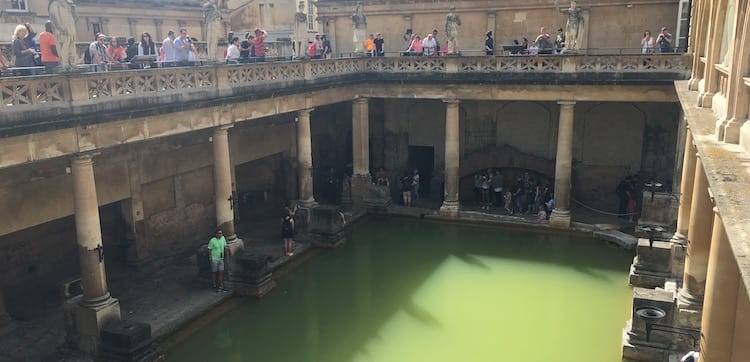
Bath Spa
IN IRELAND
The next time we hear of Brigid is from the 9th century writings of Cormac, an Irish bishop who wrote a sort of encyclopaedic dictionary known as Cormac’s Glossary. Bishop or not, he clearly names Brigid as a goddess, saying that she was the daughter of the Dagda, that she was expert in filidhecht (poetry and oral learning), and that she had two sisters who were also called Brigid. One sister was associated with healing and the other with smith craft. He goes on to say that Brigid was a sort of general word for “goddess”.
In approximately the same period, the Book of Invasions lists her as a poetess, and as daughter of the Dagda. It discusses her associations with magical livestock and certain plains in Leinster associated with agriculture. Her magical livestock included the king of boars, king of bulls, and king of rams, – all of which used to cry out when rapine was committed in Ireland. The Torc Triath, the king of boars, is obviously cognate with the Twrch Trwyth, the magical boar mentioned in the Welsh tale of Culwch and Olwen.
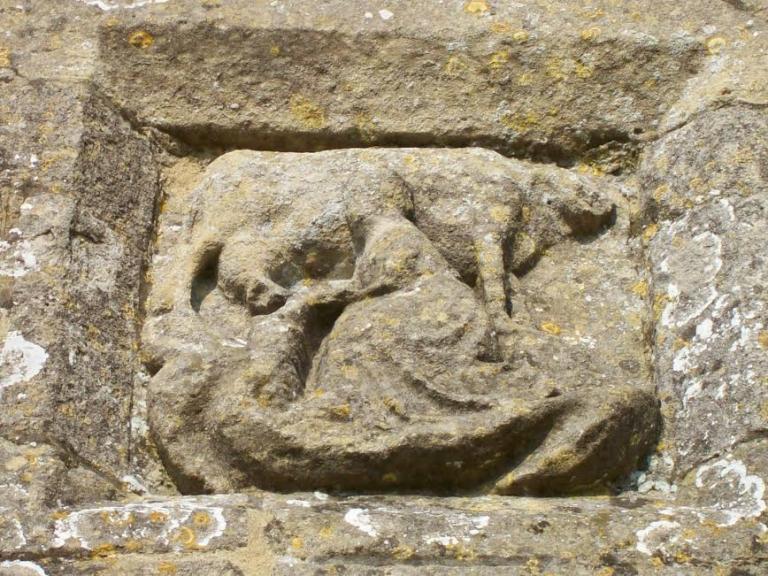
St Brigid Milking a Cow, Glastonbury – Tony Grist – Wikimedia
In the second battle of Mag Tuired, Brigid is described as daughter of Dagda and wife of Bres, who is half Fomorian. They have a son, Ruadhán, fighting on the Fomorian side. The Fomorians notice that the spears of the Tuatha Dé Danann are superior to their own. Ruadhán is sent to investigate and asks the Tuatha smith, Goibniu, to make him a spear, which he does. He then flings the spear at Goibniu, who flings it back killing him. Brigid wails and cries, thus inventing the Irish custom of keening for the dead.
This is essentially all we know of the goddess Brigid from history, archaeology and myth.
ST. BRIGID
There are 15 different Irish saints called Brigid, perhaps reinforcing the idea that Brigid is a generalised deific or sacred name. The one who is considered to have inherited aspects of the goddess is Brigid of Kildare, who probably lived in the 5th century, although there are no contemporary mentions of her from that time. Like some other early saints, it’s possible that she never lived.
Modern Pagans generally believe that the Catholic Church co-opted the goddess Brigid and changed Her into St. Brigid, to popularise Christianity and downplay Pagan practices. This may well be the case, but there are some interesting political reasons why St. Brigid was pushed to the fore, as well. In the early 5th century the Uí Dhuínlainge (modern anglicised version Dowling/O’Dowling) dynasty came to power in Leinster. Their leader, who seized power in 633, was the brother of the Bishop of Kildare.
By 650 the first hagiography (a saint’s biography listing their miracles) of St. Brigid had been produced. Bishoprics could be seats of immense political power at the time, and ties to an important and popular saint could vastly increase that power. It was definitely in the interest of the Uí Dhuínlainges to promote Brigid as the holiest and most powerful of indigenous saints, bringing power, wealth and pilgrims to the region.
So it may have been less a question of replacing a goddess with a saint, and more a question of keeping Brigid and Leinster to the fore. I can’t help but be intrigued by the possible (but impossible to prove!) line from the Brigantii of Gaul, through the Brigantes of Britain and Ireland, to Brigid of Kildare. After all, Kildare is not far from where those 1st century Brigantes settled when they came to Ireland from Britain.
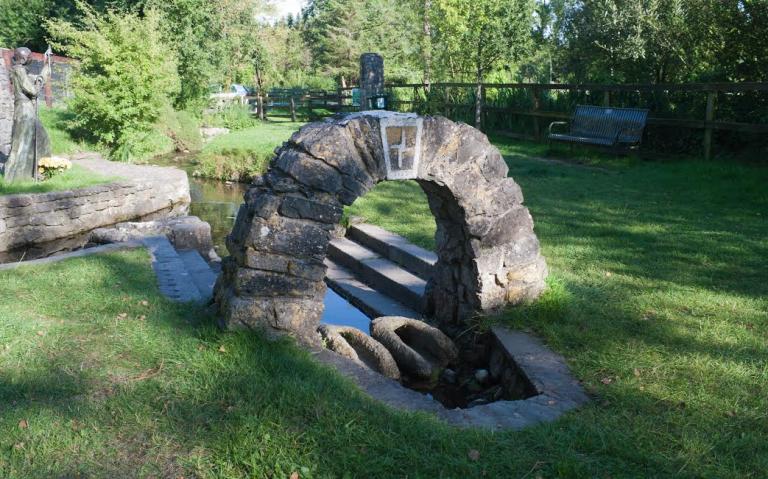
Little St Brigid’s Well, Kildare – Andreas F. Borchert – Wikimedia. Creative Commons Attribution-Share Alike 3.0 Germany

It may be that at some point in the past Kildare had been a Druidic centre. Cill Dare = chapel or the oak. Brigid may have been worshipped there or may possibly have been the title of some chief Druidess. Medieval historian Gerald of Wales wrote that St. Brigid and nineteen or her nuns guarded a sacred fire at Kildare, which burned perpetually and was surrounded by a hedge which excluded men. At least one Roman writer described “Minerva’s” temple in Britain as having a perpetual flame, as well.
The first hagiography of St. Brigid contains a fairly standard list of miracles associated with saints of the period, but also a few items which are typical of Celtic myth. Brigid is born at sunrise, neither within nor without a house – both references to liminality. She will only drink the milk of a white cow with red ears, a standard description of magical or otherworldly cattle. And the house in which she dwells appears to those outside to contain a blazing fire.
Later biographies say that she and her mother were sold into slavery to a Druid, for whom they did agricultural work. Thus, Brigid is essentially brought up by a Druid, suggesting that she inherits some special knowledge or power, but without any blood ties, which might have been a cause for concern.
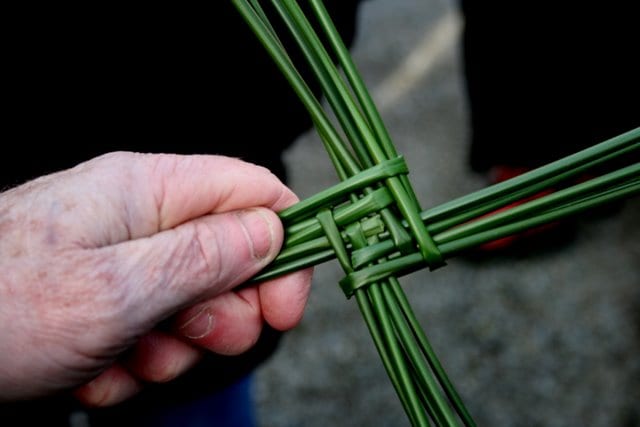
St Brigid’s cross – liscannorman – wikimedia. Creative Commons Attribution-Share Alike 3.0 Unported license.

One final story from a later biography that has always struck me is the story of the deathbed conversion of a stubborn Pagan. In this tale, St. Patrick has been trying to convert this man, but he has refused to change his beliefs. St. Brigid then makes her attempt and weaves a cross of rushes over the man’s bed, which somehow does the trick! I have to confess that this has completely put me off Brigid’s crosses for life.
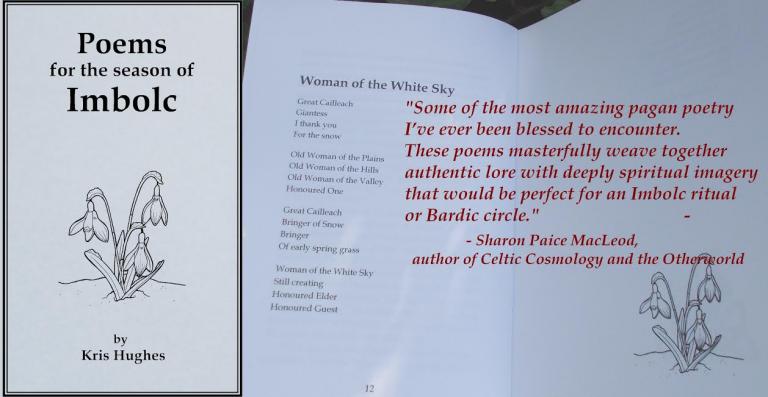
I had hoped to include something on Brigid and the Cailleach in Scottish folklore, but it would make this post too long, so I will save that for another time. However, if you can’t wait, I’ve written a few things on my own blog, such as We Need to Talk About The Cailleach and First There is a Mountain. I’ve also just published a little book of poetry on that very subject called Poems for the Season of Imbolc.
Further reading/my main sources:
Celtic Mythology – Prionsias Mac Cana p 32-34
The Lore of Ireland — Dáithí Ó hÓgáin p 50-55
On the web:
https://www.historyfiles.co.uk/KingListsBritain/BritainBrigantes.htm
You can follow Kris at her blog Go Deeper and support her work on Patreon.
About Kris Hughes
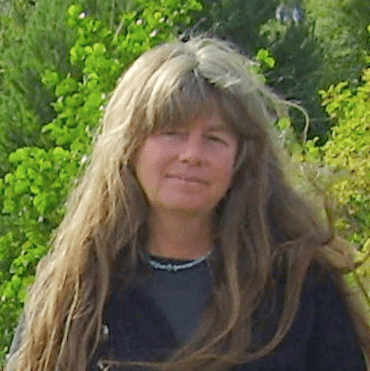
Kris Hughes is a nice, older Pagan woman who loves the gods of the Celts. She doesn't claim to be anything in particular, but she might possibly be described as a hedge teacher, a writer, a part time Druid, an exiled Scot, a poet, cartomancer, ritualist, storyteller, or just someone with a lot to say about a lot of things. In the past she has been a professional musician, a farmer, and a horsewoman. She is currently writing a book, working title The Celtic Horse Goddesses: Myth, History and Personal Reflection. Her interests include herbalism, mythology, and British native ponies. She also blogs at her own website Go Deeper. You can read more about the author here.
Previous Post

January 29, 2019
Hearth of Hellenism: Hekate in the Greek Tradition
Next Post

January 31, 2019 The Corner Crone: Hekate of the Sacred Snowplows
Browse Our Archives
Select a Category A Lakeside Hearth Adventures in Wortcunning Alone In Her Presence Arts, Crafts & Cooking Birthing Hereditary Witchcraft Book of Blackbirds Book Reviews Born-Again Witch Cauldron, Sword, Spear, & Stone Cermony and Liturgy Columns Community Dandelion Seeds Dear Jasmine Druid Thoughts Editor's Picks Everyday Pagan Family & Household Practice Family Traditions Full Frontal Magic Gateway Goddess Guest Articles Happily Heathen Health and Wellness Hearth of Hellenism Heathen Woman Hills of the Horizon History Holidays Horse Goddesses Interfaith Interviews Irish-American Witchcraft Jewish Witch Lamp & Labyrinth Letters from Midgard Literature, Media, Film, Music Loop of Brighid Love, Sex & Relationships Magic or Magick Making Light Naturalistic Traditions Nature News Outside The Circle Pantheisticon Politics Prayers, Poems, Blessings & Stories Queer Femme Mystic Queer of Swords Recipes Ritual and Practice Science and Research Seekers and Guides Seeking the Grail Socially Responsible Magic Spear of Athena Star Made Witch Syncretic Electric Technology The Blooming Staff The Busy Witch The Cartomancer The Crow's Nest The Dance of Pagan Recovery The Hearth of Hellenism The Lady's Quill The Other Side of the Hedge The Path of She The Rantin' Raven The Witches Next Door The Zen Pagan Theology, Ethics, Philosophy Tree City Witch Urban Earthwitch Wayfaring Woman Witch on Fire Wyrd Words
Select a Month January 2026 March 2025 December 2024 June 2024 April 2024 March 2024 January 2024 December 2023 November 2023 October 2023 August 2023 July 2023 May 2023 April 2023 March 2023 February 2023 January 2023 December 2022 November 2022 October 2022 September 2022 August 2022 July 2022 June 2022 May 2022 March 2022 February 2022 January 2022 December 2021 November 2021 October 2021 September 2021 August 2021 July 2021 June 2021 May 2021 April 2021 March 2021 February 2021 January 2021 December 2020 November 2020 October 2020 September 2020 August 2020 July 2020 June 2020 May 2020 April 2020 March 2020 February 2020 January 2020 December 2019 November 2019 October 2019 September 2019 August 2019 July 2019 June 2019 May 2019 April 2019 March 2019 February 2019 January 2019 December 2018 November 2018 October 2018 September 2018 August 2018 July 2018 June 2018 May 2018 April 2018 March 2018 February 2018 January 2018 December 2017 November 2017 October 2017 September 2017 August 2017 July 2017 June 2017 May 2017 April 2017 March 2017 February 2017 January 2017 December 2016 November 2016 October 2016 September 2016 August 2016 July 2016 June 2016 May 2016 April 2016 March 2016 February 2016 January 2016 December 2015 November 2015 October 2015 September 2015 August 2015 July 2015 June 2015 May 2015 April 2015 March 2015 February 2015 January 2015 December 2014 November 2014 October 2014 September 2014 August 2014 July 2014 June 2014 May 2014 April 2014 March 2014 February 2014 January 2014 December 2013 November 2013 October 2013 September 2013 August 2013 July 2013 June 2013 May 2013 April 2013 March 2013 February 2013 January 2013 December 2012 November 2012 October 2012 September 2012 August 2012 July 2012 June 2012 May 2012 April 2012 March 2012 February 2012 January 2012
Follow Us!
TAKE THE
Religious Wisdom Quiz
In 2 Thessalonians, what does Paul say the man of lawlessness will proclaim himself to be?
Select your answer to see how you score.
God A prophet The Messiah King of the world
Related posts from Agora

Simple Witchery: To Keep Silent

Simple Witchery: Leaning On The Four Pillars

Pergamum Unfurled: Magic with the Greek Gods (Book...

Pergamum Unfurled: Cunning Words (Review)
TRENDING AT PATHEOS Pagan

I was recently chatting with someone on Instagram. She asked me what...

While there are many people who share their results, the end of...

On July 23, I saw Christopher Nolan's The Odyssey which is Homer’s...

As I write this two big events have just finished up. One...

Restoring the Watershed of Divine Love
Perhaps cooperation is not something we manufacture through legislation, ideology, or moral...

Many UUs don’t pray because of bad experiences in a previous religion,...
view all Pagan blogs
Ad-Free & Subscriber Log-In Subscription Support
- About Us
- 2026 Calendar
- Videos
- Podcasts
- Library of World Religions
- Faith In Media Tracker
- Advertise With Us
- Write for Us
- Privacy Policy
- Terms of Service
- Do Not Sell My Data
- Contact Us
- Radiant Digital
- Manage Newsletter Subscriptions
- Unsubscribe From Notifications
- Sitemap
Copyright 2008-2026, Patheos. All rights reserved.
Subscription Support Ad-Free & Subscriber Log-In
Follow Patheos