
BuddhistCatholicContemplativeEvangelicalGeneral ChristianHinduJewishLatter-day SaintMuslimNew VisionsProgressive Christian
Beliefs
- Buddhist
- Catholic
- Contemplative
- Evangelical
- General Christian
- Hindu
- Jewish
- Latter-day Saint
- More Voices
- Muslim
- New Visions
- Pagan
- Progressive Christian
Topics
- Religion News
- Food and Religion
- Sports and Religion
- Religious Art
- Religious Music and Entertainment
- Religious Events
- History and Religion
- Style and Religion
- Politics and Religion
- Women in Religion
- Recreation Outdoors and Religion
- Business Finance and Religion
- Careers Workplace and Religion
- Education and Religion
- Family Parenting and Religion
- Health Fitness and Religion
- Home and Religion
- Relationships and Religion
- Technology and Religion
- Travel and Religion
Columnists
- Buddhist Columnists
- Business Finance and Religion Columnists
- Careers Workplace and Religion Columnists
- Catholic Columnists
- Contemplative Columnists
- Education and Religion Columnists
- Evangelists Columnists
- Family Parenting and Religion Columnists
- General Christian Columnists
- Health Fitness and Religion Columnists
- Hindu Columnists
- History and Religion Columnists
- Home and Religion Columnists
- Jewish Columnists
- More Voices Columnists
- Latter Day Columnists
- Muslim Columnists
- New Visions Columnists
- Nonreligious Columnists
- Pagan Columnists
- Politics and Religion Columnists
- Progressive Columnists
- Recreation Outdoors and Religion Columnists
- Relationships and Religion Columnists
- Religion News Columnists
- Religious Art Columnists
- Religious Events Columnists
- Religious Music and Entertainment Columnists
- Sports and Religion Columnists
- Style and Religion Columnists
- Technology and Religion Columnists
- Travel and Religion Columnists
- Women in Religion Columnists
Resource Library
- 2026 Calendar
- Library of World Religions
- The 100 Most Holy Places on Earth
- Patheos Answers
- Podcasts
- Videos
- Faith Leaders Database
- Anglican Episcopalian
- Bahai
- Baptist
- Buddhism
- Christianity
- Confucianism
- Eastern Orthodoxy
- Hinduism
- Holiness and Pentecostal
- ISKCON
- Islam
- Judaism
- Lutheran
- Methodist
- The Church of Jesus Christ of Latter-day Saints
- New Age
- Paganism
- Presbytarian and Reformed
- Protestantism
- Religion Behind the Scenes
- Roman Catholic
- Scientology
- Shia Islam
- Sikhism
- Sufism
- Sunni Islam
- Taoism
- Zen
- See all religions
Research Tools
 Ad-Free & Subscriber Log-In Subscription Support
Follow Patheos 

- Trending:
- Advent
- |
- Forgiveness
- |
- Thanksgiving
- |
- Election
- |
- Seasonal Holidays
- |
- Marriage

- Home
- Pagan
- Pan-Celtic Hoofbeats: Why You Should be Wary of Celtic Facts
Pan-Celtic Hoofbeats: Why You Should be Wary of Celtic Facts
Last updated on: December 27, 2018 at 6:33 am by Kris Hughes
Pan-Celtic Hoofbeats: Why You Should be Wary of Celtic Facts 2018-12-27T06:33:21+00:00 Kris Hughes
Patheos Explore the world's faith through different perspectives on religion and spirituality! Patheos has the views of the prevalent religions and spiritualities of the world.
If you are new to Celtic Paganism, you probably have a lot of questions about what Celts did in the past, the right way to honour the gods, the meaning of the myths, and so on. You may be searching for good books on the topic, or just a bit of casual advice about things. I see people reaching out for information almost every day, and often getting unsatisfactory answers. On the one hand, self-appointed experts may hit them with a long list of things they “must” read or laugh at the sources they’ve tried so far. On the other hand, there is a faction who are fond of saying things like “just find your own path” or “everyone has different ideas about these things”. A generous attitude, but not very informative.
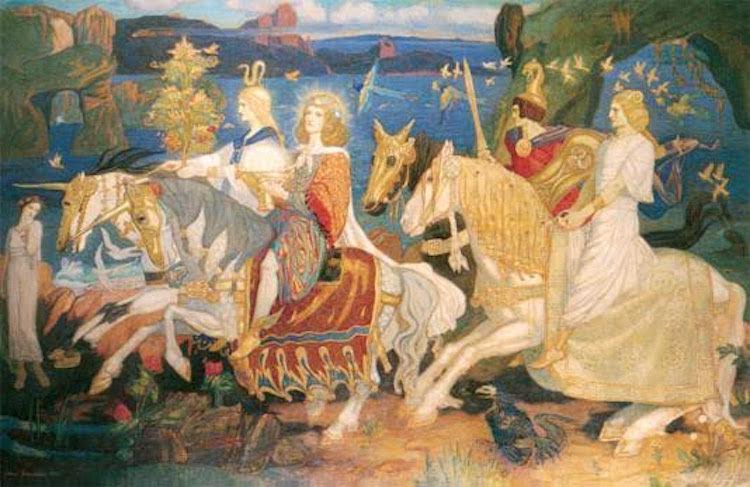
“Riders of the Sidhe” by John Duncan Wikimedia Commons
The truth is, finding good information about early Celtic beliefs takes effort, and most of it comes from academic sources or from Pagans with an academic approach to things. I think this is something the Celtic Pagan community needs to work on, because not every sincere seeker into our path has the patience, education, or access to obscure and expensive books to do this work for themselves. I’ve written about getting into Celtic mythology before, but the rest is messier.
I want to help you understand why it’s so messy, and to warn you that the truth about what early Celts believed or what their religious practices were is largely unknown. So, if you encounter someone making hard and fast statements about this stuff, ask to see the evidence. There is nothing wrong with people making educated guesses, and there is nothing wrong with personal gnosis or personal preference. The trouble starts when people state their opinions as if they were provable facts.

Image by Anonymous9000, CC License 2.0
Both internet pundits and some Pagan authors are prone to making statements like “The Celts worshipped the sun and the moon.” “Brigid was a fertility goddess!” Declarations like these are a major red flag. A good source will probably say things like “The Celts might have done ___ because this particular Roman writer mentioned it.” or “Archaeologist Susan Smith found inscriptions to the same goddess at six different Iron Age pig farms, but none of the inscriptions actually mentions pigs, so it could be coincidence.” There are good books based on personal gnosis and opinion, too. One of the things that makes them good, is that they don’t pretend to be something else.
The classic definition of history is something like “The study of the past through written documents.” That definition is beginning to change as we become more confident in disciplines like archaeology, oral history, linguistics, and genetics. However, adherence to the written word is a hard habit for historians to break. This makes the study of the Celts problematic because they chose not to use writing to record their history, genealogy, laws, or mythology until the medieval period. (To put this in perspective, writing was a part of Greek culture some 2,000 years earlier.) Not all Celts were illiterate. A few Iron Age Celts could read and write Greek or Latin, for example, but as a culture they valued oral transmission and avoided the written word. As with so many things, the reasons for that choice are lost to us.
Most of what we have long believed about the ancient Celts comes from the writing of the Romans, and the vast majority of that from one man, Julius Caesar. Historians have taken the position that he would know, because he was there. Caesar built his imperial career out of making war on the Celts, and wrote a memoir of his exploits. but scholars question whether he really witnessed everything he described, or whether some of it was hearsay, or even plagiarism. Anyway, we must wonder whether Romans were simply writing propaganda against the Celts, or bending the truth for personal reasons. The Romans generally portrayed the Celts as noble and exotic savages.
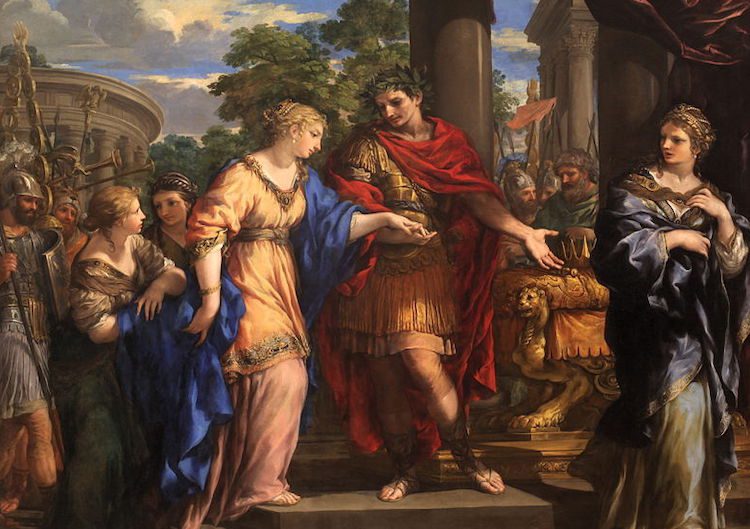
“Caesar giving Cleopatra the Throne of Egypt” By Pietro de Cortone. From WikiMedia.
The Celts are not the only culture to have suffered from historical misunderstanding when their oral traditions met the force of a mighty military power which destroyed their culture and then got to write the story of who they were. The same thing happened to the native peoples of Africa and the Americas during their invasion and subjugation by Europeans in recent centuries.
European scholars have not questioned the Roman writers enough, largely because they identified with them as literate, urbane and civilised colonisers. Until recently, most western historians comparing Rome to the British Empire or the United States, have done so proudly. We have finally begun to let go of our belief in the rightness of powerful nations imposing their “improvements” on everyone they encounter, but there is still a long way to go.
Archaeology is another way we can learn about the past, but without contemporary written material, everything is open to interpretation. Is that piece of art religious, or not? Was that Latin inscription left by a Roman, or a Romanised Celt? What do burial practice tell us about belief? And the most basic question of all, is the stuff we’ve dug up even Celtic?
“Celtic” is an evocative word, but not a very specific one. Is it defined by language, geography, culture, or genetics? Many academics limit the definition to speakers of Celtic languages during the Iron Age, and perhaps a few centuries beyond. This appears to remove a lot of gray areas, but real life is full of gray areas. For example, many people living in Scotland, Ireland or Wales today consider themselves to be Celtic because of cultural differences and/or genetics, regardless of what language they speak. Did Celts in other times define themselves by language? We don’t know. We don’t even know whether they defined themselves as Celts, or just as Aedui, Iceni, Epidii, etc. The genealogy of dynasties was considered very important, but there is no evidence that “racial purity” was.
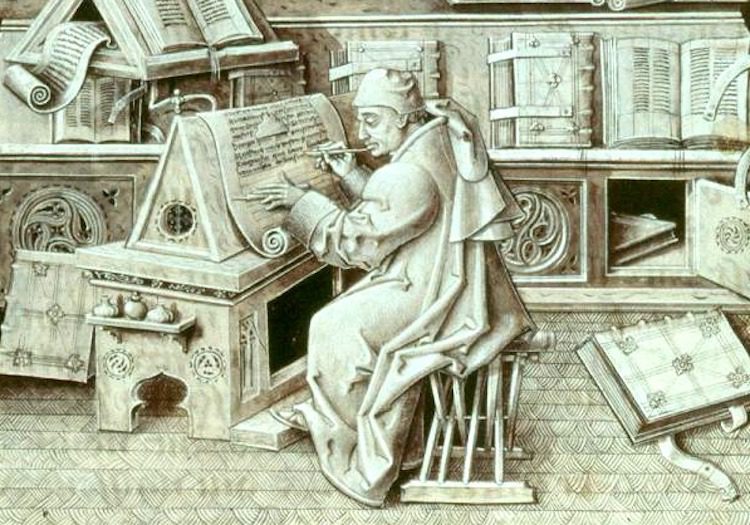
“Portrait of Jean Miélot” by Jean Le Tavernier. From WikiMedia.
As the Romans faded from the picture, Germanic peoples vied with the Celts for power and territory, and their cultures undoubtedly influenced each other, although neither side left much in the way of written records until the Medieval period. By the time scribes finally began setting the myths, laws, history, and poetry of the Irish and Welsh down in books, much of the material was fragmented. We can’t always tell, a thousand years later, how “authentic” some of these texts are, or how old the ideas in them are. Most of the scribes must have been fluent Welsh or Gaelic speakers, but both their methods and their agenda are unclear.
In modern times, “Celtic culture” is frequently reduced to clichés and repackaged by corporations for consumption by all. Our dramatic landscapes, delicious beer and whisky, our wars, our music and mythology, even the way we speak English, become one dimensional tropes, easily cut and pasted to suit the occasion, or marketed as a package tour. Celtic spirituality, Paganism and Polytheism often get the same treatment and sadly, some of the stereotypes are perpetuated by the Pagan community.
St. Patrick’s Day Postcard via WikiMedia and the Missouri History Museum.
This little essay isn’t meant to discourage you from doing research, or from taking an interest in anything Celtic that strikes your fancy. Just beware of glib pronouncements about how things were with the Celts of prehistory, or even during parts of the historical period. Much of what they believed, what their daily lives were like, or what their religious practices were, is lost to us. All of us tend to interpret the evidence to suit our own theories and beliefs, even if we think we don’t. Take time to stop and consider the things you read about Celtic history, mythology, religion, and culture. Are writers basing their statements on study, or fantasy? Did they study a reliable source? Is there an agenda behind their statements?

About Kris Hughes
Kris Hughes is a nice, older Pagan woman who loves the gods of the Celts. She doesn't claim to be anything in particular, but she might possibly be described as a hedge teacher, a writer, a part time Druid, an exiled Scot, a poet, cartomancer, ritualist, storyteller, or just someone with a lot to say about a lot of things. In the past she has been a professional musician, a farmer, and a horsewoman. She is currently writing a book, working title The Celtic Horse Goddesses: Myth, History and Personal Reflection. Her interests include herbalism, mythology, and British native ponies. She also blogs at her own website Go Deeper. You can read more about the author here.
Previous Post

December 25, 2018
The Radical Pantheist: Chasing American Monsters
Next Post

December 27, 2018 The Purple Spiral Turns: Baby, It's a Cold Controversy
Browse Our Archives
Select a Category A Lakeside Hearth Adventures in Wortcunning Alone In Her Presence Arts, Crafts & Cooking Birthing Hereditary Witchcraft Book of Blackbirds Book Reviews Born-Again Witch Cauldron, Sword, Spear, & Stone Cermony and Liturgy Columns Community Dandelion Seeds Dear Jasmine Druid Thoughts Editor's Picks Everyday Pagan Family & Household Practice Family Traditions Full Frontal Magic Gateway Goddess Guest Articles Happily Heathen Health and Wellness Hearth of Hellenism Heathen Woman Hills of the Horizon History Holidays Horse Goddesses Interfaith Interviews Irish-American Witchcraft Jewish Witch Lamp & Labyrinth Letters from Midgard Literature, Media, Film, Music Loop of Brighid Love, Sex & Relationships Magic or Magick Making Light Naturalistic Traditions Nature News Outside The Circle Pantheisticon Politics Prayers, Poems, Blessings & Stories Queer Femme Mystic Queer of Swords Recipes Ritual and Practice Science and Research Seekers and Guides Seeking the Grail Socially Responsible Magic Spear of Athena Star Made Witch Syncretic Electric Technology The Blooming Staff The Busy Witch The Cartomancer The Crow's Nest The Dance of Pagan Recovery The Hearth of Hellenism The Lady's Quill The Other Side of the Hedge The Path of She The Rantin' Raven The Witches Next Door The Zen Pagan Theology, Ethics, Philosophy Tree City Witch Urban Earthwitch Wayfaring Woman Witch on Fire Wyrd Words
Select a Month January 2026 March 2025 December 2024 June 2024 April 2024 March 2024 January 2024 December 2023 November 2023 October 2023 August 2023 July 2023 May 2023 April 2023 March 2023 February 2023 January 2023 December 2022 November 2022 October 2022 September 2022 August 2022 July 2022 June 2022 May 2022 March 2022 February 2022 January 2022 December 2021 November 2021 October 2021 September 2021 August 2021 July 2021 June 2021 May 2021 April 2021 March 2021 February 2021 January 2021 December 2020 November 2020 October 2020 September 2020 August 2020 July 2020 June 2020 May 2020 April 2020 March 2020 February 2020 January 2020 December 2019 November 2019 October 2019 September 2019 August 2019 July 2019 June 2019 May 2019 April 2019 March 2019 February 2019 January 2019 December 2018 November 2018 October 2018 September 2018 August 2018 July 2018 June 2018 May 2018 April 2018 March 2018 February 2018 January 2018 December 2017 November 2017 October 2017 September 2017 August 2017 July 2017 June 2017 May 2017 April 2017 March 2017 February 2017 January 2017 December 2016 November 2016 October 2016 September 2016 August 2016 July 2016 June 2016 May 2016 April 2016 March 2016 February 2016 January 2016 December 2015 November 2015 October 2015 September 2015 August 2015 July 2015 June 2015 May 2015 April 2015 March 2015 February 2015 January 2015 December 2014 November 2014 October 2014 September 2014 August 2014 July 2014 June 2014 May 2014 April 2014 March 2014 February 2014 January 2014 December 2013 November 2013 October 2013 September 2013 August 2013 July 2013 June 2013 May 2013 April 2013 March 2013 February 2013 January 2013 December 2012 November 2012 October 2012 September 2012 August 2012 July 2012 June 2012 May 2012 April 2012 March 2012 February 2012 January 2012
Follow Us!
TAKE THE
Religious Wisdom Quiz
Where did Elisha cure Naaman?
Select your answer to see how you score.
Dead Sea Mediterranean Sea Jordan River Sea of Galilee
Related posts from Agora
Simple Witchery: To Keep Silent

Simple Witchery: Leaning On The Four Pillars
Pergamum Unfurled: Magic with the Greek Gods (Book...
Pergamum Unfurled: Cunning Words (Review)
TRENDING AT PATHEOS Pagan

To help with the upcoming holiday season, I'm introducing the Holiday Helper...

10 years of the Power Sigil & Moving...
Last week while reorganizing my studio space, I found the sketchbook that...

Why are younger seekers drawn to Paganism and...
One of the things I've noticed the most is that I'm far...

When we talk about Greek religion, we often begin with the dodekatheion—the...

I was recently chatting with someone on Instagram. She asked me what...

On July 23, I saw Christopher Nolan's The Odyssey which is Homer’s...
view all Pagan blogs
Ad-Free & Subscriber Log-In Subscription Support
- About Us
- 2026 Calendar
- Videos
- Podcasts
- Library of World Religions
- Faith In Media Tracker
- Advertise With Us
- Write for Us
- Privacy Policy
- Terms of Service
- Do Not Sell My Data
- Contact Us
- Radiant Digital
- Manage Newsletter Subscriptions
- Unsubscribe From Notifications
- Sitemap
Copyright 2008-2026, Patheos, part of the Radiant Digital network of media brands. All rights reserved.
Subscription Support Ad-Free & Subscriber Log-In
Follow Patheos