
BuddhistCatholicContemplativeEvangelicalGeneral ChristianHinduJewishLatter-day SaintMuslimNew VisionsProgressive Christian
Beliefs
- Buddhist
- Catholic
- Contemplative
- Evangelical
- General Christian
- Hindu
- Jewish
- Latter-day Saint
- More Voices
- Muslim
- New Visions
- Pagan
- Progressive Christian
Topics
- Religion News
- Food and Religion
- Sports and Religion
- Religious Art
- Religious Music and Entertainment
- Religious Events
- History and Religion
- Style and Religion
- Politics and Religion
- Women in Religion
- Recreation Outdoors and Religion
- Business Finance and Religion
- Careers Workplace and Religion
- Education and Religion
- Family Parenting and Religion
- Health Fitness and Religion
- Home and Religion
- Relationships and Religion
- Technology and Religion
- Travel and Religion
Columnists
- Buddhist Columnists
- Business Finance and Religion Columnists
- Careers Workplace and Religion Columnists
- Catholic Columnists
- Contemplative Columnists
- Education and Religion Columnists
- Evangelists Columnists
- Family Parenting and Religion Columnists
- General Christian Columnists
- Health Fitness and Religion Columnists
- Hindu Columnists
- History and Religion Columnists
- Home and Religion Columnists
- Jewish Columnists
- More Voices Columnists
- Latter Day Columnists
- Muslim Columnists
- New Visions Columnists
- Nonreligious Columnists
- Pagan Columnists
- Politics and Religion Columnists
- Progressive Columnists
- Recreation Outdoors and Religion Columnists
- Relationships and Religion Columnists
- Religion News Columnists
- Religious Art Columnists
- Religious Events Columnists
- Religious Music and Entertainment Columnists
- Sports and Religion Columnists
- Style and Religion Columnists
- Technology and Religion Columnists
- Travel and Religion Columnists
- Women in Religion Columnists
Resource Library
- 2026 Calendar
- Library of World Religions
- The 100 Most Holy Places on Earth
- Patheos Answers
- Podcasts
- Videos
- Faith Leaders Database
- Anglican Episcopalian
- Bahai
- Baptist
- Buddhism
- Christianity
- Confucianism
- Eastern Orthodoxy
- Hinduism
- Holiness and Pentecostal
- ISKCON
- Islam
- Judaism
- Lutheran
- Methodist
- The Church of Jesus Christ of Latter-day Saints
- New Age
- Paganism
- Presbytarian and Reformed
- Protestantism
- Religion Behind the Scenes
- Roman Catholic
- Scientology
- Shia Islam
- Sikhism
- Sufism
- Sunni Islam
- Taoism
- Zen
- See all religions
Research Tools
 Ad-Free & Subscriber Log-In Subscription Support
Follow Patheos 

- Trending:
- Advent
- |
- Forgiveness
- |
- Thanksgiving
- |
- Election
- |
- Seasonal Holidays
- |
- Marriage

- Home
- Pagan
- Pan-Celtic Hoofbeats: Horses of the Dark Time, Yuletide
Pan-Celtic Hoofbeats: Horses of the Dark Time, Yuletide
Last updated on: December 14, 2019 at 6:38 pm by Kris Hughes
Pan-Celtic Hoofbeats: Horses of the Dark Time, Yuletide 2019-12-14T18:38:50+00:00 Kris Hughes
Patheos Explore the world's faith through different perspectives on religion and spirituality! Patheos has the views of the prevalent religions and spiritualities of the world.
In Horses of the Dark Time, I explored some of the horse mumming customs which happen toward the end of October in Britain. But most of these frisky, yet mysterious, skull horses make their appearance over the Christmas and New Year season. Lots of people are familiar with the Welsh Mari Lwyd, and you can read about her here, but there’s more to these traditions than just her, so much more, and I love them all!
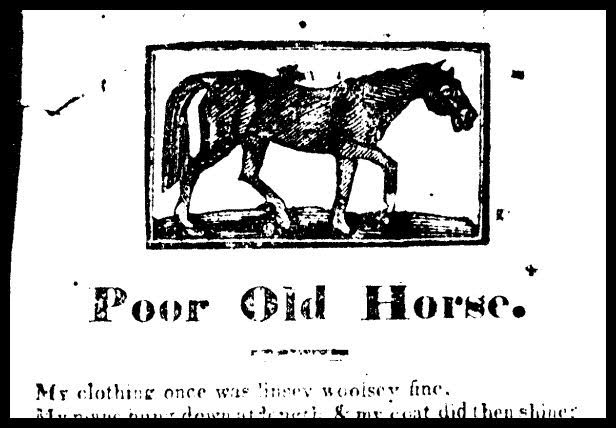
Top of an old ballad sheet-Bodleian Library CC 3.0
We have a poor owd horse
And he’s standing at your door,
And if you wish to let in
He’ll please you all I’m sure.
Poor owd horse, poor owd horse.
He once was a young horse
And in his youthful prime;
His master used to ride on him
And thought him very fine
But now he’s getting owd
And his nature doth decay,
He’s forced to nab yon short grass
That grows beneath yon way.
We’ll whip him, hunt him, slash him
And a-hunting let him go,
Over hedges, over ditches,
Over fancy gates and stiles.
I’ll ride him to the huntsman;
So freely I will give
My body to the hounds then,
I’d rather die than live.
Poor owd horse, poor owd horse.
So goes the song of one of Britain’s house-visiting traditions involving dead horses at Midwinter. The tradition of the Old Horse is mostly found in the area around Sheffield, South Yorkshire, including bits of Nottinghamshire and Derbyshire. The tradition can only be proven to go back to the mid-19th century in this form, but how old is it really? Nobody knows. The church’s Council of Auxerre (circa 578 AD) states that “It is forbidden to masquerade as a bull-calf or stag on the first of January.” A hundred years later the Archbishop of Canterbury expanded the theme in his Liber Penitentialis:
“If anyone at the Kalends of January goes about as a stag or a bull; that is, making himself into a wild animal and dressing in the skin of a herd animal, and putting on the heads of beasts; those who in such wise transform themselves into the appearance of a wild animal, penance for three years because this is devilish.”
Proof that animal disguise has been popular in Europe for a long time. Whether these traditions grew out of the behaviour that was bothering the Archbishop, is another question, along with how long before the 6th century such practices had existed. But since Christianity was still far from being the only game in town in 6th century England, it’s likely that the practice of animal disguise was an old one, whether it was Saxon, Celtic or something else. I’m not even going to speculate on the purpose or meaning of these early customs. I also have doubts that The Old Horse is a direct survival of a pre-Christian ritual, even if I may quietly wish it was!
Like other mumming traditions, The Old Horse has a death and resurrection theme but instead of a human, it’s the horse, itself, which dies and is revived. In some traditions, like Richmond, in the video below, the song is sung while it’s acted out. The horse just crouches down quietly for a moment and is told to “get up” again, at the appropriate moment in the song. I’ve read of an earlier version with a play in which the horse has lost a shoe. A blacksmith is called to shoe it, which the horse resists, but the job is done wrong and the horse dies. Then a farrier is called, who revives the horse with medicine. I don’t know whether that version still exists.
When I watch this video, my thoughts are mixed. The singing is wonderful and adds to the festive midwinter feel, but I find the beating of the horse a bit disturbing, even though it’s just an act. My thoughts turn to peasants stoning hapless donkeys to death in remote Iberian villages, but I suspect that’s a false analogy. In scapegoating, there is rarely any hope of resurrection. In the 19th century, this tradition was a bit of fun and a way to get extra cash and beer. Like The Derby Tup, a similar tradition involving a ram’s head and a mock sheep butchering, perhaps it was also a way of coming to terms with the ever-present reality of the short, sometimes brutal lives of animals, that country people dealt with.
The teams soon got to know which houses were best to visit, and where they would be unwelcome. There is no evidence that the participants thought that their custom was magical or Pagan. They would have all been nominal Christians in the 19th century, and perhaps even pious ones.
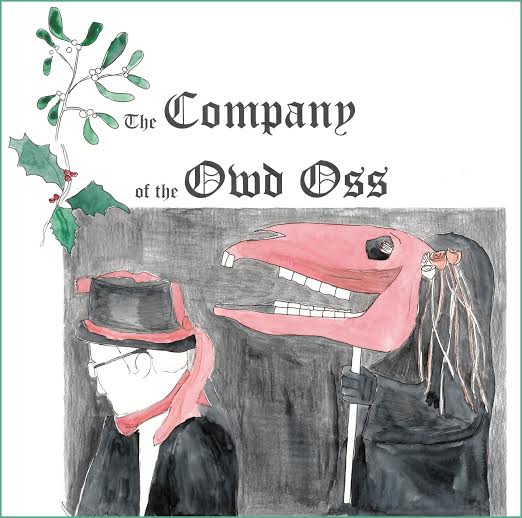
Poster by Sarah Mooney, used with permission
Whatever Pagan-ness that we sense bleeding through these customs is not what motivates most of the current participants. Most of them will tell you they just enjoy doing it and would hate to see it die out, and although their rhetoric often includes the idea that their tradition “goes back to Pagan times”, they rarely sound all that convinced. Dave Mooney, who founded the modern team in Kimberley, Notts. told me:
“I think that the horse may symbolise the season – he’s old and ready to die, just like the old year – but I don’t attach any religious significance to that.”
However, his passion and commitment to the tradition is typical.
“It was my idea to revive the custom. I was quite young at the time, and stumbled on it, accidentally, in a book. I persuaded some friends to help me. I helped to make the first incarnations of the horse (from wood, papier-mâché and chicken wire), and financed the buying of a horse’s skull for the current version. Dobbin is currently stabled in my bedroom.”
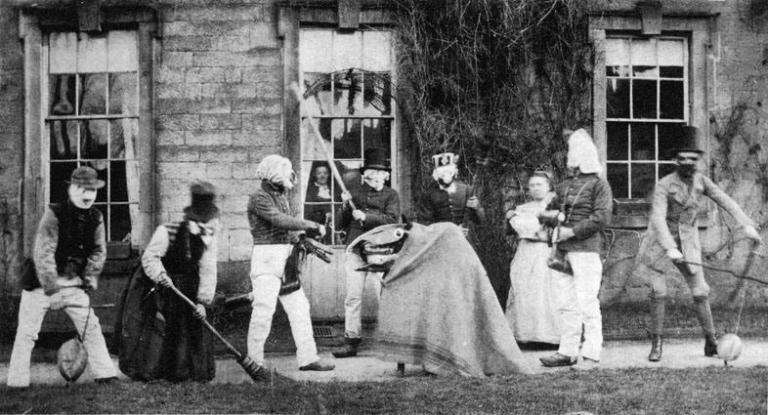
Mummers at Winster Hall, Derbyshire, 1870, Wikimedia Commons
Meanwhile, in Kent (England’s extreme SE corner) is the tradition of Hoodening. The name comes from the “Hooden Horse”. The “H” is often dropped to make it ‘ooden ‘oss and ‘oodening. This tradition also has a lot of singing associated with it — even carol singing and sometimes handbells. Written references to it go back to the mid-18th century, and although individual villages may have gaps, or periods when their horse “slept” for a few decades, it is still going.
In the 19th century, and probably before, the Hoodeners were usually men and boys who worked with the horses on larger farms. The horses were generally turned out over Christmas, giving the men free time, which some of them used to take the horse ’round to other farms or villages. As far as I know, there was no play associated with Hoodening at that time, and no death and resurrection element, although there was still likely to be a groom or wagoner to lead the horse, a man in drag, possibly a “boy” or jockey, and other stock characters.
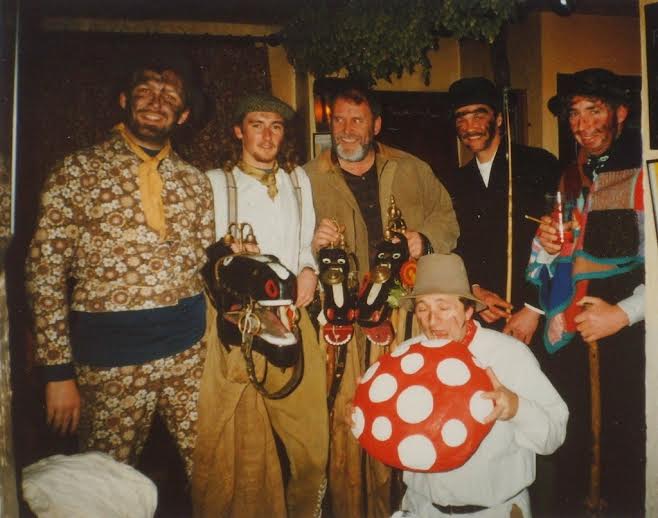
St. Nicholas-at-Wade Hoodeners by Ben Jones, used with permission
The party would arrive and sing songs, the horse typically chased the women, especially servants, and often frightened the children. There would be a lot of joking and “horseplay” and the jockey or some of the onlookers might try to mount the horse. Sometimes the onlookers tried to pull the jockey off the horse, instead. The Hoodeners would be given beer and maybe cake or money before they moved on to their next visit.
Unlike most traditions, which usually have a real horse or pony skull for their horse, the Kentish tradition is to make the horse head out of wood. Although they vary, the style is still distinctive, and can also be just as scary, I think.
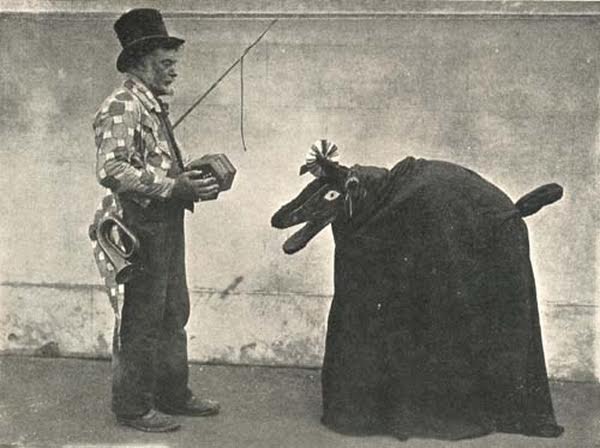
Hoodeners at Deal, Kent 1909 by H B Collis, Wikipedia Public Domain
In modern times it has become more usual to do a play of some kind. At St Nicholas-at-Wade, a village with a long tradition of Hoodening, a new play is written every year, with references to both local and global events worked into the script, and someone dies and is revived. At Whitstable singing is more important, and the play Is more a case of ritualized horseplay with a few lines of dialogue.
Hoodening became pretty rare from the start on the First World War until after the Second, but in Kent they prefer to view that as the tradition just having a little rest, and it is interesting to see how it clawed its way back to popularity again as different groups in different villages decided it was time to bring the horse back into use. “George” of the St Nicholas-at-Wade group spoke to me about it this way:
“In the year I was born [1966], Dobbin started his horseplay in the village again after his nap, and our family has been involved since that year – so I would have been in the audience of course since then, and probably played my first part in it in around 1977.”
George is one of the musicians for the group, but occasionally takes on a role as one of their herd of three horses, which are stabled at his house. He obviously has some deep feelings for them.
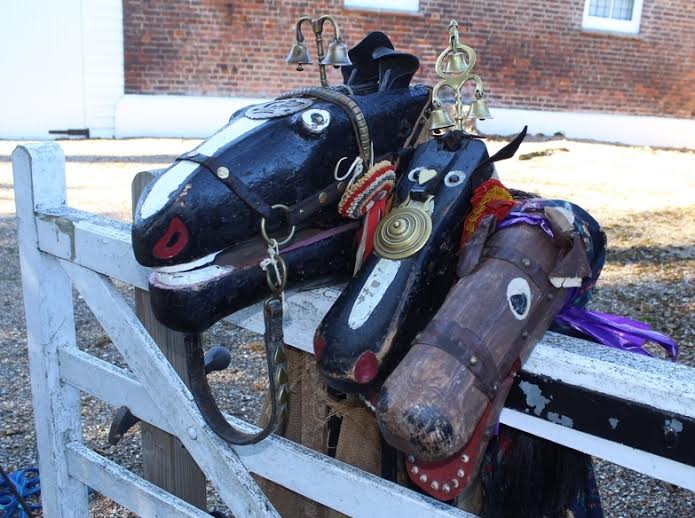
St. Nicholas-at-Wade Horses, Ben Jones, used with permission
“One thing that feels quite special is to carry the horse home at night, particularly on the last night – just me and him, alone in the world, the pub’s normally closed, the village asleep, and (partly no doubt thanks to the beer) we feel invulnerable – even if a car did come, we’d walk in the middle of the road, because it’s our village, we (collectively) have been here centuries longer than those iron horses or other newcomers.”
“We’re also incidentally adamant that the horses (now) are nobody’s possession, they belong in the village, they belong to the village, they live here. If the house caught fire, Dobbin would probably be the first thing I’d rescue.”
About Kris Hughes
Kris Hughes is a nice, older Pagan woman who loves the gods of the Celts. She doesn't claim to be anything in particular, but she might possibly be described as a hedge teacher, a writer, a part time Druid, an exiled Scot, a poet, cartomancer, ritualist, storyteller, or just someone with a lot to say about a lot of things. In the past she has been a professional musician, a farmer, and a horsewoman. She is currently writing a book, working title The Celtic Horse Goddesses: Myth, History and Personal Reflection. Her interests include herbalism, mythology, and British native ponies. She also blogs at her own website Go Deeper. You can read more about the author here.
Previous Post

December 6, 2018
Dance of the Maenad: Top 3 Pop Culture Portrayals of Dionysus
Browse Our Archives
Select a Category A Lakeside Hearth Adventures in Wortcunning Alone In Her Presence Arts, Crafts & Cooking Birthing Hereditary Witchcraft Book of Blackbirds Book Reviews Born-Again Witch Cauldron, Sword, Spear, & Stone Cermony and Liturgy Columns Community Dandelion Seeds Dear Jasmine Druid Thoughts Editor's Picks Everyday Pagan Family & Household Practice Family Traditions Full Frontal Magic Gateway Goddess Guest Articles Happily Heathen Health and Wellness Hearth of Hellenism Heathen Woman Hills of the Horizon History Holidays Horse Goddesses Interfaith Interviews Irish-American Witchcraft Jewish Witch Lamp & Labyrinth Letters from Midgard Literature, Media, Film, Music Loop of Brighid Love, Sex & Relationships Magic or Magick Making Light Naturalistic Traditions Nature News Outside The Circle Pantheisticon Politics Prayers, Poems, Blessings & Stories Queer Femme Mystic Queer of Swords Recipes Ritual and Practice Science and Research Seekers and Guides Seeking the Grail Socially Responsible Magic Spear of Athena Star Made Witch Syncretic Electric Technology The Blooming Staff The Busy Witch The Cartomancer The Crow's Nest The Dance of Pagan Recovery The Hearth of Hellenism The Lady's Quill The Other Side of the Hedge The Path of She The Rantin' Raven The Witches Next Door The Zen Pagan Theology, Ethics, Philosophy Tree City Witch Urban Earthwitch Wayfaring Woman Witch on Fire Wyrd Words
Select a Month January 2026 March 2025 December 2024 June 2024 April 2024 March 2024 January 2024 December 2023 November 2023 October 2023 August 2023 July 2023 May 2023 April 2023 March 2023 February 2023 January 2023 December 2022 November 2022 October 2022 September 2022 August 2022 July 2022 June 2022 May 2022 March 2022 February 2022 January 2022 December 2021 November 2021 October 2021 September 2021 August 2021 July 2021 June 2021 May 2021 April 2021 March 2021 February 2021 January 2021 December 2020 November 2020 October 2020 September 2020 August 2020 July 2020 June 2020 May 2020 April 2020 March 2020 February 2020 January 2020 December 2019 November 2019 October 2019 September 2019 August 2019 July 2019 June 2019 May 2019 April 2019 March 2019 February 2019 January 2019 December 2018 November 2018 October 2018 September 2018 August 2018 July 2018 June 2018 May 2018 April 2018 March 2018 February 2018 January 2018 December 2017 November 2017 October 2017 September 2017 August 2017 July 2017 June 2017 May 2017 April 2017 March 2017 February 2017 January 2017 December 2016 November 2016 October 2016 September 2016 August 2016 July 2016 June 2016 May 2016 April 2016 March 2016 February 2016 January 2016 December 2015 November 2015 October 2015 September 2015 August 2015 July 2015 June 2015 May 2015 April 2015 March 2015 February 2015 January 2015 December 2014 November 2014 October 2014 September 2014 August 2014 July 2014 June 2014 May 2014 April 2014 March 2014 February 2014 January 2014 December 2013 November 2013 October 2013 September 2013 August 2013 July 2013 June 2013 May 2013 April 2013 March 2013 February 2013 January 2013 December 2012 November 2012 October 2012 September 2012 August 2012 July 2012 June 2012 May 2012 April 2012 March 2012 February 2012 January 2012
Follow Us!
TAKE THE
Religious Wisdom Quiz
Who said, "Father, I have sinned against heaven and against you"?
Select your answer to see how you score.
The Lost Sheep The Rich Young Ruler The Prodigal Son The Pharisee
Related posts from Agora

Phoenix Rising: Last-Minute, Easy Yule Gifts on a...

Phoenix Rising: A Book for the Season -...
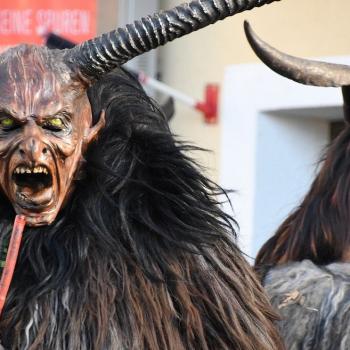
Havamal Mama: Krampusnacht Horned Crown

The DruWitch Way: It Doesn’t Have to Be...
TRENDING AT PATHEOS Pagan

To help with the upcoming holiday season, I'm introducing the Holiday Helper...

10 years of the Power Sigil & Moving...
Last week while reorganizing my studio space, I found the sketchbook that...

Why are younger seekers drawn to Paganism and...
One of the things I've noticed the most is that I'm far...

When we talk about Greek religion, we often begin with the dodekatheion—the...

I was recently chatting with someone on Instagram. She asked me what...

On July 23, I saw Christopher Nolan's The Odyssey which is Homer’s...
view all Pagan blogs
Ad-Free & Subscriber Log-In Subscription Support
- About Us
- 2026 Calendar
- Videos
- Podcasts
- Library of World Religions
- Faith In Media Tracker
- Advertise With Us
- Write for Us
- Privacy Policy
- Terms of Service
- Do Not Sell My Data
- Contact Us
- Radiant Digital
- Manage Newsletter Subscriptions
- Unsubscribe From Notifications
- Sitemap
Copyright 2008-2026, Patheos, part of the Radiant Digital network of media brands. All rights reserved.
Subscription Support Ad-Free & Subscriber Log-In
Follow Patheos