
BuddhistCatholicContemplativeEvangelicalGeneral ChristianHinduJewishLatter-day SaintMuslimNew VisionsProgressive Christian
Beliefs
- Buddhist
- Catholic
- Contemplative
- Evangelical
- General Christian
- Hindu
- Jewish
- Latter-day Saint
- More Voices
- Muslim
- New Visions
- Pagan
- Progressive Christian
Topics
- Religion News
- Food and Religion
- Sports and Religion
- Religious Art
- Religious Music and Entertainment
- Religious Events
- History and Religion
- Style and Religion
- Politics and Religion
- Women in Religion
- Recreation Outdoors and Religion
- Business Finance and Religion
- Careers Workplace and Religion
- Education and Religion
- Family Parenting and Religion
- Health Fitness and Religion
- Home and Religion
- Relationships and Religion
- Technology and Religion
- Travel and Religion
Columnists
- Buddhist Columnists
- Business Finance and Religion Columnists
- Careers Workplace and Religion Columnists
- Catholic Columnists
- Contemplative Columnists
- Education and Religion Columnists
- Evangelists Columnists
- Family Parenting and Religion Columnists
- General Christian Columnists
- Health Fitness and Religion Columnists
- Hindu Columnists
- History and Religion Columnists
- Home and Religion Columnists
- Jewish Columnists
- More Voices Columnists
- Latter Day Columnists
- Muslim Columnists
- New Visions Columnists
- Nonreligious Columnists
- Pagan Columnists
- Politics and Religion Columnists
- Progressive Columnists
- Recreation Outdoors and Religion Columnists
- Relationships and Religion Columnists
- Religion News Columnists
- Religious Art Columnists
- Religious Events Columnists
- Religious Music and Entertainment Columnists
- Sports and Religion Columnists
- Style and Religion Columnists
- Technology and Religion Columnists
- Travel and Religion Columnists
- Women in Religion Columnists
Resource Library
- 2026 Calendar
- Library of World Religions
- The 100 Most Holy Places on Earth
- Patheos Answers
- Podcasts
- Videos
- Faith Leaders Database
- Anglican Episcopalian
- Bahai
- Baptist
- Buddhism
- Christianity
- Confucianism
- Eastern Orthodoxy
- Hinduism
- Holiness and Pentecostal
- ISKCON
- Islam
- Judaism
- Lutheran
- Methodist
- The Church of Jesus Christ of Latter-day Saints
- New Age
- Paganism
- Presbytarian and Reformed
- Protestantism
- Religion Behind the Scenes
- Roman Catholic
- Scientology
- Shia Islam
- Sikhism
- Sufism
- Sunni Islam
- Taoism
- Zen
- See all religions
Research Tools
 Ad-Free & Subscriber Log-In Subscription Support
Ad-Free & Subscriber Log-In Subscription Support
Follow Patheos 

- Trending:
- Forgiveness
- |
- Marriage
- |
- Consciousness
- |
- Death Penalty
- |
- Election
- |
- Halloween

- Home
- Pagan
- Hearth of Hellenism: Separation of Church and State – Greece After Orthodoxy
Hearth of Hellenism: Separation of Church and State – Greece After Orthodoxy
Last updated on: November 12, 2018 at 5:25 pm by Angelo Nasios
Hearth of Hellenism: Separation of Church and State – Greece After Orthodoxy 2018-11-12T17:25:05+00:00 Angelo Nasios
Patheos Explore the world's faith through different perspectives on religion and spirituality! Patheos has the views of the prevalent religions and spiritualities of the world.
I have a dream that one day the Greek people will be liberated from Orthodoxy and fully revive Hellenism. This dream may not be so farfetched as recent news reports that Greece is planning to follow the secular example of other European countries and separate State from Church.
For those who do not know, the Orthodox Church is deeply rooted in state affairs. Article 3 of the Greek Constitution, Relationship of Church and State, acknowledges that the “…prevailing religion in Greece is that of the Eastern Orthodox Church of Christ. The Orthodox Church of Greece, acknowledging our Lord Jesus Christ as its head, is inseparably united in doctrine with the Great Church of Christ in Constantinople…” The political cartoon below criticizes the deep “roots” by showing the Church built on a tree stomp (perhaps the cutdown tree of Hellenism) with its roots breaking through all the institutions of the State (education, military, judicial, and so on). It reads, “The Church has deep roots in Greek society!”
— Πάνος Ζάχαρης (@Panos_Zacharis) October 13, 2017
The disproportionate power and influence of the Orthodox Church in Greece have resulted in Greece’s poor ranking in international ratings for freedom of religion. Humanists UK reports that “Greece’s blasphemy law is actively enforced and continues to be among the worst in Europe. Prayer and religious instruction are mandatory in Greek schools, and even secular courts are adorned in Christian imagery.” I myself have been to court in Greece; it was very unnerving to see an icon of Jesus behind the judge hanging on the wall.
Not all Priests are in agreement with the proposed split as many vow a “holy war” against the Prime Minister. I do think it is a losing battle for them. The Church and State will separate eventually but the people are split over this. Some believe it will have negative consequences for the country, viewing this as an attempt to change the national character. Some look forward to the split citing that the Church is a drain on the country. The Guardian reports that “[t]he Greek church is by far the country’s richest institution with hotels, enterprises and other assets in its portfolio. The scale of such wealth frequently caused friction during Greece’s long-running financial crisis. Under the deal, revenues from properties whose ownership has been contested since the early 1950s would be split 50-50.” Maybe their so called “holy war” is really over euros.
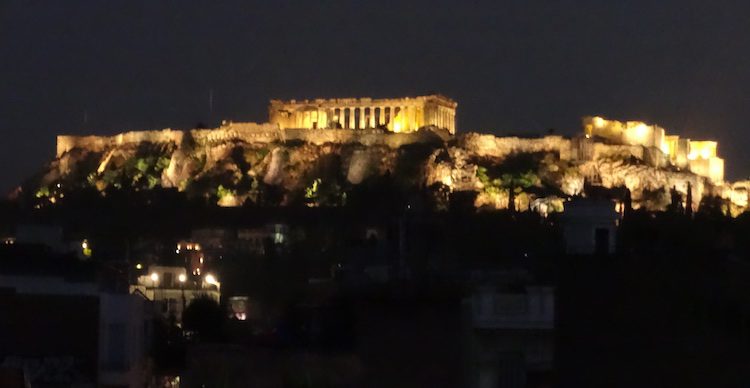
The Acropolis-Athens
Obviously, I think separation will be a positive change on the national character of the country. I see more opportunities for Hellenism’s revival with the separation. The removal of the Church from matters such as education means the end of indoctrination and propaganda via mandatory religious instruction. With time Hellenism will naturally fill in the void which will then eventually lead to wider activation. I say “wider activation” because Hellenism is not missing in Greece; it is just underutilized. Hellenism is in the schools, children read Homer in ancient Greek, learn mythology, and of course ancient history. However, it does not go deep enough from what I gathered from my conversation with my teenage cousin in Greece. The serious stuff is always saved for higher education. What is lacking in public education which makes it shallow is the absence of meaningful exegesis, at least with the case of my cousin, but I think it is safe to assume it is the norm. How much exegesis can a Christian teacher provide on the real meaning behind the myths? If any teacher who was wiser on the subject did try to give meaningful exegesis, I suspect they would face some kind of repercussions.
Hellenism is not missing as many engage with it on an academic level. Those who do not participate in the academic level still experience it through various ways. Many engage in personal study, have pride in their local ancient sites/local stories, work at museums or as tour guides. Driving to Delphi with my younger cousins, their father looked at them from the rearview mirror and asked them, “do you know where we are going? We’re going to the center of the world!” However, out of those who are engaged with Hellenism; how many activate it by offering libations to the Gods or put into practice the ethics/philosophy? Activating Hellenism means disseminating knowledge to the broader population, making it accessible, desirable, and viable as a living tradition again. This will encourage people to take the leap and put into practice the whole of the tradition. Hellenism can recapture people’s heart completely once more. I would love to see more theatrical performances such as this the Abduction of Dionysus by the Tyrrhenian Pirates. How can this not stir the soul to activation? I will never forget my experience of watching a play in the Roman era theatre of my city as a child, Hellenism captivates easily.
With the likelihood of a constitutional change to establish religious neutrality, Hellenism can be brought back as the central fixture of Greek society. It all begins with educating the next generation to love Hellenism enough to activate it themselves. Secularism, I think, will actually open the door for Hellenism on its own without anyone needing to push it. It will naturally rise again to blossom like a flower pushing up through the earth to see the light of day.
As for the Greeks of the diaspora, I think there are challenges but potential nonetheless. I live in New York, first generation on my father’s side. I have always been detached from the Church, my heart was never into it. I have cousins here who are also detached from the Church. My aunt came into town recently and we talked about religion and history. She is active in the church but thinks most of the religion feels irrelevant today; she gets what she can out of it. I said that maybe it feels irrelevant because it’s showing signs of inauthenticity. I explained that while Orthodoxy does have Greek elements, many in fact, it is laid over with Jewish theology that has been syncretized with some Greek philosophy. The meaning behind the Greek elements are not properly taught because of the change in theology, which makes it unrelatable in my opinion. The Greeks are walking around with a fake Prada bag thinking it’s the real deal (in terms of Orthodoxy being “Greek religion”) I told her. She understood my position and did not protest it.
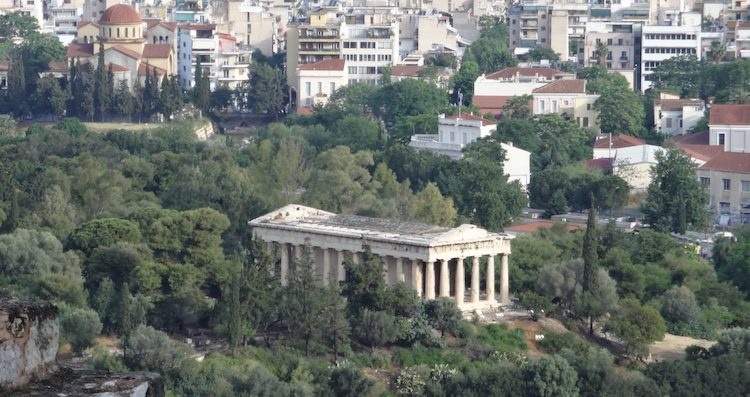
Temple of Hephaestus-Athens.
Our conversation got me thinking that Hellenism may have more potential in the diaspora than I originally thought. People like me who are somewhat removed – a generation or two could become interested in Hellenism. There are plenty of Greeks in the diaspora like my aunt (getting little out of the church) and cousins (not involved with the church) who might want Hellenism if they knew it was a valid option today. For those who do not know that Hellenism is viable, end up staying in the Church out of habit/social needs/family pressure or they reject it; becoming atheists.
Identity ultimately keeps most Greeks affiliated with Orthodoxy. A recent Pew Research poll revealed that in Greece three-quarters of Greeks agree that being Orthodox is “at least somewhat important to being truly Greek.” The same may be loosely said of the diaspora. However, in the diaspora, there’s a tendency for Greeks to be more strict concerning religion. Greeks have always defined themselves through their religion. A conservative position on religion within the diaspora serves to reinforce Greek identity as to not lose the culture. The identification between Orthodoxy and Greek identity because of this may actually be higher in the diaspora. Within my family, my uncle (born in Greece) cannot think about Greek identity without Orthodoxy, my mother (second generation American) on the other hand can comprehend the separation between religion and identity.
Additionally, the poll revealed “[n]ine-in-ten Greeks (92%) believe in God – including 59% who say they believe with absolute certainty.” Greece has always been a very religious country wither it be polytheistic or monotheistic. Because of the high belief in God, I think the adoption of the Greek religion is possible with the right education and time to undo the damage done by the Church. Because of the Church’s influences of education, knowledge on ancient Greek religion is limited, some even not knowing it existed. Greeks in the diaspora also tend to have high rates of belief in God as I gather from my experience. The biggest advantage of being in the diaspora is religious freedom, legal protection, and easy access to information which makes it easier to question and challenge the status quo. Persecution at work and social ostracism are two reasons why many avoid openly activating Hellenism in Greece, while in the diaspora openly practicing Hellenism can cause friction within the family.
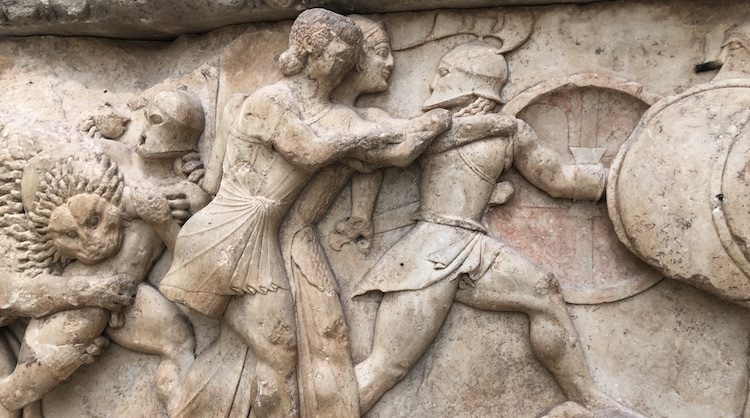
Relief from Eleusis.
Normalizing Hellenism will aid to remedy any problems. Already in Greece after decades of legal fighting on the part of the Supreme Council of Ethnic Hellenes (YSEE), the Hellenic religion received legal status as a “known religion” in 2017. Religious neutrality via constitutional amendment will only further normalization.
Time is our friend, it only took 60 years for Christianity to dominate the Roman empire; supplanting polytheism and philosophy. I am hopeful that the tide will turn once again and Hellenism will take back its rightful place in Greek society as the standard.

Next Post

November 14, 2018 Between Two Worlds: Post Samhain Musings From New Mexico
Browse Our Archives
Select a Category A Lakeside Hearth Adventures in Wortcunning Alone In Her Presence Arts, Crafts & Cooking Birthing Hereditary Witchcraft Book of Blackbirds Book Reviews Born-Again Witch Cauldron, Sword, Spear, & Stone Cermony and Liturgy Columns Community Dandelion Seeds Dear Jasmine Druid Thoughts Editor's Picks Everyday Pagan Family & Household Practice Family Traditions Full Frontal Magic Gateway Goddess Guest Articles Happily Heathen Health and Wellness Hearth of Hellenism Heathen Woman Hills of the Horizon History Holidays Horse Goddesses Interfaith Interviews Irish-American Witchcraft Jewish Witch Lamp & Labyrinth Letters from Midgard Literature, Media, Film, Music Loop of Brighid Love, Sex & Relationships Magic or Magick Making Light Naturalistic Traditions Nature News Outside The Circle Pantheisticon Politics Prayers, Poems, Blessings & Stories Queer Femme Mystic Queer of Swords Recipes Ritual and Practice Science and Research Seekers and Guides Seeking the Grail Socially Responsible Magic Spear of Athena Star Made Witch Syncretic Electric Technology The Blooming Staff The Busy Witch The Cartomancer The Crow's Nest The Dance of Pagan Recovery The Hearth of Hellenism The Lady's Quill The Other Side of the Hedge The Path of She The Rantin' Raven The Witches Next Door The Zen Pagan Theology, Ethics, Philosophy Tree City Witch Urban Earthwitch Wayfaring Woman Witch on Fire Wyrd Words
Select a Month January 2026 March 2025 December 2024 June 2024 April 2024 March 2024 January 2024 December 2023 November 2023 October 2023 August 2023 July 2023 May 2023 April 2023 March 2023 February 2023 January 2023 December 2022 November 2022 October 2022 September 2022 August 2022 July 2022 June 2022 May 2022 March 2022 February 2022 January 2022 December 2021 November 2021 October 2021 September 2021 August 2021 July 2021 June 2021 May 2021 April 2021 March 2021 February 2021 January 2021 December 2020 November 2020 October 2020 September 2020 August 2020 July 2020 June 2020 May 2020 April 2020 March 2020 February 2020 January 2020 December 2019 November 2019 October 2019 September 2019 August 2019 July 2019 June 2019 May 2019 April 2019 March 2019 February 2019 January 2019 December 2018 November 2018 October 2018 September 2018 August 2018 July 2018 June 2018 May 2018 April 2018 March 2018 February 2018 January 2018 December 2017 November 2017 October 2017 September 2017 August 2017 July 2017 June 2017 May 2017 April 2017 March 2017 February 2017 January 2017 December 2016 November 2016 October 2016 September 2016 August 2016 July 2016 June 2016 May 2016 April 2016 March 2016 February 2016 January 2016 December 2015 November 2015 October 2015 September 2015 August 2015 July 2015 June 2015 May 2015 April 2015 March 2015 February 2015 January 2015 December 2014 November 2014 October 2014 September 2014 August 2014 July 2014 June 2014 May 2014 April 2014 March 2014 February 2014 January 2014 December 2013 November 2013 October 2013 September 2013 August 2013 July 2013 June 2013 May 2013 April 2013 March 2013 February 2013 January 2013 December 2012 November 2012 October 2012 September 2012 August 2012 July 2012 June 2012 May 2012 April 2012 March 2012 February 2012 January 2012
Follow Us!
TAKE THE
Religious Wisdom Quiz
Which prophet stood watch on a rampart to hear from God?
Select your answer to see how you score.
Ezekiel Habakkuk Joel Amos
Related posts from Agora

Simple Witchery: To Keep Silent

Simple Witchery: Leaning On The Four Pillars

Pergamum Unfurled: Magic with the Greek Gods (Book...

Pergamum Unfurled: Cunning Words (Review)
TRENDING AT PATHEOS Pagan

I was recently chatting with someone on Instagram. She asked me what...

While there are many people who share their results, the end of...

On July 23, I saw Christopher Nolan's The Odyssey which is Homer’s...

As I write this two big events have just finished up. One...

Restoring the Watershed of Divine Love
Perhaps cooperation is not something we manufacture through legislation, ideology, or moral...

Many UUs don’t pray because of bad experiences in a previous religion,...
view all Pagan blogs
Ad-Free & Subscriber Log-In Subscription Support
- About Us
- 2026 Calendar
- Videos
- Podcasts
- Library of World Religions
- Faith In Media Tracker
- Advertise With Us
- Write for Us
- Privacy Policy
- Terms of Service
- Do Not Sell My Data
- Contact Us
- Radiant Digital
- Manage Newsletter Subscriptions
- Unsubscribe From Notifications
- Sitemap
Copyright 2008-2026, Patheos. All rights reserved.
Subscription Support Ad-Free & Subscriber Log-In
Follow Patheos