
BuddhistCatholicContemplativeEvangelicalGeneral ChristianHinduJewishLatter-day SaintMuslimNew VisionsProgressive Christian
Beliefs
- Buddhist
- Catholic
- Contemplative
- Evangelical
- General Christian
- Hindu
- Jewish
- Latter-day Saint
- More Voices
- Muslim
- New Visions
- Pagan
- Progressive Christian
Topics
- Religion News
- Food and Religion
- Sports and Religion
- Religious Art
- Religious Music and Entertainment
- Religious Events
- History and Religion
- Style and Religion
- Politics and Religion
- Women in Religion
- Recreation Outdoors and Religion
- Business Finance and Religion
- Careers Workplace and Religion
- Education and Religion
- Family Parenting and Religion
- Health Fitness and Religion
- Home and Religion
- Relationships and Religion
- Technology and Religion
- Travel and Religion
Columnists
- Buddhist Columnists
- Business Finance and Religion Columnists
- Careers Workplace and Religion Columnists
- Catholic Columnists
- Contemplative Columnists
- Education and Religion Columnists
- Evangelists Columnists
- Family Parenting and Religion Columnists
- General Christian Columnists
- Health Fitness and Religion Columnists
- Hindu Columnists
- History and Religion Columnists
- Home and Religion Columnists
- Jewish Columnists
- More Voices Columnists
- Latter Day Columnists
- Muslim Columnists
- New Visions Columnists
- Nonreligious Columnists
- Pagan Columnists
- Politics and Religion Columnists
- Progressive Columnists
- Recreation Outdoors and Religion Columnists
- Relationships and Religion Columnists
- Religion News Columnists
- Religious Art Columnists
- Religious Events Columnists
- Religious Music and Entertainment Columnists
- Sports and Religion Columnists
- Style and Religion Columnists
- Technology and Religion Columnists
- Travel and Religion Columnists
- Women in Religion Columnists
Resource Library
- 2026 Calendar
- Library of World Religions
- The 100 Most Holy Places on Earth
- Patheos Answers
- Podcasts
- Videos
- Faith Leaders Database
- Anglican Episcopalian
- Bahai
- Baptist
- Buddhism
- Christianity
- Confucianism
- Eastern Orthodoxy
- Hinduism
- Holiness and Pentecostal
- ISKCON
- Islam
- Judaism
- Lutheran
- Methodist
- The Church of Jesus Christ of Latter-day Saints
- New Age
- Paganism
- Presbytarian and Reformed
- Protestantism
- Religion Behind the Scenes
- Roman Catholic
- Scientology
- Shia Islam
- Sikhism
- Sufism
- Sunni Islam
- Taoism
- Zen
- See all religions
Research Tools
 Ad-Free & Subscriber Log-In Subscription Support
Ad-Free & Subscriber Log-In Subscription Support
Follow Patheos 

- Trending:
- Forgiveness
- |
- Marriage
- |
- Consciousness
- |
- Death Penalty
- |
- Election
- |
- Halloween

- Home
- Pagan
- Hearth of Hellenism: How Are We Equals with the Gods?
Hearth of Hellenism: How Are We Equals with the Gods?
Last updated on: October 15, 2018 at 11:20 pm by Angelo Nasios
Hearth of Hellenism: How Are We Equals with the Gods? 2018-10-15T23:20:02+00:00 Angelo Nasios
Patheos Explore the world's faith through different perspectives on religion and spirituality! Patheos has the views of the prevalent religions and spiritualities of the world.
The article I wrote in August, Freedom from Spiritual Slavery, left a bad taste in the mouths of some of my readers. I was charged with being hubris when I wrote that we “approach the gods as equals” in worship. The article was a complaint against contemporary Orthodox Christian behavior and its incompatibility with Hellenism. In Orthodox Christianity, humans are called servants/slaves (δοῦλος/doulos) of God. This is against the principles of Hellenism to think of yourself as a slave to any God because of your human nature.
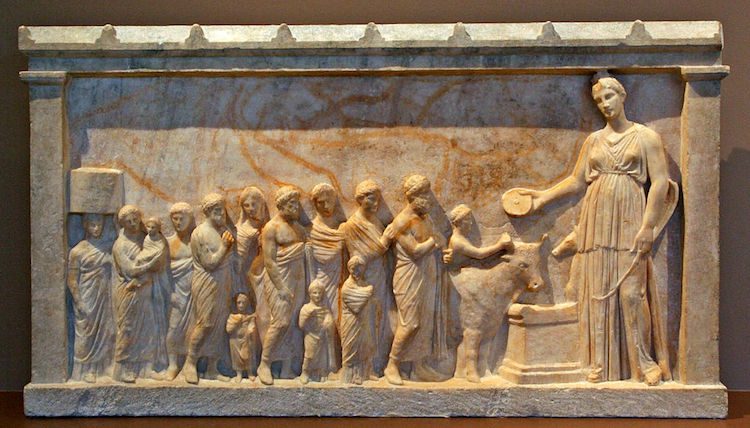
Aristonike, the wife of Antiphates from the deme of Thorai prayed and dedicated to Artemis, via WikiMedia.
The Orthodox concept of “servant of God” is the result of a distortion of the Greek tradition. Yes, there were “servants” of gods but it meant something different. At the bottom of the social structure of Mycenaean Greece (1600-1100 BCE), there was the do(h)elos “salve” or “unfree” in contrast to the eleutheros “free.” These terms designated legal status tied to land ownership. The unfree could not own land but could hold leases. There’s an inscription which says “Idomeneia, a do(h)ela of a deity, holds an onaton-lease on a ktoina kekkesmena from the damos.”[1] Idomeneia was a servant of a deity meaning she was connected to a temple. Temples needed people to maintain them, Idomeneia was someone who managed a temple estate. Being that she obtained a lease, she held exceptional status in the community.
Do(h)elos would over time be distorted, in the Orthodox understanding of someone who’s status was of direct and personal subrogation to God or to the emperor, as was the case in the Byzantine Empire.[2] In classical Greece, Socrates makes a reference to being a co-servant ὁμόδουλός (along with the swans) to Apollo, his master.[3] The relationship between Socrates and Apollo and what is being conveyed there is not a universally applicable for everyone and needs contemplation upon this individual case. Socrates probably accepted the role of doulos and Apollo to be his “master.” It seems to me Socrates became a “servant” of Apollo to fulfill a specific role on earth.
It is the manipulated use of doulos which causes some today to worship in a way which is humiliating and degrading. In Christianity, God is God, and we are not God, we are sinful humans born of low cosmological status, servants of God; subordinates. This is far from the truth of Hellenism that humans and gods have equality between them. Are we equal to the Gods? Yes and no. Like most things, there needs explanation.
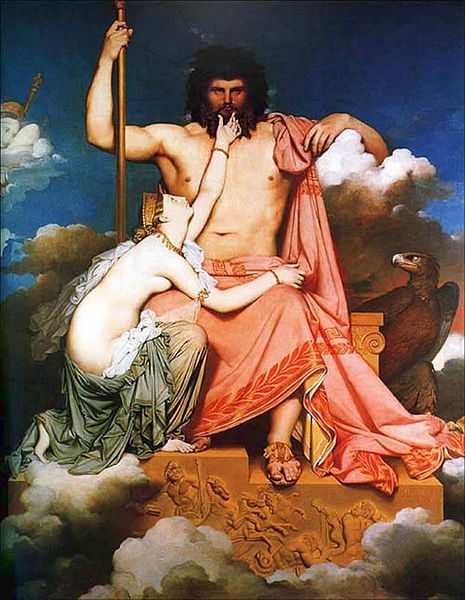
“Zeus and Thetis” by Jean Auguste Dominique Ingres. From WikiMedia.
Firstly, equality with the gods is not hubris. It would be hubris to think of ourselves as better than the Gods. For anyone to elevate themselves beyond the gods is hubris because it is impossible to be above the gods. Queen Niobe learned this lesson the hard way.
Queen Niobe believed herself to be better than Leto (mother of Apollo and Artemis) because she thought herself to be more fertile, having birthed fourteen children. She thought fourteen mortal children were better than two divine children. Thus, her hubris lead to the death of her children, Apollo killed her seven sons and Artemis killed her seven daughters. This myth demonstrates the harmonizing power of the Gods, who seek to maintain equilibrium in the cosmos.
Secondly, to be equal with the gods does not mean we are the same as the Gods. Clearly, we are different, as evident by the physical bodies that die which we inhabit. The Gods are deathless and do not have bodies like us. However, this difference does not mean we are inferior or lack equality simply because we have bodies and they do not. To quote Heraclitus “What are men? Mortal gods. What are gods? Immortal men.” The line between us is thin. The differences do not warrant a negative self-imagine or for us to adopt a meek attitude of ourselves. Plutarch calls Apollo “friend” φιλος.[4]There can only be equality between friends, it is the only way for friendship to be real. Friendship is the “most pleasant thing in the world”[5] and because it is most pleasant thing, it can be achieved with the Gods.
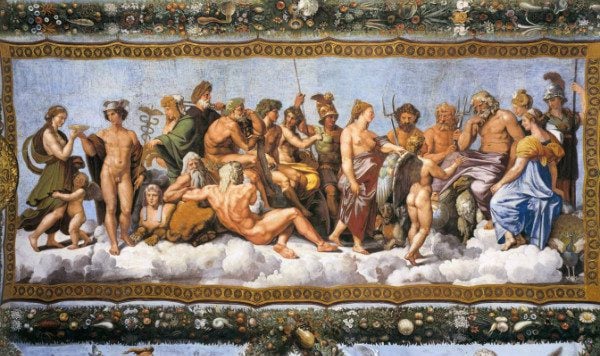
Our friendship with the Gods is possible through a fundamental cosmological relationship. Humanity has divine origins. Hesiod tells us in Works and Days that “…from the same origin are sprung gods and mortal men.” The vast orphic literature also testifies to our divine origins.
First (I have sung) the vast necessity of ancient Chaos,
And Cronus, who in the boundless tracts brought forth
The Ether, and the splendid and glorious Eros of a two-fold nature,
The illustrious father of night, existing from eternity.
Whom men call Phanes, for he first appeared.
I have sung the birth of powerful Brimo (Hecate), and the unhallowed deeds
Of the earth-born (giants), who showered down from heaven
Their blood, the lamentable seed of generation, from whene sprung
The race of mortals, who inhabit the boundless earth for ever.
(Orphic Fragment Arg. v. 12)
The Orphic Hymn to Protogonus identifies Protogonus as the “procreator of the blessed gods and mortal men.” In addition to these two sources, we can find the idea of humanity’s divine nature found in the Zagreus myth. Zagreus (Dionysus), the son of Zeus and Persephone, was given his father’s throne. The jealous Titans lured the baby Dionysus away from the protection of the Kouretes. Using toys to distract the baby, they tore him to pieces. Athena saved the heart of Dionysus, gave it to Zeus and Apollo buried the limbs on Mt. Parnassus. Zeus with the lightning bolt destroyed the Titans. From the soot of the burnt Titans, humans were created. Because the Titans had eaten a portion of Dionysus, humans are dual natured, comprised of Dionysiac and Titanic elements. It is our Dionysiac element which extends equality between the Gods and us. While we have Titanic bodies, our souls are divine, and it is because of this we are equal in this regard. Thus, as I explained in the original article, in worship, we behave in a manner appropriate that recognizes and honors the Dionysiac portion of ourselves.
All this that I explained is why Greeks approach the Gods in ritual/worship as equals. As the votive relief below demonstrates to us this idea in practice. Below you will see worshipers bringing a sacrifice to Artemis. All figures are standing including Artemis. Though she is larger in size (signifying her divinity) the people stand as well, acting appropriately for the worship they are engaging in. It is not hubris to see our relationship with the Gods as one based on equality. It is the greatest gift we have.
Notes
[1] Parker, Victor. A History of Greece: 1300 to 30 BC. Chichester, West Sussex: John Wiley & Sons, 2014. 38.
2 Rotman, Youval, and Jane Marie Todd. Byzantine Slavery and the Mediterranean World. Cambridge, MA: Harvard University Press, 2009. 167.
3 Plato, Phaedo
4 Plutarch, On the E at Delphi
5 Plutarch, Moralia. How to Tell a Flatterer from a Friend
Previous Post

October 10, 2018
21st Century Viking: My Community, My Cornerstone

Browse Our Archives
Select a Category A Lakeside Hearth Adventures in Wortcunning Alone In Her Presence Arts, Crafts & Cooking Birthing Hereditary Witchcraft Book of Blackbirds Book Reviews Born-Again Witch Cauldron, Sword, Spear, & Stone Cermony and Liturgy Columns Community Dandelion Seeds Dear Jasmine Druid Thoughts Editor's Picks Everyday Pagan Family & Household Practice Family Traditions Full Frontal Magic Gateway Goddess Guest Articles Happily Heathen Health and Wellness Hearth of Hellenism Heathen Woman Hills of the Horizon History Holidays Horse Goddesses Interfaith Interviews Irish-American Witchcraft Jewish Witch Lamp & Labyrinth Letters from Midgard Literature, Media, Film, Music Loop of Brighid Love, Sex & Relationships Magic or Magick Making Light Naturalistic Traditions Nature News Outside The Circle Pantheisticon Politics Prayers, Poems, Blessings & Stories Queer Femme Mystic Queer of Swords Recipes Ritual and Practice Science and Research Seekers and Guides Seeking the Grail Socially Responsible Magic Spear of Athena Star Made Witch Syncretic Electric Technology The Blooming Staff The Busy Witch The Cartomancer The Crow's Nest The Dance of Pagan Recovery The Hearth of Hellenism The Lady's Quill The Other Side of the Hedge The Path of She The Rantin' Raven The Witches Next Door The Zen Pagan Theology, Ethics, Philosophy Tree City Witch Urban Earthwitch Wayfaring Woman Witch on Fire Wyrd Words
Select a Month January 2026 March 2025 December 2024 June 2024 April 2024 March 2024 January 2024 December 2023 November 2023 October 2023 August 2023 July 2023 May 2023 April 2023 March 2023 February 2023 January 2023 December 2022 November 2022 October 2022 September 2022 August 2022 July 2022 June 2022 May 2022 March 2022 February 2022 January 2022 December 2021 November 2021 October 2021 September 2021 August 2021 July 2021 June 2021 May 2021 April 2021 March 2021 February 2021 January 2021 December 2020 November 2020 October 2020 September 2020 August 2020 July 2020 June 2020 May 2020 April 2020 March 2020 February 2020 January 2020 December 2019 November 2019 October 2019 September 2019 August 2019 July 2019 June 2019 May 2019 April 2019 March 2019 February 2019 January 2019 December 2018 November 2018 October 2018 September 2018 August 2018 July 2018 June 2018 May 2018 April 2018 March 2018 February 2018 January 2018 December 2017 November 2017 October 2017 September 2017 August 2017 July 2017 June 2017 May 2017 April 2017 March 2017 February 2017 January 2017 December 2016 November 2016 October 2016 September 2016 August 2016 July 2016 June 2016 May 2016 April 2016 March 2016 February 2016 January 2016 December 2015 November 2015 October 2015 September 2015 August 2015 July 2015 June 2015 May 2015 April 2015 March 2015 February 2015 January 2015 December 2014 November 2014 October 2014 September 2014 August 2014 July 2014 June 2014 May 2014 April 2014 March 2014 February 2014 January 2014 December 2013 November 2013 October 2013 September 2013 August 2013 July 2013 June 2013 May 2013 April 2013 March 2013 February 2013 January 2013 December 2012 November 2012 October 2012 September 2012 August 2012 July 2012 June 2012 May 2012 April 2012 March 2012 February 2012 January 2012
Follow Us!
TAKE THE
Religious Wisdom Quiz
What did Peter see in his vision on the rooftop in Joppa?
Select your answer to see how you score.
A ladder reaching to heaven A burning bush A large sheet with unclean animals An angel with a sword
Related posts from Agora
The Corner Crone: Modern Witchcraft with the Greek...
Hadrian’s Garden: How Can I Believe in Monsters...

The Corner Crone: Personal Agency, Healthy Boundaries &...
Hearth of Hellenism: The Cult of Academia
TRENDING AT PATHEOS Pagan

I was recently chatting with someone on Instagram. She asked me what...

While there are many people who share their results, the end of...

On July 23, I saw Christopher Nolan's The Odyssey which is Homer’s...

As I write this two big events have just finished up. One...

Restoring the Watershed of Divine Love
Perhaps cooperation is not something we manufacture through legislation, ideology, or moral...

Many UUs don’t pray because of bad experiences in a previous religion,...
view all Pagan blogs
Ad-Free & Subscriber Log-In Subscription Support
- About Us
- 2026 Calendar
- Videos
- Podcasts
- Library of World Religions
- Faith In Media Tracker
- Advertise With Us
- Write for Us
- Privacy Policy
- Terms of Service
- Do Not Sell My Data
- Contact Us
- Radiant Digital
- Manage Newsletter Subscriptions
- Unsubscribe From Notifications
- Sitemap
Copyright 2008-2026, Patheos. All rights reserved.
Subscription Support Ad-Free & Subscriber Log-In
Follow Patheos