
BuddhistCatholicContemplativeEvangelicalGeneral ChristianHinduJewishLatter-day SaintMuslimNew VisionsProgressive Christian
Beliefs
- Buddhist
- Catholic
- Contemplative
- Evangelical
- General Christian
- Hindu
- Jewish
- Latter-day Saint
- More Voices
- Muslim
- New Visions
- Pagan
- Progressive Christian
Topics
- Religion News
- Food and Religion
- Sports and Religion
- Religious Art
- Religious Music and Entertainment
- Religious Events
- History and Religion
- Style and Religion
- Politics and Religion
- Women in Religion
- Recreation Outdoors and Religion
- Business Finance and Religion
- Careers Workplace and Religion
- Education and Religion
- Family Parenting and Religion
- Health Fitness and Religion
- Home and Religion
- Relationships and Religion
- Technology and Religion
- Travel and Religion
Columnists
- Buddhist Columnists
- Business Finance and Religion Columnists
- Careers Workplace and Religion Columnists
- Catholic Columnists
- Contemplative Columnists
- Education and Religion Columnists
- Evangelists Columnists
- Family Parenting and Religion Columnists
- General Christian Columnists
- Health Fitness and Religion Columnists
- Hindu Columnists
- History and Religion Columnists
- Home and Religion Columnists
- Jewish Columnists
- More Voices Columnists
- Latter Day Columnists
- Muslim Columnists
- New Visions Columnists
- Nonreligious Columnists
- Pagan Columnists
- Politics and Religion Columnists
- Progressive Columnists
- Recreation Outdoors and Religion Columnists
- Relationships and Religion Columnists
- Religion News Columnists
- Religious Art Columnists
- Religious Events Columnists
- Religious Music and Entertainment Columnists
- Sports and Religion Columnists
- Style and Religion Columnists
- Technology and Religion Columnists
- Travel and Religion Columnists
- Women in Religion Columnists
Resource Library
- 2026 Calendar
- Library of World Religions
- The 100 Most Holy Places on Earth
- Patheos Answers
- Podcasts
- Videos
- Faith Leaders Database
- Anglican Episcopalian
- Bahai
- Baptist
- Buddhism
- Christianity
- Confucianism
- Eastern Orthodoxy
- Hinduism
- Holiness and Pentecostal
- ISKCON
- Islam
- Judaism
- Lutheran
- Methodist
- The Church of Jesus Christ of Latter-day Saints
- New Age
- Paganism
- Presbytarian and Reformed
- Protestantism
- Religion Behind the Scenes
- Roman Catholic
- Scientology
- Shia Islam
- Sikhism
- Sufism
- Sunni Islam
- Taoism
- Zen
- See all religions
Research Tools
 Ad-Free & Subscriber Log-In Subscription Support
Ad-Free & Subscriber Log-In Subscription Support
Follow Patheos 

- Trending:
- Forgiveness
- |
- Marriage
- |
- Consciousness
- |
- Death Penalty
- |
- Election
- |
- Halloween

- Home
- Pagan
- Hearth of Hellenism: Beginning Hellenism
Hearth of Hellenism: Beginning Hellenism
Last updated on: October 3, 2018 at 5:58 pm by Angelo Nasios
Hearth of Hellenism: Beginning Hellenism 2018-10-03T17:58:22+00:00 Angelo Nasios
Patheos Explore the world's faith through different perspectives on religion and spirituality! Patheos has the views of the prevalent religions and spiritualities of the world.
A beginner to Hellenism had a list of questions which I asked him to send me to answer. The list is long, so I will address the questions in several posts. In this entry, I am answering five questions. If you have questions for me for future blogs, leave them in the comment section below. My goal is to provide meaningful answers based on my academic studies and contemporary reflection.

Temple of Hephaestus in Athens.
1. What is the difference between Hellenism and Hellenismos? Do they differ considerably?
Hellenismos is the English transliteration of the Greek word Ἑλληνισμός (Ἑllēnismós). The Greek-English Lexicon by H.G. Liddell and R. Scott defines Hellenismos as “imitation of the Greeks, Hellenism.” Hellenismos often is used to describe Greek religion. The ancient Greeks, however, did not use the term Hellenismos as a label for their religion. Instead, what we conceptualize as religion, they simply referred to them as their ancestral “traditions and customs.”
Hellenism is the English translation of Hellenismos. It is often used to describe Greek culture overall. Hellenism is also used by historians to refer to the Hellenistic period and the spread of Greek culture. For my purposes, there is no significant difference in these two terms. I use them interchangeably.
2. Are all the stories considered as facts or as mythology which cannot be ascertained?
Myth and history both consist of stories about the past. The difference between the two is the level of truth that both claims. Myth has truth, not always historical truth though. I understand myth for their symbolic/spiritual/cosmic truths. However, myth does preserve historical truths.
There was a time where people thought that Homer’s Iliad was utterly fictitious, that Troy did not exist. Heinrich Schliemann found Troy using Homer to guide him. People of his time thought he was crazy, but with Homer as his guide, he found the lost city. There are truths in Homer; things handed down from one generation to the next. Historians do use Homer as a source for pre-Classical history.
When it comes to mythology, it is best not to search out their historicity, but to understand the meaning of them and what they seek to teach us. I recommend reading On the Gods and The World by Sallustius. There he gives five explanations of myth.

The Pillars of Zeus in Athens.
3. Are there any written records of do’s and don’ts in Hellenism?
There are no commandments per say, but we do have guidelines which are encouraged. Two guides for living well are the Delphic Maxims and the Pythagorean Golden Verses. I recommend reading and contemplating them.
4. Which is the highest authority in Hellenism? In a sense, who decides what would happen?
As a Y.S.E.E member, I can speak to my experience in this Greek community. Each of the Y.S.E.E communities (e.g., Athens, Rhodes, Cyprus, New York) are self-governing and do not have a central authority dictating what should happen. However, the communities are in harmony with each other in general. Current communities model the polis system of classical times, where each city (e.g., Athens, Sparta, Corinth, etc.) governed itself.
In antiquity, Delphi was a source of PanHellenic “authority” – that if the cities had to refer to outside authority concerning cultic practice, it often went to the oracle for guidance. However we today lack the oracle of Delphi thus we cannot seek the Pythia for help. I would suspect if there were a significant cultic matter at hand that one of the communities came up with, let’s say, New York, we would probably bring it to attention to HQ in Athens for advice.
As for everyone else, the general Hellenic pagan, none of this would probably matter. Thus there is a large amount of freedom from authority for those practitioners. However for the Greeks, this is not so much the case, we do our best to stick to our traditions and customs.
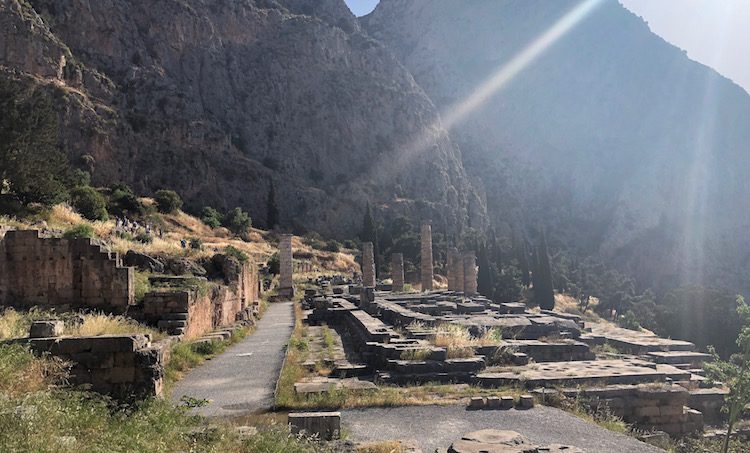
The remains of Apollo’s Temple at Delphi.
5. What is the philosophy of Hellenism?
The main three are Orphism, Pythagoreanism, and Platonism (which is essentially a synthesis of the previous two with new contributions). Plato represents the best of the Greek tradition while also adding to it, Plato’s ideas. Thus Platonism is the Greek tradition, but also a tradition of its own. There are additional philosophical schools, but these three are pretty foundational and will get you a reliable picture of the philosophy of Hellenism.
All the above mentioned carry the philosophic torch from pre-Classical times forward, which encompass piety, virtue, and theurgy. These three elements are the (timeless) bedrock of Hellenism that is rooted in the veneration of the cosmos, the gods, nature, and a desire to commune with the gods, live in harmony within the world and with each other.
I recommend the following as recommended reading:
• The Golden Chain: An Anthology of Pythagorean and Platonic Philosophy by Algis Uzdavinys
• Orpheus and the Roots of Platonism by Algis Uzdavinys
Previous Post

October 1, 2018
Radical Pantheist: Zombies From Slavery To Apocalypse
Next Post

October 3, 2018 Pan-Celtic Hoofbeats: Moon Drum
Browse Our Archives
Select a Category A Lakeside Hearth Adventures in Wortcunning Alone In Her Presence Arts, Crafts & Cooking Birthing Hereditary Witchcraft Book of Blackbirds Book Reviews Born-Again Witch Cauldron, Sword, Spear, & Stone Cermony and Liturgy Columns Community Dandelion Seeds Dear Jasmine Druid Thoughts Editor's Picks Everyday Pagan Family & Household Practice Family Traditions Full Frontal Magic Gateway Goddess Guest Articles Happily Heathen Health and Wellness Hearth of Hellenism Heathen Woman Hills of the Horizon History Holidays Horse Goddesses Interfaith Interviews Irish-American Witchcraft Jewish Witch Lamp & Labyrinth Letters from Midgard Literature, Media, Film, Music Loop of Brighid Love, Sex & Relationships Magic or Magick Making Light Naturalistic Traditions Nature News Outside The Circle Pantheisticon Politics Prayers, Poems, Blessings & Stories Queer Femme Mystic Queer of Swords Recipes Ritual and Practice Science and Research Seekers and Guides Seeking the Grail Socially Responsible Magic Spear of Athena Star Made Witch Syncretic Electric Technology The Blooming Staff The Busy Witch The Cartomancer The Crow's Nest The Dance of Pagan Recovery The Hearth of Hellenism The Lady's Quill The Other Side of the Hedge The Path of She The Rantin' Raven The Witches Next Door The Zen Pagan Theology, Ethics, Philosophy Tree City Witch Urban Earthwitch Wayfaring Woman Witch on Fire Wyrd Words
Select a Month January 2026 March 2025 December 2024 June 2024 April 2024 March 2024 January 2024 December 2023 November 2023 October 2023 August 2023 July 2023 May 2023 April 2023 March 2023 February 2023 January 2023 December 2022 November 2022 October 2022 September 2022 August 2022 July 2022 June 2022 May 2022 March 2022 February 2022 January 2022 December 2021 November 2021 October 2021 September 2021 August 2021 July 2021 June 2021 May 2021 April 2021 March 2021 February 2021 January 2021 December 2020 November 2020 October 2020 September 2020 August 2020 July 2020 June 2020 May 2020 April 2020 March 2020 February 2020 January 2020 December 2019 November 2019 October 2019 September 2019 August 2019 July 2019 June 2019 May 2019 April 2019 March 2019 February 2019 January 2019 December 2018 November 2018 October 2018 September 2018 August 2018 July 2018 June 2018 May 2018 April 2018 March 2018 February 2018 January 2018 December 2017 November 2017 October 2017 September 2017 August 2017 July 2017 June 2017 May 2017 April 2017 March 2017 February 2017 January 2017 December 2016 November 2016 October 2016 September 2016 August 2016 July 2016 June 2016 May 2016 April 2016 March 2016 February 2016 January 2016 December 2015 November 2015 October 2015 September 2015 August 2015 July 2015 June 2015 May 2015 April 2015 March 2015 February 2015 January 2015 December 2014 November 2014 October 2014 September 2014 August 2014 July 2014 June 2014 May 2014 April 2014 March 2014 February 2014 January 2014 December 2013 November 2013 October 2013 September 2013 August 2013 July 2013 June 2013 May 2013 April 2013 March 2013 February 2013 January 2013 December 2012 November 2012 October 2012 September 2012 August 2012 July 2012 June 2012 May 2012 April 2012 March 2012 February 2012 January 2012
Follow Us!
TAKE THE
Religious Wisdom Quiz
What was Nehemiah's royal position?
Select your answer to see how you score.
Priest Cupbearer Governor Soldier
Related posts from Agora
Hearth of Hellenism: The Cult of Academia

Hearth of Hellenism: Anti-Hellenism in the Pagan Community

Hearth of Hellenism: Are You Feeling Disconnected?

Hearth of Hellenism: The One Book You Should...
TRENDING AT PATHEOS Pagan

I was recently chatting with someone on Instagram. She asked me what...

While there are many people who share their results, the end of...

On July 23, I saw Christopher Nolan's The Odyssey which is Homer’s...

As I write this two big events have just finished up. One...

Restoring the Watershed of Divine Love
Perhaps cooperation is not something we manufacture through legislation, ideology, or moral...

Many UUs don’t pray because of bad experiences in a previous religion,...
view all Pagan blogs
Ad-Free & Subscriber Log-In Subscription Support
- About Us
- 2026 Calendar
- Videos
- Podcasts
- Library of World Religions
- Faith In Media Tracker
- Advertise With Us
- Write for Us
- Privacy Policy
- Terms of Service
- Do Not Sell My Data
- Contact Us
- Radiant Digital
- Manage Newsletter Subscriptions
- Unsubscribe From Notifications
- Sitemap
Copyright 2008-2026, Patheos. All rights reserved.
Subscription Support Ad-Free & Subscriber Log-In
Follow Patheos