
BuddhistCatholicContemplativeEvangelicalGeneral ChristianHinduJewishLatter-day SaintMuslimNew VisionsProgressive Christian
Beliefs
- Buddhist
- Catholic
- Contemplative
- Evangelical
- General Christian
- Hindu
- Jewish
- Latter-day Saint
- More Voices
- Muslim
- New Visions
- Pagan
- Progressive Christian
Topics
- Religion News
- Food and Religion
- Sports and Religion
- Religious Art
- Religious Music and Entertainment
- Religious Events
- History and Religion
- Style and Religion
- Politics and Religion
- Women in Religion
- Recreation Outdoors and Religion
- Business Finance and Religion
- Careers Workplace and Religion
- Education and Religion
- Family Parenting and Religion
- Health Fitness and Religion
- Home and Religion
- Relationships and Religion
- Technology and Religion
- Travel and Religion
Columnists
- Buddhist Columnists
- Business Finance and Religion Columnists
- Careers Workplace and Religion Columnists
- Catholic Columnists
- Contemplative Columnists
- Education and Religion Columnists
- Evangelists Columnists
- Family Parenting and Religion Columnists
- General Christian Columnists
- Health Fitness and Religion Columnists
- Hindu Columnists
- History and Religion Columnists
- Home and Religion Columnists
- Jewish Columnists
- More Voices Columnists
- Latter Day Columnists
- Muslim Columnists
- New Visions Columnists
- Nonreligious Columnists
- Pagan Columnists
- Politics and Religion Columnists
- Progressive Columnists
- Recreation Outdoors and Religion Columnists
- Relationships and Religion Columnists
- Religion News Columnists
- Religious Art Columnists
- Religious Events Columnists
- Religious Music and Entertainment Columnists
- Sports and Religion Columnists
- Style and Religion Columnists
- Technology and Religion Columnists
- Travel and Religion Columnists
- Women in Religion Columnists
Resource Library
- 2026 Calendar
- Library of World Religions
- The 100 Most Holy Places on Earth
- Patheos Answers
- Podcasts
- Videos
- Faith Leaders Database
- Anglican Episcopalian
- Bahai
- Baptist
- Buddhism
- Christianity
- Confucianism
- Eastern Orthodoxy
- Hinduism
- Holiness and Pentecostal
- ISKCON
- Islam
- Judaism
- Lutheran
- Methodist
- The Church of Jesus Christ of Latter-day Saints
- New Age
- Paganism
- Presbytarian and Reformed
- Protestantism
- Religion Behind the Scenes
- Roman Catholic
- Scientology
- Shia Islam
- Sikhism
- Sufism
- Sunni Islam
- Taoism
- Zen
- See all religions
Research Tools
 Ad-Free & Subscriber Log-In Subscription Support
Ad-Free & Subscriber Log-In Subscription Support
Follow Patheos 

- Trending:
- Forgiveness
- |
- Marriage
- |
- Consciousness
- |
- Death Penalty
- |
- Election
- |
- Halloween

- Home
- Pagan
- Hearth of Hellenism: Netflix’s ‘Origins’ Fails at History
Hearth of Hellenism: Netflix’s ‘Origins’ Fails at History
Last updated on: August 1, 2018 at 6:13 pm by Angelo Nasios
Hearth of Hellenism: Netflix’s ‘Origins’ Fails at History 2018-08-01T18:13:16+00:00 Angelo Nasios
Patheos Explore the world's faith through different perspectives on religion and spirituality! Patheos has the views of the prevalent religions and spiritualities of the world.
The other night I was scrolling through Netflix and saw a documentary series called Origins. The description appealed to me so I looked at their episode list and watched two that I thought I would enjoy. Season 1 Episode 15 Writing, Libraries, & Internet (three ways for leaving a legacy, for the future) and episode 16 Monarchy, Democracy, & Communism (three forms of government and the struggle for nations to define themselves).
I picked these two episodes specifically because I knew they would have to cover Greek history and I wanted to see how they would cover it. I am sad to report that whoever wrote the scripts either willfully overlooked Greek history, or was merely uneducated on the topics. I suspect though it was the former.
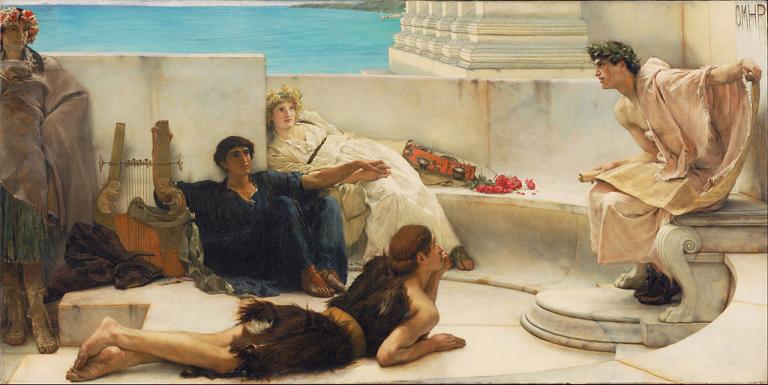
“A Reading from Homer” by Lawrence Alma-Tadema. From WikiMedia.
Episode 15, Writing, Libraries, & Internet left a big gap in the history of writing. I this episode, they explain the “origins” of writing, libraries, and the internet. Here is part of the timeline concerning the topic of ‘writing’ in the show.
1. Romania. 5,300 BCE
a. Vinca symbols
2. Sumer. 4,000 BCE
a. Cuneiform
3. Saqqara, Egypt. 2,800 BCE
a. The Maxims of Ptahhotep
4. Babylonia. 1,772 BCE
a. The Code of Hammurabi
5. China. 1,500 BCE
a. Gives a summary of topics Chinese writing.
6. Rome. 1st Century CE
a. Birth of the book. The Codex.
7. China 1045 CE.
a. Movable type method of printing.
You’ll notice a gap between China 1,500 BCE and Rome 1st century. This is where Greece would be talked about. The Homeric epics would have been a quick and easy talking point. The Homeric Epic’s long-lasting influence on Western Civilization is unquestionable. To me, it is criminal not to bring them up. The Iliad contains 15,693 lines while the Odyssey contains 12,110 lines. That is almost 28,000 lines of poetry in dactylic hexameter together.
Outside of the familiar Greek writings of Homer and later, the show could have showcased the Cretan hieroglyphic system c. 2100−1700 BCE, Linear A c. 1800−1450 BCE, and Linear B 1450−1200 BCE. All three are contemporaries with the other writings system mentioned in the show.
When the episode arrived on the topic of libraries things get hairy. When discussing libraries, it is certain that the Library of Alexandria will be mentioned and they did cover it in the episode. However, the way the oriented the subject is concerning. They position the topic starting with Alexander and Macedonia in 330 BCE. The show says that Alexander, after seeing King Ashurbanipal’s library (Neo-Assyrian Empire), he wanted to build one to rival it. Alexander dies at 32, and the task of creating the library was completed by one of his successors, Ptolemy Soter.
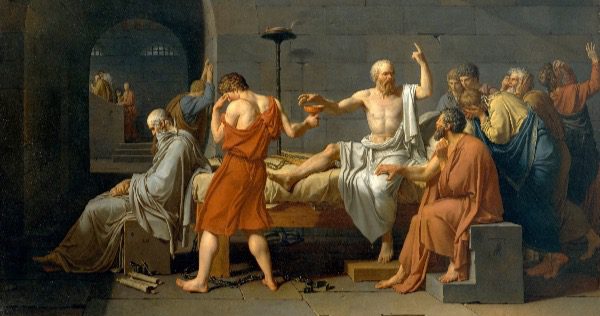
“The Death of Socrates, “by Jacques-Louis David. From WikiMedia.
What is the problem? There is no mention of Greeks. Greece and Greeks do not appear in this episode concerning writing and libraries. When talking about Alexander he is described as only a Macedonian. This will inevitably mislead people into thinking he was not Greek in the long run. For years now, I have noticed the repositioning of Alexander as only Macedonian, as if Macedonians were not Greek. It is like saying Alexander the Athenian, and ignoring that Athenians are Greeks.
Additionally, there is a country north of Greece which has been calling themselves Macedonia and has appropriated Alexander for themselves. I cannot go into details here, please read up on the name dispute. While this episode and the name dispute are two separate issues, they tie together in changing people’s understanding of the world. If I knew nothing about history, after seeing this episode, I’d know that Alexander was from Macedonia. If I were to go online to look it up, I’d find that there is a country calling themselves Macedonia and if I do not investigate further, I will suspect this is where Alexander was from, when in fact Alexander’s place of birth, Pella, is in Greece. Also, if I were to run into someone who said they were Macedonian (from FYRM), I would think they are probably decedents of Alexander. It is the little things that change people’s perceptions of history which can have dangerous consequences.
In episode 16 Monarchy, Democracy, & Communism the Greek development of democracy was severely downplayed. Sparta and Athens are spoken about for a roughly one minute then the show moves on to England 1215. When discussing Athens (508 BCE), they highlight the reforms of Cleisthenes the “father of Athenian democracy.” For some reason, the show had to mention that Cleisthenes is the grandson of the tyrant Cleisthenes Of Sicyon, who the show says murdered his opponents. It seems the reason they mention this is to give probable cause to why Cleisthenes thought it was a good idea to reduce the power of the nobility, but I think the writer was just trying just to throw something negative in, because it is a random fact you need to look hard for. They also gave a laundry list of people who could not vote in Athens, an attempt to tarnish them.
The fact that they only give one minute to Greek democracy is shameful. If I did not know history and watched this episode I would not have learned that Greeks invented democracy and would just think it occurred there like it was not historically significate. Even with its failings, Athenian democracy is the most enduring legacy to the western world that the Greeks gave. Democracy, when we examine history, was not the normative form of government, and today is held to be one of our highest ideals. The lack of any emphasis of this is disturbing.
In sum, Netflix’s Origins gets a big fat F on their report card. The downplaying of Greek contributions and history is highly suspicious. It is either deliberately done by someone with an agenda, or done by someone ignorant of history. I plan on watching one more episode from season two, Gods, Ghosts, & UFO’s to see if the pattern of misrepresenting Hellenism continues.
Previous Post

July 28, 2018
Radical Pantheist: Asatru, Building Temples and Breaking Barriers
Next Post

August 7, 2018 The Corner Crone: Interview With a Crone
Browse Our Archives
Select a Category A Lakeside Hearth Adventures in Wortcunning Alone In Her Presence Arts, Crafts & Cooking Birthing Hereditary Witchcraft Book of Blackbirds Book Reviews Born-Again Witch Cauldron, Sword, Spear, & Stone Cermony and Liturgy Columns Community Dandelion Seeds Dear Jasmine Druid Thoughts Editor's Picks Everyday Pagan Family & Household Practice Family Traditions Full Frontal Magic Gateway Goddess Guest Articles Happily Heathen Health and Wellness Hearth of Hellenism Heathen Woman Hills of the Horizon History Holidays Horse Goddesses Interfaith Interviews Irish-American Witchcraft Jewish Witch Lamp & Labyrinth Letters from Midgard Literature, Media, Film, Music Loop of Brighid Love, Sex & Relationships Magic or Magick Making Light Naturalistic Traditions Nature News Outside The Circle Pantheisticon Politics Prayers, Poems, Blessings & Stories Queer Femme Mystic Queer of Swords Recipes Ritual and Practice Science and Research Seekers and Guides Seeking the Grail Socially Responsible Magic Spear of Athena Star Made Witch Syncretic Electric Technology The Blooming Staff The Busy Witch The Cartomancer The Crow's Nest The Dance of Pagan Recovery The Hearth of Hellenism The Lady's Quill The Other Side of the Hedge The Path of She The Rantin' Raven The Witches Next Door The Zen Pagan Theology, Ethics, Philosophy Tree City Witch Urban Earthwitch Wayfaring Woman Witch on Fire Wyrd Words
Select a Month January 2026 March 2025 December 2024 June 2024 April 2024 March 2024 January 2024 December 2023 November 2023 October 2023 August 2023 July 2023 May 2023 April 2023 March 2023 February 2023 January 2023 December 2022 November 2022 October 2022 September 2022 August 2022 July 2022 June 2022 May 2022 March 2022 February 2022 January 2022 December 2021 November 2021 October 2021 September 2021 August 2021 July 2021 June 2021 May 2021 April 2021 March 2021 February 2021 January 2021 December 2020 November 2020 October 2020 September 2020 August 2020 July 2020 June 2020 May 2020 April 2020 March 2020 February 2020 January 2020 December 2019 November 2019 October 2019 September 2019 August 2019 July 2019 June 2019 May 2019 April 2019 March 2019 February 2019 January 2019 December 2018 November 2018 October 2018 September 2018 August 2018 July 2018 June 2018 May 2018 April 2018 March 2018 February 2018 January 2018 December 2017 November 2017 October 2017 September 2017 August 2017 July 2017 June 2017 May 2017 April 2017 March 2017 February 2017 January 2017 December 2016 November 2016 October 2016 September 2016 August 2016 July 2016 June 2016 May 2016 April 2016 March 2016 February 2016 January 2016 December 2015 November 2015 October 2015 September 2015 August 2015 July 2015 June 2015 May 2015 April 2015 March 2015 February 2015 January 2015 December 2014 November 2014 October 2014 September 2014 August 2014 July 2014 June 2014 May 2014 April 2014 March 2014 February 2014 January 2014 December 2013 November 2013 October 2013 September 2013 August 2013 July 2013 June 2013 May 2013 April 2013 March 2013 February 2013 January 2013 December 2012 November 2012 October 2012 September 2012 August 2012 July 2012 June 2012 May 2012 April 2012 March 2012 February 2012 January 2012
Follow Us!
TAKE THE
Religious Wisdom Quiz
What does the name "Israel" mean?
Select your answer to see how you score.
The Lord Saves Chosen One Struggles with God God Provides
Related posts from Agora
Hearth of Hellenism: The Cult of Academia
Hearth of Hellenism: Anti-Hellenism in the Pagan Community

Hearth of Hellenism: Are You Feeling Disconnected?

Hearth of Hellenism: The One Book You Should...
TRENDING AT PATHEOS Pagan

When we talk about Greek religion, we often begin with the dodekatheion—the...

I was recently chatting with someone on Instagram. She asked me what...

While there are many people who share their results, the end of...

On July 23, I saw Christopher Nolan's The Odyssey which is Homer’s...

As I write this two big events have just finished up. One...

Restoring the Watershed of Divine Love
Perhaps cooperation is not something we manufacture through legislation, ideology, or moral...
view all Pagan blogs
Ad-Free & Subscriber Log-In Subscription Support
- About Us
- 2026 Calendar
- Videos
- Podcasts
- Library of World Religions
- Faith In Media Tracker
- Advertise With Us
- Write for Us
- Privacy Policy
- Terms of Service
- Do Not Sell My Data
- Contact Us
- Radiant Digital
- Manage Newsletter Subscriptions
- Unsubscribe From Notifications
- Sitemap
Copyright 2008-2026, Patheos. All rights reserved.
Subscription Support Ad-Free & Subscriber Log-In
Follow Patheos