
BuddhistCatholicContemplativeEvangelicalGeneral ChristianHinduJewishLatter-day SaintMuslimNew VisionsProgressive Christian
Beliefs
- Buddhist
- Catholic
- Contemplative
- Evangelical
- General Christian
- Hindu
- Jewish
- Latter-day Saint
- More Voices
- Muslim
- New Visions
- Pagan
- Progressive Christian
Topics
- Religion News
- Food and Religion
- Sports and Religion
- Religious Art
- Religious Music and Entertainment
- Religious Events
- History and Religion
- Style and Religion
- Politics and Religion
- Women in Religion
- Recreation Outdoors and Religion
- Business Finance and Religion
- Careers Workplace and Religion
- Education and Religion
- Family Parenting and Religion
- Health Fitness and Religion
- Home and Religion
- Relationships and Religion
- Technology and Religion
- Travel and Religion
Columnists
- Buddhist Columnists
- Business Finance and Religion Columnists
- Careers Workplace and Religion Columnists
- Catholic Columnists
- Contemplative Columnists
- Education and Religion Columnists
- Evangelists Columnists
- Family Parenting and Religion Columnists
- General Christian Columnists
- Health Fitness and Religion Columnists
- Hindu Columnists
- History and Religion Columnists
- Home and Religion Columnists
- Jewish Columnists
- More Voices Columnists
- Latter Day Columnists
- Muslim Columnists
- New Visions Columnists
- Nonreligious Columnists
- Pagan Columnists
- Politics and Religion Columnists
- Progressive Columnists
- Recreation Outdoors and Religion Columnists
- Relationships and Religion Columnists
- Religion News Columnists
- Religious Art Columnists
- Religious Events Columnists
- Religious Music and Entertainment Columnists
- Sports and Religion Columnists
- Style and Religion Columnists
- Technology and Religion Columnists
- Travel and Religion Columnists
- Women in Religion Columnists
Resource Library
- 2026 Calendar
- Library of World Religions
- The 100 Most Holy Places on Earth
- Patheos Answers
- Podcasts
- Videos
- Faith Leaders Database
- Anglican Episcopalian
- Bahai
- Baptist
- Buddhism
- Christianity
- Confucianism
- Eastern Orthodoxy
- Hinduism
- Holiness and Pentecostal
- ISKCON
- Islam
- Judaism
- Lutheran
- Methodist
- The Church of Jesus Christ of Latter-day Saints
- New Age
- Paganism
- Presbytarian and Reformed
- Protestantism
- Religion Behind the Scenes
- Roman Catholic
- Scientology
- Shia Islam
- Sikhism
- Sufism
- Sunni Islam
- Taoism
- Zen
- See all religions
Research Tools
 Ad-Free & Subscriber Log-In Subscription Support
Ad-Free & Subscriber Log-In Subscription Support
Follow Patheos 

- Trending:
- Forgiveness
- |
- Marriage
- |
- Consciousness
- |
- Death Penalty
- |
- Election
- |
- Halloween

- Home
- Pagan
- Hearth of Hellenism: What is and is not Magic?
Hearth of Hellenism: What is and is not Magic?
Last updated on: May 22, 2018 at 9:17 am by Angelo Nasios
Hearth of Hellenism: What is and is not Magic? 2018-05-22T09:17:26+00:00 Angelo Nasios
Patheos Explore the world's faith through different perspectives on religion and spirituality! Patheos has the views of the prevalent religions and spiritualities of the world.
I have been wanting to talk about magic since the initiation of the Hearth of Hellenism. I’ve pushed the topic off because I needed figure out how to properly address the topic that will allow the read to be receptive and not reactive. Magic is a very popular subject, with various traditions and many practitioners to match – it is easy for this topic to get out of hand quickly.
I use to do a little magic back in the day, my favorite kind is candle magic. My relationship with magic has been a conflicted one because I’ve sensed a disconnect between contemporary magical attitudes with traditional Greek religious and philosophical attitudes that I am aware of. Studying Hellenism has helped me flesh out what these issues are.
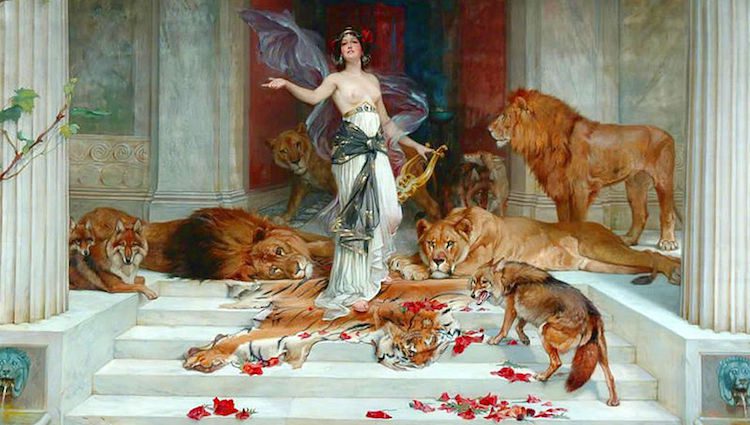
“Circe” by Wright Barker. From WikiMedia.
The position which I am taking is not a negative one. I am not negating magical traditions, denying their existence in antiquity and or today. Nor am I condemning magic or making any negative claim. With this said, the purpose of this entry is to explain the incompatibility with magic (as it is popularly understood and practiced today) and Hellenism.
I will be addressing this issue as a Greek in 2018. I need to state it this way because this is not an exploration into magical behavior of antiquity from the etic scholarly perspective. This is an emic perspective and answer. Magic (as it is popularly understood and practiced), for Greeks, is neither condemned nor encouraged. Simply, we understand that it is unessential to Hellenism, it is not a pillar of our culture. There is culturally specific understanding of what magic is which I will explain.
This indifference towards magic (popularly understood and practiced) as I interpret stems from its obsolescence. Magic became an obsolete techne (technology/skill/craft). Mankind produces technologies appropriate for any given time to fulfill a need. Our need to communicate with each other created the postal service, telegrams, the phone, SMS, and facetime. While we could use any of these technologies today, we don’t think of using a telegram because the phone is more effective. In this line of thinking, magic is obsolete considering other advancements which we have available to us to improve our lives and engage with the gods harmoniously.
What is the “advancement” to which I am referring to which have made magic obsolete? It would be the Greek virtue system. At the core of Hellenism, the system of virtue are our tools for transforming and cultivating the soul which creates harmony. Virtue (arete) aims at helping you to achieve excellence, lifting your soul in the process. There are the four cardinal virtues which you may be familiar with – prudence, temperance, fortitude, and justice. There are also other virtues such as bravery, generosity, industriousness, honesty, respect, diligence and so on.
Virtue is tied to the gods because the gods, in their nature, possess virtue. Human’s cannot truly possess virtue, but through the habit of imitating the gods and their virtues as best as we can, we can grow and develop our souls. These virtues have real implications in our lives and create change within us and outside of us. I have seen it in action and it can work instantaneously. Now, isn’t one of the main goals of magic to create change of some sort? Virtue works at what I would consider the highest levels that the gods operate at. Because virtue is tied to the gods, virtue is powerful. Through it, you can “activate” the gods in your life so to speak.
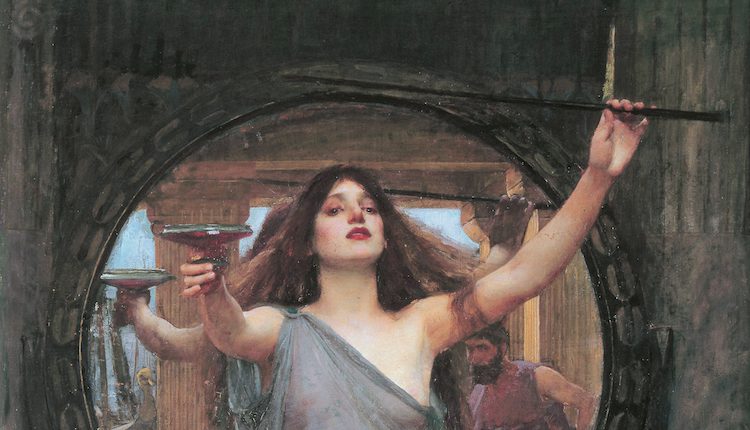
“Circe Offering the Cup to Odysseus” by John William Waterhouse.
The Greek philosophical tradition was pushing mankind on the path of reason and logic for understanding the world and how to live the best way possible. Logos (reason) is divine and thus so is our intellect as a species. Following reason does not deny divinity, it is deeply intimate with divinity. Philosophy is supposed to be practical in your life to help you live well, not just to theorize endlessly as it has become today – detach from our lives. Philosophy in Hellenism is not void of religious significance. What we consider “religion” was ubiquitous in antiquity, diffused into all activities. Keep this in mind when thinking about the importance of philosophy. Philosophy in Hellenism is the theory of our religion, the mechanics.
While magic still existed after and throughout the Greek and later Roman world, it did not really fit into the new paradigm of rational thinking, seeking to understand the word through reason. Magic is not foundational in Hellenism as it mainly operated on the periphery of society, like an add-on, but not as a centerpiece or defining character trait of Hellenism. Religion in Hellenism is theocentric, Greek culture has always centered itself around the gods. Piety, devotion, sacrifice, and prayer are Pan-Hellenic ways of engaging with the gods, these things are not magic.
Magic alters the basic religious structure in ways that make it incompatible. Magic is like prayer in the sense that you are going to a god for help. But it is done improperly. Cruse tablets for example demonstrate this – they read a lot like prayers in structure but they are asking the god to do harm to others. According to the major philosophical tradition, Platonism, gods do not harm people. As such, curse tablets are not an acceptable practice worthy of imitation today.
Additionally, I think the basic logic behind magic that our ancestors may have had was flawed. I think that approached magic as an attempt to “pray loudly.” If you wanted the gods to hear your prayer first over others (Greek society was highly competitive don’t forget), it seems the logical thing to do is to ritualize the prayer in some way to give it a little “kick.” Magic thus is created to amplify the prayer to get the gods’ attention before other prayers. As such this is one reason why ancient magic and religion is blurry. Magic borrows from religion’s ritualism and modifies it outside of the normative use. Magic with this logic is “bad religion” because you do not need to “pray loudly” – the gods are not hard of hearing, you are not going to get special attention.
Magic is antagonistic to the Greek tradition. Magic for some is viewed as an attempt to exercise your will onto forces beyond your own. In the most negative belief, magic is used to bend the will of the gods to do your bidding. This notion is blasphemy to Greeks. You cannot make the gods do anything for you, you cannot force them, bribe them in any way. Freedom is a virtue, it is loved by the gods, so you shouldn’t try to force your will on to others or gods.
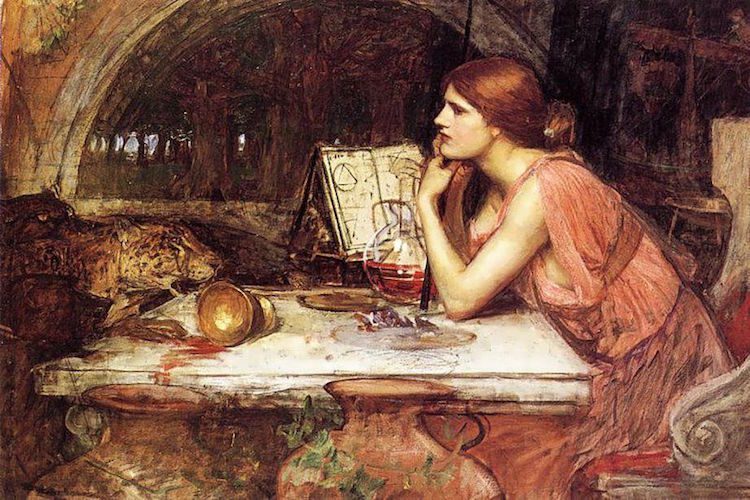
“Circe Sketch” By John William Waterhouse. From WikiMedia.
You can practice the virtues. Emulating the gods will elevate you and through that process the gods are more likely to “aide you” because you are aligning yourself with their nature. In myth, gods help exceptional beings such as heroes because they earned it, and it was not earned by magic. The more align we are with the gods, the more we elevate towards them. The greater we become through cultivating the soul, then the essence of what magic is in Hellenism is experienced. Because “magic” in Hellenism is not spells and charms, magic means to be become “great.”
Anything other than this understanding and practice of magic is regarded by the tradition to be a superstitious practice or belief. Superstition in Hellenism is the fear of the gods, and more broadly irrational religious behavior. Superstition is “wrong judgement inflamed by passion” (Plut. de Superstit, IX). The superstitious are afraid of the gods yet run to them for help and protection. Flatter them yet revile them. Blame them but invoke them.
In a reference to magic, Plutarch describes how the “ridiculous actions and emotions of superstition” give reason for people to say “that it were better there should be no gods at all than gods who accept with pleasure such forms of worship, and are so overbearing, so petty, and so easily offended.” Superstitious actions defined here include “its words, gestures, magic charms and spells, rushing about and beating of drums, impure purifications and dirty sanctifications, barbarous and outlandish penances and mortifications at the shrines.” It is illogical and impious behavior. It throws the soul out of harmony.
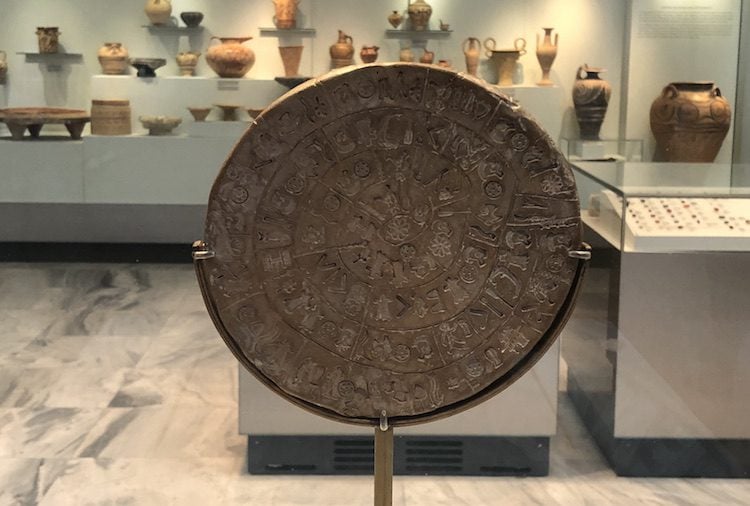
Cretan spell tablet, photo by Mankey.
Putting Plutarch into context is important. He was trying to help society, by helping people not be afraid of the gods because that leads to wrong judgements, illogical behavior, and atheism. He wanted people to be happy and love the gods, not fear them. Magic, in this context is preformed from a place of anxiety/fear of the supernatural – a fear and anxiety not warranted.
For more context, we need to imagine ourselves in the ancient world, a place very different from our own today, a time without the excess of luxuries and safety we have now. Back then, life was rough and hard for most people, they had more fears and anxieties about the world. They feared their nightmares could harm them, illness that we can cure today could easily kill them, and so forth. The irrational person in those days blamed the gods for their troubles but then would go pray to the same god to help. By Plutarch’s account – superstitious mentality.
You may think that your magical practice today is not rooted in this definition of superstation, the behavior of illogical judgement inflamed by passion. Look closer because still today we seek to control the elements which we have no control over because we desire the safety it affords or the peace of mind it may provide when we cast that spell. I wager that many people get a feeling of satisfaction in magic because it promises that you can how power and influence in the “spiritual realm” when you cannot in the physical. This is still superstitious by the Greek worldview.
This what real magic is in Hellenism, it is greatness – a specific kind – greatness through virtue and mastering our nature. Real magic is not in candles, oils, crystals, and herbs. Real magic and magicians are artists who can create and manifest from the realm of thought to reality their art. Musicians who stir the motions of the soul through voice and instrument to heal, that is magic those are magicians. The doctor that heals illness is a magician. The diplomat who brings peace instead of war is a magician. These people have excelled and become great – becoming a magos.
Previous Post

May 21, 2018
Between Two Worlds: New Moon, New Crossroads, New Journey with Hekate
Next Post

May 29, 2018 Tree City Witch: Homework For the New Moon Eclipse in Cancer
Browse Our Archives
Select a Category A Lakeside Hearth Adventures in Wortcunning Alone In Her Presence Arts, Crafts & Cooking Birthing Hereditary Witchcraft Book of Blackbirds Book Reviews Born-Again Witch Cauldron, Sword, Spear, & Stone Cermony and Liturgy Columns Community Dandelion Seeds Dear Jasmine Druid Thoughts Editor's Picks Everyday Pagan Family & Household Practice Family Traditions Full Frontal Magic Gateway Goddess Guest Articles Happily Heathen Health and Wellness Hearth of Hellenism Heathen Woman Hills of the Horizon History Holidays Horse Goddesses Interfaith Interviews Irish-American Witchcraft Jewish Witch Lamp & Labyrinth Letters from Midgard Literature, Media, Film, Music Loop of Brighid Love, Sex & Relationships Magic or Magick Making Light Naturalistic Traditions Nature News Outside The Circle Pantheisticon Politics Prayers, Poems, Blessings & Stories Queer Femme Mystic Queer of Swords Recipes Ritual and Practice Science and Research Seekers and Guides Seeking the Grail Socially Responsible Magic Spear of Athena Star Made Witch Syncretic Electric Technology The Blooming Staff The Busy Witch The Cartomancer The Crow's Nest The Dance of Pagan Recovery The Hearth of Hellenism The Lady's Quill The Other Side of the Hedge The Path of She The Rantin' Raven The Witches Next Door The Zen Pagan Theology, Ethics, Philosophy Tree City Witch Urban Earthwitch Wayfaring Woman Witch on Fire Wyrd Words
Select a Month January 2026 March 2025 December 2024 June 2024 April 2024 March 2024 January 2024 December 2023 November 2023 October 2023 August 2023 July 2023 May 2023 April 2023 March 2023 February 2023 January 2023 December 2022 November 2022 October 2022 September 2022 August 2022 July 2022 June 2022 May 2022 March 2022 February 2022 January 2022 December 2021 November 2021 October 2021 September 2021 August 2021 July 2021 June 2021 May 2021 April 2021 March 2021 February 2021 January 2021 December 2020 November 2020 October 2020 September 2020 August 2020 July 2020 June 2020 May 2020 April 2020 March 2020 February 2020 January 2020 December 2019 November 2019 October 2019 September 2019 August 2019 July 2019 June 2019 May 2019 April 2019 March 2019 February 2019 January 2019 December 2018 November 2018 October 2018 September 2018 August 2018 July 2018 June 2018 May 2018 April 2018 March 2018 February 2018 January 2018 December 2017 November 2017 October 2017 September 2017 August 2017 July 2017 June 2017 May 2017 April 2017 March 2017 February 2017 January 2017 December 2016 November 2016 October 2016 September 2016 August 2016 July 2016 June 2016 May 2016 April 2016 March 2016 February 2016 January 2016 December 2015 November 2015 October 2015 September 2015 August 2015 July 2015 June 2015 May 2015 April 2015 March 2015 February 2015 January 2015 December 2014 November 2014 October 2014 September 2014 August 2014 July 2014 June 2014 May 2014 April 2014 March 2014 February 2014 January 2014 December 2013 November 2013 October 2013 September 2013 August 2013 July 2013 June 2013 May 2013 April 2013 March 2013 February 2013 January 2013 December 2012 November 2012 October 2012 September 2012 August 2012 July 2012 June 2012 May 2012 April 2012 March 2012 February 2012 January 2012
Follow Us!
TAKE THE
Religious Wisdom Quiz
What Jewish festival celebrates the deliverance in Esther?
Select your answer to see how you score.
Purim Hanukkah Tabernacles Passover
Related posts from Agora

Simple Witchery: Leaning On The Four Pillars

Pergamum Unfurled: Cunning Words (Review)
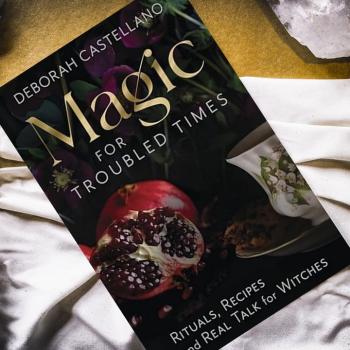
Pergamum Unfurled: Review - Magic for Troubled Times
The Corner Crone: Choosing a Signifier Card in...
TRENDING AT PATHEOS Pagan

I was recently chatting with someone on Instagram. She asked me what...

While there are many people who share their results, the end of...

On July 23, I saw Christopher Nolan's The Odyssey which is Homer’s...

As I write this two big events have just finished up. One...

Restoring the Watershed of Divine Love
Perhaps cooperation is not something we manufacture through legislation, ideology, or moral...

Many UUs don’t pray because of bad experiences in a previous religion,...
view all Pagan blogs
Ad-Free & Subscriber Log-In Subscription Support
- About Us
- 2026 Calendar
- Videos
- Podcasts
- Library of World Religions
- Faith In Media Tracker
- Advertise With Us
- Write for Us
- Privacy Policy
- Terms of Service
- Do Not Sell My Data
- Contact Us
- Radiant Digital
- Manage Newsletter Subscriptions
- Unsubscribe From Notifications
- Sitemap
Copyright 2008-2026, Patheos. All rights reserved.
Subscription Support Ad-Free & Subscriber Log-In
Follow Patheos