
BuddhistCatholicContemplativeEvangelicalGeneral ChristianHinduJewishLatter-day SaintMuslimNew VisionsProgressive Christian
Beliefs
- Buddhist
- Catholic
- Contemplative
- Evangelical
- General Christian
- Hindu
- Jewish
- Latter-day Saint
- More Voices
- Muslim
- New Visions
- Pagan
- Progressive Christian
Topics
- Religion News
- Food and Religion
- Sports and Religion
- Religious Art
- Religious Music and Entertainment
- Religious Events
- History and Religion
- Style and Religion
- Politics and Religion
- Women in Religion
- Recreation Outdoors and Religion
- Business Finance and Religion
- Careers Workplace and Religion
- Education and Religion
- Family Parenting and Religion
- Health Fitness and Religion
- Home and Religion
- Relationships and Religion
- Technology and Religion
- Travel and Religion
Columnists
- Buddhist Columnists
- Business Finance and Religion Columnists
- Careers Workplace and Religion Columnists
- Catholic Columnists
- Contemplative Columnists
- Education and Religion Columnists
- Evangelists Columnists
- Family Parenting and Religion Columnists
- General Christian Columnists
- Health Fitness and Religion Columnists
- Hindu Columnists
- History and Religion Columnists
- Home and Religion Columnists
- Jewish Columnists
- More Voices Columnists
- Latter Day Columnists
- Muslim Columnists
- New Visions Columnists
- Nonreligious Columnists
- Pagan Columnists
- Politics and Religion Columnists
- Progressive Columnists
- Recreation Outdoors and Religion Columnists
- Relationships and Religion Columnists
- Religion News Columnists
- Religious Art Columnists
- Religious Events Columnists
- Religious Music and Entertainment Columnists
- Sports and Religion Columnists
- Style and Religion Columnists
- Technology and Religion Columnists
- Travel and Religion Columnists
- Women in Religion Columnists
Resource Library
- 2026 Calendar
- Library of World Religions
- The 100 Most Holy Places on Earth
- Patheos Answers
- Podcasts
- Videos
- Faith Leaders Database
- Anglican Episcopalian
- Bahai
- Baptist
- Buddhism
- Christianity
- Confucianism
- Eastern Orthodoxy
- Hinduism
- Holiness and Pentecostal
- ISKCON
- Islam
- Judaism
- Lutheran
- Methodist
- The Church of Jesus Christ of Latter-day Saints
- New Age
- Paganism
- Presbytarian and Reformed
- Protestantism
- Religion Behind the Scenes
- Roman Catholic
- Scientology
- Shia Islam
- Sikhism
- Sufism
- Sunni Islam
- Taoism
- Zen
- See all religions
Research Tools
 Ad-Free & Subscriber Log-In Subscription Support
Ad-Free & Subscriber Log-In Subscription Support
Follow Patheos 

- Trending:
- Forgiveness
- |
- Marriage
- |
- Consciousness
- |
- Death Penalty
- |
- Election
- |
- Halloween

- Home
- Pagan
- Irish-American Witchcraft: Open Q and A (The Morrigan, The Fair Folk, & More)
Irish-American Witchcraft: Open Q and A (The Morrigan, The Fair Folk, & More)
Last updated on: April 26, 2018 at 4:28 pm by Morgan Daimler
Irish-American Witchcraft: Open Q and A (The Morrigan, The Fair Folk, & More) 2018-04-26T16:28:58+00:00 Morgan Daimler
Patheos Explore the world's faith through different perspectives on religion and spirituality! Patheos has the views of the prevalent religions and spiritualities of the world.
I’ve done a couple question and answer posts before and I thought this time it would be interesting to do a more open ended one. Rather than a specific set topic for me to answer questions for this time around I just put it out on social media for anyone who had questions on any (reasonable) topic to ask and I’d offer my best answer to the question.
Here’s what we got:
About My Books
Vyviane asks: When will your next novel be out?
My answer: I’m about three quarters finished with the 7th book in my urban fantasy/paranormal romance series ‘Between the Worlds’ and since I self publish those I’m hopeful it will be finished and out by late May or early June. I’m also planning to do another anthology for the series, this time focusing on some of the more popular minor characters. That will probably be written in the late fall.
Until then I do have a facebook group for fans of my fiction where I occasionally post in canon short stories or little world building facts that may not have ever made it to the actual books. You can find it under ‘Fans of Between the Worlds UF Series‘.

“Cliffs of Moher, Clare” photo by Atomic Puppy. CC 2.0 License.

About the Morrigan
Keith asks: “I’ve heard that there may be a connection between the Morrigan and Hecate. Is this true?”
My answer: Some of this will depend on exactly how you understand the Gods, and whether you see Goddesses as aspects of each other. For my part though I’d say that while the two have some characteristics that overlap they also have a lot of differences. For example Hecate’s name is of uncertain meaning but possibly traces to ‘She who works from afar’ (Atsma, 2017) while the Morrigan’s name means either ‘Great Queen’ or ‘Phantom Queen’. They do both have some associations with the dead but the Morrigan also has connections to war and battle which Hecate doesn’t, while Hecate has associations with the moon and guidance which the Morrigan doesn’t. Hecate had no known consorts or children while the Morrigan was married to the Dagda in folklore and had at least two children, Adair and Meiche.
I imagine they would probably get along well with each other though.
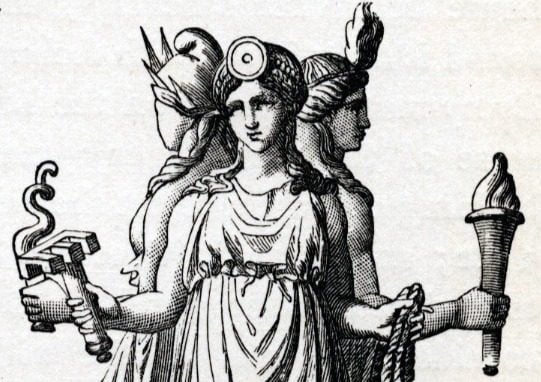
“Hecate” by Stéphane Mallarmé. From WIkiMedia.
About Americans and Celtic Culture(s)
David asks: Why do American tourists keep associating Irish sites with Celtic deities and treating the folklore as definitive?
My answer: For my own opinion, I think its complicated. From the tourist angle a lot of sites have that connection emphasized. Why? Maybe because there is a lot of mythology and folklore written or told about it, connecting it to a specific deity. Maybe because tour guides think that’s what people want to hear. Certainly when I was at Sid in Broga [Newgrange] the tour guide talked about Aengus mac Óg a bit. When I was at Tlachtga for the Fire Festival there was a lot of focus on Tlachtga (the deity) and that was by native Irish pagans.
I can see what you mean about the written accounts, although I take a more nativist view with the material myself, it certainly has to be understood in its context. I guess ultimately for a lot of people there’s no nuances.
Jennifer asks: How can someone living in the US practice a Celtic spirituality with cultural sensitivity? How do you respond to people who say you have to live in Ireland or Scotland to honour those Gods?
My answer: my personal opinion is that the Gods have always travelled with the people they were connected to, and while its true that there are strong place associations for them in Ireland and Scotland that doesn’t mean they are limited to those locations. They are Gods, they can be wherever they want to be.
I would say the key to practicing with sensitivity is to respect and appreciate the living cultures and do as much as you can to learn about them.
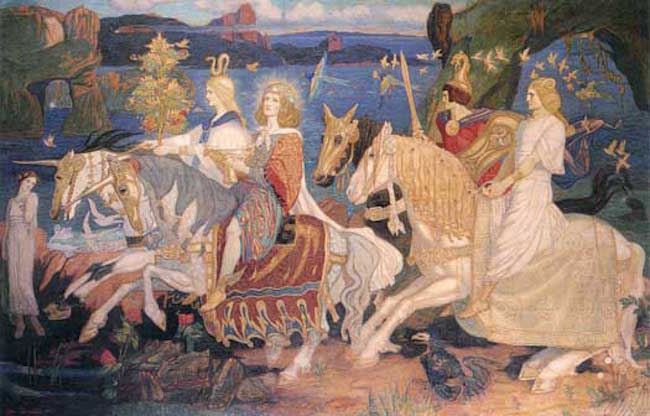
“The Riders of the Sidhe” by John Duncan (1911). From WikiMedia.
About the Fair Folk
Adrienne asks: What are some things we can do when the Daoine Maithe come into your life and you find yourself having to work with Them? How can one adjust from going “Here are some offerings to keep you happy and be respectful. I’m going to keep you at a distance, if your ok with that.” To “Well, I guess you really want me to work with you and I don’t really have a choice now, can we work on how this relationship is going to work?
My answer: Well the first thing I tend to recommend is to just research and read as much as possible. Don’t jump into any commitments if you can avoid it. Obviously easier said than done sometimes. Don’t give or commit to anything you aren’t willing or able to do.
As to shifting from ‘here’s your cream don’t mess up my stuff’ to ‘okay I’ve been drafted’ I think it’s important to figure out as much as you can exactly what is wanted, whether its permanent or temporary (there may be no clear answer to that tbh because they can be weird about our concept of time, but it may also be a very decisive 1 year, or 7 years, or forever), and establish some boundaries. Figure out if they want you serving them or they want you as a connection between them and humanity, or taking the role of serving the human community to them because those are different things.
Betty asks: How difficult was it for you to go from honoring and working with specific Gods to having that experience in Ireland where it changed your devotional focus? And how did you know for sure it was right to make that change?
My answer: It was enormously difficult to be honest.
The second part of the question is a bit harder to answer. I still worry that I’m neglecting the Gods in some way, but overall there’s been strong reinforcement that where I’m at is where I’m supposed to be, spiritually. I also think that making the change itself was a bit of a foregone conclusion after the experience I went through. It was a bit like losing one job and being hired at another – the change from one to the next isn’t so much a choice as an organic process, if that makes sense?
Aleja asks: What do you think of the idea that we should never tell any of the Good Folk our birth name/”true” name? Is this a modern idea, or is there evidence for it in the lore? Does it matter if they over hear vs you tell them and how does that work with things like brownies who live in the house?
My answer: I’d say our birth name and our true name are different, but yes there’s definitely evidence in the stories that its a bad idea to tell them any name strongly connected to us. Names have power and being given our name gives them power over us, just like knowing their name would give us power over them. As to the telling them your name versus them overhearing it, its a bit formulaic on our end – we have to tell them afaik. Although sometimes they do seem to just know so overhearing in certain areas may be a concern.
Linda asks: Do you think the Fae are the same all over the world? For instance, do (did) we have a Seelie Court in America as well? Water horses, red caps, etc?
My answer: That’s a layered answer. In one sense I think there are beings who we could, in english, call fae all over the world but every area tends to have their own native ones, just like different parts of earth have different animals. But the same way that humans and some animals have gone into areas they weren’t originally native to and established themselves I think, arguably, we see the same thing in some cases with the Other Crowd. Certainly there’s folklore of beings like pixies, fairies, gnomes, will’o’the’wisps, and fairy hounds in America alongside stories of native fey.
I think that there’s a strong argument that the different fairy beings are both tied to locations and also to populations that believe in them, depending on exactly the type of being, so that as populations move the Otherworldly beings attached to them move as well.
Kellene asks: What would be indicators that things/phenomenon you are experiencing might be related to or coming from Themselves and what are ways one can show respect without being too “welcoming” if you know what I mean.
My answer: I tend to look at the nature of the phenomena – there’s some overlap between hauntings and fairies but also some differences. In my experience fairies will out right take objects, and are more prone to audio phenomena like music, laughter, and voices, inexplicable spoiling of food, dreams with an Otherworldly tone to them, catching quick glimpses of beings that immediately disappear….
A good way to show respect without setting out a full on welcome mat is a simple occasional offering of cream or a baked good, especially on a holy day.
Also Kellene: Once you establish you may have activity attributed to Themselves (not necessarily negative, maybe bothersome is a better word) how do you go about doing something about it, or can you? If you have the same thing happening from place to place could you have some that are following you, and how do you politely get them to stop?
My answer: They will sometimes follow you yes, and there are stories of specific fairy beings that attached themselves to a family or individual and followed them when they moved, including boggarts and leannán sí.
I’ve found sometimes simply asking them to stop can work. giving milk or cream once a weak can be helpful. Worst case you;ll have to try warding against them but that can often complicate the situation so I recommend that as a last ditch approach.
Patricia asks: When you teach kids about the Good Neighbors how far do you go to explain to them that they are not all Disney pretty little fairies and that there are dangerous beings of fairy?
My answer: My personal approach is to tell them the stories, but also give them the knowledge of how to stay safe or what to do. For example there’s a great book by Lari Don called ‘The Secret of the Kelpie‘ that doesn’t pull any punches about how dangerous kelpies are but also ends with a brave girl rescuing her siblings before they get eaten by using some iron to free them. Obviously you don’t want to scare them to a point that the mention of fairies sends them screaming from a room, but I think it’s important to make the dangers clear the same way I would with something like a bear or crossing or a busy street. I’ve found the traditional stories about Themselves work very well for that.
With my own children I’ve always tried to teach them to be respectful and to know that respect will go a long way to keep them safe. They know about making offerings and about what sorts of things ward off the more dangerous Good Neighbours.
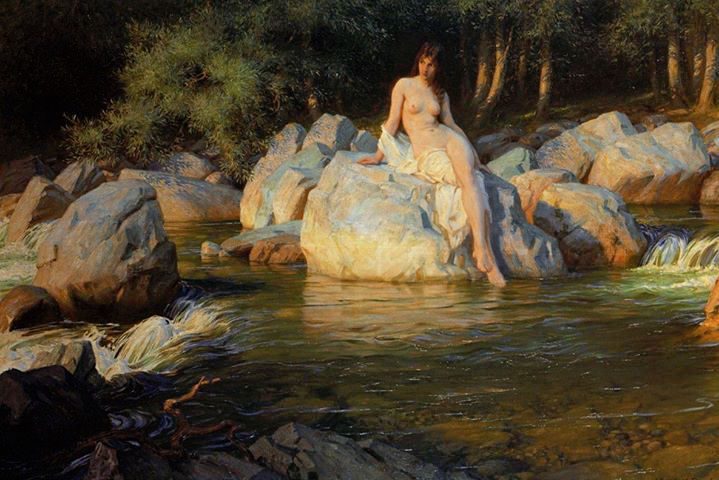
“The Kelpie” by Herbert James Draper (1912). From WikiMedia.
Sheena asks: “When working with the Good Folk what sort of precautions would you suggest when in a life phase of preferred type to spirit away? (Eg, pregnant, with newborn, lactating, wedding day) How do you keep obligations or do journey work while also safeguarding yourself and potentially those around you?”
My answer: Iron is the usual one recommended for women in labour, newborns, and nursing mothers, although folklore also suggests that salt and rowan and red thread are good protections. This would hold true on a person’s wedding day as well.
Maintaining obligations or keeping up with journeywork while in such states is a bit tricker as often the same protections make such work harder to do. Sometimes compromises can be reached by using somewhat weaker protections, but often the only safe option is to avoid that kind of work until that particular transitional time passes.
Hanna asks: What are your recommended reading for those of us who have read some of the more obvious collected stories on the Other Crowd?
My answer: I’d say it’s twofold. Firstly I think looking into the local stories of different areas is very helpful. You can find some of this written down, like I have a book by Westropp on the Folklore of Clare. There’s also, thanks to the wonders of youtube, some really good stories being preserved told directly by people. I highly recommend Michael Fortune’s channel for that as well as the documentary ‘The Fairy Faith’
Beyond that there’s often quite a bit of good material in the more academic texts, particularly the older stories that have been preserved in writing a long time ago but aren’t heard orally anymore, often. Henderson and Cowan’s Scottish Fairy Beliefs, Lysaght’s The Banshee, Beveridge’s Children Into Swans, for a few suggestions there.
And I’ve found the old Scottish ballad material extremely useful as it often has a lot of fairylore in it.
References
Atsma, A., (2017) Hekate http://www.theoi.com/Khthonios/Hekate.html
Previous Post
April 25, 2018
Between Two Worlds: Celebrating Beltaine With Hekate
Next Post

April 27, 2018 Salt City Pagan: Paganism in America & Cultural Appropriation
Browse Our Archives
Select a Category A Lakeside Hearth Adventures in Wortcunning Alone In Her Presence Arts, Crafts & Cooking Birthing Hereditary Witchcraft Book of Blackbirds Book Reviews Born-Again Witch Cauldron, Sword, Spear, & Stone Cermony and Liturgy Columns Community Dandelion Seeds Dear Jasmine Druid Thoughts Editor's Picks Everyday Pagan Family & Household Practice Family Traditions Full Frontal Magic Gateway Goddess Guest Articles Happily Heathen Health and Wellness Hearth of Hellenism Heathen Woman Hills of the Horizon History Holidays Horse Goddesses Interfaith Interviews Irish-American Witchcraft Jewish Witch Lamp & Labyrinth Letters from Midgard Literature, Media, Film, Music Loop of Brighid Love, Sex & Relationships Magic or Magick Making Light Naturalistic Traditions Nature News Outside The Circle Pantheisticon Politics Prayers, Poems, Blessings & Stories Queer Femme Mystic Queer of Swords Recipes Ritual and Practice Science and Research Seekers and Guides Seeking the Grail Socially Responsible Magic Spear of Athena Star Made Witch Syncretic Electric Technology The Blooming Staff The Busy Witch The Cartomancer The Crow's Nest The Dance of Pagan Recovery The Hearth of Hellenism The Lady's Quill The Other Side of the Hedge The Path of She The Rantin' Raven The Witches Next Door The Zen Pagan Theology, Ethics, Philosophy Tree City Witch Urban Earthwitch Wayfaring Woman Witch on Fire Wyrd Words
Select a Month January 2026 March 2025 December 2024 June 2024 April 2024 March 2024 January 2024 December 2023 November 2023 October 2023 August 2023 July 2023 May 2023 April 2023 March 2023 February 2023 January 2023 December 2022 November 2022 October 2022 September 2022 August 2022 July 2022 June 2022 May 2022 March 2022 February 2022 January 2022 December 2021 November 2021 October 2021 September 2021 August 2021 July 2021 June 2021 May 2021 April 2021 March 2021 February 2021 January 2021 December 2020 November 2020 October 2020 September 2020 August 2020 July 2020 June 2020 May 2020 April 2020 March 2020 February 2020 January 2020 December 2019 November 2019 October 2019 September 2019 August 2019 July 2019 June 2019 May 2019 April 2019 March 2019 February 2019 January 2019 December 2018 November 2018 October 2018 September 2018 August 2018 July 2018 June 2018 May 2018 April 2018 March 2018 February 2018 January 2018 December 2017 November 2017 October 2017 September 2017 August 2017 July 2017 June 2017 May 2017 April 2017 March 2017 February 2017 January 2017 December 2016 November 2016 October 2016 September 2016 August 2016 July 2016 June 2016 May 2016 April 2016 March 2016 February 2016 January 2016 December 2015 November 2015 October 2015 September 2015 August 2015 July 2015 June 2015 May 2015 April 2015 March 2015 February 2015 January 2015 December 2014 November 2014 October 2014 September 2014 August 2014 July 2014 June 2014 May 2014 April 2014 March 2014 February 2014 January 2014 December 2013 November 2013 October 2013 September 2013 August 2013 July 2013 June 2013 May 2013 April 2013 March 2013 February 2013 January 2013 December 2012 November 2012 October 2012 September 2012 August 2012 July 2012 June 2012 May 2012 April 2012 March 2012 February 2012 January 2012
Follow Us!
TAKE THE
Religious Wisdom Quiz
Which Gospel begins "In the beginning was the Word"?
Select your answer to see how you score.
Matthew Mark Luke John
Related posts from Agora

Simple Witchery: To Keep Silent

Simple Witchery: Leaning On The Four Pillars

Pergamum Unfurled: Magic with the Greek Gods (Book...

Pergamum Unfurled: Cunning Words (Review)
TRENDING AT PATHEOS Pagan

I was recently chatting with someone on Instagram. She asked me what...

While there are many people who share their results, the end of...

On July 23, I saw Christopher Nolan's The Odyssey which is Homer’s...

As I write this two big events have just finished up. One...

Restoring the Watershed of Divine Love
Perhaps cooperation is not something we manufacture through legislation, ideology, or moral...

Many UUs don’t pray because of bad experiences in a previous religion,...
view all Pagan blogs
Ad-Free & Subscriber Log-In Subscription Support
- About Us
- 2026 Calendar
- Videos
- Podcasts
- Library of World Religions
- Faith In Media Tracker
- Advertise With Us
- Write for Us
- Privacy Policy
- Terms of Service
- Do Not Sell My Data
- Contact Us
- Radiant Digital
- Manage Newsletter Subscriptions
- Unsubscribe From Notifications
- Sitemap
Copyright 2008-2026, Patheos. All rights reserved.
Subscription Support Ad-Free & Subscriber Log-In
Follow Patheos