
BuddhistCatholicContemplativeEvangelicalGeneral ChristianHinduJewishLatter-day SaintMuslimNew VisionsProgressive Christian
Beliefs
- Buddhist
- Catholic
- Contemplative
- Evangelical
- General Christian
- Hindu
- Jewish
- Latter-day Saint
- More Voices
- Muslim
- New Visions
- Pagan
- Progressive Christian
Topics
- Religion News
- Food and Religion
- Sports and Religion
- Religious Art
- Religious Music and Entertainment
- Religious Events
- History and Religion
- Style and Religion
- Politics and Religion
- Women in Religion
- Recreation Outdoors and Religion
- Business Finance and Religion
- Careers Workplace and Religion
- Education and Religion
- Family Parenting and Religion
- Health Fitness and Religion
- Home and Religion
- Relationships and Religion
- Technology and Religion
- Travel and Religion
Columnists
- Buddhist Columnists
- Business Finance and Religion Columnists
- Careers Workplace and Religion Columnists
- Catholic Columnists
- Contemplative Columnists
- Education and Religion Columnists
- Evangelists Columnists
- Family Parenting and Religion Columnists
- General Christian Columnists
- Health Fitness and Religion Columnists
- Hindu Columnists
- History and Religion Columnists
- Home and Religion Columnists
- Jewish Columnists
- More Voices Columnists
- Latter Day Columnists
- Muslim Columnists
- New Visions Columnists
- Nonreligious Columnists
- Pagan Columnists
- Politics and Religion Columnists
- Progressive Columnists
- Recreation Outdoors and Religion Columnists
- Relationships and Religion Columnists
- Religion News Columnists
- Religious Art Columnists
- Religious Events Columnists
- Religious Music and Entertainment Columnists
- Sports and Religion Columnists
- Style and Religion Columnists
- Technology and Religion Columnists
- Travel and Religion Columnists
- Women in Religion Columnists
Resource Library
- 2026 Calendar
- Library of World Religions
- The 100 Most Holy Places on Earth
- Patheos Answers
- Podcasts
- Videos
- Faith Leaders Database
- Anglican Episcopalian
- Bahai
- Baptist
- Buddhism
- Christianity
- Confucianism
- Eastern Orthodoxy
- Hinduism
- Holiness and Pentecostal
- ISKCON
- Islam
- Judaism
- Lutheran
- Methodist
- The Church of Jesus Christ of Latter-day Saints
- New Age
- Paganism
- Presbytarian and Reformed
- Protestantism
- Religion Behind the Scenes
- Roman Catholic
- Scientology
- Shia Islam
- Sikhism
- Sufism
- Sunni Islam
- Taoism
- Zen
- See all religions
Research Tools
 Ad-Free & Subscriber Log-In Subscription Support
Ad-Free & Subscriber Log-In Subscription Support
Follow Patheos 

- Trending:
- Forgiveness
- |
- Marriage
- |
- Consciousness
- |
- Death Penalty
- |
- Election
- |
- Halloween

- Home
- Pagan
- Irish-American Witchcraft: “Dead, Mad, or a Poet”
Irish-American Witchcraft: “Dead, Mad, or a Poet”
Last updated on: March 4, 2018 at 6:46 pm by Morgan Daimler
Irish-American Witchcraft: “Dead, Mad, or a Poet” 2018-03-04T18:46:26+00:00 Morgan Daimler
Patheos Explore the world's faith through different perspectives on religion and spirituality! Patheos has the views of the prevalent religions and spiritualities of the world.
‘Dead, mad, or a poet’ is a phrase we hear sometimes in various branches of Celtic-inspired paganism. Having heard it repeatedly I began to wonder where exactly the phrase came from and how it related to folk belief, and this led me on a quest to see if I could find out. Like so many things the answer turned out to be both simple and complicated.
The exact quote itself is from Robert Graves’ 1948 book The White Goddess. Page 19: “There is a stone seat at the top of Cader Idris , ‘the Chair of Idris’, where, according to the local legend, whoever spends the night is found in the morning either dead, mad, or a poet.” Now Graves has a reputation for being quite inventive with the source material – let us not forget his creation whole cloth of the ‘Druidic goddess’ Druantia or the tree calendar – so once I realized the quote came from Graves my next question, logically, was: did Graves make this up himself or was he repeating something older?
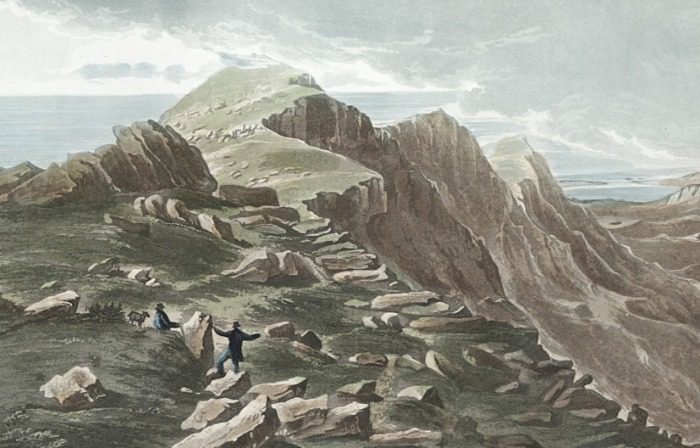
“Cadair Idris in 1818” Lithograph by Daniel Havell, From WikiMedia.
Folklore
There’s certainly a lot of folklore backing up the wider concept of going to a sacred place, often one associated with the Good People, and sleeping there to acquire inspiration or to be driven mad for one’s hubris. We see this in some versions of the story of the Brahan Seer, Coinneach Odhar, a Scottish seer who may have been given his gift after sleeping on a fairy howe and waking to find a holed stone resting on his chest. In the same way Turlough O’Carolan, a famous blind Irish musician of the 17th century, was supposed to have gained his skill and many of his songs by sleeping on a fairy hill.

Duma na nGaill, Teamhair, 2016. Photo by the author.
In the folktale of Lus Mór [Foxglove] the eponymous main character was a man with a hunched back who fell asleep on a fairy hill and woke to hear the inhabitants of the hill signing; when he joined the song at the exact right moment with a new line for the song the delighted Fair Folk healed his back. However when another man with a similar hunched back tried the same thing but interrupted the song rudely mid-verse he was punished by having his back twisted twice as badly. These are only a few examples of the substance behind the concept, the idea that risking everything by being vulnerable in the Good People’s places can bring either great reward or great danger, sometimes both. I might suggest, from my own perspective, that there seem to be potential hints here of what could be initiatory rites relating to the practice of sleeping on or going into the sí, but that’s a topic that would take a whole other article to unpack.
Welsh Sources
Now I knew that the concept was genuine, but that the quote itself came from a mid 20th century source of questionable integrity. That led me to keep digging to see what else I could find. In researching the roots of ‘dead, mad’ or a poet’ and trying to find Graves unnamed source I found an 1874 entry discussing Cader Idris in the 1884 book ‘Bye-Gones, Relating to Wales and the Border Countries‘ which says: “There is a popular Welsh tradition that on the summit of Cader Idris is an excavation in the rock resembling a couch and that whoever should pass a night in that seat would be found in the morning either dead, raving mad, or endowed with supernatural genius.” It would seem likely from the similarity in wording that this or another identical such source from Welsh folklore influenced Graves’ later writing.
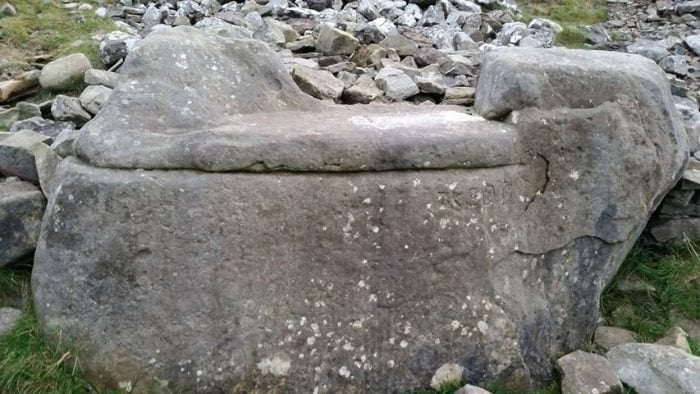
the Hag’s Chair, Sliabh na Caillighe, 2016. Photo by the author.
The same text mentions that this idea was not unique to Cader Idris but was found in other areas of Wales as well, and offers the example of Maen Du Yr Arddu [black stone of Arddu] where it was said if two people slept on the eponymous stone one would go mad and the other become a poet. The Maen Du Yr Arrdu example is particularly interesting to me, because while Cader Idris offers three possibilities for a single person Maen Du Yr Arrdu implies that two people must go in and one is guaranteed inspiration and the other madness. The Welsh material differs from the above mentioned Scottish and Irish folklore only in that there is no explicit connection with the fairies there, however if we look elsewhere in Welsh folklore we do find that Cader Idris was known as a habitation of the fairies and Maen Du Yr Arrdu is near a lake, Llyn Du Yr Arrdu [Black lake of Arrdu] associated with the Tylweth Teg [Fair Family aka fairies].
Graves was a controversial figure in many ways, inspired and far more influential for modern paganism than many people give him credit for but also prone to invention that he freely attributed to non-existent historic sources. His legacy is a muddle of his own poetic license: new material born of his imagination and genuinely older material re-dressed and re-told in his words. In this case however we see an example of Graves repeating genuine folklore and as a poet with a way with words doing so in a very evocative way. ‘Dead, mad, or a poet’ is not only concise but beautiful, certainly more so than ‘dead, raving mad, or endowed with supernatural genius’. That second one hardly rolls off the tongue. And in this case he manages to convey both the potential gain and genuine risk that comes from engaging with these Otherworldly powers.
So if you are feeling brave and you are willing to risk your life and your sanity to gain the gift of prophecy and magical speech, you might consider going out and sleeping in the sacred space of the Fair Folk – just remember that no one can truly tell you what they will ask of you in trade. And in the morning you will wake, if you wake at all, ‘dead, mad, or a poet’.
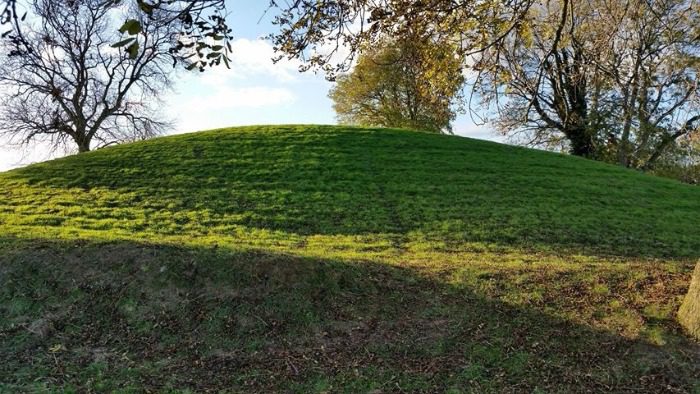
Duma na nGaill, Teamhair, 2016. Photo by the author.
References:
Mackenzie, A., (1899) The Prophecies of the Brahan Seer
Askew, R., (1884) Bye-Gones, Relating to Wales and the Border Countries
Graves, R., (1948) The White Goddess
Pennick, N., (2015) Pagan Magic of the Northern Tradition
Thomas, J., (1908) The Welsh Fairy Book
Halliwell-Phillips, J., (1860) Notes of Family Excursions in North Wales
Rhys, J., (1907) Celtic Folklore Welsh and Manx
Previous Post

February 27, 2018
The Other Side of the Hedge: Dignity for Dunces
Next Post

March 7, 2018 The Corner Crone: Un-Becoming
Browse Our Archives
Select a Category A Lakeside Hearth Adventures in Wortcunning Alone In Her Presence Arts, Crafts & Cooking Birthing Hereditary Witchcraft Book of Blackbirds Book Reviews Born-Again Witch Cauldron, Sword, Spear, & Stone Cermony and Liturgy Columns Community Dandelion Seeds Dear Jasmine Druid Thoughts Editor's Picks Everyday Pagan Family & Household Practice Family Traditions Full Frontal Magic Gateway Goddess Guest Articles Happily Heathen Health and Wellness Hearth of Hellenism Heathen Woman Hills of the Horizon History Holidays Horse Goddesses Interfaith Interviews Irish-American Witchcraft Jewish Witch Lamp & Labyrinth Letters from Midgard Literature, Media, Film, Music Loop of Brighid Love, Sex & Relationships Magic or Magick Making Light Naturalistic Traditions Nature News Outside The Circle Pantheisticon Politics Prayers, Poems, Blessings & Stories Queer Femme Mystic Queer of Swords Recipes Ritual and Practice Science and Research Seekers and Guides Seeking the Grail Socially Responsible Magic Spear of Athena Star Made Witch Syncretic Electric Technology The Blooming Staff The Busy Witch The Cartomancer The Crow's Nest The Dance of Pagan Recovery The Hearth of Hellenism The Lady's Quill The Other Side of the Hedge The Path of She The Rantin' Raven The Witches Next Door The Zen Pagan Theology, Ethics, Philosophy Tree City Witch Urban Earthwitch Wayfaring Woman Witch on Fire Wyrd Words
Select a Month January 2026 March 2025 December 2024 June 2024 April 2024 March 2024 January 2024 December 2023 November 2023 October 2023 August 2023 July 2023 May 2023 April 2023 March 2023 February 2023 January 2023 December 2022 November 2022 October 2022 September 2022 August 2022 July 2022 June 2022 May 2022 March 2022 February 2022 January 2022 December 2021 November 2021 October 2021 September 2021 August 2021 July 2021 June 2021 May 2021 April 2021 March 2021 February 2021 January 2021 December 2020 November 2020 October 2020 September 2020 August 2020 July 2020 June 2020 May 2020 April 2020 March 2020 February 2020 January 2020 December 2019 November 2019 October 2019 September 2019 August 2019 July 2019 June 2019 May 2019 April 2019 March 2019 February 2019 January 2019 December 2018 November 2018 October 2018 September 2018 August 2018 July 2018 June 2018 May 2018 April 2018 March 2018 February 2018 January 2018 December 2017 November 2017 October 2017 September 2017 August 2017 July 2017 June 2017 May 2017 April 2017 March 2017 February 2017 January 2017 December 2016 November 2016 October 2016 September 2016 August 2016 July 2016 June 2016 May 2016 April 2016 March 2016 February 2016 January 2016 December 2015 November 2015 October 2015 September 2015 August 2015 July 2015 June 2015 May 2015 April 2015 March 2015 February 2015 January 2015 December 2014 November 2014 October 2014 September 2014 August 2014 July 2014 June 2014 May 2014 April 2014 March 2014 February 2014 January 2014 December 2013 November 2013 October 2013 September 2013 August 2013 July 2013 June 2013 May 2013 April 2013 March 2013 February 2013 January 2013 December 2012 November 2012 October 2012 September 2012 August 2012 July 2012 June 2012 May 2012 April 2012 March 2012 February 2012 January 2012
Follow Us!
TAKE THE
Religious Wisdom Quiz
How many disciples did Jesus choose?
Select your answer to see how you score.
10 11 12 13
Related posts from Agora

Simple Witchery: To Keep Silent

Simple Witchery: Leaning On The Four Pillars

Pergamum Unfurled: Magic with the Greek Gods (Book...

Pergamum Unfurled: Cunning Words (Review)
TRENDING AT PATHEOS Pagan

I was recently chatting with someone on Instagram. She asked me what...

While there are many people who share their results, the end of...

On July 23, I saw Christopher Nolan's The Odyssey which is Homer’s...

As I write this two big events have just finished up. One...

Restoring the Watershed of Divine Love
Perhaps cooperation is not something we manufacture through legislation, ideology, or moral...

Many UUs don’t pray because of bad experiences in a previous religion,...
view all Pagan blogs
Ad-Free & Subscriber Log-In Subscription Support
- About Us
- 2026 Calendar
- Videos
- Podcasts
- Library of World Religions
- Faith In Media Tracker
- Advertise With Us
- Write for Us
- Privacy Policy
- Terms of Service
- Do Not Sell My Data
- Contact Us
- Radiant Digital
- Manage Newsletter Subscriptions
- Unsubscribe From Notifications
- Sitemap
Copyright 2008-2026, Patheos. All rights reserved.
Subscription Support Ad-Free & Subscriber Log-In
Follow Patheos