
BuddhistCatholicContemplativeEvangelicalGeneral ChristianHinduJewishLatter-day SaintMuslimNew VisionsProgressive Christian
Beliefs
- Buddhist
- Catholic
- Contemplative
- Evangelical
- General Christian
- Hindu
- Jewish
- Latter-day Saint
- More Voices
- Muslim
- New Visions
- Pagan
- Progressive Christian
Topics
- Religion News
- Food and Religion
- Sports and Religion
- Religious Art
- Religious Music and Entertainment
- Religious Events
- History and Religion
- Style and Religion
- Politics and Religion
- Women in Religion
- Recreation Outdoors and Religion
- Business Finance and Religion
- Careers Workplace and Religion
- Education and Religion
- Family Parenting and Religion
- Health Fitness and Religion
- Home and Religion
- Relationships and Religion
- Technology and Religion
- Travel and Religion
Columnists
- Buddhist Columnists
- Business Finance and Religion Columnists
- Careers Workplace and Religion Columnists
- Catholic Columnists
- Contemplative Columnists
- Education and Religion Columnists
- Evangelists Columnists
- Family Parenting and Religion Columnists
- General Christian Columnists
- Health Fitness and Religion Columnists
- Hindu Columnists
- History and Religion Columnists
- Home and Religion Columnists
- Jewish Columnists
- More Voices Columnists
- Latter Day Columnists
- Muslim Columnists
- New Visions Columnists
- Nonreligious Columnists
- Pagan Columnists
- Politics and Religion Columnists
- Progressive Columnists
- Recreation Outdoors and Religion Columnists
- Relationships and Religion Columnists
- Religion News Columnists
- Religious Art Columnists
- Religious Events Columnists
- Religious Music and Entertainment Columnists
- Sports and Religion Columnists
- Style and Religion Columnists
- Technology and Religion Columnists
- Travel and Religion Columnists
- Women in Religion Columnists
Resource Library
- 2026 Calendar
- Library of World Religions
- The 100 Most Holy Places on Earth
- Patheos Answers
- Podcasts
- Videos
- Faith Leaders Database
- Anglican Episcopalian
- Bahai
- Baptist
- Buddhism
- Christianity
- Confucianism
- Eastern Orthodoxy
- Hinduism
- Holiness and Pentecostal
- ISKCON
- Islam
- Judaism
- Lutheran
- Methodist
- The Church of Jesus Christ of Latter-day Saints
- New Age
- Paganism
- Presbytarian and Reformed
- Protestantism
- Religion Behind the Scenes
- Roman Catholic
- Scientology
- Shia Islam
- Sikhism
- Sufism
- Sunni Islam
- Taoism
- Zen
- See all religions
Research Tools
 Ad-Free & Subscriber Log-In Subscription Support
Ad-Free & Subscriber Log-In Subscription Support
Follow Patheos 

- Trending:
- Forgiveness
- |
- Marriage
- |
- Consciousness
- |
- Death Penalty
- |
- Election
- |
- Halloween

- Home
- Pagan
- Irish-American Witchcraft: The Dagda Q & A
Irish-American Witchcraft: The Dagda Q & A
Last updated on: February 22, 2018 at 9:57 pm by Morgan Daimler
Irish-American Witchcraft: The Dagda Q & A 2018-02-22T21:57:34+00:00 Morgan Daimler
Patheos Explore the world's faith through different perspectives on religion and spirituality! Patheos has the views of the prevalent religions and spiritualities of the world.
I’ve had a lot of Dagda going on in my life in the last few months, having recently written a book about that deity and also having contributed pieces to an upcoming anthology called Harp, Club, and Cauldron dedicated to him.
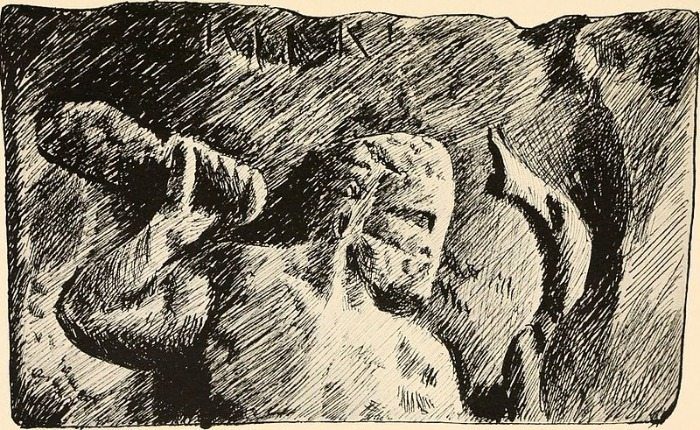
From the book “The Mythology of All Races” (1918) via WikiMedia.
Maybe that’s made me more aware of people discussing him or maybe he’s just been on more people’s radars besides mine, but it’s seemed recently like I’ve been running across more and more discussion and questions about the Dagda. He’s a great deity but also one that people can have trouble finding good information about so I thought it would be helpful to do a blog here with a question and answer format focused on him. I asked people on social media to ask me their questions, and am repeating them here with my answers.
Catherine asks: what are the ways the Dagda is commonly understood in modern paganism that are just plain wrong or wish fulfillment?
My answer: I think there are two main ones that I see and those are the idea that he is an ‘all father’ and that he is a primogenitor of the pantheon.
The first issue comes from confusion of his name ‘Ollathair’ because people confuse the older Irish oll with it’s english homonym all. But ollathair doesn’t mean all father, oll has meanings that are closer to vast, ample, and great in the sense of size. I prefer to translate this as ‘ample father’ because of its comparison to the Latin word amplus in the dictionary, although Stokes tends to go with ‘Great Father’.
The idea that the Dagda is the father of all the Gods is likely rooted in a book from the late 20th century by Peter Berresford Ellis, who invented an Irish creation story wherein the Dagda and Brighid were children of Danu and Bile who then founded the pantheon. This has become more popular over the years but is vastly at odds with the actual existing mythology. We know who the Dagda’s father was and also who his children were, and while he was fairly prolific there were many other deities who were more so. The Tuatha Dé Danann were also not the first divine beings created into an empty world, but rather came after a series of previous beings had already existed including their own progenitors the Nemedians.
Jennifer asks: Why doesn’t the Dagda have as big a modern cult following as the Morrigan or Brighid
My answer: I think people just aren’t aware enough of him, which is a shame because he’s an amazing deity.
Anthony asks: Is it true that, as some scholars have claimed, Dagda largely disappears from the scene after Oengus deposes him of ownership of the Brú [Brú na Bóinne]? And if so, why do you think that is? Why would one of the supreme TDD figureheads suffer such an ignominious demotion?
My answer: I think, for my own part, that some scholars get too caught up in the idea of younger Gods displacing and replacing older ones. We could possibly argue that the Dagda has less or no influence around the Brú na Bóinne after Oengus takes over but stories like the Aislinge Oenguso show that he still remains a significant power – after all in that story Oengus has the Brú but must ultimately go to the Dagda for help finding Caer, and the Dagda is described in that tale as ‘king of all the Sí of Ireland’.
There are several versions of how Oengus won the Brú, and who he tricked, and in one [from the Tochmarc Etaine] the Dagda is the one advising and helping Oengus to win the land from Elcmar. Which to me says the story itself is more about Oengus and his claim to that place than the details of who he tricked exactly.
From the position of why one of the supreme figureheads would suffer such an ignominious defeat – Oengus is a clever one, and there seems to be some kind of balance in a child conceived through his father’s trickery that involved a play on time (magically holding it still) then claiming his birthright from his father with another play on time (word play re: all life going by nights and days)
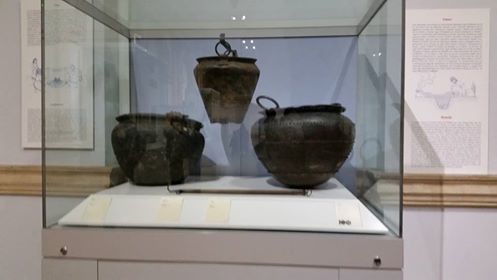
cauldrons, National Museum of Ireland, 2016, M. Daimler
Michael asks: Do you personally feel that the Dagda wore a short tunic that showed his genitals, or was that a later Christian insertaion?
My answer: that description is accurate to what iron age Irish peasants wore according to scholars like Williams in ‘Ireland’s Immortals’. There is debate among academics as to whether the description from the Cath Maige Tuired was genuine or inserted to emphasize the Dagda’s baseness (ie he dressed like peasant) but I think we need to keep in mind he was in disguise spying on the Fomorians at the time. It is likely that he did wear that but I would venture to say that wasn’t how he regularly dressed every day.
Aleja asks: I would like your best take on his close family tree.
My answer: His father is Elada which is also sometimes spelled Elatha. His brothers are Ogma, Bres [not the king], Alloth, and Delbeath, and according to some sources Nuada. His children are Oengus, Aedh, Cermait, Conan, Bodb Derg, Midhir, Ainge, Adair, and Brighid. His wife is the Morrigan, and Boínne is his lover as is an unnamed Fomorian, the daughter of Indech.
Ian asks: is there a reliable account of the Dagda as Ruad Rofessa rather than fertility god or warrior?
My answer: Personally I might argue his role as a fertility god is a bit harder to support, but sure if you mean ‘Ruad Rofessa’ in the sense of a god of wisdom/knowledge. The Cóir Anmann describes him as having ‘all heathen knowledge’ with heathen often being a euphemism for occult. In some versions of Oengus winning the Brú, as I mention above, it was the Dagda who advises Oengus on how to succeed, and in the Dindshenchas of Ailech I and II we see him in the role of king giving good and wise judgements.
Segomâros asks: Thunder God or not a Thunder God?
My answer: there seems to be a decent amount of evidence in academia to at least tentatively support the Dagda fitting the category of thunder gods along the lines of Thor and Secullos. He carries a weapon described as a club or staff [the word lorg can be read either way], he’s associated with the success of crops and with weather, and of warriors/kingship.
Like Thor he has a myth where he fights an aquatic menace and defeats it with his staff. That said his name obviously doesn’t mean thunder and it isn’t related to thunder and in other respects he seems more like what we’d categorize as a sky deity, a la Zeus, or even similar to Dis Pater.
For my part I find that this very variety in abilities and connections tends to put me in the ‘probably not’ camp, but then I tend to be very cautious of the Classical lens and the idea of deities fitting these formats. I think arguments can be made and supported in either direction.
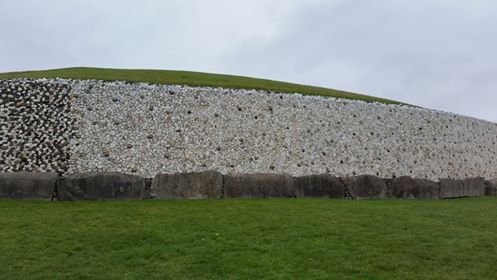
Newgrange, 2016, M. Daimler
Seán-Pól asks: Dagda as “good god” is said to be similar to the fairies as the “good folk” and some have thought this was said more out of fear and placating than any sense of altruism etc? Thoughts?
My answer: It would be impossible to say for sure, but at least according to the mythology the Dagda was given his name in response to his pledges to do as much as other deities were promising to do. We see this in the Cath Maige Tuired where he promises in two separate places to do everything the other Gods have pledged to do in battle and they proclaim him the ‘Dagdae’ or literally good/excellent [dag] God [dae a form of dia]. The meaning of his name features in word play, such as we see in the Cét-Chath Maige Tuired where he volunteers to lead the Tuatha Dé Danann into battle saying ‘for in me you have an excellent god [dag dia].
My own opinion on it would be that the Dagda’s nature in general seems to be much more benevolent than the Daoine Maithe and I wouldn’t necessarily see a need for euphemisms with him in the same way we use for Themselves.
Seán-Pól also asks: How many names does he have and are they all the same God or a mix of gods or aspects of one God.
My answer: Besides the name Dagda, which is always given with the prefix ‘the’, I’m aware of 9 epithets and common other names for him: Eochaid Ollathair, Ruad Rofessa, Aedh Alainn, Aodh Ruad Rofessa, Dagda Mór, Dagda Dein, Dagda Duir, Dagda Deirg, and Dagda Donn. In the Cath Maige Tuired he also gives a long list of 26 obscure names which he says are his.
They seem to be all names of one God, although there’s no way to be absolutely certain that at some very early point they weren’t distinct deities later fused into one. Certainly the sources tend to often emphasize ‘Eochaid who was the Dagda’ or ‘The Dagda had three names, that is Eochaid Ollathair, Ruad Rofessa, and Aedh Alainn’.
So that’s my take on a variety of questions people had on the Dagda. If you have questions of your own ask them in the comments and I’ll try to answer them here. The Dagda is a complex and complicated deity and one who has a lot of mythology and associations, so its hard to reduce all of that down into a blog, but hopefully this addresses at least the common questions.
Previous Post
February 13, 2018
The Other Side of the Hedge: The Future of Paganism
Next Post

February 23, 2018 Hearth of Hellenism: Anthesteria, Celebrating Dionysus
Browse Our Archives
Select a Category A Lakeside Hearth Adventures in Wortcunning Alone In Her Presence Arts, Crafts & Cooking Birthing Hereditary Witchcraft Book of Blackbirds Book Reviews Born-Again Witch Cauldron, Sword, Spear, & Stone Cermony and Liturgy Columns Community Dandelion Seeds Dear Jasmine Druid Thoughts Editor's Picks Everyday Pagan Family & Household Practice Family Traditions Full Frontal Magic Gateway Goddess Guest Articles Happily Heathen Health and Wellness Hearth of Hellenism Heathen Woman Hills of the Horizon History Holidays Horse Goddesses Interfaith Interviews Irish-American Witchcraft Jewish Witch Lamp & Labyrinth Letters from Midgard Literature, Media, Film, Music Loop of Brighid Love, Sex & Relationships Magic or Magick Making Light Naturalistic Traditions Nature News Outside The Circle Pantheisticon Politics Prayers, Poems, Blessings & Stories Queer Femme Mystic Queer of Swords Recipes Ritual and Practice Science and Research Seekers and Guides Seeking the Grail Socially Responsible Magic Spear of Athena Star Made Witch Syncretic Electric Technology The Blooming Staff The Busy Witch The Cartomancer The Crow's Nest The Dance of Pagan Recovery The Hearth of Hellenism The Lady's Quill The Other Side of the Hedge The Path of She The Rantin' Raven The Witches Next Door The Zen Pagan Theology, Ethics, Philosophy Tree City Witch Urban Earthwitch Wayfaring Woman Witch on Fire Wyrd Words
Select a Month January 2026 March 2025 December 2024 June 2024 April 2024 March 2024 January 2024 December 2023 November 2023 October 2023 August 2023 July 2023 May 2023 April 2023 March 2023 February 2023 January 2023 December 2022 November 2022 October 2022 September 2022 August 2022 July 2022 June 2022 May 2022 March 2022 February 2022 January 2022 December 2021 November 2021 October 2021 September 2021 August 2021 July 2021 June 2021 May 2021 April 2021 March 2021 February 2021 January 2021 December 2020 November 2020 October 2020 September 2020 August 2020 July 2020 June 2020 May 2020 April 2020 March 2020 February 2020 January 2020 December 2019 November 2019 October 2019 September 2019 August 2019 July 2019 June 2019 May 2019 April 2019 March 2019 February 2019 January 2019 December 2018 November 2018 October 2018 September 2018 August 2018 July 2018 June 2018 May 2018 April 2018 March 2018 February 2018 January 2018 December 2017 November 2017 October 2017 September 2017 August 2017 July 2017 June 2017 May 2017 April 2017 March 2017 February 2017 January 2017 December 2016 November 2016 October 2016 September 2016 August 2016 July 2016 June 2016 May 2016 April 2016 March 2016 February 2016 January 2016 December 2015 November 2015 October 2015 September 2015 August 2015 July 2015 June 2015 May 2015 April 2015 March 2015 February 2015 January 2015 December 2014 November 2014 October 2014 September 2014 August 2014 July 2014 June 2014 May 2014 April 2014 March 2014 February 2014 January 2014 December 2013 November 2013 October 2013 September 2013 August 2013 July 2013 June 2013 May 2013 April 2013 March 2013 February 2013 January 2013 December 2012 November 2012 October 2012 September 2012 August 2012 July 2012 June 2012 May 2012 April 2012 March 2012 February 2012 January 2012
Follow Us!
TAKE THE
Religious Wisdom Quiz
Who was the prophet who pronounced doom on Jezebel and Ahab?
Select your answer to see how you score.
Isaiah Elijah Elisha Hosea
Related posts from Agora

Simple Witchery: To Keep Silent

Simple Witchery: Leaning On The Four Pillars

Pergamum Unfurled: Magic with the Greek Gods (Book...

Pergamum Unfurled: Cunning Words (Review)
TRENDING AT PATHEOS Pagan

I was recently chatting with someone on Instagram. She asked me what...

While there are many people who share their results, the end of...

On July 23, I saw Christopher Nolan's The Odyssey which is Homer’s...

As I write this two big events have just finished up. One...

Restoring the Watershed of Divine Love
Perhaps cooperation is not something we manufacture through legislation, ideology, or moral...

Many UUs don’t pray because of bad experiences in a previous religion,...
view all Pagan blogs
Ad-Free & Subscriber Log-In Subscription Support
- About Us
- 2026 Calendar
- Videos
- Podcasts
- Library of World Religions
- Faith In Media Tracker
- Advertise With Us
- Write for Us
- Privacy Policy
- Terms of Service
- Do Not Sell My Data
- Contact Us
- Radiant Digital
- Manage Newsletter Subscriptions
- Unsubscribe From Notifications
- Sitemap
Copyright 2008-2026, Patheos. All rights reserved.
Subscription Support Ad-Free & Subscriber Log-In
Follow Patheos