
BuddhistCatholicContemplativeEvangelicalGeneral ChristianHinduJewishLatter-day SaintMuslimNew VisionsProgressive Christian
Beliefs
- Buddhist
- Catholic
- Contemplative
- Evangelical
- General Christian
- Hindu
- Jewish
- Latter-day Saint
- More Voices
- Muslim
- New Visions
- Pagan
- Progressive Christian
Topics
- Religion News
- Food and Religion
- Sports and Religion
- Religious Art
- Religious Music and Entertainment
- Religious Events
- History and Religion
- Style and Religion
- Politics and Religion
- Women in Religion
- Recreation Outdoors and Religion
- Business Finance and Religion
- Careers Workplace and Religion
- Education and Religion
- Family Parenting and Religion
- Health Fitness and Religion
- Home and Religion
- Relationships and Religion
- Technology and Religion
- Travel and Religion
Columnists
- Buddhist Columnists
- Business Finance and Religion Columnists
- Careers Workplace and Religion Columnists
- Catholic Columnists
- Contemplative Columnists
- Education and Religion Columnists
- Evangelists Columnists
- Family Parenting and Religion Columnists
- General Christian Columnists
- Health Fitness and Religion Columnists
- Hindu Columnists
- History and Religion Columnists
- Home and Religion Columnists
- Jewish Columnists
- More Voices Columnists
- Latter Day Columnists
- Muslim Columnists
- New Visions Columnists
- Nonreligious Columnists
- Pagan Columnists
- Politics and Religion Columnists
- Progressive Columnists
- Recreation Outdoors and Religion Columnists
- Relationships and Religion Columnists
- Religion News Columnists
- Religious Art Columnists
- Religious Events Columnists
- Religious Music and Entertainment Columnists
- Sports and Religion Columnists
- Style and Religion Columnists
- Technology and Religion Columnists
- Travel and Religion Columnists
- Women in Religion Columnists
Resource Library
- 2026 Calendar
- Library of World Religions
- The 100 Most Holy Places on Earth
- Patheos Answers
- Podcasts
- Videos
- Faith Leaders Database
- Anglican Episcopalian
- Bahai
- Baptist
- Buddhism
- Christianity
- Confucianism
- Eastern Orthodoxy
- Hinduism
- Holiness and Pentecostal
- ISKCON
- Islam
- Judaism
- Lutheran
- Methodist
- The Church of Jesus Christ of Latter-day Saints
- New Age
- Paganism
- Presbytarian and Reformed
- Protestantism
- Religion Behind the Scenes
- Roman Catholic
- Scientology
- Shia Islam
- Sikhism
- Sufism
- Sunni Islam
- Taoism
- Zen
- See all religions
Research Tools
 Ad-Free & Subscriber Log-In Subscription Support
Ad-Free & Subscriber Log-In Subscription Support
Follow Patheos 

- Trending:
- Forgiveness
- |
- Marriage
- |
- Consciousness
- |
- Death Penalty
- |
- Election
- |
- Halloween

- Home
- Pagan
- Hearth of Hellenism: How Christianity Rewrote History
Hearth of Hellenism: How Christianity Rewrote History
Last updated on: January 6, 2018 at 6:41 pm by Angelo Nasios
Hearth of Hellenism: How Christianity Rewrote History 2018-01-06T18:41:05+00:00 Angelo Nasios
Patheos Explore the world's faith through different perspectives on religion and spirituality! Patheos has the views of the prevalent religions and spiritualities of the world.
With the rise of Christianity, Historiography went under some radical changes. Previous approaches and perspectives of the Greeks and Romans were either rejected or revised. To create a Christian historiography, pagan history was reworked in a Christian worldview, which dismantled traditional pagan identities in the process. Christians formulated new interpretations of history, one in which God guides human affairs, instead of fate, chance, emperors, and or capricious gods of the Roman world. Christians also changed how time operated.
Crafting Christian history required a reconciliation between paganism and Christianity. Reconciliation was a twofold process, one centered on the problem of interpretation and the second, the problem of chronology.[1] Accommodating allegorical interpretation remedied the first problem, allegory allowed Christians to claim pagan experiences as prefiguring of Jesus Christ. To rectify the second problem Christians would need to synchronize the geologies of the Old Testament and classical time periods.[2]

“The Procession of the Trojan Horse in Troy” by Giovanni Domenico Tiepolo. From WikiMedia.
Pagan concepts of history vary and differ between classical Greece, the Hellenistic era, and Roman. In the process of creating a universal history, the Greeks fell short, Rome excelled, and Christian’s would adapt to craft their sense of history. Greek history can be characterized in two ways, the first is discontinuous history, that of the Epics of Homer. The second is continuous history, that of writers like Herodotus or Thucydides. The Discontinuous history of Homer’s epics connects the audience to a time long ago which the dating of events is irrelevant. It was the time of the Trojan war, of heroes like Achilles and Odysseus who interacted with the gods of Olympus. The history of the poet was of great deeds, of extraordinary men designed to entertain and inspire the audience in cultivating virtue.[3] Aristotle considered epic to be an art and thus the imitation of important and serious matters. The epic is “absolute past”, it is a-temporal, enclosed in itself.[4] The deeds of heroes occurs in epic time, their “proper time” (kairos) cannot be controlled, thus the heroes are not under the influence providence.[5]
Within continuous history, which is centered on the polis, links present man to the timeless past. The gods are seen as intervening forces that can help the course of events, but they are not inherently seen as guiding all of human history. Herodotus believes that the gods pay attention to human affairs, they also punish mortals who are impious. Poseidon the “savior” is credited for destroying a Persian naval fleet at Artemision, by causing a four-day storm.[6] The operation of time for Herodotus is non-linear running, if not cyclical, then at least it is repetitive.[7]
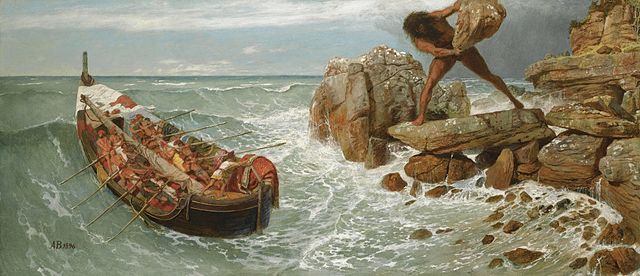
“Odysseus and Polyphemus” by Arnold Böcklin. From WikiMedia.
The difference in the operation one of the clear distinctions between pagan and Christian history. In pagan history, there is no providential end only a pragmatic end of history.[8] In such, the Greeks could not have created a universal history, for there was no inevitable end of history which time progressed towards. Christianity emphasized linear based time which was guided by the sovereignty of God. Time had a beginning which started at Creation and would have an end at the Last Judgement.[9] The deeds of Christ signify the guidepost for all the is behind and all this is ahead. Time and history are now understood as the process of redemption.[10]
Originally, Christians showed little concern over history, the chiliasts and millenarians were waiting for the second coming of Christ would hardly produce a historiography.[11] The future was expected to be short, Jesus return would usher in the end of history – reconciliation the past and present were irrelevant. When Christians did eventually create a historiography, coming to terms with the real possibility that the second coming may not be imminent, pagan along with Jewish history was integrated into a Christian historiography. Christians such as Irenaeus saw history as the recapitulation of previous events. The Old Testament was examined with a Christian lens, Adam was understood as a “foreshadowing” of Christ.
Greek philosophy also had to be reexamined to fit into the Christian historiographical narrative. Christians would view Greek education and philosophy as a stage in growth where God’s revelation was unfolding partially. Philosophers such as Socrates, Plato, and Aristotle were reinterpreted as proto-monotheists, who were preparing the Greeks for the gospel. Justin Martyr would declare that Jesus was known partially by Socrates.[12] Homer would lose his authority to Moses, who Christians claimed to have greater antiquity. Pagan identity would lose itself through Christian historiographical rewriting where Judaism’s scripture is elevated over Greek teachings, and promoted as the real source of wisdom.

“Pallas Athene Visits Invidia” by Karel Dujardin. From WikiMedia.
The Roman Empire itself would be understood as an instrument of God, for the Pax Romana occurred because of Christ’s birth. The Pax Romana was conducive for the gospel to spread, the Empire was effectively connected and travel was safe. It would be Roman Emperors, Constantine and Theodosius that would allow Christianity to first gain imperial favor and later becoming the official religion of the Empire. The Roman Empire was an important vehicle for Christianity’s growth.
In conclusion, the creation of Christian historiography had two profound changes from that of their pagan counterparts. Christians emphasized linear time and redemptive history guided by providence. They established a definitive beginning and end, time now progressed in a forward motion, with all of pagan and Jewish history prefiguring Christ’s incarnation and preparing humanity for the gospel. In doing so, a universal history was created at the expense of pagan cultural identity.
NOTES
1. Donald R Kelley, Versions of History from Antiquity to the Enlightenment (New Haven: Yale University Press, 1991), 117-118.
2. ibid, 118
3. Ernst Breisach, Historiography: Ancient, Medieval, & Modern (Chicago: University of Chicago Press, 1983), 5-7.
4. Dmitri Nikulin, The Concept of History (London: Bloomsbury Academic, 2017), 48.
5. Ibid, 49
6. Herodotus, Histories 7.192
7. Mélina Tamiolaki and Antonis Tsakmakis, Thucydides between History and Literature (Berlin: De Gruyter, 2013), 14.
8. Dmitri Nikulin, The Concept of History, 24
9. Ernst Breisach, Historiography, 78.
10. Oscar Cullmann, Christ and Time: The Primitive Christian Conception of Time and History. Translated from the German by Floyd V. Filson (Philadelphia: Westminster Press, 1964), 53-54.
11. ibid, 79
12. ibid, 80
Previous Post

January 1, 2018
Irish-American Witchcraft: 2017 Retrospective in Books
Next Post

January 3, 2018 The Corner Crone: The Good Stuff
Browse Our Archives
Select a Category A Lakeside Hearth Adventures in Wortcunning Alone In Her Presence Arts, Crafts & Cooking Birthing Hereditary Witchcraft Book of Blackbirds Book Reviews Born-Again Witch Cauldron, Sword, Spear, & Stone Cermony and Liturgy Columns Community Dandelion Seeds Dear Jasmine Druid Thoughts Editor's Picks Everyday Pagan Family & Household Practice Family Traditions Full Frontal Magic Gateway Goddess Guest Articles Happily Heathen Health and Wellness Hearth of Hellenism Heathen Woman Hills of the Horizon History Holidays Horse Goddesses Interfaith Interviews Irish-American Witchcraft Jewish Witch Lamp & Labyrinth Letters from Midgard Literature, Media, Film, Music Loop of Brighid Love, Sex & Relationships Magic or Magick Making Light Naturalistic Traditions Nature News Outside The Circle Pantheisticon Politics Prayers, Poems, Blessings & Stories Queer Femme Mystic Queer of Swords Recipes Ritual and Practice Science and Research Seekers and Guides Seeking the Grail Socially Responsible Magic Spear of Athena Star Made Witch Syncretic Electric Technology The Blooming Staff The Busy Witch The Cartomancer The Crow's Nest The Dance of Pagan Recovery The Hearth of Hellenism The Lady's Quill The Other Side of the Hedge The Path of She The Rantin' Raven The Witches Next Door The Zen Pagan Theology, Ethics, Philosophy Tree City Witch Urban Earthwitch Wayfaring Woman Witch on Fire Wyrd Words
Select a Month January 2026 March 2025 December 2024 June 2024 April 2024 March 2024 January 2024 December 2023 November 2023 October 2023 August 2023 July 2023 May 2023 April 2023 March 2023 February 2023 January 2023 December 2022 November 2022 October 2022 September 2022 August 2022 July 2022 June 2022 May 2022 March 2022 February 2022 January 2022 December 2021 November 2021 October 2021 September 2021 August 2021 July 2021 June 2021 May 2021 April 2021 March 2021 February 2021 January 2021 December 2020 November 2020 October 2020 September 2020 August 2020 July 2020 June 2020 May 2020 April 2020 March 2020 February 2020 January 2020 December 2019 November 2019 October 2019 September 2019 August 2019 July 2019 June 2019 May 2019 April 2019 March 2019 February 2019 January 2019 December 2018 November 2018 October 2018 September 2018 August 2018 July 2018 June 2018 May 2018 April 2018 March 2018 February 2018 January 2018 December 2017 November 2017 October 2017 September 2017 August 2017 July 2017 June 2017 May 2017 April 2017 March 2017 February 2017 January 2017 December 2016 November 2016 October 2016 September 2016 August 2016 July 2016 June 2016 May 2016 April 2016 March 2016 February 2016 January 2016 December 2015 November 2015 October 2015 September 2015 August 2015 July 2015 June 2015 May 2015 April 2015 March 2015 February 2015 January 2015 December 2014 November 2014 October 2014 September 2014 August 2014 July 2014 June 2014 May 2014 April 2014 March 2014 February 2014 January 2014 December 2013 November 2013 October 2013 September 2013 August 2013 July 2013 June 2013 May 2013 April 2013 March 2013 February 2013 January 2013 December 2012 November 2012 October 2012 September 2012 August 2012 July 2012 June 2012 May 2012 April 2012 March 2012 February 2012 January 2012
Follow Us!
TAKE THE
Religious Wisdom Quiz
Who parted the Red Sea for the Israelites?
Select your answer to see how you score.
God Jacob Moses Aaron
Related posts from Agora

Simple Witchery: To Keep Silent

Simple Witchery: Leaning On The Four Pillars

Pergamum Unfurled: Magic with the Greek Gods (Book...

Pergamum Unfurled: Cunning Words (Review)
TRENDING AT PATHEOS Pagan

I was recently chatting with someone on Instagram. She asked me what...

While there are many people who share their results, the end of...

On July 23, I saw Christopher Nolan's The Odyssey which is Homer’s...

As I write this two big events have just finished up. One...

Restoring the Watershed of Divine Love
Perhaps cooperation is not something we manufacture through legislation, ideology, or moral...

Many UUs don’t pray because of bad experiences in a previous religion,...
view all Pagan blogs
Ad-Free & Subscriber Log-In Subscription Support
- About Us
- 2026 Calendar
- Videos
- Podcasts
- Library of World Religions
- Faith In Media Tracker
- Advertise With Us
- Write for Us
- Privacy Policy
- Terms of Service
- Do Not Sell My Data
- Contact Us
- Radiant Digital
- Manage Newsletter Subscriptions
- Unsubscribe From Notifications
- Sitemap
Copyright 2008-2026, Patheos. All rights reserved.
Subscription Support Ad-Free & Subscriber Log-In
Follow Patheos