
BuddhistCatholicContemplativeEvangelicalGeneral ChristianHinduJewishLatter-day SaintMuslimNew VisionsProgressive Christian
Beliefs
- Buddhist
- Catholic
- Contemplative
- Evangelical
- General Christian
- Hindu
- Jewish
- Latter-day Saint
- More Voices
- Muslim
- New Visions
- Pagan
- Progressive Christian
Topics
- Religion News
- Food and Religion
- Sports and Religion
- Religious Art
- Religious Music and Entertainment
- Religious Events
- History and Religion
- Style and Religion
- Politics and Religion
- Women in Religion
- Recreation Outdoors and Religion
- Business Finance and Religion
- Careers Workplace and Religion
- Education and Religion
- Family Parenting and Religion
- Health Fitness and Religion
- Home and Religion
- Relationships and Religion
- Technology and Religion
- Travel and Religion
Columnists
- Buddhist Columnists
- Business Finance and Religion Columnists
- Careers Workplace and Religion Columnists
- Catholic Columnists
- Contemplative Columnists
- Education and Religion Columnists
- Evangelists Columnists
- Family Parenting and Religion Columnists
- General Christian Columnists
- Health Fitness and Religion Columnists
- Hindu Columnists
- History and Religion Columnists
- Home and Religion Columnists
- Jewish Columnists
- More Voices Columnists
- Latter Day Columnists
- Muslim Columnists
- New Visions Columnists
- Nonreligious Columnists
- Pagan Columnists
- Politics and Religion Columnists
- Progressive Columnists
- Recreation Outdoors and Religion Columnists
- Relationships and Religion Columnists
- Religion News Columnists
- Religious Art Columnists
- Religious Events Columnists
- Religious Music and Entertainment Columnists
- Sports and Religion Columnists
- Style and Religion Columnists
- Technology and Religion Columnists
- Travel and Religion Columnists
- Women in Religion Columnists
Resource Library
- 2026 Calendar
- Library of World Religions
- The 100 Most Holy Places on Earth
- Patheos Answers
- Podcasts
- Videos
- Faith Leaders Database
- Anglican Episcopalian
- Bahai
- Baptist
- Buddhism
- Christianity
- Confucianism
- Eastern Orthodoxy
- Hinduism
- Holiness and Pentecostal
- ISKCON
- Islam
- Judaism
- Lutheran
- Methodist
- The Church of Jesus Christ of Latter-day Saints
- New Age
- Paganism
- Presbytarian and Reformed
- Protestantism
- Religion Behind the Scenes
- Roman Catholic
- Scientology
- Shia Islam
- Sikhism
- Sufism
- Sunni Islam
- Taoism
- Zen
- See all religions
Research Tools
 Ad-Free & Subscriber Log-In Subscription Support
Ad-Free & Subscriber Log-In Subscription Support
Follow Patheos 

- Trending:
- Forgiveness
- |
- Marriage
- |
- Consciousness
- |
- Death Penalty
- |
- Election
- |
- Halloween

- Home
- Pagan
- The Corner Crone: The Good Stuff
The Corner Crone: The Good Stuff
Last updated on: January 12, 2018 at 3:58 pm by Martha Kirby Capo
The Corner Crone: The Good Stuff 2018-01-12T15:58:42+00:00 Martha Kirby Capo
Patheos Explore the world's faith through different perspectives on religion and spirituality! Patheos has the views of the prevalent religions and spiritualities of the world.
On my first day of graduate school the professor told our class, “New graduate students always think that now they’re going to have access to ‘the good stuff’, that they’re going to learn some sort of secret knowledge that we kept hidden from them when they were undergraduates. What they don’t realize is that it’s the same ‘stuff’, the same knowledge they’ve been studying throughout their first four years of college; there’s just more of it.”
The secreting away of the “good stuff”, of Higher Knowledge, happens across a wide spectrum of religious and non-religious groups and has been a practice since the time before time. Secret societies such as the Freemasons and/or Illuminati, Rosicrucian, and the Knights Templar come to mind, as do the Catholic Masses of the medieval period, conducted in a language (Latin) the general population (peasants) could not possibly understand, behind a rood screen through which they could not clearly see. High Mysteries were in play. Secrets. The Good Stuff.

Photo by the author.
There are, of course, greater nuances to secret societies and medieval church architecture than are being touched upon here—I’m painting with some pretty broad brush strokes, and by no means am I a scholar on either topic. My own experience with secret societies, of being one of the insiders, is much more based in the socio-economic stratum I was born into. The uneasy awareness I have of the benefits I’ve derived from my privileged status negatively skews my view of almost any group that requires some sort of admission fee, be it financial, mental, emotional, physical or spiritual.
So it should come as no surprise that I’ve never been a member of a coven. I’ve never been through an initiation rite with a group of like-minded folks nor do I particularly care to experience one. The closest I’ve come to anything remotely resembling an initiation rite was being dragged, kicking and screaming, through my debutante year, and that was ten months of a pure and holy hell that ended in ruptured relationships and burned bridges, none of which were ever rebuilt.
And I want to be very clear that I am not positing that any one way of faith expression is better than another, or that one way is truer or more authentic or more noble or more to be desired or more anything than another. In my view, it’s not about “more than” or “less than”. Each stand of woods has within it several paths; or, in terms of the famous story of the blind men and the elephant, it’s all the same elephant. It’s all “the good stuff”.
So, initiation into a group is not for me. I walk a Solitary Path, even though at times it is exhausting. Even though at times I find I have veered far away from my path, which generally has happened when I start second-guessing myself on how I ought to be living my faith practice. (John Beckett’s post on this kind of “self-gaslighting” is well worth a read. He writes, “Your senses may sometimes confuse you, but they will not lie to you”). And I’m self-aware enough to realize that my own bad experience with a secular initiation has little or no relationship to the qualities inherent in a sacred initiation. Initiations into a spiritual group are meaningful—and hopefully meaning-filled—spiritual border stones.
As a liturgist, I understand the value of ritual and of its psycho/social components, and I understand how initiation serves to further strengthen the connective tissues of a body of believers. The experience is meant to be—and often is—profoundly moving, even life-altering, the same sort of experience I try to provide when I write liturgy for the Earth-centered spirituality group I co-lead.
And while I can sometimes access the High Mysteries during the rituals I lead, it’s far more often the case that I am so focused on what comes next that the ineffable slides right past me. I’ve made my peace with that—sometimes I think of it as the cost of leadership—but it does mean that I must be intentional about seeking out and experiencing “the good stuff” on my own, as a Solitary. It means (to paraphrase e.e. cummings) that I must keep the “ears of my ears awake” and the “eyes of my eyes” open, for one never knows when the wildness of magic is afoot.
The Opening Ritual at Chicago Pagan Pride a few years ago offered one such moment—a startling surprise to me as usually my moments of deep connection occur when I am wandering about in the woods and far away from people. In a loosely organized line, over one hundred attendees, hand-in-hand as they were able, streamed through a gateway of two lit torches and formed an ever-moving spiral of concentric circles until all had passed through the symbolic entrance.
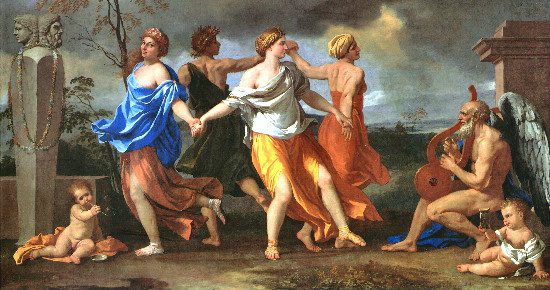
“A Dance to the Music of Time” by Nicolas Poussin, from WikiMedia.
Instead of throwing up my mental/emotional blocks as I usually do when in a crowd of strangers, I opened myself to the barely-controlled chaos of bodies of every sort and condition all walking or rolling or tripping or skipping or limping or dancing, each in their own rhythms, as the spirals grew deeper and wider and more compact. It was noisy and colorful, mismatched and pulsingly alive, with way too many people standing way too close to me . . . and it was delightfully, unutterably magical.
What meaning have I made from this experience and others like it? It’s that interpersonal relationships can offer me a peak experience that I had once thought I could only access when alone in nature. It means not getting sidetracked by semantics, and resisting the rush to judgment. It means I’m on a shared journey, whether I practice as a Solitary or in a coven. It’s all “the good stuff”, and there’s always more of it, if I remember to loosen my control and soften my borders.
Magic really is everywhere—even in places or situations that make me uncomfortable—if I only open myself to it.
Previous Post
January 2, 2018
Hearth of Hellenism: How Christianity Rewrote History
Next Post

January 4, 2018 The Other Side of the Hedge: Street Magic and Magic Theory
Browse Our Archives
Select a Category A Lakeside Hearth Adventures in Wortcunning Alone In Her Presence Arts, Crafts & Cooking Birthing Hereditary Witchcraft Book of Blackbirds Book Reviews Born-Again Witch Cauldron, Sword, Spear, & Stone Cermony and Liturgy Columns Community Dandelion Seeds Dear Jasmine Druid Thoughts Editor's Picks Everyday Pagan Family & Household Practice Family Traditions Full Frontal Magic Gateway Goddess Guest Articles Happily Heathen Health and Wellness Hearth of Hellenism Heathen Woman Hills of the Horizon History Holidays Horse Goddesses Interfaith Interviews Irish-American Witchcraft Jewish Witch Lamp & Labyrinth Letters from Midgard Literature, Media, Film, Music Loop of Brighid Love, Sex & Relationships Magic or Magick Making Light Naturalistic Traditions Nature News Outside The Circle Pantheisticon Politics Prayers, Poems, Blessings & Stories Queer Femme Mystic Queer of Swords Recipes Ritual and Practice Science and Research Seekers and Guides Seeking the Grail Socially Responsible Magic Spear of Athena Star Made Witch Syncretic Electric Technology The Blooming Staff The Busy Witch The Cartomancer The Crow's Nest The Dance of Pagan Recovery The Hearth of Hellenism The Lady's Quill The Other Side of the Hedge The Path of She The Rantin' Raven The Witches Next Door The Zen Pagan Theology, Ethics, Philosophy Tree City Witch Urban Earthwitch Wayfaring Woman Witch on Fire Wyrd Words
Select a Month January 2026 March 2025 December 2024 June 2024 April 2024 March 2024 January 2024 December 2023 November 2023 October 2023 August 2023 July 2023 May 2023 April 2023 March 2023 February 2023 January 2023 December 2022 November 2022 October 2022 September 2022 August 2022 July 2022 June 2022 May 2022 March 2022 February 2022 January 2022 December 2021 November 2021 October 2021 September 2021 August 2021 July 2021 June 2021 May 2021 April 2021 March 2021 February 2021 January 2021 December 2020 November 2020 October 2020 September 2020 August 2020 July 2020 June 2020 May 2020 April 2020 March 2020 February 2020 January 2020 December 2019 November 2019 October 2019 September 2019 August 2019 July 2019 June 2019 May 2019 April 2019 March 2019 February 2019 January 2019 December 2018 November 2018 October 2018 September 2018 August 2018 July 2018 June 2018 May 2018 April 2018 March 2018 February 2018 January 2018 December 2017 November 2017 October 2017 September 2017 August 2017 July 2017 June 2017 May 2017 April 2017 March 2017 February 2017 January 2017 December 2016 November 2016 October 2016 September 2016 August 2016 July 2016 June 2016 May 2016 April 2016 March 2016 February 2016 January 2016 December 2015 November 2015 October 2015 September 2015 August 2015 July 2015 June 2015 May 2015 April 2015 March 2015 February 2015 January 2015 December 2014 November 2014 October 2014 September 2014 August 2014 July 2014 June 2014 May 2014 April 2014 March 2014 February 2014 January 2014 December 2013 November 2013 October 2013 September 2013 August 2013 July 2013 June 2013 May 2013 April 2013 March 2013 February 2013 January 2013 December 2012 November 2012 October 2012 September 2012 August 2012 July 2012 June 2012 May 2012 April 2012 March 2012 February 2012 January 2012
Follow Us!
TAKE THE
Religious Wisdom Quiz
What African country is known for its ancient Coptic Christian Church?
Select your answer to see how you score.
Nigeria Egypt South Africa Ghana
Related posts from Agora

Simple Witchery: To Keep Silent

Simple Witchery: Leaning On The Four Pillars

Pergamum Unfurled: Magic with the Greek Gods (Book...

Pergamum Unfurled: Cunning Words (Review)
TRENDING AT PATHEOS Pagan

I was recently chatting with someone on Instagram. She asked me what...

While there are many people who share their results, the end of...

On July 23, I saw Christopher Nolan's The Odyssey which is Homer’s...

As I write this two big events have just finished up. One...

Restoring the Watershed of Divine Love
Perhaps cooperation is not something we manufacture through legislation, ideology, or moral...

Many UUs don’t pray because of bad experiences in a previous religion,...
view all Pagan blogs
Ad-Free & Subscriber Log-In Subscription Support
- About Us
- 2026 Calendar
- Videos
- Podcasts
- Library of World Religions
- Faith In Media Tracker
- Advertise With Us
- Write for Us
- Privacy Policy
- Terms of Service
- Do Not Sell My Data
- Contact Us
- Radiant Digital
- Manage Newsletter Subscriptions
- Unsubscribe From Notifications
- Sitemap
Copyright 2008-2026, Patheos. All rights reserved.
Subscription Support Ad-Free & Subscriber Log-In
Follow Patheos