
BuddhistCatholicContemplativeEvangelicalGeneral ChristianHinduJewishLatter-day SaintMuslimNew VisionsProgressive Christian
Beliefs
- Buddhist
- Catholic
- Contemplative
- Evangelical
- General Christian
- Hindu
- Jewish
- Latter-day Saint
- More Voices
- Muslim
- New Visions
- Pagan
- Progressive Christian
Topics
- Religion News
- Food and Religion
- Sports and Religion
- Religious Art
- Religious Music and Entertainment
- Religious Events
- History and Religion
- Style and Religion
- Politics and Religion
- Women in Religion
- Recreation Outdoors and Religion
- Business Finance and Religion
- Careers Workplace and Religion
- Education and Religion
- Family Parenting and Religion
- Health Fitness and Religion
- Home and Religion
- Relationships and Religion
- Technology and Religion
- Travel and Religion
Columnists
- Buddhist Columnists
- Business Finance and Religion Columnists
- Careers Workplace and Religion Columnists
- Catholic Columnists
- Contemplative Columnists
- Education and Religion Columnists
- Evangelists Columnists
- Family Parenting and Religion Columnists
- General Christian Columnists
- Health Fitness and Religion Columnists
- Hindu Columnists
- History and Religion Columnists
- Home and Religion Columnists
- Jewish Columnists
- More Voices Columnists
- Latter Day Columnists
- Muslim Columnists
- New Visions Columnists
- Nonreligious Columnists
- Pagan Columnists
- Politics and Religion Columnists
- Progressive Columnists
- Recreation Outdoors and Religion Columnists
- Relationships and Religion Columnists
- Religion News Columnists
- Religious Art Columnists
- Religious Events Columnists
- Religious Music and Entertainment Columnists
- Sports and Religion Columnists
- Style and Religion Columnists
- Technology and Religion Columnists
- Travel and Religion Columnists
- Women in Religion Columnists
Resource Library
- 2026 Calendar
- Library of World Religions
- The 100 Most Holy Places on Earth
- Patheos Answers
- Podcasts
- Videos
- Faith Leaders Database
- Anglican Episcopalian
- Bahai
- Baptist
- Buddhism
- Christianity
- Confucianism
- Eastern Orthodoxy
- Hinduism
- Holiness and Pentecostal
- ISKCON
- Islam
- Judaism
- Lutheran
- Methodist
- The Church of Jesus Christ of Latter-day Saints
- New Age
- Paganism
- Presbytarian and Reformed
- Protestantism
- Religion Behind the Scenes
- Roman Catholic
- Scientology
- Shia Islam
- Sikhism
- Sufism
- Sunni Islam
- Taoism
- Zen
- See all religions
Research Tools
 Ad-Free & Subscriber Log-In Subscription Support
Ad-Free & Subscriber Log-In Subscription Support
Follow Patheos 

- Trending:
- Forgiveness
- |
- Marriage
- |
- Consciousness
- |
- Death Penalty
- |
- Election
- |
- Halloween

- Home
- Pagan
- Hermes Resurrected: What Hermetic Literature Reveals to Contemporary Seekers
Hermes Resurrected: What Hermetic Literature Reveals to Contemporary Seekers
Last updated on: October 17, 2017 at 2:54 pm by Mitch Horowitz
Hermes Resurrected: What Hermetic Literature Reveals to Contemporary Seekers 2017-10-17T14:54:31+00:00 Mitch Horowitz
Patheos Explore the world's faith through different perspectives on religion and spirituality! Patheos has the views of the prevalent religions and spiritualities of the world.
Does Hermetic literature hold any meaning for today’s seekers?
I sometimes suspect that we deploy the word “Hermetic”—a term for late ancient Greek-Egyptian mystical texts attributed to the mythical man-god Hermes Trismegistus, or thrice-greatest Hermes—as a kind of marker, intended to connote a venerable ancestor to modern mysticism, and thus giving our current spiritual pursuits the weight of historical gravitas.

“Dream of Aesculapius” by Sebastiano Ricci (1710).
But, the truth is, Hermeticism is a living philosophy, which ought to be read, debated, and engaged in. The Hermetic texts, mostly those found in the Corpus Hermeticum and the dialogue called Asclepius, can serve the needs of a twenty-first century person in search of metaphysical ideas and clarity.
Hermeticism is of immediate value much like the more arcane books of the Old Testament. Although certain Hebrew rites, rituals, and genealogical recordkeeping may seem period-bound, or of little more than liturgical significance to any but the religiously orthodox, such passages provide a framework for luminous ethical and spiritual insights. Similarly, elements of the late-Egyptian Hermetic books also reflect traditions of formalism, ritual, and recital—and these elements likewise frame passages of penetrating relevance to current seekers. This fact has not always been apparent due the longstanding paucity of quality translations, a deficit that is thankfully being redressed in our time. (1)
The central and most enduring theme of the Hermetic literature—and one that left its mark on the ancient and Renaissance worlds, and, indirectly, on our contemporary culture of New Thought and mind metaphysics—is that the human mind is an extension and imitation of Nous, the Higher Mind, which serves as the divine creative force behind all that is.
This perspective finds particular resonance in books I and XI of the seventeen tracts that make up the Corpus Hermeticum. In book I, sometimes called the Divine Pymander of Hermes Trismegistus, we learn of the mind’s causative abilities: “. . . your mind is god the father; they are not divided from one another for their union is life.” (2) As we come to realize our creative capacities, we grow closer in nature and perspective to the Eternal: ” . . he who has understood himself advances toward god.”
Book XI goes further in urging man’s awareness of how his mind, through its abilities to visualize all things, originate new concepts, and surpass physical boundaries, reflects innate divinity:
See what power you have, what quickness! If you can do these things, can god not do them? So you must think of god in this way, as having everything—the cosmos, himself, (the) universe—like thoughts within himself. Thus, unless you make yourself equal to god, you cannot understand god; like is understood by like. Make yourself grow to immeasurable immensity, outleap all body, outstrip all time, become eternity and you will understand god. Having conceived that nothing is impossible to you, consider yourself immortal and able to understand everything, all art, all learning, the temper of every living thing.
In the student-teacher dialogue called Asclepius, which is often grouped as an adjunct to the Corpus Hermeticum, man’s estimate is even further elevated. We first learn that “one who has joined himself to the gods in divine reverence, using the mind that joins him to the gods, almost attains divinity.” Using a variant of the famous Hermetic formula, “as above, so below” (enunciated in another text called the Emerald Tablet), this dialogue counsels: “Forms of all things follow kinds … Thus, the kind made up of gods will produce from itself the forms of gods.” This adds a deeper resonance to man being made in God’s image, as found in Hebrew scripture.
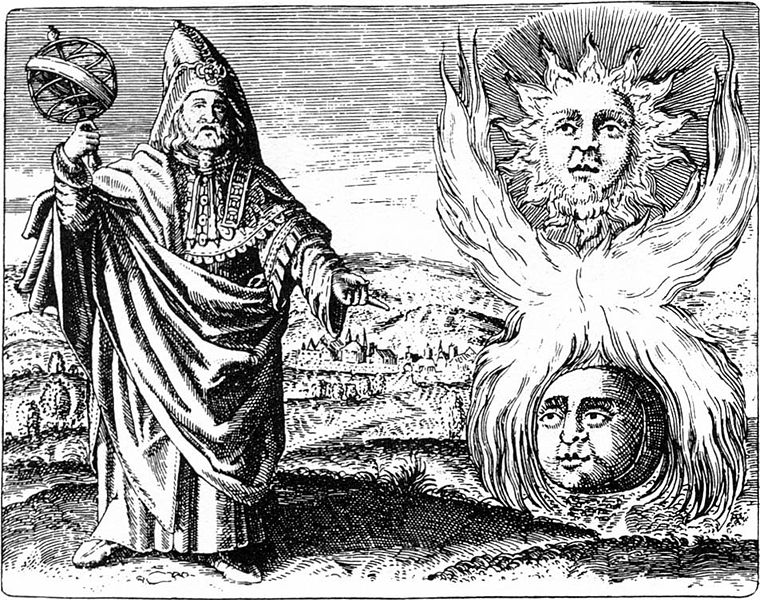
Trismegistos from 1610 via WikiMedia.
Hermes goes on to teach his disciple Asclepius that man, at his highest, is actually on par with the gods: “Because of this, Asclepius, a human being is a great wonder, a living thing to be worshipped and honored: for he changes his nature into a god’s…” Hermes ultimately evaluates man as even greater than the gods because, while a god’s nature is fixed in immorality, the striving and aware man is ever in process of becoming and fulfilling his highest nature: “In short, god made mankind good and capable of immortality through his two natures, divine and mortal, and so god willed the arrangement whereby mankind was ordained to be better than the gods, who were formed only from the immortal nature…”
Moreover, man in his reverence and worship, performs necessary acts of caretaking of the gods: “He not only advances toward god; he also makes the gods strong.”
In considering man’s potential, the modern reader of Hermetic literature may find himself facing a question that also faces contemporary students of New Thought: Given the causative powers ascribed to our minds, and the manner in which thought relates to the highest source of creation, why do we suffer physical decline, illness, and bodily death? Indeed, the most Hermetic of all New Thought teachers, Neville Goddard (1905-1972), instructed that your mind is God, and all that you experience is the product of your imagination—so, again, why must we “die as princes?” as the psalmist puts it?
The Corpus Hermetic offers a reconciling response. Man, for all his potential greatness, is nonetheless conscripted to dwell within a “cosmic framework,” where physical laws must be suffered and limitations experienced. “The master of eternity,” Hermes tells Asclepius, “is the first god, the world”—or great nature—“is second, mankind is the third.” Man may be the greatest of beings in God’s schema of creation, but he nonetheless remains bound to other aspects of the creative order.
In book I we learn: “mankind is affected by mortality because he is subject to fate”—fate being a term for nature’s governance—“thus, although man is above the cosmic framework, he became a slave within in.”
These views of man’s greatness and weakness, the forces in which he functions, and his higher possibilities are considered with surprising adroitness in the 1908 occult classic, The Kybalion. Published under the tantalizingly Hermetic pseudonym “Three Initiates,” the slender but powerful book is a reasonable iteration of certain Hermetic concepts, as well its author’s personal insights into New Thought psychology.
In essence, The Kybalion adds specific techniques to the overarching Hermetic principle that the mind of the individual is an adjunct to the Mind of God, through which man may not only create but also aspire to his eventual return to the source from which he was created.
For those seeking a guiding, cosmic philosophy, as well as the reconciliation of certain vexing ideas within New Thought and other modern mystical schools, I recommend reading the Hermetic literature hand in hand with Neville, The Kybalion, and other mature New Thought works.
You will also discover within the Hermetic texts, particularly Asclepius, a poignant and, incidentally, accurate prophecy of Ancient Egypt’s decline, and the demise of its lexicon of gods. But with today’s renewed interested in Hermeticism, and the arrival of a new generation of supple translations, we may be entering a phase of Hermetic rebirth. This renewal, however, comes with a caveat, one deeply grounded in Hermetic tradition: If Hermes is to be resurrected, such an operation must occur within you.
_______

Photo courtesy of the author.
Mitch Horowitz is a PEN Award-winning historian and publisher, and the author of books including Occult America and One Simple Idea: How Positive Thinking Reshaped Modern Life, which was recently censored in China. His new book The Miracle Club: How Thoughts Become Reality comes out in fall 2018. Follow him @MitchHorowitz.
NOTES
1. Of particular note are Hermetica translated by Brian P. Copenhaver (Cambridge University Press, 1992), and The Way of Hermes translated by Clement Salaman, Dorine van Oyen, and Jean Pierre-Mahé (Inner Traditions, 1999, 2000).
2. In this essay, I use Copenhaver’s translation.
Previous Post
October 9, 2017
The Other Side of the Hedge: Four Hundred Days
Next Post
October 13, 2017 Book of Blackbirds: Teachers
Browse Our Archives
Select a Category A Lakeside Hearth Adventures in Wortcunning Alone In Her Presence Arts, Crafts & Cooking Birthing Hereditary Witchcraft Book of Blackbirds Book Reviews Born-Again Witch Cauldron, Sword, Spear, & Stone Cermony and Liturgy Columns Community Dandelion Seeds Dear Jasmine Druid Thoughts Editor's Picks Everyday Pagan Family & Household Practice Family Traditions Full Frontal Magic Gateway Goddess Guest Articles Happily Heathen Health and Wellness Hearth of Hellenism Heathen Woman Hills of the Horizon History Holidays Horse Goddesses Interfaith Interviews Irish-American Witchcraft Jewish Witch Lamp & Labyrinth Letters from Midgard Literature, Media, Film, Music Loop of Brighid Love, Sex & Relationships Magic or Magick Making Light Naturalistic Traditions Nature News Outside The Circle Pantheisticon Politics Prayers, Poems, Blessings & Stories Queer Femme Mystic Queer of Swords Recipes Ritual and Practice Science and Research Seekers and Guides Seeking the Grail Socially Responsible Magic Spear of Athena Star Made Witch Syncretic Electric Technology The Blooming Staff The Busy Witch The Cartomancer The Crow's Nest The Dance of Pagan Recovery The Hearth of Hellenism The Lady's Quill The Other Side of the Hedge The Path of She The Rantin' Raven The Witches Next Door The Zen Pagan Theology, Ethics, Philosophy Tree City Witch Urban Earthwitch Wayfaring Woman Witch on Fire Wyrd Words
Select a Month January 2026 March 2025 December 2024 June 2024 April 2024 March 2024 January 2024 December 2023 November 2023 October 2023 August 2023 July 2023 May 2023 April 2023 March 2023 February 2023 January 2023 December 2022 November 2022 October 2022 September 2022 August 2022 July 2022 June 2022 May 2022 March 2022 February 2022 January 2022 December 2021 November 2021 October 2021 September 2021 August 2021 July 2021 June 2021 May 2021 April 2021 March 2021 February 2021 January 2021 December 2020 November 2020 October 2020 September 2020 August 2020 July 2020 June 2020 May 2020 April 2020 March 2020 February 2020 January 2020 December 2019 November 2019 October 2019 September 2019 August 2019 July 2019 June 2019 May 2019 April 2019 March 2019 February 2019 January 2019 December 2018 November 2018 October 2018 September 2018 August 2018 July 2018 June 2018 May 2018 April 2018 March 2018 February 2018 January 2018 December 2017 November 2017 October 2017 September 2017 August 2017 July 2017 June 2017 May 2017 April 2017 March 2017 February 2017 January 2017 December 2016 November 2016 October 2016 September 2016 August 2016 July 2016 June 2016 May 2016 April 2016 March 2016 February 2016 January 2016 December 2015 November 2015 October 2015 September 2015 August 2015 July 2015 June 2015 May 2015 April 2015 March 2015 February 2015 January 2015 December 2014 November 2014 October 2014 September 2014 August 2014 July 2014 June 2014 May 2014 April 2014 March 2014 February 2014 January 2014 December 2013 November 2013 October 2013 September 2013 August 2013 July 2013 June 2013 May 2013 April 2013 March 2013 February 2013 January 2013 December 2012 November 2012 October 2012 September 2012 August 2012 July 2012 June 2012 May 2012 April 2012 March 2012 February 2012 January 2012
Follow Us!
TAKE THE
Religious Wisdom Quiz
What kingdom did Isaiah prophesy would take Judah into exile?
Select your answer to see how you score.
Babylon Assyria Persia Egypt
Related posts from Agora

The Other Side of the Hedge: Practical Idolatry

The Blooming Staff: On the Papal World-Tree, or,...
The Blooming Staff: Prisca Theologia, Pansophy, and Integral...

Simple Witchery: To Keep Silent
TRENDING AT PATHEOS Pagan

I was recently chatting with someone on Instagram. She asked me what...

While there are many people who share their results, the end of...

On July 23, I saw Christopher Nolan's The Odyssey which is Homer’s...

As I write this two big events have just finished up. One...

Restoring the Watershed of Divine Love
Perhaps cooperation is not something we manufacture through legislation, ideology, or moral...

Many UUs don’t pray because of bad experiences in a previous religion,...
view all Pagan blogs
Ad-Free & Subscriber Log-In Subscription Support
- About Us
- 2026 Calendar
- Videos
- Podcasts
- Library of World Religions
- Faith In Media Tracker
- Advertise With Us
- Write for Us
- Privacy Policy
- Terms of Service
- Do Not Sell My Data
- Contact Us
- Radiant Digital
- Manage Newsletter Subscriptions
- Unsubscribe From Notifications
- Sitemap
Copyright 2008-2026, Patheos. All rights reserved.
Subscription Support Ad-Free & Subscriber Log-In
Follow Patheos