
BuddhistCatholicContemplativeEvangelicalGeneral ChristianHinduJewishLatter-day SaintMuslimNew VisionsProgressive Christian
Beliefs
- Buddhist
- Catholic
- Contemplative
- Evangelical
- General Christian
- Hindu
- Jewish
- Latter-day Saint
- More Voices
- Muslim
- New Visions
- Pagan
- Progressive Christian
Topics
- Religion News
- Food and Religion
- Sports and Religion
- Religious Art
- Religious Music and Entertainment
- Religious Events
- History and Religion
- Style and Religion
- Politics and Religion
- Women in Religion
- Recreation Outdoors and Religion
- Business Finance and Religion
- Careers Workplace and Religion
- Education and Religion
- Family Parenting and Religion
- Health Fitness and Religion
- Home and Religion
- Relationships and Religion
- Technology and Religion
- Travel and Religion
Columnists
- Buddhist Columnists
- Business Finance and Religion Columnists
- Careers Workplace and Religion Columnists
- Catholic Columnists
- Contemplative Columnists
- Education and Religion Columnists
- Evangelists Columnists
- Family Parenting and Religion Columnists
- General Christian Columnists
- Health Fitness and Religion Columnists
- Hindu Columnists
- History and Religion Columnists
- Home and Religion Columnists
- Jewish Columnists
- More Voices Columnists
- Latter Day Columnists
- Muslim Columnists
- New Visions Columnists
- Nonreligious Columnists
- Pagan Columnists
- Politics and Religion Columnists
- Progressive Columnists
- Recreation Outdoors and Religion Columnists
- Relationships and Religion Columnists
- Religion News Columnists
- Religious Art Columnists
- Religious Events Columnists
- Religious Music and Entertainment Columnists
- Sports and Religion Columnists
- Style and Religion Columnists
- Technology and Religion Columnists
- Travel and Religion Columnists
- Women in Religion Columnists
Resource Library
- 2026 Calendar
- Library of World Religions
- The 100 Most Holy Places on Earth
- Patheos Answers
- Podcasts
- Videos
- Faith Leaders Database
- Anglican Episcopalian
- Bahai
- Baptist
- Buddhism
- Christianity
- Confucianism
- Eastern Orthodoxy
- Hinduism
- Holiness and Pentecostal
- ISKCON
- Islam
- Judaism
- Lutheran
- Methodist
- The Church of Jesus Christ of Latter-day Saints
- New Age
- Paganism
- Presbytarian and Reformed
- Protestantism
- Religion Behind the Scenes
- Roman Catholic
- Scientology
- Shia Islam
- Sikhism
- Sufism
- Sunni Islam
- Taoism
- Zen
- See all religions
Research Tools
 Ad-Free & Subscriber Log-In Subscription Support
Ad-Free & Subscriber Log-In Subscription Support
Follow Patheos 

- Trending:
- Forgiveness
- |
- Marriage
- |
- Consciousness
- |
- Death Penalty
- |
- Election
- |
- Halloween

- Home
- Pagan
- Hearth of Hellenism: Why is Mythology Mocked?
Hearth of Hellenism: Why is Mythology Mocked?
Last updated on: October 23, 2017 at 10:05 pm by Angelo Nasios
Hearth of Hellenism: Why is Mythology Mocked? 2017-10-23T22:05:50+00:00 Angelo Nasios
Patheos Explore the world's faith through different perspectives on religion and spirituality! Patheos has the views of the prevalent religions and spiritualities of the world.
“[W]hy the myths are divine it is the duty of philosophy to inquire.”
-Sallustius On the Gods and the World
Mythology is often the first exposure to Paganism that we experience. I can recall being exposed to Greek myths throughout my career in school. From elementary to college, mythology has been there. There is one problem with the way myth is dealt with in and outside of academia: it is not treated as a living tradition.
A living tradition by my definition is a tradition which is (a) functional and (b) meaningful for use as a way of life and understanding life. The functionality of a living tradition means that the tradition does something and it works for the followers of that tradition. Functionality leads to meaningfulness, which is the sense of purpose, wisdom, and knowledge.
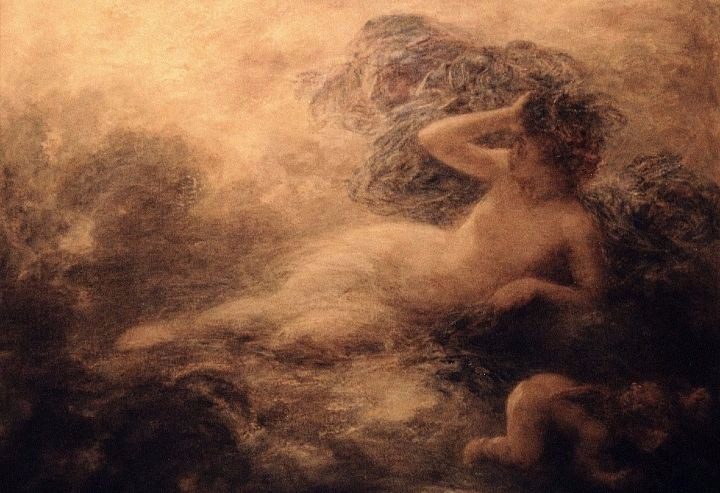
“Nyx” by Henri Fantin-Latour. From WikiMedia.
Functionality and meaningfulness are the two criteria I use when evaluating a tradition for their incorporation into my spiritual practices. Qabalah is a good example of this. Qabalah as a knowledge system provides function and meaning. It is a system that does something and works. Does that mean Qabalah is “true?” Maybe not in the way scientists think of what is true or not. But it is true if it works for you as a system of understanding and wisdom.
In academia, mythology does not receive the same treatment as world religions because of the notion that mythology is dead religion. While classicists do treat myth seriously, they only do so as an artifact of ancient culture. Myth functions as a means to understand a past culture, not as a means for living today, or understanding a current culture, or as a knowledge system for relating to the divine and the world.
The distinction between how we approach and understanding mythology in and outside of academia is obvious to me. The Crash Course series is a contemporary example of this. Crash Course offers free educational videos on various topics on YouTube. Among their various series, they include World Religions and Mythology. When you compare the discourse and evaluation of the two topics, you will notice they are dealt with differently. There is a more serious tone with World Religions compared to the comical treatment of Mythology, which often includes mocking and jokes.
Why is mythology treated like this? Why do we mock myth? Mythology is mocked because society views myth as primitive stories attempting to explain the unknown. Mythology is mocked for being thought of as false stories, fantasies, immoral, violent, and so on. Much of this comes from Christian culture which directed how we viewed the world. There were “pagan” critics of mythology, but I think we take those criticism to have more importance than they really had in their time, or maybe that we are not understanding the sense those criticisms had in their own context.
The mocking of myth is deeply rooted in our consciousness. On a visit to Poughkeepsie this year, I stopped into the local Barnes and Noble to muse around. I came across a book in the bargain section, Classical Mythology by British historian H.A. Guerber. It looked to be a solid book, comprehensive with many myths. I bought it, $8 was not a lot anyway.
As I read this book, the Judeo-Christian bias was apparent right from page one. The opening chapter addresses creation. The author writes that “among all the nations of the earth, the Hebrews alone were instructed by God, who gave them not only a full account of the creation of the world and of all living creatures, but also a code of laws to regulate their conduct.” Further on, Guerber writes that the other nations lacked such instruction and revelation by the Hebrew god. The Greeks and Romans lacked “definite knowledge which we obtained from Scriptures, and still anxious to know everything, were forced to construct, in part their own theory.”
Further in, when addressing the creation stories of Greece, Guerber recounts the story of Chaos and Nyx, the first two divinities to appear. From them are generated Erebus, Aether, and Hemera. Erebus dethrones his father Chaos and marries his mother Nyx. The author comments on this saying, “with our present views, this marriage was a heinous sin; but the ancients, who at first had no fixed laws, did not consider this union unsuitable.”
Reading three pages into the book and the author has disparaged the myths of Greece as immoral and ignorant. Greco-Roman polytheism is argued to be inferior to the Judeo-Christian tradition. Such an attitude and evaluation of myth reflects poor scholarship. The author’s attitude stems from improper understanding on Greco-Roman religion. Guerber reads the myths literally, a grievous error that many still fall into when reading myths. Many believers in the Christian tradition approach their texts with a literal eye. The Virgin Birth was literally a virgin birth. Jesus literally walked on water, raised the dead and would later be resurrected after his crucifixion. Applying this mindset to myths, with the presumption that the myths are untrue, will lead the reader to think one thing, how silly and crazy these stories are, how could anyone actually believe them?
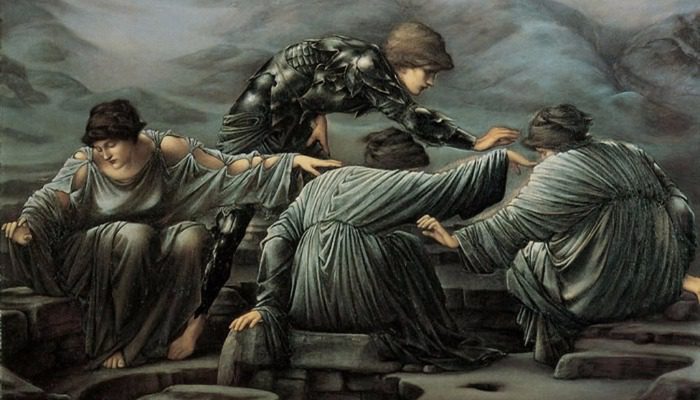
“Perseus and the Graiae” by Edward Burne-Jones. From WikiMedia.
“It is requisite that those who are willing to hear concerning the gods should have been well informed from their childhood, and not nourished with foolish opinions.”
-Sallustius On the Gods and the World
Literalism in myth plagues paganism today, as a carry-over from our exposure to monotheism. We tend to treat mythology as evidence for how the gods literally behave. In one of my first posts here on Patheos, “We Don’t Have Relationships with the Gods, or Do We?” – I questioned the assumption that relationships with gods were possible. The rebuttals I received cited myth as evidence of relationships between mortals and humans.
This brings us to two approaches to myth, the poetic and philosophic. The poetic approach views mythology as literal/concrete while the philosophic approach views myth as having deeper meaning. The latter requires little analysis while the former requires contemplation. Sallustius, writing in the 4th century of the common era, shows us the philosophic approach. In his On the Gods and the World, Sallustius explains that myths can be theological, psychical, physical, and sometimes material in their content.
If you are familiar with the story of Kronos swallowing his children, those without the theological understanding will simply be baffled by this tale. How immoral and evil Kronos must be to eat his own children! How could Greeks believe in this myth? It must be nonsense! Sallustius comments on this myth, and explains the theological teaching that “[s]ince god is intellectual, and all intellect returns into itself, this myth expresses in allegory the essence of god.”
Essentially what I am arguing here is that because “pagan” culture was effectively killed off, the seriousness and meaning of mythology was lost. Mythology and the gods are thus treated as subservient to monotheism, because either society won’t allow it to be equal, or we assume it cannot be equal. I think it is both.
Pop culture reveals our attitudes and how we play with things like religion and myth. Reflect back on the shows and movies you have watched that had to do with mythology in some way. How was it portrayed? You’ll notice a theme in how mythology is used.
Supernatural on the CW is one of my favorite shows because of its involvement with myth and religion. In this show, Dean and Sam are hunters, who travel around the United States killing monsters. Throughout the series they sometimes encounter gods. The gods are always causing trouble and doing harm, and Dean and Sam end up killing many of these gods. There is one episode where Dean and Sam end up at the Elysian Fields Hotel, where various gods are meeting to deal the oncoming Judeo-Christian Apocalypse that was started by Lucifer. Lucifer arrives at the hotel, confronts Mercury, calling him and the other gods “petty little things, worse than humans, worse than demons, yet you claim to be gods.” Lucifer goes on a rampage where he kills off almost all the gods in the hotel.
Only in our monotheistic world would such a plot happen. All of this stems from our loss of paganism as a legitimate living tradition. The divine mythology is degraded to fairy tales, shrugged off as irrational stories from primitive society. For mythology to be treated seriously once again, we must treat them seriously. Mythological hermeneutics needs to return. I ask that you revisit your myths and contemplate on their deeper meaning(s), dig beneath the surface of the story, you’ll find gold of wisdom underneath.
Previous Post

October 18, 2017
Tree City Witch: A Jewish Ghost Story For Halloween
Next Post

October 24, 2017 The Other Side of the Hedge: Defining Paganism
Browse Our Archives
Select a Category A Lakeside Hearth Adventures in Wortcunning Alone In Her Presence Arts, Crafts & Cooking Birthing Hereditary Witchcraft Book of Blackbirds Book Reviews Born-Again Witch Cauldron, Sword, Spear, & Stone Cermony and Liturgy Columns Community Dandelion Seeds Dear Jasmine Druid Thoughts Editor's Picks Everyday Pagan Family & Household Practice Family Traditions Full Frontal Magic Gateway Goddess Guest Articles Happily Heathen Health and Wellness Hearth of Hellenism Heathen Woman Hills of the Horizon History Holidays Horse Goddesses Interfaith Interviews Irish-American Witchcraft Jewish Witch Lamp & Labyrinth Letters from Midgard Literature, Media, Film, Music Loop of Brighid Love, Sex & Relationships Magic or Magick Making Light Naturalistic Traditions Nature News Outside The Circle Pantheisticon Politics Prayers, Poems, Blessings & Stories Queer Femme Mystic Queer of Swords Recipes Ritual and Practice Science and Research Seekers and Guides Seeking the Grail Socially Responsible Magic Spear of Athena Star Made Witch Syncretic Electric Technology The Blooming Staff The Busy Witch The Cartomancer The Crow's Nest The Dance of Pagan Recovery The Hearth of Hellenism The Lady's Quill The Other Side of the Hedge The Path of She The Rantin' Raven The Witches Next Door The Zen Pagan Theology, Ethics, Philosophy Tree City Witch Urban Earthwitch Wayfaring Woman Witch on Fire Wyrd Words
Select a Month January 2026 March 2025 December 2024 June 2024 April 2024 March 2024 January 2024 December 2023 November 2023 October 2023 August 2023 July 2023 May 2023 April 2023 March 2023 February 2023 January 2023 December 2022 November 2022 October 2022 September 2022 August 2022 July 2022 June 2022 May 2022 March 2022 February 2022 January 2022 December 2021 November 2021 October 2021 September 2021 August 2021 July 2021 June 2021 May 2021 April 2021 March 2021 February 2021 January 2021 December 2020 November 2020 October 2020 September 2020 August 2020 July 2020 June 2020 May 2020 April 2020 March 2020 February 2020 January 2020 December 2019 November 2019 October 2019 September 2019 August 2019 July 2019 June 2019 May 2019 April 2019 March 2019 February 2019 January 2019 December 2018 November 2018 October 2018 September 2018 August 2018 July 2018 June 2018 May 2018 April 2018 March 2018 February 2018 January 2018 December 2017 November 2017 October 2017 September 2017 August 2017 July 2017 June 2017 May 2017 April 2017 March 2017 February 2017 January 2017 December 2016 November 2016 October 2016 September 2016 August 2016 July 2016 June 2016 May 2016 April 2016 March 2016 February 2016 January 2016 December 2015 November 2015 October 2015 September 2015 August 2015 July 2015 June 2015 May 2015 April 2015 March 2015 February 2015 January 2015 December 2014 November 2014 October 2014 September 2014 August 2014 July 2014 June 2014 May 2014 April 2014 March 2014 February 2014 January 2014 December 2013 November 2013 October 2013 September 2013 August 2013 July 2013 June 2013 May 2013 April 2013 March 2013 February 2013 January 2013 December 2012 November 2012 October 2012 September 2012 August 2012 July 2012 June 2012 May 2012 April 2012 March 2012 February 2012 January 2012
Follow Us!
TAKE THE
Religious Wisdom Quiz
What kind of animal did Jesus ride into Jerusalem?
Select your answer to see how you score.
Donkey Camel Ox Horse
Related posts from Agora

Simple Witchery: To Keep Silent

Simple Witchery: Leaning On The Four Pillars

Pergamum Unfurled: Magic with the Greek Gods (Book...

Pergamum Unfurled: Cunning Words (Review)
TRENDING AT PATHEOS Pagan

I was recently chatting with someone on Instagram. She asked me what...

While there are many people who share their results, the end of...

On July 23, I saw Christopher Nolan's The Odyssey which is Homer’s...

As I write this two big events have just finished up. One...

Restoring the Watershed of Divine Love
Perhaps cooperation is not something we manufacture through legislation, ideology, or moral...

Many UUs don’t pray because of bad experiences in a previous religion,...
view all Pagan blogs
Ad-Free & Subscriber Log-In Subscription Support
- About Us
- 2026 Calendar
- Videos
- Podcasts
- Library of World Religions
- Faith In Media Tracker
- Advertise With Us
- Write for Us
- Privacy Policy
- Terms of Service
- Do Not Sell My Data
- Contact Us
- Radiant Digital
- Manage Newsletter Subscriptions
- Unsubscribe From Notifications
- Sitemap
Copyright 2008-2026, Patheos. All rights reserved.
Subscription Support Ad-Free & Subscriber Log-In
Follow Patheos