
BuddhistCatholicContemplativeEvangelicalGeneral ChristianHinduJewishLatter-day SaintMuslimNew VisionsProgressive Christian
Beliefs
- Buddhist
- Catholic
- Contemplative
- Evangelical
- General Christian
- Hindu
- Jewish
- Latter-day Saint
- More Voices
- Muslim
- New Visions
- Pagan
- Progressive Christian
Topics
- Religion News
- Food and Religion
- Sports and Religion
- Religious Art
- Religious Music and Entertainment
- Religious Events
- History and Religion
- Style and Religion
- Politics and Religion
- Women in Religion
- Recreation Outdoors and Religion
- Business Finance and Religion
- Careers Workplace and Religion
- Education and Religion
- Family Parenting and Religion
- Health Fitness and Religion
- Home and Religion
- Relationships and Religion
- Technology and Religion
- Travel and Religion
Columnists
- Buddhist Columnists
- Business Finance and Religion Columnists
- Careers Workplace and Religion Columnists
- Catholic Columnists
- Contemplative Columnists
- Education and Religion Columnists
- Evangelists Columnists
- Family Parenting and Religion Columnists
- General Christian Columnists
- Health Fitness and Religion Columnists
- Hindu Columnists
- History and Religion Columnists
- Home and Religion Columnists
- Jewish Columnists
- More Voices Columnists
- Latter Day Columnists
- Muslim Columnists
- New Visions Columnists
- Nonreligious Columnists
- Pagan Columnists
- Politics and Religion Columnists
- Progressive Columnists
- Recreation Outdoors and Religion Columnists
- Relationships and Religion Columnists
- Religion News Columnists
- Religious Art Columnists
- Religious Events Columnists
- Religious Music and Entertainment Columnists
- Sports and Religion Columnists
- Style and Religion Columnists
- Technology and Religion Columnists
- Travel and Religion Columnists
- Women in Religion Columnists
Resource Library
- 2026 Calendar
- Library of World Religions
- The 100 Most Holy Places on Earth
- Patheos Answers
- Podcasts
- Videos
- Faith Leaders Database
- Anglican Episcopalian
- Bahai
- Baptist
- Buddhism
- Christianity
- Confucianism
- Eastern Orthodoxy
- Hinduism
- Holiness and Pentecostal
- ISKCON
- Islam
- Judaism
- Lutheran
- Methodist
- The Church of Jesus Christ of Latter-day Saints
- New Age
- Paganism
- Presbytarian and Reformed
- Protestantism
- Religion Behind the Scenes
- Roman Catholic
- Scientology
- Shia Islam
- Sikhism
- Sufism
- Sunni Islam
- Taoism
- Zen
- See all religions
Research Tools
 Ad-Free & Subscriber Log-In Subscription Support
Ad-Free & Subscriber Log-In Subscription Support
Follow Patheos 

- Trending:
- Forgiveness
- |
- Marriage
- |
- Consciousness
- |
- Death Penalty
- |
- Election
- |
- Halloween
 The Other Side of the Hedge
- Home
- Pagan
- The Other Side of the Hedge: The Witchhack
The Other Side of the Hedge: The Witchhack
Last updated on: September 5, 2017 at 4:34 pm by Christopher Drysdale
The Other Side of the Hedge: The Witchhack 2017-09-05T16:34:21-07:00 Christopher Drysdale
Patheos Explore the world's faith through different perspectives on religion and spirituality! Patheos has the views of the prevalent religions and spiritualities of the world.
If you’re like me, you probably have more than a few store-bought magical tools lying around. We all do, despite the fact that there is, embedded deep in the Western esoteric consciousness, the idea that our magical tools should be handmade. In our guts, we believe that there’s something impure about the mass-produced article.
This idea is a relatively new one. After all, by definition it can’t be any older than factories. I suspect that it is founded on, or grows from the same Romantic roots as, the Marxist notion of the alienation of labor. Marx’s theory of alienation rests on idea that the value of an object comes not on its market value, nor solely on its pragmatic use, but on its relationship to person who made it. Thus, for Marx, the factory-made item is always of less “value” than that made by hand.

“Venus visiting Vulcan’s Forge ” by David Teniers the Elder, From WikiMedia.
That being the case, Pagans in particular seem to be attached to this idea of the “impure” coming off the factory line. The reasoning behind this belief is complex, with aspects that are both mundane and spiritual in nature. It is an idea worthy of some attention; it’s a practice that is both illuminating and revealing.
A #WitchHack is a practical application of esoteric ideals. From blending your herbals to balancing your checkbook,from ascending the sephirot to climbing a mountain, the #WitchHack team is here with practical advice on impractical challenges. Follow the #WitchHack team!
The Pagan DIY Ethic
We live in a time of immense wealth and diversity. It’s entirely possible to go online and have pretty much whatever magical tool you want delivered to your door.
At least around my neighborhood, we need it. Where I live, we’re more likely to be functionaries than artisans, more often programmers than blacksmiths. Maybe your neighborhood is different, but I’d bet not.
So why don’t we want to just go out and buy tools willy-nilly? The rational aspect of this is that, whatever craziness we’re living through now, Western magical practices are meant to be hidden. Let’s face it, it’s hard to hide your magical practices if you head down to ye olde magic shoppe to pick up your weekly supplies. Buy a grimoire with a credit card, and you’re forever in the records, somewhere.
Yet there’s more to this DIY Pagan tradition than simple social pragmatics. In a world where everything can be cheaply made in factories that supply global needs and desires, things that are handmade, or better yet self-made, take on greater meaning and power.
With the wealth and diversity of the modern era, it’s possible to live in places where we can, as the saying goes, “let our freak flags fly.” Here in the Bay Area, no one cares what I buy or what I believe. Nonetheless, there’s still a value put on either making our own gear, or hiring someone who is a skilled artisan to do so.
We’re willing to pay extra for a handmade, well-constructed item. Personally, I’ll pay even more if I know that the maker is also a practitioner. When it comes to the values of magic and money, the profligate Crowley suggests that one should “buy the egg of a perfectly black hen without haggling” — only settle for perfection, and not worry about the price.

Wayland the Smith on “Franks Casket”, from The Encyclopedia Brittanica (1911) via WikiMedia.
As Without, So Within
As Pagans, we will often find a need to invest in things that don’t seem to hold much value for the average Westerner. On the other hands, that doesn’t mean we should be spendthrift fools.
On the surface, the DIY ethic of Western Paganism is a rejection of the out-of-control materialism of our culture. But if we scratch the surface, the same ethic is a metaphor for our paganism.
It can be deeply satisfying to make something with your own hands. Maybe it’s instinct, and maybe it’s just the way we spend our lives enjoying the fruits of others’ labors. Who knows?
Whatever it is, things that we make have something to them that store-bought things do not.
In that same way, when we build our tools to touch the mysteries of the universe, we forge those same connections within ourselves. Crafting, and charging, a chalice dedicated to the Lady not only builds that connection between the cup and that god. It also draws you into a closer relationship as well.
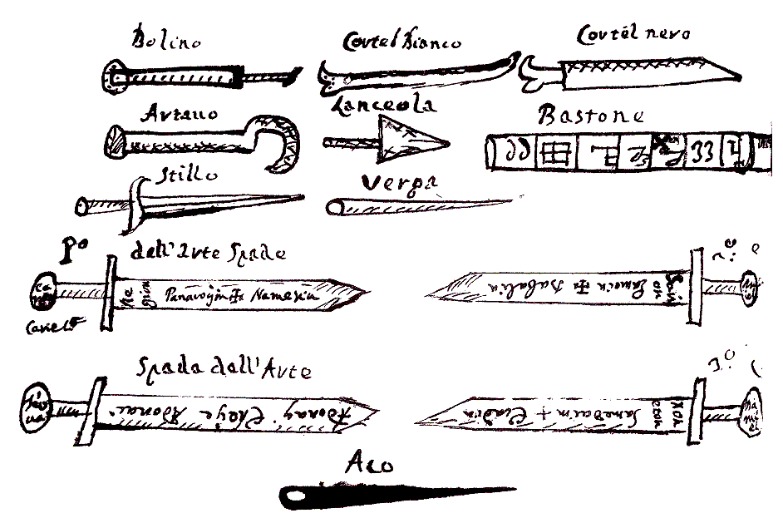
Ritual Tools from a 17th Century copy of “The Key of Solomon.” You think all of these were handmade? From WikiMedia.
Crafting from Blanks
If you ever spend time on crafting websites, or stop by one of the big craft chains, you’ll see plenty of opportunities to find “blanks” – items that are built and complete, but not finished. They’re just waiting for us to put our personal touches on them. Sometimes, those are useful for making magical tools. Personally, I really like the one-inch wooden disks for making talismans.
But there is another kind of blank to talk about. Any magical tools that you buy, unless they’re second-hand, are essentially spiritual blanks. You might buy, for example, a perfectly stained and complete athame designed exactly as required by your working group. But until you awaken that item, it’s no more (or less) magical than a stone you’d find in a river.
You can find, in most beginner books, rituals for charging tools. But for long-term practice, that isn’t something you’ll want to do just once. Reaffirm that connection again and again, and you will find tools that turn from tchotchkes into allies as the years pass.
ProTip: If you buy, inherit, or find a second-hand tool, you might want to be a little careful. If the practitioner knew enough (and was dogged enough) to really awaken your new pentacle, knife, or whatever, you might have just inherited something more akin to a former pet gone feral than a tool. If that’s the case, you’ll want to befriend it and build trust.
There are also cases where you’ll want to simply clean whatever residue is on the item, and possibly even situations where you’ll find it incompatible with your practices and need to get rid of it. I’ve even had items that I simply wasn’t ready for, which sat on a shelf for ten years until they told me it was time.
Previous Post

August 22, 2017
The Other Side of the Hedge: True Discipline
Next Post
September 26, 2017 The Other Side of the Hedge: A Deep Dive on Orthopraxy and Immanence
Browse Our Archives
Select a Category Columns History Holidays Politics Ritual and Practice The Other Side of the Hedge Theology, Ethics, Philosophy
Select a Month June 2019 May 2019 April 2019 March 2019 February 2019 January 2019 December 2018 November 2018 October 2018 September 2018 August 2018 July 2018 June 2018 May 2018 April 2018 March 2018 February 2018 January 2018 November 2017 October 2017 September 2017 August 2017 July 2017 June 2017 May 2017 April 2017 March 2017 February 2017 January 2016 December 2015 November 2015 October 2015 September 2015
TAKE THE
Religious Wisdom Quiz
Who said: "Behold, I stand at the door and knock. If anyone hears My voice and opens the door, I will come in"?
Select your answer to see how you score.
Paul Jesus (to the church in Laodicea) John The Spirit
Related posts from The Other Side of the Hedge




TRENDING AT PATHEOS Pagan

I was recently chatting with someone on Instagram. She asked me what...

While there are many people who share their results, the end of...

On July 23, I saw Christopher Nolan's The Odyssey which is Homer’s...

As I write this two big events have just finished up. One...

Restoring the Watershed of Divine Love
Perhaps cooperation is not something we manufacture through legislation, ideology, or moral...

Many UUs don’t pray because of bad experiences in a previous religion,...
view all Pagan blogs
Ad-Free & Subscriber Log-In Subscription Support
- About Us
- 2026 Calendar
- Videos
- Podcasts
- Library of World Religions
- Faith In Media Tracker
- Advertise With Us
- Write for Us
- Privacy Policy
- Terms of Service
- Do Not Sell My Data
- Contact Us
- Radiant Digital
- Manage Newsletter Subscriptions
- Unsubscribe From Notifications
- Sitemap
Copyright 2008-2026, Patheos. All rights reserved.
Subscription Support Ad-Free & Subscriber Log-In
Follow Patheos