
BuddhistCatholicContemplativeEvangelicalGeneral ChristianHinduJewishLatter-day SaintMuslimNew VisionsProgressive Christian
Beliefs
- Buddhist
- Catholic
- Contemplative
- Evangelical
- General Christian
- Hindu
- Jewish
- Latter-day Saint
- More Voices
- Muslim
- New Visions
- Pagan
- Progressive Christian
Topics
- Religion News
- Food and Religion
- Sports and Religion
- Religious Art
- Religious Music and Entertainment
- Religious Events
- History and Religion
- Style and Religion
- Politics and Religion
- Women in Religion
- Recreation Outdoors and Religion
- Business Finance and Religion
- Careers Workplace and Religion
- Education and Religion
- Family Parenting and Religion
- Health Fitness and Religion
- Home and Religion
- Relationships and Religion
- Technology and Religion
- Travel and Religion
Columnists
- Buddhist Columnists
- Business Finance and Religion Columnists
- Careers Workplace and Religion Columnists
- Catholic Columnists
- Contemplative Columnists
- Education and Religion Columnists
- Evangelists Columnists
- Family Parenting and Religion Columnists
- General Christian Columnists
- Health Fitness and Religion Columnists
- Hindu Columnists
- History and Religion Columnists
- Home and Religion Columnists
- Jewish Columnists
- More Voices Columnists
- Latter Day Columnists
- Muslim Columnists
- New Visions Columnists
- Nonreligious Columnists
- Pagan Columnists
- Politics and Religion Columnists
- Progressive Columnists
- Recreation Outdoors and Religion Columnists
- Relationships and Religion Columnists
- Religion News Columnists
- Religious Art Columnists
- Religious Events Columnists
- Religious Music and Entertainment Columnists
- Sports and Religion Columnists
- Style and Religion Columnists
- Technology and Religion Columnists
- Travel and Religion Columnists
- Women in Religion Columnists
Resource Library
- 2026 Calendar
- Library of World Religions
- The 100 Most Holy Places on Earth
- Patheos Answers
- Podcasts
- Videos
- Faith Leaders Database
- Anglican Episcopalian
- Bahai
- Baptist
- Buddhism
- Christianity
- Confucianism
- Eastern Orthodoxy
- Hinduism
- Holiness and Pentecostal
- ISKCON
- Islam
- Judaism
- Lutheran
- Methodist
- The Church of Jesus Christ of Latter-day Saints
- New Age
- Paganism
- Presbytarian and Reformed
- Protestantism
- Religion Behind the Scenes
- Roman Catholic
- Scientology
- Shia Islam
- Sikhism
- Sufism
- Sunni Islam
- Taoism
- Zen
- See all religions
Research Tools
 Ad-Free & Subscriber Log-In Subscription Support
Ad-Free & Subscriber Log-In Subscription Support
Follow Patheos 

- Trending:
- Forgiveness
- |
- Marriage
- |
- Consciousness
- |
- Death Penalty
- |
- Election
- |
- Halloween

- Home
- Pagan
- The Hearth of Hellenism: : The Virtues of Hephaistos
The Hearth of Hellenism: : The Virtues of Hephaistos
Last updated on: September 9, 2017 at 11:46 pm by Angelo Nasios
The Hearth of Hellenism: : The Virtues of Hephaistos 2017-09-09T23:46:17+00:00 Angelo Nasios
Patheos Explore the world's faith through different perspectives on religion and spirituality! Patheos has the views of the prevalent religions and spiritualities of the world.
“September, beginning in the sign of Libra, celebration of the Autumn Equinox and honors to the heroes of the battle of Marathon. During this month God Hephaistos dominates and the virtues of Creativity (Ευμηχανία- Evmichanía) and Diligence (Φιλοπονία – Philoponia) are cultivated.” (Translated from Greek, Y.S.E.E Theology & Practice)
In September, the Supreme Council of the Ethnic Hellenes commemorates the battle of Marathon of 490 B.C.E during the first Persian invasion of Greece. The Greeks confronted the Persian army of King Darius, defeating them with fewer soldiers compared to the larger Persian force. The victory would be regarded as one of the greatest moments in Greek history at that time. For those who fought in the battle and lived, it was regarded as their greatest accomplishment. On the gravestone of Aeschylus, the father of tragedy, it made no reference to his literary accomplishments, instead what was important for him was to memorialize his participation in the battle of Marathon.
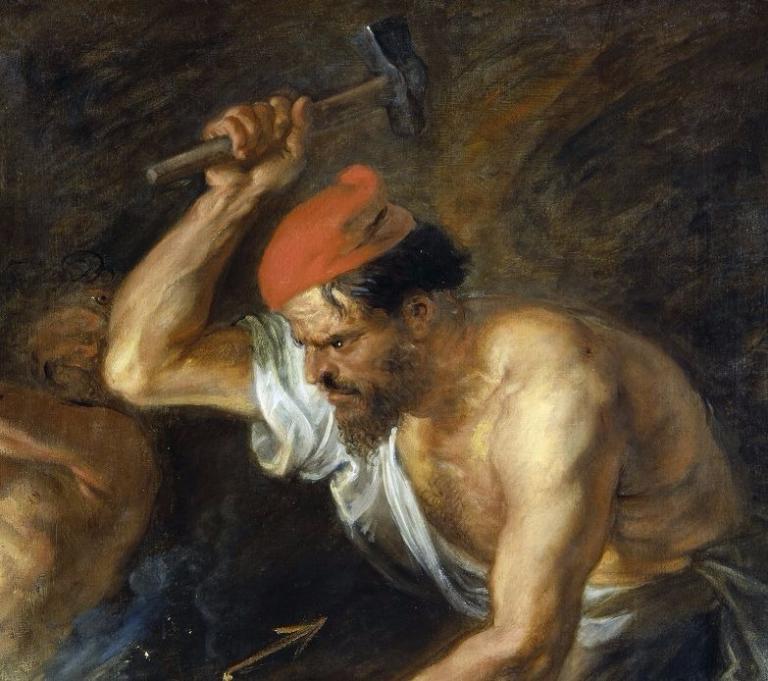
“Vulcan Forging the Thunderbolts of Zeus” by Peter Paul Rubens. From WikiMedia.
Beneath this stone lies Aeschylus, son of Euphorion, the Athenian,
who perished in the wheat-bearing land of Gela;
of his noble prowess the grove of Marathon can speak, and the long-haired Persian knows it well.
-Inscription on Aeschylus’s gravestone
Focusing on spiritual observance, September is ruled by the god Hephaistos. In honor of Hephaistos, we recite and reflect on his Hymn:
Sing, clear-voiced Muse, of Hephaistos famed for inventions. With bright-eyed Athena, he taught men glorious crafts throughout the world, —men who before used to dwell in caves in the mountains like wild beasts. But now that they have learned crafts through Hephaistos the famed worker, easily they live a peaceful life in their own houses the whole year round. Be gracious, Hephaistos, and grant me success and prosperity!
During this month, the virtues of Creativity (Ευμηχανία- Evmichanía) and Diligence (Φιλοπονία- Philoponía) are cultivated. I want to start with “Philoponía”, which means love for labor and activity. Opposite to it is “Fyponia”, that is, avoidance of labor, laziness, sluggishness, inactivity. As a virtue, Philoponia is defined as a permanent labor, which, through the diligence, zeal and stability of the subject, seeks to achieve high goals without material interest (laboring for intrinsic value).
Philoponía was one of the four virtues which shaped teenagers into social and political members of the polis. Philoponía strengthens self-respect, as well as respect for the labor of fellow people. What is understood is that whoever offers nothing but, worse yet, does not respect the efforts of others, is a parasitic being that is nourished by the energy of others or exploits the effort of others.
Evmichanía produces intelligence and inventiveness. Evmichanía guides us in perfecting our work, while avoiding perfectionism. Focusing on the important and the feasible is the path of Evmichanía. Perfectionism is a pursuit of the impossible. Evmichanía takes us duality, and opens us to other options, alternatives to what we think are the only possible ways doing or achieve something. Evmichanía reveals to us your success is not “this or that” but “this, that, or the other”.
Understanding these virtues, we can apply them to our lives by being aware of our efforts and intentions in our creative endeavors. Hephaistos is an inventor, a craftsman. For this month, to honor Hephaestus, focus on your skills, crafts, hobbies and or any creative projects you wish to initiate. It is also important to be aware of your role in society, at work, in your family and or in personal relationships. Ask yourself, “What do I provide?” “Do I take more than I give?” or “Do I give more than I take?”
Evmichanía and Philoponia go together in that Philoponia aids and complements Evmichanía. Our diligence and attention contributes to creativity and production. As a tarot reader, I cannot help but to make a connection between these virtues and the 8 of Pentacles. The 8 of Pentacles, the Lord of Prudence is a card of diligence in our craft/productive efforts. Prudence, in the Greek root, relates to practical knowledge. This practical knowledge relates back to Evmichanía’s guidance in doing what is feasible.
Being diligent to activate our creativity requires us to keep our mind focused in the present and demands that we be patient and attentive to our tasks, projects, and general work overall. Ultimately, practicing these virtues cultivates the happiness and satisfaction that comes from being a creator, a maker. Practicing the virtues of Hephaistos can be as mundane as completing tasks in an orderly fashion, and getting things done. Hephaistos calls upon us to contribute to contribute to the community for the benefit of others along with ourselves, and not for ourselves alone.
Reflecting on his myth, Hephaistos is crippled from birth. Hesiod tells us his mother, Hera, tossed him from Olympus at the sight of his deformity. Another myth has Zeus tossing him off Olympus. In this version, the fall is what cripples him. Why is he crippled? I ask this, not in the literal sense, that he is literally crippled. But why did the Greeks think of this God as crippled? His malformation may be a literal representation of the risks associated with the occupation. The God thus represents a spectrum of the occupation. The ability to create wonderful things, but also the risk of injury. Eros’ arrows and the armor that Achilles wore in the Trojan war are two examples of his creative powers.
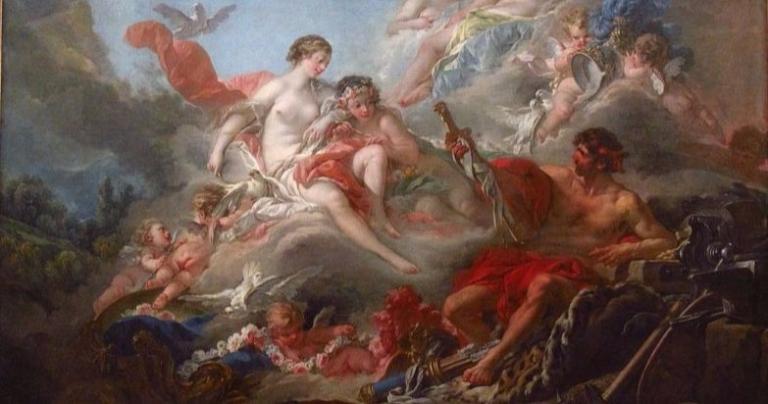
“The Forge of Vulcan” by Francois Boucher. From WikiMedia.
Hephaistos is married to Aphrodite, this tells us that what Hephaistos produces is beauty/beautiful and he labors for the love of the work and end result. It reveals to us that Love is a fundamental force of creation. Greek philosophy teaches us that it is Eros (love) which brings the elements together. Eros is the son of Aphrodite and not Hephaistos. However, through association, these three are connected. There exists a relationship between artisanship/artistry and beauty/love.
Finishing my reflection on Hephaistos, I admire Hephaistos because despite being lamed, he still is powerful and able to produce and create. Hephaistos shows us mortals that despite our own disabilities or limitations, whatever they may be, it does not separate us from the divine in any way. We have the capacity to do great things if we practice the virtues Philoponía and Evmichanía.
Repeat after me:
Be gracious, Hēphaistos, and grant me success and prosperity!
This is a first of a series which are dedicated to the festivals of the official calendar of the Hellenic Religion as observed by the Supreme Council of the Ethnic Hellenes. Each month there is a festival, a god which dominates the month, and virtues which are cultivated in honor of the deity.
Sources on the virtues are attributed to the following:
Vlassis G. Rassia,Areti, The Value System of the Greeks”, vol. 2, “Open City”, Athens 2016, ISBN 978-960-7748-53-9
Previous Post

September 5, 2017
The Other Side of the Hedge: The Witchhack
Next Post

September 12, 2017 The Cartomancer: 5 Ways of Boosting Your Mojo Through Patience
Browse Our Archives
Select a Category A Lakeside Hearth Adventures in Wortcunning Alone In Her Presence Arts, Crafts & Cooking Birthing Hereditary Witchcraft Book of Blackbirds Book Reviews Born-Again Witch Cauldron, Sword, Spear, & Stone Cermony and Liturgy Columns Community Dandelion Seeds Dear Jasmine Druid Thoughts Editor's Picks Everyday Pagan Family & Household Practice Family Traditions Full Frontal Magic Gateway Goddess Guest Articles Happily Heathen Health and Wellness Hearth of Hellenism Heathen Woman Hills of the Horizon History Holidays Horse Goddesses Interfaith Interviews Irish-American Witchcraft Jewish Witch Lamp & Labyrinth Letters from Midgard Literature, Media, Film, Music Loop of Brighid Love, Sex & Relationships Magic or Magick Making Light Naturalistic Traditions Nature News Outside The Circle Pantheisticon Politics Prayers, Poems, Blessings & Stories Queer Femme Mystic Queer of Swords Recipes Ritual and Practice Science and Research Seekers and Guides Seeking the Grail Socially Responsible Magic Spear of Athena Star Made Witch Syncretic Electric Technology The Blooming Staff The Busy Witch The Cartomancer The Crow's Nest The Dance of Pagan Recovery The Hearth of Hellenism The Lady's Quill The Other Side of the Hedge The Path of She The Rantin' Raven The Witches Next Door The Zen Pagan Theology, Ethics, Philosophy Tree City Witch Urban Earthwitch Wayfaring Woman Witch on Fire Wyrd Words
Select a Month January 2026 March 2025 December 2024 June 2024 April 2024 March 2024 January 2024 December 2023 November 2023 October 2023 August 2023 July 2023 May 2023 April 2023 March 2023 February 2023 January 2023 December 2022 November 2022 October 2022 September 2022 August 2022 July 2022 June 2022 May 2022 March 2022 February 2022 January 2022 December 2021 November 2021 October 2021 September 2021 August 2021 July 2021 June 2021 May 2021 April 2021 March 2021 February 2021 January 2021 December 2020 November 2020 October 2020 September 2020 August 2020 July 2020 June 2020 May 2020 April 2020 March 2020 February 2020 January 2020 December 2019 November 2019 October 2019 September 2019 August 2019 July 2019 June 2019 May 2019 April 2019 March 2019 February 2019 January 2019 December 2018 November 2018 October 2018 September 2018 August 2018 July 2018 June 2018 May 2018 April 2018 March 2018 February 2018 January 2018 December 2017 November 2017 October 2017 September 2017 August 2017 July 2017 June 2017 May 2017 April 2017 March 2017 February 2017 January 2017 December 2016 November 2016 October 2016 September 2016 August 2016 July 2016 June 2016 May 2016 April 2016 March 2016 February 2016 January 2016 December 2015 November 2015 October 2015 September 2015 August 2015 July 2015 June 2015 May 2015 April 2015 March 2015 February 2015 January 2015 December 2014 November 2014 October 2014 September 2014 August 2014 July 2014 June 2014 May 2014 April 2014 March 2014 February 2014 January 2014 December 2013 November 2013 October 2013 September 2013 August 2013 July 2013 June 2013 May 2013 April 2013 March 2013 February 2013 January 2013 December 2012 November 2012 October 2012 September 2012 August 2012 July 2012 June 2012 May 2012 April 2012 March 2012 February 2012 January 2012
Follow Us!
TAKE THE
Religious Wisdom Quiz
Who gave Jesus gifts of gold, frankincense, and myrrh?
Select your answer to see how you score.
Wise men Disciples Shepherds Fishermen
Related posts from Agora

Simple Witchery: To Keep Silent

Simple Witchery: Leaning On The Four Pillars

Pergamum Unfurled: Magic with the Greek Gods (Book...

Pergamum Unfurled: Cunning Words (Review)
TRENDING AT PATHEOS Pagan

I was recently chatting with someone on Instagram. She asked me what...

While there are many people who share their results, the end of...

On July 23, I saw Christopher Nolan's The Odyssey which is Homer’s...

As I write this two big events have just finished up. One...

Restoring the Watershed of Divine Love
Perhaps cooperation is not something we manufacture through legislation, ideology, or moral...

Many UUs don’t pray because of bad experiences in a previous religion,...
view all Pagan blogs
Ad-Free & Subscriber Log-In Subscription Support
- About Us
- 2026 Calendar
- Videos
- Podcasts
- Library of World Religions
- Faith In Media Tracker
- Advertise With Us
- Write for Us
- Privacy Policy
- Terms of Service
- Do Not Sell My Data
- Contact Us
- Radiant Digital
- Manage Newsletter Subscriptions
- Unsubscribe From Notifications
- Sitemap
Copyright 2008-2026, Patheos. All rights reserved.
Subscription Support Ad-Free & Subscriber Log-In
Follow Patheos