
BuddhistCatholicContemplativeEvangelicalGeneral ChristianHinduJewishLatter-day SaintMuslimNew VisionsProgressive Christian
Beliefs
- Buddhist
- Catholic
- Contemplative
- Evangelical
- General Christian
- Hindu
- Jewish
- Latter-day Saint
- More Voices
- Muslim
- New Visions
- Pagan
- Progressive Christian
Topics
- Religion News
- Food and Religion
- Sports and Religion
- Religious Art
- Religious Music and Entertainment
- Religious Events
- History and Religion
- Style and Religion
- Politics and Religion
- Women in Religion
- Recreation Outdoors and Religion
- Business Finance and Religion
- Careers Workplace and Religion
- Education and Religion
- Family Parenting and Religion
- Health Fitness and Religion
- Home and Religion
- Relationships and Religion
- Technology and Religion
- Travel and Religion
Columnists
- Buddhist Columnists
- Business Finance and Religion Columnists
- Careers Workplace and Religion Columnists
- Catholic Columnists
- Contemplative Columnists
- Education and Religion Columnists
- Evangelists Columnists
- Family Parenting and Religion Columnists
- General Christian Columnists
- Health Fitness and Religion Columnists
- Hindu Columnists
- History and Religion Columnists
- Home and Religion Columnists
- Jewish Columnists
- More Voices Columnists
- Latter Day Columnists
- Muslim Columnists
- New Visions Columnists
- Nonreligious Columnists
- Pagan Columnists
- Politics and Religion Columnists
- Progressive Columnists
- Recreation Outdoors and Religion Columnists
- Relationships and Religion Columnists
- Religion News Columnists
- Religious Art Columnists
- Religious Events Columnists
- Religious Music and Entertainment Columnists
- Sports and Religion Columnists
- Style and Religion Columnists
- Technology and Religion Columnists
- Travel and Religion Columnists
- Women in Religion Columnists
Resource Library
- 2026 Calendar
- Library of World Religions
- The 100 Most Holy Places on Earth
- Patheos Answers
- Podcasts
- Videos
- Faith Leaders Database
- Anglican Episcopalian
- Bahai
- Baptist
- Buddhism
- Christianity
- Confucianism
- Eastern Orthodoxy
- Hinduism
- Holiness and Pentecostal
- ISKCON
- Islam
- Judaism
- Lutheran
- Methodist
- The Church of Jesus Christ of Latter-day Saints
- New Age
- Paganism
- Presbytarian and Reformed
- Protestantism
- Religion Behind the Scenes
- Roman Catholic
- Scientology
- Shia Islam
- Sikhism
- Sufism
- Sunni Islam
- Taoism
- Zen
- See all religions
Research Tools
 Ad-Free & Subscriber Log-In Subscription Support
Ad-Free & Subscriber Log-In Subscription Support
Follow Patheos 

- Trending:
- Forgiveness
- |
- Marriage
- |
- Consciousness
- |
- Death Penalty
- |
- Election
- |
- Halloween

- Home
- Pagan
- The Cartomancer: The Full Moon Cut
The Cartomancer: The Full Moon Cut
Last updated on: October 3, 2017 at 2:28 pm by Camelia Elias
The Cartomancer: The Full Moon Cut 2017-10-03T14:28:07+00:00 Camelia Elias
Patheos Explore the world's faith through different perspectives on religion and spirituality! Patheos has the views of the prevalent religions and spiritualities of the world.
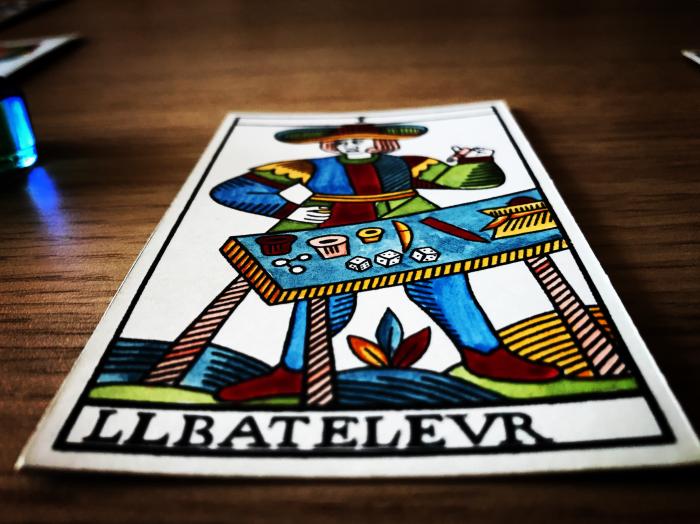
Jean Noblet Marseille Tarot, 1650, reconstructed by Jean-Claude Flornoy, hand-painted by Edmund Zebrowsky as a gift
These days I’ve been sharing my love of all things Zen as represented in popular culture, more specifically in Japanese and Chinese samurai and martial arts films from the 60s.
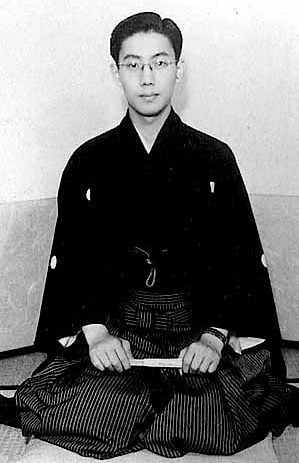
Raizō Ichikawa, 1951 (Photo: Wikimedia Public Domain in Japan and the US)
One of my favorite Japanese actors is Raizo Ichikawa, who famously played the swordsman Nemuri Kyoshiro, a badass ronin, described by critics as a nihilist and cynic.
The figure of the nihilist and cynic is, however, a Western concoction based on existentialist thought à la Jean-Paul Sartre.
But if you know your Zen, then you also know that we call nihilism and cynicism is but the representation of a highly educated mind that understands non-attachment in a non-conceptual grasping-at-the-mind kind of way to ‘understand’ the mind.
This sounds convoluted as it goes in a ring that teases out the dualist idea of the perceiver and the perceived, which the mind does not distinguish as such, the mind being the grand void, the empty mirror that it is, always reflecting form that doesn’t even exist.
Let’s save this discussion for later. What I want to say here is that there’s something very specific in the aesthetics of the samurai mind-set that I consistently apply to reading cards.
As early as last week already, on my other blog, Taroflexions, I gave away my prime secret, as it were, in terms of what I consider the best method of reading cards that enables you to achieve a level of mastery beyond comparison: The samurai’s Cut.

Shibata Renzaburo (Photo: Wikimedia in Public Domain)
This year I’ve been celebrating 100 years since the birth of writer Shibata Renzaburo, the creator of the character Nemuri Kyoshiro, by watching an endless string of films featuring the famous ‘full moon cut’, the samurai’s signature blow.
From a martial arts perspective this cut does not entail much sophistication other than the tracing of a circle with the sword. You start at the base, sword pointing to the ground. You turn the blade upwards so that it reflects the opponent’s gaze. You start tracing the moon’s counterclockwise movement. You win everything because the opponent has no patience, and tends to walk straight into the circle of your sword. You get out of the circle yourself when you almost complete it, with blood on your blade. The strike is always on the back of the other.
Now, the reason why I find this fascinating is because of this cut’s relation to how the swordsman gives himself time. He is not in a hurry. There’s a lot to be present for in the tracing of the empty mind.
In this sense the full moon cut is not overrated, as one of Nemuri Kyoshiro’s opponents tells him in Sleepy Eyes of Death: The Chinese Jade, but rather it entails the highest treatise on emptiness.
You make your cuts in accordance, when you live life, have fun, or read the cards, when you can grasp precisely what your empty mind is doing.
As with all stereotypes, in own understanding of fortunetelling and martial arts, what I see happening when the cartomancer succeeds is this:
She gives herself time to check with what the cards mirror about her situation, if she reads for herself, or for another.
Today is my last post on Patheos Agora. The Cartomancer Agora Column has been promoted to The Cartomancer Patheos Individual Blog. What this means for the audience is a shift in my approach, as I want to make new cuts in accordance with what I see is necessary to share, cartomantically speaking, as far as I’m concerned.
The Full Moon Cut spread
In honor of my Zen masters (from Bodhidharma to Hui Neng and Huang Po), I’ve decided to design a new spread called The Full Moon Cut, channeling the spirits of actor Raizo Ichikawa and writer Shibata Renzaburo, who died too early, the first at 37, and the latter at 61, but not before leaving us with shining blades we can use to cut through all illusion.
This is a 10-card spread following the method of reading in line, creating a narrative that is built of a few sentences, formulated according to the following positions:
Card 1: The tip of the sword is your empty mind; your empty agenda
When you pose a question, you may think that your mind is involved, disclosing fear, desire, worry, strong emotions and the like. In reality, your mind is as empty as it has always been.
What does the tip of your sword point to, when this emptiness is considered?
What weighs on your ‘emptiness’? You can think of this point as a gravity point, anchoring your mind in this awareness.
Card 2: The turned up blade is what the world reflects back at you
Think of this as the agenda that the world, through your perception, hands over to you. If you read for another, then this reflects that person’s agenda.
Cards 3-8: Take your time. These cards tell you what you do with your time
What do you spend your time on?
What do you cultivate?
What do you waste your time on?
Read these cards as one sentence.
Card 9-10: Fullness of being, and strike
Think of these cards as a representation of what makes you say:
I’ve arrived. Thus.
You know what the problem is. How do you solve it? What makes you say, ‘I’m nailing it like this’?
The Full Moon Cut in action
When you read cards, you deliver. Whether on a silver or golden plate, it doesn’t matter. You deliver. You deliver yourself and the other.
Here’s my example of my own Full Moon Cut.
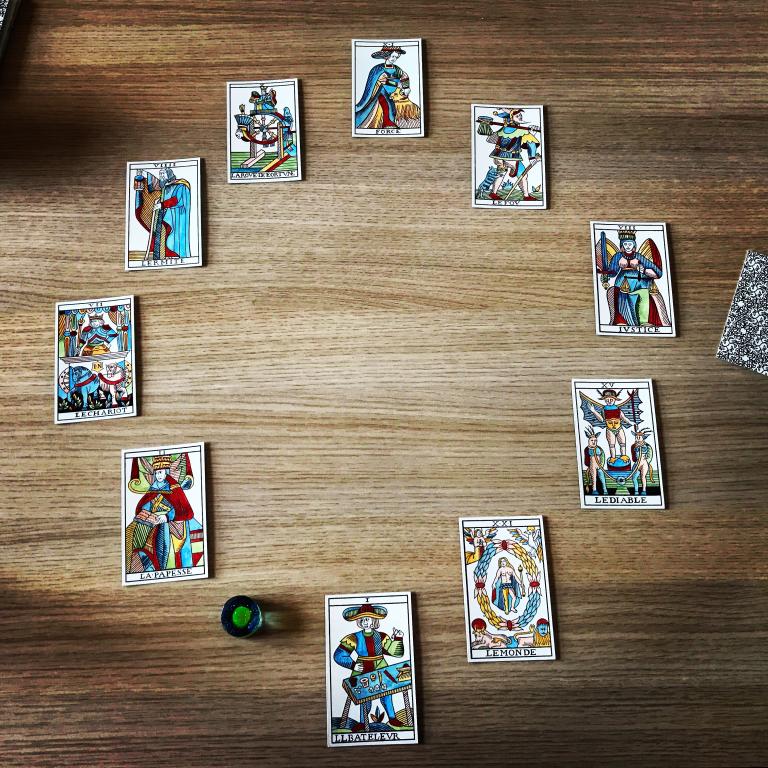
Jean Noblet Marseille Tarot, 1650, reconstructed by Jean-Claude Flornoy, hand-painted by Edmund Zebrowsky as a gift
My entry point is the Magician. I know how the mind works, and what tricks it plays. When the tip of my sword enters another body, it has the magic of the trick to it. You never know what it is.
The world reflects back at me the World. How appropriate. No need to waste more words on the implication of this one. It is what is.
I spend time on cutting through illusion, cultivating freedom. Problems still arise, but I let them pass, while investigating into their nature.
I arrive in a chariot, thus, with a book in my hands.
The Popess’s book is my exit point out of the Zen circle. My sword is my word. I strike with the written word on the back of all who are full of concepts, understanding nothing.
The cards never lie.
Think of the The Full Moon Cut as an exercise in Thusness.
You are here now, watching, and making your cuts in accordance.
♠
More cartomancy of virtuosity?
Stay tuned for courses and other, or check out the related post The Samurai’s Cut, featuring an original 13-card design with only the suit of swords.
Previous Post

September 27, 2017
Tree City Witch: Blood Magick & Pluto Goes Direct
Next Post
October 2, 2017 The Hearth of Hellenism: Did the Philosophers Believe in God?
Browse Our Archives
Select a Category A Lakeside Hearth Adventures in Wortcunning Alone In Her Presence Arts, Crafts & Cooking Birthing Hereditary Witchcraft Book of Blackbirds Book Reviews Born-Again Witch Cauldron, Sword, Spear, & Stone Cermony and Liturgy Columns Community Dandelion Seeds Dear Jasmine Druid Thoughts Editor's Picks Everyday Pagan Family & Household Practice Family Traditions Full Frontal Magic Gateway Goddess Guest Articles Happily Heathen Health and Wellness Hearth of Hellenism Heathen Woman Hills of the Horizon History Holidays Horse Goddesses Interfaith Interviews Irish-American Witchcraft Jewish Witch Lamp & Labyrinth Letters from Midgard Literature, Media, Film, Music Loop of Brighid Love, Sex & Relationships Magic or Magick Making Light Naturalistic Traditions Nature News Outside The Circle Pantheisticon Politics Prayers, Poems, Blessings & Stories Queer Femme Mystic Queer of Swords Recipes Ritual and Practice Science and Research Seekers and Guides Seeking the Grail Socially Responsible Magic Spear of Athena Star Made Witch Syncretic Electric Technology The Blooming Staff The Busy Witch The Cartomancer The Crow's Nest The Dance of Pagan Recovery The Hearth of Hellenism The Lady's Quill The Other Side of the Hedge The Path of She The Rantin' Raven The Witches Next Door The Zen Pagan Theology, Ethics, Philosophy Tree City Witch Urban Earthwitch Wayfaring Woman Witch on Fire Wyrd Words
Select a Month January 2026 March 2025 December 2024 June 2024 April 2024 March 2024 January 2024 December 2023 November 2023 October 2023 August 2023 July 2023 May 2023 April 2023 March 2023 February 2023 January 2023 December 2022 November 2022 October 2022 September 2022 August 2022 July 2022 June 2022 May 2022 March 2022 February 2022 January 2022 December 2021 November 2021 October 2021 September 2021 August 2021 July 2021 June 2021 May 2021 April 2021 March 2021 February 2021 January 2021 December 2020 November 2020 October 2020 September 2020 August 2020 July 2020 June 2020 May 2020 April 2020 March 2020 February 2020 January 2020 December 2019 November 2019 October 2019 September 2019 August 2019 July 2019 June 2019 May 2019 April 2019 March 2019 February 2019 January 2019 December 2018 November 2018 October 2018 September 2018 August 2018 July 2018 June 2018 May 2018 April 2018 March 2018 February 2018 January 2018 December 2017 November 2017 October 2017 September 2017 August 2017 July 2017 June 2017 May 2017 April 2017 March 2017 February 2017 January 2017 December 2016 November 2016 October 2016 September 2016 August 2016 July 2016 June 2016 May 2016 April 2016 March 2016 February 2016 January 2016 December 2015 November 2015 October 2015 September 2015 August 2015 July 2015 June 2015 May 2015 April 2015 March 2015 February 2015 January 2015 December 2014 November 2014 October 2014 September 2014 August 2014 July 2014 June 2014 May 2014 April 2014 March 2014 February 2014 January 2014 December 2013 November 2013 October 2013 September 2013 August 2013 July 2013 June 2013 May 2013 April 2013 March 2013 February 2013 January 2013 December 2012 November 2012 October 2012 September 2012 August 2012 July 2012 June 2012 May 2012 April 2012 March 2012 February 2012 January 2012
Follow Us!
TAKE THE
Religious Wisdom Quiz
True or False: Job lost all his children, wealth, and health in a single day.
Select your answer to see how you score.
TRUE FALSE
Related posts from Agora
The Corner Crone: Choosing a Signifier Card in...
The Corner Crone: Creating Your Own Tarot Spreads
The Corner Crone: Tarot by the Moon -...
Between Two Worlds: Dark Moon, Tarot, Facebook and...
TRENDING AT PATHEOS Pagan

I was recently chatting with someone on Instagram. She asked me what...

While there are many people who share their results, the end of...

On July 23, I saw Christopher Nolan's The Odyssey which is Homer’s...

As I write this two big events have just finished up. One...

Restoring the Watershed of Divine Love
Perhaps cooperation is not something we manufacture through legislation, ideology, or moral...

Many UUs don’t pray because of bad experiences in a previous religion,...
view all Pagan blogs
Ad-Free & Subscriber Log-In Subscription Support
- About Us
- 2026 Calendar
- Videos
- Podcasts
- Library of World Religions
- Faith In Media Tracker
- Advertise With Us
- Write for Us
- Privacy Policy
- Terms of Service
- Do Not Sell My Data
- Contact Us
- Radiant Digital
- Manage Newsletter Subscriptions
- Unsubscribe From Notifications
- Sitemap
Copyright 2008-2026, Patheos. All rights reserved.
Subscription Support Ad-Free & Subscriber Log-In
Follow Patheos