
BuddhistCatholicContemplativeEvangelicalGeneral ChristianHinduJewishLatter-day SaintMuslimNew VisionsProgressive Christian
Beliefs
- Buddhist
- Catholic
- Contemplative
- Evangelical
- General Christian
- Hindu
- Jewish
- Latter-day Saint
- More Voices
- Muslim
- New Visions
- Pagan
- Progressive Christian
Topics
- Religion News
- Food and Religion
- Sports and Religion
- Religious Art
- Religious Music and Entertainment
- Religious Events
- History and Religion
- Style and Religion
- Politics and Religion
- Women in Religion
- Recreation Outdoors and Religion
- Business Finance and Religion
- Careers Workplace and Religion
- Education and Religion
- Family Parenting and Religion
- Health Fitness and Religion
- Home and Religion
- Relationships and Religion
- Technology and Religion
- Travel and Religion
Columnists
- Buddhist Columnists
- Business Finance and Religion Columnists
- Careers Workplace and Religion Columnists
- Catholic Columnists
- Contemplative Columnists
- Education and Religion Columnists
- Evangelists Columnists
- Family Parenting and Religion Columnists
- General Christian Columnists
- Health Fitness and Religion Columnists
- Hindu Columnists
- History and Religion Columnists
- Home and Religion Columnists
- Jewish Columnists
- More Voices Columnists
- Latter Day Columnists
- Muslim Columnists
- New Visions Columnists
- Nonreligious Columnists
- Pagan Columnists
- Politics and Religion Columnists
- Progressive Columnists
- Recreation Outdoors and Religion Columnists
- Relationships and Religion Columnists
- Religion News Columnists
- Religious Art Columnists
- Religious Events Columnists
- Religious Music and Entertainment Columnists
- Sports and Religion Columnists
- Style and Religion Columnists
- Technology and Religion Columnists
- Travel and Religion Columnists
- Women in Religion Columnists
Resource Library
- 2026 Calendar
- Library of World Religions
- The 100 Most Holy Places on Earth
- Patheos Answers
- Podcasts
- Videos
- Faith Leaders Database
- Anglican Episcopalian
- Bahai
- Baptist
- Buddhism
- Christianity
- Confucianism
- Eastern Orthodoxy
- Hinduism
- Holiness and Pentecostal
- ISKCON
- Islam
- Judaism
- Lutheran
- Methodist
- The Church of Jesus Christ of Latter-day Saints
- New Age
- Paganism
- Presbytarian and Reformed
- Protestantism
- Religion Behind the Scenes
- Roman Catholic
- Scientology
- Shia Islam
- Sikhism
- Sufism
- Sunni Islam
- Taoism
- Zen
- See all religions
Research Tools
 Ad-Free & Subscriber Log-In Subscription Support
Ad-Free & Subscriber Log-In Subscription Support
Follow Patheos 

- Trending:
- Forgiveness
- |
- Marriage
- |
- Consciousness
- |
- Death Penalty
- |
- Election
- |
- Halloween
 The Other Side of the Hedge
- Home
- Pagan
- The Other Side of the Hedge: Don’t Panic
The Other Side of the Hedge: Don’t Panic
Last updated on: August 14, 2017 at 3:05 am by Christopher Drysdale
The Other Side of the Hedge: Don’t Panic 2017-08-14T03:05:56-07:00 Christopher Drysdale
Patheos Explore the world's faith through different perspectives on religion and spirituality! Patheos has the views of the prevalent religions and spiritualities of the world.
It often feels like we live in trying times. With instant, constant communication, it’s too easy for us to get wrapped up in things and forget the simple power of common sense. And while that’s true for everyone, it’s a huge problem for practitioners of magic.
Trying to carry too much of the weight of the world is an occupational hazard for spiritual practitioners of all stripes. The very nature spiritual pursuits opens us to taking on the struggles of others.
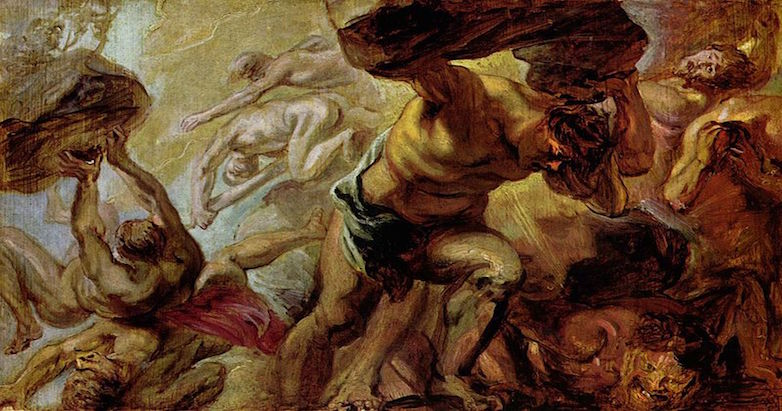
“Fall of the Titans” by Peter Paul Rubens. From WikiMedia.
Whether it’s literal empathy, cultivated compassion, or a simple feeling of responsibility for the world, we tend to try to carry more than our share. But if we follow our practices diligently, they can give us the ballast we need to face the world without panicking.
When we speak of self-cultivation, those practices don’t have to be esoteric or spectacular. What matters is if they are effective, and we can learn a lot from the common wisdom of what “everybody knows.”
Purity, Power, and the Long Hot Shower
Back in the 90s , I used to watch a now long-forgotten superhero-cop television show called The Sentinel. As far as the genre goes, I rather enjoyed it. But what I remember most wasn’t the way the main character took down the bad guys.
What stuck with me was a little gem of writing borne in a conversation between Jim, the hero-cop with super senses and his sidekick’s over-the-top 90s TV New-Age mother.
“What do you do to keep yourself clean?” she asks, earnestly.
Trying to avoid an awkward moment, the worldly Jim responds, “I take a shower.”
“No,” she repeats with clear passive-aggressive frustration, “what do you do to keep yourself clean?”
And he firmly repeats himself, “I take a shower.”
Yes, it’s a too-cute scene from a TV show. But it has a good point. Sometimes it’s too easy to get wrapped up in the esoteric side of things and forget the overwhelming power of common sense and common knowledge.
While we might justify our daily showers with a scientific “it washes the germs away!” we can just as easily understand this practice in the context of Shinto’s misogi, the daily ritual of cleansing under a waterfall.

Image by Darren Stone via WikiMedia. GNU Documentation License.
Daily cleansing is daily cleansing, and our showers wash away a lot more than oil, dirt, and the occasional germ. Our spiritual practices don’t always have to be an extra dimension of our lives. They just need to be an extra dimension of our understanding.
The New Age and Pagan movements sold us on the idea that we modern Westerners don’t have esoteric practices. The pitch was that you needed to learn meditation from abroad, steal shamanism from the locals, and buy it all for the low, low price of whatever you had on you.
We were taught that a great time of change was coming, and we needed to be ready. The New Age said to look to the future, and the Pagans said to look to the past. But either way, the change that came wasn’t the one that was promised.
The Real New Age
We live in a time when the mundane world is unimaginably powerful and overwhelming. Just to keep our heads on straight, we have to believe seven impossible things before breakfast. Everyone is selling ways to improve our lives if we would just do them for “five minutes a day.”
People get caught up in the new rat race, and it can be hard to step back and have any perspective whatsoever. We imagine that it could be better, but for primates, we’re doing pretty well.

“Origami” by Polly Peterson. Used with permission.
At least here in America, most of the people get fed most of the time, violence is limited (though certainly not evenly distributed through the population), people commonly have housing, and most everyone has access to heretofore unimaginable education, technology, medicine, and information.
It’s easy to take these things for granted. But honestly, even when things are bad, they’re pretty good. Our wars are far away, our political class is (thankfully) limited in how much it can get away with, and many of our problems actually focus around the unintended consequences of new and awesome technologies.
We struggle because our new technologies aren’t well integrated into our culture. Access to opportunity, life-saving medicine, and even healthy food is contentious. Resources are poorly distributed. The proponents of old power dynamics struggle with the bringers of new ones, and there’s a massive artificial scarcity that is more philosophical than necessary.
We thought that all this progress would make people better. This new age looks a lot like all the previous times, only in a science fiction setting. Maybe we don’t live in spaceships, but we do carry unfathomably powerful, globally connected computers in our pockets.
Maybe we don’t live forever, but we also don’t live with the same uncertainly of previous generations. We travel the globe without a second thought, translate languages on the fly, work, and even date from the comfort of our homes.
The Role of the Magus
Sometimes I hear people complain that there are no new frontiers to explore. If we step back, however, the exact opposite is true. The wild frontier isn’t some far off place. The unknown is here and now and all around us.
Because of rapid technological and social change, nothing really seems to mean what we think it means. We can see this in politics, where everything is spin and nothing is actually taken for granted. We see this in education, where suddenly a college degree isn’t a ticket to the middle class; instead it is “necessary but insufficient.”
We see this loss of meaning in our everyday lives, and nowhere more clearly than social media. Constantly, people try to panic everyone around them with terrified cries and grandiose claims. Everything is rhetoric, but no one trains in the subject in order to inoculate themselves from the constant barrage.
If only there were a group of people interested in the wisdom of ancient texts and lost ways of knowing. Oh, wait! That’s us.
No matter whether we title ourselves witches, a mages, shamans, or just plain old curmudgeons, the social role we play is similar. We watch as, grasping at power, pundits and politicians make wild claims. We observe silently as they say things to bend our minds and tear at our hearts. As people around us panic, we persevere.
The unwise always have their ears bent by the clever. Followers get ungrounded by the people panicking around them. The everyday person is ruled by the mob mind and by groupthink and by people gaming social codes.
Our role is only this: to dig deeper. Not just to know the truths from the lies, but to recognize that both truths and lies are only words, shadows, descriptions of a world far deeper than language.
Previous Post

August 7, 2017
The Other Side of the Hedge: The Magic Is in You
Next Post
August 22, 2017 The Other Side of the Hedge: True Discipline
Browse Our Archives
Select a Category Columns History Holidays Politics Ritual and Practice The Other Side of the Hedge Theology, Ethics, Philosophy
Select a Month June 2019 May 2019 April 2019 March 2019 February 2019 January 2019 December 2018 November 2018 October 2018 September 2018 August 2018 July 2018 June 2018 May 2018 April 2018 March 2018 February 2018 January 2018 November 2017 October 2017 September 2017 August 2017 July 2017 June 2017 May 2017 April 2017 March 2017 February 2017 January 2016 December 2015 November 2015 October 2015 September 2015
TAKE THE
Religious Wisdom Quiz
How many "types" of Psalms are often recognized (e.g., praise, lament, wisdom)?
Select your answer to see how you score.
Fifty Ten only One Five or more
Related posts from The Other Side of the Hedge




TRENDING AT PATHEOS Pagan

I was recently chatting with someone on Instagram. She asked me what...

While there are many people who share their results, the end of...

On July 23, I saw Christopher Nolan's The Odyssey which is Homer’s...

As I write this two big events have just finished up. One...

Restoring the Watershed of Divine Love
Perhaps cooperation is not something we manufacture through legislation, ideology, or moral...

Many UUs don’t pray because of bad experiences in a previous religion,...
view all Pagan blogs
Ad-Free & Subscriber Log-In Subscription Support
- About Us
- 2026 Calendar
- Videos
- Podcasts
- Library of World Religions
- Faith In Media Tracker
- Advertise With Us
- Write for Us
- Privacy Policy
- Terms of Service
- Do Not Sell My Data
- Contact Us
- Radiant Digital
- Manage Newsletter Subscriptions
- Unsubscribe From Notifications
- Sitemap
Copyright 2008-2026, Patheos. All rights reserved.
Subscription Support Ad-Free & Subscriber Log-In
Follow Patheos