
BuddhistCatholicContemplativeEvangelicalGeneral ChristianHinduJewishLatter-day SaintMuslimNew VisionsProgressive Christian
Beliefs
- Buddhist
- Catholic
- Contemplative
- Evangelical
- General Christian
- Hindu
- Jewish
- Latter-day Saint
- More Voices
- Muslim
- New Visions
- Pagan
- Progressive Christian
Topics
- Religion News
- Food and Religion
- Sports and Religion
- Religious Art
- Religious Music and Entertainment
- Religious Events
- History and Religion
- Style and Religion
- Politics and Religion
- Women in Religion
- Recreation Outdoors and Religion
- Business Finance and Religion
- Careers Workplace and Religion
- Education and Religion
- Family Parenting and Religion
- Health Fitness and Religion
- Home and Religion
- Relationships and Religion
- Technology and Religion
- Travel and Religion
Columnists
- Buddhist Columnists
- Business Finance and Religion Columnists
- Careers Workplace and Religion Columnists
- Catholic Columnists
- Contemplative Columnists
- Education and Religion Columnists
- Evangelists Columnists
- Family Parenting and Religion Columnists
- General Christian Columnists
- Health Fitness and Religion Columnists
- Hindu Columnists
- History and Religion Columnists
- Home and Religion Columnists
- Jewish Columnists
- More Voices Columnists
- Latter Day Columnists
- Muslim Columnists
- New Visions Columnists
- Nonreligious Columnists
- Pagan Columnists
- Politics and Religion Columnists
- Progressive Columnists
- Recreation Outdoors and Religion Columnists
- Relationships and Religion Columnists
- Religion News Columnists
- Religious Art Columnists
- Religious Events Columnists
- Religious Music and Entertainment Columnists
- Sports and Religion Columnists
- Style and Religion Columnists
- Technology and Religion Columnists
- Travel and Religion Columnists
- Women in Religion Columnists
Resource Library
- 2026 Calendar
- Library of World Religions
- The 100 Most Holy Places on Earth
- Patheos Answers
- Podcasts
- Videos
- Faith Leaders Database
- Anglican Episcopalian
- Bahai
- Baptist
- Buddhism
- Christianity
- Confucianism
- Eastern Orthodoxy
- Hinduism
- Holiness and Pentecostal
- ISKCON
- Islam
- Judaism
- Lutheran
- Methodist
- The Church of Jesus Christ of Latter-day Saints
- New Age
- Paganism
- Presbytarian and Reformed
- Protestantism
- Religion Behind the Scenes
- Roman Catholic
- Scientology
- Shia Islam
- Sikhism
- Sufism
- Sunni Islam
- Taoism
- Zen
- See all religions
Research Tools
 Ad-Free & Subscriber Log-In Subscription Support
Ad-Free & Subscriber Log-In Subscription Support
Follow Patheos 

- Trending:
- Forgiveness
- |
- Marriage
- |
- Consciousness
- |
- Death Penalty
- |
- Election
- |
- Halloween
 The Other Side of the Hedge
- Home
- Pagan
- The Other Side of the Hedge: Practical Idolatry
The Other Side of the Hedge: Practical Idolatry
Last updated on: June 12, 2017 at 9:53 pm by Christopher Drysdale
The Other Side of the Hedge: Practical Idolatry 2017-06-12T21:53:17-07:00 Christopher Drysdale
Patheos Explore the world's faith through different perspectives on religion and spirituality! Patheos has the views of the prevalent religions and spiritualities of the world.
In the West, people think idolatry is the worst. It’s considered so terrible, and so obviously terrible, that people hate it unthinkingly. The very mention of the word causes nervousness and emotional outbursts.
Merriam-Webster’s dictionary defines idolatry as “the worship of a physical object as a god.” If that definition doesn’t seem to be complete that’s because, like most religious terms, it has layer after layer of meaning and history.
It would be closer to the ordinary understanding to say that “idolatry” is the worship of anything that isn’t a god, whether it be a rock, an idea, or a “false” god (in the eye of the beholder). But that understanding doesn’t go far enough. Since the rise of monotheism, idolatry has been a straw man in Western thought. It’s considered a proverbial punching bag with nothing to offer.
When we examine it, idolatry ends up being few of the things people claim it is. Its tenets aren’t so wild and crazy at all. For the animist, the kneejerk critiques are misunderstandings of “worship” and “sacred” and “path.”
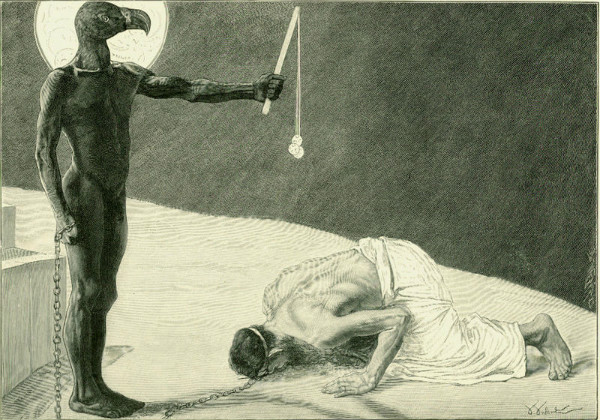
“Mammon and His Slave” by Sascha Schneider. From WikiMedia.
Why the West (Traditionally) Hates Idolatry
There are two main avenues of critique cast at idolatry. One is religious in nature, the other is scientific.
In broad strokes, monotheists hate idolatry for being a false path to the sacred and for challenging their understanding of the order of the universe. The materialists hate it for being an irrational belief in the spiritual and for challenging their understanding of the order of the universe. While the monotheists and the materialists don’t agree on much, they’re both firmly in agreement that those dirty, primitive, ignorant idolaters are just plain wrong.
The images of idolatry in the West conjure up a disdained primitivism that combines a failure of both faith and rationality. Idolatry harks back to a time before we were all saved, enlightened, and civilized. That’s what we’re led to believe.
There’s something else that harks back to a time before we were all saved, enlightened, and civilized: Modern Western Paganism.
Idolatry and Monotheism
For monotheists, the premise of idolatry beats against Western cultural underpinnings. The West has been more or less monotheistic since the rise of the Neoplatonists and the Christians.
While there’s a lot of variation among individual believers, both the Neoplatonists and the Christians who were influenced by them saw (and see) the world as existing on a hierarchy, the Great Chain of Being.
At the top of the hierarchy is the One, or God. At the very bottom is the dross, the lifeless physical world. One becomes a better being by serving those who are up the ladder, or even by simply entering into their presence.
As it turns out, the Great Chain of Being is also a handy tool for explaining and reinforcing hierarchy. For the monotheist, to confuse the dross for God would be to completely misunderstand the order of the universe. And that is exactly the mistake claimed of “idolaters.”
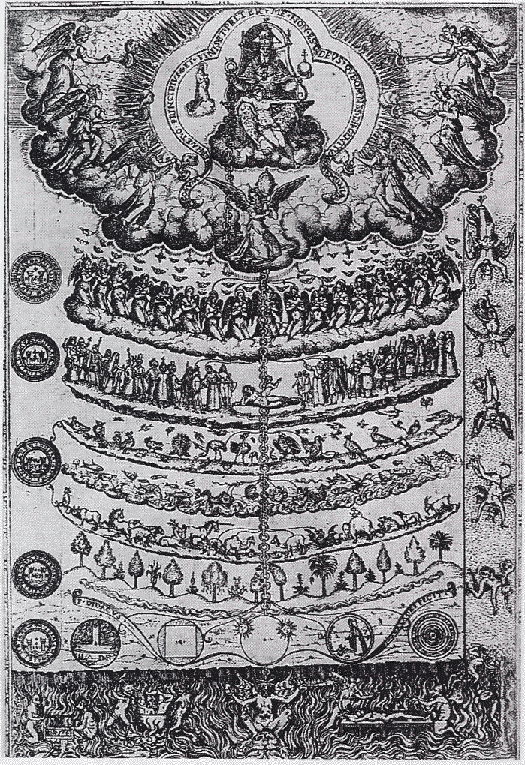
“The Great Chain of Being” by Didacus Valades. From WikiMedia.
If, the monotheists argue, there is only One (God) who can only be reached through one path, then any other path to the divine must be false. Their premise is that all other representations of deities are false idols, metaphorically or literally empty clay. To the true monotheist, all false belief is idolatry.
The root of their argument is that the only worthwhile action in our lives is to raise ourselves up the chain, and to help others raise themselves up that chain as well. Reductio ad absurdum, nothing in life matters but drawing closer to God – a position of quite a few monotheistic sects.
The very thought of seeking the divine through an “idol” – literal or metaphorical – is anathema to their theological approach. To them, no act should be practiced “religiously” except the one act of pursuing their monotheistic deity on a singular path.
Idolatry and Materialism
For the materialist, idolatry is a philosophical category mistake. It challenges their underlying assumption – a belief that the spiritual, if it exists at all, is separate from the physical. For the materialist, the definition of “exist” is quite narrow.
Even for the non-materialist, materialism is useful as a tool of analysis. It has been spectacularly useful in shrugging off a multitude of explanations of the horrors of the world, from poverty to sexism to disease, as “God’s will.” Materialist approaches have driven the growing wealth of the world, and few wish to give that up.
But materialism doesn’t answer all of the questions of life. In my experience as an animist, it fails at explaining all of the experiential data. Aberrations are explained away with non-explanations. At its most simple, “I saw a ghost” is resolved by casting doubt on the viewer, rather than an actual examination of the data followed by a shrug of “there are more things in Heaven and Earth, Horatio.”
In the West, traditional materialists are certain that any crossover between the physical and spiritual can only be a direct result of the meddling of a transcendent deity. And they are equally certain that the last time that might have happened was about two millennia ago. Or Never. Preferably never.
The idea that there might be any interplay between the spiritual and the physical, let alone an expression of the sacred embodied in the physical, is considered ludicrous. Beliefs in the spiritual and sacred are held up as unevolved. This has been a pattern in the West at least since the time of E. B. Tylor, who first proposed the theory of the evolution of religion in 1871.

“Mammon” by George Frederic Watts (detail). From WikiMedia.
Redefining Idolatry
In short, “idolatry” is a slur word for beliefs and practices that challenge both of these so-called truths: monotheism and materialism. But when we realize that “primitives” are actually our ancestors – smart, practical people – this explanation falls by the wayside.
While there are materialist Pagans and monotheistic Pagans, the broad bulk of Paganism transgresses these two basic Western truths. And they are right to do so.
Paganism itself is assembled from multiple “paths” such as Wicca, Kabala, Hermeticism, and Druidry. What makes these paths interesting is their lack of devotion to being the one and only true way. And while we might think of Kabala and Hermeticism as “monotheistic” and thus against idolatry, we would stumble as soon as the first magical tool has been made to manipulate the world.
“Idolatry” is not really about worship in the Western sense. It’s about awakening to the sacred in the self, in the world, and in the universe. Our cultural ancestors, the ancient Greeks and Romans we Westerners hold in such high esteem? Idolaters.
Anyone who believes that spirit can affect the everyday world, or that the sacred can be reached along many paths, is an “idolater.” In truth, it’s such a common idea that it seems crazy to castigate the believers.
Pagans, and especially animists, know experientially that the physical and the spiritual are closer to each other than most suspect. In fact, when we talk about the broader Pagan community, this might in be the common thread that binds us together.
Modern Paganism is not a belief in some straw-man version of idolatry. We are not ignorant people worshiping a dead statue. We are the people who know that the worlds of the physical and the spiritual are not in contention. They both exist, and we can learn to stand with a foot in each.
Previous Post

June 5, 2017
The Other Side of the Hedge: Living With Fear
Next Post
June 19, 2017 The Other Side of the Hedge: The Boline
Browse Our Archives
Select a Category Columns History Holidays Politics Ritual and Practice The Other Side of the Hedge Theology, Ethics, Philosophy
Select a Month June 2019 May 2019 April 2019 March 2019 February 2019 January 2019 December 2018 November 2018 October 2018 September 2018 August 2018 July 2018 June 2018 May 2018 April 2018 March 2018 February 2018 January 2018 November 2017 October 2017 September 2017 August 2017 July 2017 June 2017 May 2017 April 2017 March 2017 February 2017 January 2016 December 2015 November 2015 October 2015 September 2015
TAKE THE
Religious Wisdom Quiz
What does Paul say happens when we are baptized into Christ Jesus?
Select your answer to see how you score.
We receive the Holy Spirit We are saved We become children of God We are baptized into his death
Related posts from The Other Side of the Hedge




TRENDING AT PATHEOS Pagan

I was recently chatting with someone on Instagram. She asked me what...

While there are many people who share their results, the end of...

On July 23, I saw Christopher Nolan's The Odyssey which is Homer’s...

As I write this two big events have just finished up. One...

Restoring the Watershed of Divine Love
Perhaps cooperation is not something we manufacture through legislation, ideology, or moral...

Many UUs don’t pray because of bad experiences in a previous religion,...
view all Pagan blogs
Ad-Free & Subscriber Log-In Subscription Support
- About Us
- 2026 Calendar
- Videos
- Podcasts
- Library of World Religions
- Faith In Media Tracker
- Advertise With Us
- Write for Us
- Privacy Policy
- Terms of Service
- Do Not Sell My Data
- Contact Us
- Radiant Digital
- Manage Newsletter Subscriptions
- Unsubscribe From Notifications
- Sitemap
Copyright 2008-2026, Patheos. All rights reserved.
Subscription Support Ad-Free & Subscriber Log-In
Follow Patheos