
BuddhistCatholicContemplativeEvangelicalGeneral ChristianHinduJewishLatter-day SaintMuslimNew VisionsProgressive Christian
Beliefs
- Buddhist
- Catholic
- Contemplative
- Evangelical
- General Christian
- Hindu
- Jewish
- Latter-day Saint
- More Voices
- Muslim
- New Visions
- Pagan
- Progressive Christian
Topics
- Religion News
- Food and Religion
- Sports and Religion
- Religious Art
- Religious Music and Entertainment
- Religious Events
- History and Religion
- Style and Religion
- Politics and Religion
- Women in Religion
- Recreation Outdoors and Religion
- Business Finance and Religion
- Careers Workplace and Religion
- Education and Religion
- Family Parenting and Religion
- Health Fitness and Religion
- Home and Religion
- Relationships and Religion
- Technology and Religion
- Travel and Religion
Columnists
- Buddhist Columnists
- Business Finance and Religion Columnists
- Careers Workplace and Religion Columnists
- Catholic Columnists
- Contemplative Columnists
- Education and Religion Columnists
- Evangelists Columnists
- Family Parenting and Religion Columnists
- General Christian Columnists
- Health Fitness and Religion Columnists
- Hindu Columnists
- History and Religion Columnists
- Home and Religion Columnists
- Jewish Columnists
- More Voices Columnists
- Latter Day Columnists
- Muslim Columnists
- New Visions Columnists
- Nonreligious Columnists
- Pagan Columnists
- Politics and Religion Columnists
- Progressive Columnists
- Recreation Outdoors and Religion Columnists
- Relationships and Religion Columnists
- Religion News Columnists
- Religious Art Columnists
- Religious Events Columnists
- Religious Music and Entertainment Columnists
- Sports and Religion Columnists
- Style and Religion Columnists
- Technology and Religion Columnists
- Travel and Religion Columnists
- Women in Religion Columnists
Resource Library
- 2026 Calendar
- Library of World Religions
- The 100 Most Holy Places on Earth
- Patheos Answers
- Podcasts
- Videos
- Faith Leaders Database
- Anglican Episcopalian
- Bahai
- Baptist
- Buddhism
- Christianity
- Confucianism
- Eastern Orthodoxy
- Hinduism
- Holiness and Pentecostal
- ISKCON
- Islam
- Judaism
- Lutheran
- Methodist
- The Church of Jesus Christ of Latter-day Saints
- New Age
- Paganism
- Presbytarian and Reformed
- Protestantism
- Religion Behind the Scenes
- Roman Catholic
- Scientology
- Shia Islam
- Sikhism
- Sufism
- Sunni Islam
- Taoism
- Zen
- See all religions
Research Tools
 Ad-Free & Subscriber Log-In Subscription Support
Ad-Free & Subscriber Log-In Subscription Support
Follow Patheos 

- Trending:
- Forgiveness
- |
- Marriage
- |
- Consciousness
- |
- Death Penalty
- |
- Election
- |
- Halloween
 The Other Side of the Hedge
- Home
- Pagan
- The Other Side of the Hedge: The Boline
The Other Side of the Hedge: The Boline
Last updated on: June 19, 2017 at 5:59 pm by Christopher Drysdale
The Other Side of the Hedge: The Boline 2017-06-19T17:59:26-07:00 Christopher Drysdale
Patheos Explore the world's faith through different perspectives on religion and spirituality! Patheos has the views of the prevalent religions and spiritualities of the world.
The Old, Odd, and Very Cool Origins of That Other Knife
If you’ve been hanging out in witchcraft circles for a while, you’ve probably heard of the boline. What you’ve seen is probably a crescent-shaped knife that brings to mind the agricultural sickle.
The sickle and the boline aren’t terribly different. The sickle is designed to efficiently cut grains and other grasses. Both tools have one-handed, curved blades. The boline sometimes gets stylized so that the shape of the blade is exactly like a crescent moon.
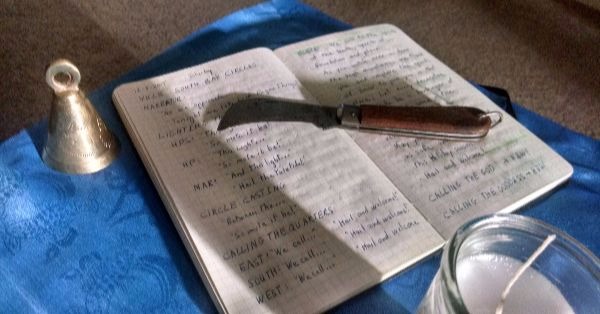
Photo by the author.
As much as the boline was a tool for harvesting, it was also used to maintain hedges between fields. And for all that they are simply tools, in the hands of the magus or witch, these tools take on a dual symbolic value. In addition to being tied to the history of the land, they are reminders of the inextricable link between life and death. If the Grim Reaper carries a scythe, those who walk the boundaries of the world carry the boline.
In recent times, the boline’s use has been mixed with that of the kirfane [1], even though their origins and symbolism are wildly different. The kirfane is a white-handled, single-edge knife used for mundane cutting tasks. Often it is referred to it as the white-handled knife.
Worse, it seems likely that the name “boline” was a misattribution of a name for another knife that looked like a needle, or bolino in Italian. Whether a mistake was made, and when the tool was named, are rather beside the point. Today, the curved knife of Wicca is generally referred to as the boline.
Bolines and Billhooks
Boline is usually pronounced “bow-leen” as in “I like to shoot my BOW, but I also like to LEAN on walls and do nothing.” Sometimes (and this is the pronunciation I prefer) the second syllable is pronounced more like it’s spelled – as “LINE.”
The curved knife commonly called the boline is a descendant of an agricultural cutting tool used throughout Europe and throughout the world. In England, the birthland of both the Golden Dawn and Wicca, these tools have long been associated with farming.
Yet not every curved farming implement is the same. In England, the tradition of local variation so strong that the different types often simply bear the names of the towns in which they were forged. The general class of implements were called “billhooks.”
But billhooks are part of something larger. Tools of similar purpose and often shape can be found around the world.
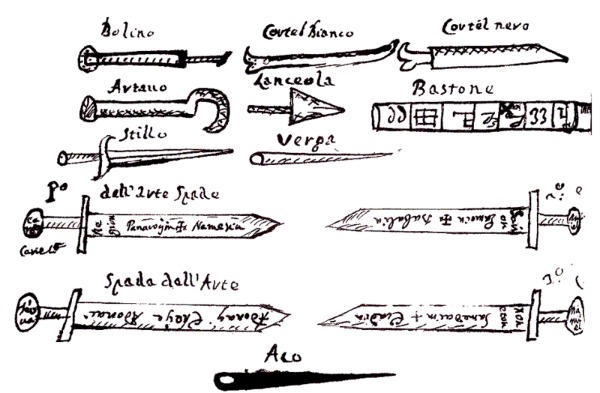
From “The Key of Solomon.”
Think Global, Chop Local
In order to understand the origin and importance of the boline, we need to take a step back from England, and from Europe, and look at edged tools from a global perspective. Rather than looking at the magical history of this specific knife, it’s worth examining the ways that similar tools are used and understood.
All over the agricultural world, there is a class of tool that’s part of everyday life. It’s not a weapon, though often it has doubled as one. It is, instead, a tool for clearing brush, working with plants, and generally assisting in farm labor. It’s a bladed tool that isn’t a sword, usually doesn’t have a hilt, and is adapted for local farm activity.
These tools vary from place to place, all with their own rich histories. As an example, if you are a knife aficionado or up on your British military history, you might know the kukri, the famous sidearm of the Gurkha warriors of Nepal. Though these distinctive knives come in many sizes, the kukri is commonly a foot-and-a-half long knife with a forward-angled bend.
The idea that the kukri is primarily a weapon is odd. It’s fetishization is part and parcel of the colonial British relationship with the Gurkha, who continue to enlist as mercenaries in regiments to this day. Because the Gurkha have the reputation of being as strong as the mountains from which they come, their traditional weapon-tool carries some of this toughness through the law of contagion.
Similar large working knives exist all over Asia, always with local variations. You might know the kama from Japanese martial arts. This is again a variation of the same class of tool. The parang of the Philippines is another example. There are too many to name, and too many variations to collect them all. But this isn’t simply a tool of Asia. It’s a feature of farming life and found all over the world.
If you live in the Americas (and probably even if you don’t), you have heard of the machete. The machete is another tool of this class. While it can be used as a fearsome weapon, it is primarily an agricultural tool, useful in growing and harvesting sugar cane.

“Devon Billhook” Photo by Trew Trewornan via WikiMedia. GNU License.
It’s a Chopper
Similar tools can be found all over the world. Just about anywhere there’s a class of agriculturalists who have developed specialized equipment for performing their work, you’ll find some variation of these bladed tools. England is no exception.
In England, the equivalent tool is generally called the billhook. The word billhook itself is an old term that means, more or less, “hacker” or “cleaver.”
In addition to its agricultural uses, the billhook took on a dual use of pruning gardens and maintaining hedges. There have long been regional variations of billhooks in England. Town by town, these styles were maintained by local smiths.
The specialization was so great that some argue it’s possible to know where a billhook was forged from its shape. This was a pattern that more-or-less ended only in the second half of the twentieth century, with the advent of truly centralized production.
The tool that witches traditionally call a “boline” has long been associated with the tradition of the land, agricultural production, and harvest. And perhaps just as importantly, it has also been long associated with building and maintaining hedges.
The Importance of the Boline
When the author Jason Mankey writes of using a boline in pruning and harvesting his garden, this is exactly the tool that was once the billhook. Though the boline is linked by purpose to agricultural and gardening tools around the world, its Pagan relevance is that it ties us to our history, as people who are part of the land.
The boline represents the agricultural assemblage of our presumed Wiccan ancestors, the “timeless” (and yet very 19th century) agricultural people whose way of life was endangered by the coming of the Industrial Revolution. As much as Wicca can romanticize the bucolic country life, it is not ignorant of the hard facts. Sometimes it can be hard to remember that life and death are inseparable, but our ancestors knew.
Unlike the double-bladed knife, the boline is not a weapon; first, it’s a tool. Further, it reminds us of the necessary harvest and the simple truth that good hedges make good neighbors. But more than that, through its links to the harvest, the boline represents cyclical death. It represents the agricultural understanding of death as necessary to life. It also represents pruning, as a necessity for the health of the whole.
Akin to the scythe carried by the Grim Reaper, the boline is a tool that can represent death. But the boline is also the descendant of blades that have long been used to maintain hedges. In that sense, they represent both the opening of the barrier to the land of the dead, but also the maintenance of the barrier itself.
NOTES
[1] See The Witch’s Athame by Jason Mankey for a discussion on this history. Also, I suspect but cannot prove that the kirfane is linguistically related to the kirpan, a knife traditionally carried by members of the Sikh religion.
Previous Post

June 12, 2017
The Other Side of the Hedge: Practical Idolatry
Next Post
June 27, 2017 The Other Side of the Hedge: Reaching the Spirit
Browse Our Archives
Select a Category Columns History Holidays Politics Ritual and Practice The Other Side of the Hedge Theology, Ethics, Philosophy
Select a Month June 2019 May 2019 April 2019 March 2019 February 2019 January 2019 December 2018 November 2018 October 2018 September 2018 August 2018 July 2018 June 2018 May 2018 April 2018 March 2018 February 2018 January 2018 November 2017 October 2017 September 2017 August 2017 July 2017 June 2017 May 2017 April 2017 March 2017 February 2017 January 2016 December 2015 November 2015 October 2015 September 2015
TAKE THE
Religious Wisdom Quiz
What does "Pentateuch" mean in Greek?
Select your answer to see how you score.
Stories of heroes First law Five scrolls Book of peace
Related posts from The Other Side of the Hedge




TRENDING AT PATHEOS Pagan

I was recently chatting with someone on Instagram. She asked me what...

While there are many people who share their results, the end of...

On July 23, I saw Christopher Nolan's The Odyssey which is Homer’s...

As I write this two big events have just finished up. One...

Restoring the Watershed of Divine Love
Perhaps cooperation is not something we manufacture through legislation, ideology, or moral...

Many UUs don’t pray because of bad experiences in a previous religion,...
view all Pagan blogs
Ad-Free & Subscriber Log-In Subscription Support
- About Us
- 2026 Calendar
- Videos
- Podcasts
- Library of World Religions
- Faith In Media Tracker
- Advertise With Us
- Write for Us
- Privacy Policy
- Terms of Service
- Do Not Sell My Data
- Contact Us
- Radiant Digital
- Manage Newsletter Subscriptions
- Unsubscribe From Notifications
- Sitemap
Copyright 2008-2026, Patheos. All rights reserved.
Subscription Support Ad-Free & Subscriber Log-In
Follow Patheos