
BuddhistCatholicContemplativeEvangelicalGeneral ChristianHinduJewishLatter-day SaintMuslimNew VisionsProgressive Christian
Beliefs
- Buddhist
- Catholic
- Contemplative
- Evangelical
- General Christian
- Hindu
- Jewish
- Latter-day Saint
- More Voices
- Muslim
- New Visions
- Pagan
- Progressive Christian
Topics
- Religion News
- Food and Religion
- Sports and Religion
- Religious Art
- Religious Music and Entertainment
- Religious Events
- History and Religion
- Style and Religion
- Politics and Religion
- Women in Religion
- Recreation Outdoors and Religion
- Business Finance and Religion
- Careers Workplace and Religion
- Education and Religion
- Family Parenting and Religion
- Health Fitness and Religion
- Home and Religion
- Relationships and Religion
- Technology and Religion
- Travel and Religion
Columnists
- Buddhist Columnists
- Business Finance and Religion Columnists
- Careers Workplace and Religion Columnists
- Catholic Columnists
- Contemplative Columnists
- Education and Religion Columnists
- Evangelists Columnists
- Family Parenting and Religion Columnists
- General Christian Columnists
- Health Fitness and Religion Columnists
- Hindu Columnists
- History and Religion Columnists
- Home and Religion Columnists
- Jewish Columnists
- More Voices Columnists
- Latter Day Columnists
- Muslim Columnists
- New Visions Columnists
- Nonreligious Columnists
- Pagan Columnists
- Politics and Religion Columnists
- Progressive Columnists
- Recreation Outdoors and Religion Columnists
- Relationships and Religion Columnists
- Religion News Columnists
- Religious Art Columnists
- Religious Events Columnists
- Religious Music and Entertainment Columnists
- Sports and Religion Columnists
- Style and Religion Columnists
- Technology and Religion Columnists
- Travel and Religion Columnists
- Women in Religion Columnists
Resource Library
- 2026 Calendar
- Library of World Religions
- The 100 Most Holy Places on Earth
- Patheos Answers
- Podcasts
- Videos
- Faith Leaders Database
- Anglican Episcopalian
- Bahai
- Baptist
- Buddhism
- Christianity
- Confucianism
- Eastern Orthodoxy
- Hinduism
- Holiness and Pentecostal
- ISKCON
- Islam
- Judaism
- Lutheran
- Methodist
- The Church of Jesus Christ of Latter-day Saints
- New Age
- Paganism
- Presbytarian and Reformed
- Protestantism
- Religion Behind the Scenes
- Roman Catholic
- Scientology
- Shia Islam
- Sikhism
- Sufism
- Sunni Islam
- Taoism
- Zen
- See all religions
Research Tools
 Ad-Free & Subscriber Log-In Subscription Support
Ad-Free & Subscriber Log-In Subscription Support
Follow Patheos 

- Trending:
- Forgiveness
- |
- Marriage
- |
- Consciousness
- |
- Death Penalty
- |
- Election
- |
- Halloween

- Home
- Pagan
- The Cartomancer: Fear of Words, Love of Labels
The Cartomancer: Fear of Words, Love of Labels
Last updated on: June 9, 2017 at 12:04 am by Camelia Elias
The Cartomancer: Fear of Words, Love of Labels 2017-06-09T00:04:56+00:00 Camelia Elias
Patheos Explore the world's faith through different perspectives on religion and spirituality! Patheos has the views of the prevalent religions and spiritualities of the world.
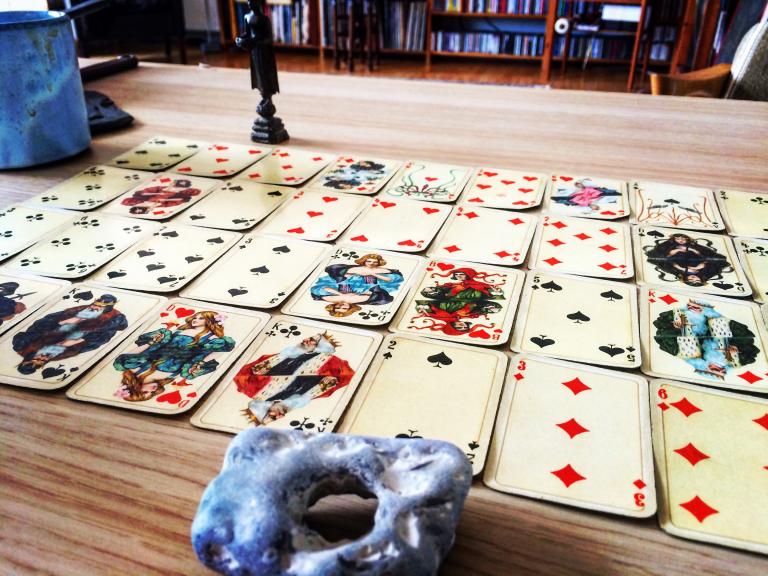
Otto Tragy Jugend Spielkarten, Ver. Stralsunder Spielkartenfabrik, 1910 (Camelia Elias)
I watch a youtube video for my cartomancy students that can prove a point I was making in class last week.
The point was rather a bold claim that if you’re afraid of words, you won’t make it as a card reader. This was offered in a discussion of why precisely we can ditch all card ‘meanings’ and simply go with what we see.
This is easier said than done, however, as most of what we see is actually the result of habitual patterns of thinking. Seeing is an actual art, especially when it’s based on displacing the idea that there’s meaning.
And this is exactly what we do when we read cards: We displace meaning, not co-create it in our own image.
There is no such thing as meaning. Meaning is not in the cards. Meaning is not in a secret encoded in the cards that only you, the reader, have access to.
From a cultural history point of view, I can see why the cartomantic world, and for that matter the pagan world too, has been invested in meaning, insisting on it too.
If you can’t make it as a male Harvard graduate, then you must find meaning in being a witch, in being a healer, a shaman, or a 6-figure entrepreneur dealing in the magical arts.
If you’re denied being a woman, the time comes when you will want to reclaim your power. You must have meaning. All these centuries of men having meaning… Now it’s your turn. You think.
In reality, just as the Harvard graduate is nothing but a concept, so are all the other societally non-consecrated and non-endorsed professions. Concepts are not reality. This is both a scientific and a ‘spiritual’ fact.
So we can relax.
But why do we insist on clinging to labels? Saying that you are this or that presupposes a reference point that doesn’t exist.
My theory is that it’s because we’re afraid of words.
We’re afraid that if we lost the ‘meaning’ of ‘I love you,’ or ‘I love myself’, all would be lost entirely. But why are we afraid of what we all know already is reality?
The ritual of ‘I do’ today can turn as easily into a ritual of ‘I don’t anymore’, with domestic war declared. The house wins. The courthouse, that is.
We know what words ‘mean’ and what fictions they create.
‘I love’ myself’ presupposes a body, or a body of beliefs about my value as a human being. But are these concepts not as shifting as the clouds? What body? What value?
‘I am a witch’ presupposes a reference that goes back to ritual, costume, and worship. But is sorcery not also a concept? If anything, the philosopher witch already knows that what she operates with at all times is a game of make-belief.
The magic of RE
When I hear people telling others to love themselves, what I hear is a game of ‘change your metaphor.’ Yesterday you were shit, today you can love yourself, empower yourself and be something else.
What this promise holds, however, is nothing but a game of re-naming, re-framing, re-labeling, re-calibrating. Now you’re empowered, you take no shit, give no fucks… and you’re still miserable.
Of course you’re miserable. You’re miserable because you buy the idea of hope. Hope that by changing your metaphors things will get better.
The only trouble is that the *I* is already a metaphor. The ‘meaning’ of the *I* is always postponed, deferred to a next station.
In the game of make-belief, it’s actually quite entertaining to watch yourself going from station to station. Yet, this position is dangerous, of course, because it’s a position that renders you completely beyond desire.
Not having any desires, ambitions, and self-improvement projects is rather bad news for culture. What ideologies of the self, redeeming the self, goods and stuff will culture sell us? The answer to this is zero.
The point is, to also go back to the idea I started out with, that in order for divination to function at its highest, it needs to place itself beyond labels, beyond the fear of words.
Divination by eyes
In the video I was watching, a young man of 33 approaches gypsies at a market. He wants to know if anyone can read his fortunes. No one admits that they can’t.
One of the gypsies offers instead an instant tirade: ‘You’re a fortunate man, this year is filled with fortunes for you, you’ll travel too, abroad, I think, yes, you’ll travel abroad, this year you’re so lucky.’
The young man wants to know: ‘And you can tell me all this, how?’ referring to the obvious fact that this spontaneous act of divination has no tools, no cards to look at, no palm in exchange for a glance, no crystals.
The gypsy then says: ‘This is called divination by eyes. I can tell you all this because I’m looking at your eyes. Ah, yes, I forgot to tell you, you’ll live to be 83, and you’ll have a boy and a girl. How much are you going to give me?’
Now, while we may think that this exchange is hilarious and completely beyond making any sense, what I see happening here is something of the highest: This, probably illiterate gypsy, realizes something about words and their power that the highest educated don’t.
After all, one gets a Harvard education because one believes that such an education will validate one’s sense of worth. One proclaims to be a witch because one believes that such a label will validate one’s sitting on the hedge, being radical and ‘against’.
But this gypsy here just knows that words mean absolutely nothing. She lives according to the highest principle of seeing WHAT IS: If it happens, it happens (in this case here, her palm being crossed with silver), and if it doesn’t, it doesn’t. This gypsy goes with what IS, not with what she imagines is the case.
You know what?
I offered this in my classroom that others here might find worth pondering on: ‘Who is the *I* thinking that I’m thinking?’
In light of the fact that this question places us right there with the absolute and the limitless, what sense does it make to still be fascinated with the liminal, in-betweenness, and the hedge position often associated with cartomancers, witches, cunning-folk and other good folk?
I like the limitless. No labels. Form is emptiness, emptiness is form.
What the cards say? They are in agreement.
I went for a quick reading of 40 cards on the table, so there’s no temptation to look at center cards as being more significant than the others. For the mechanics of reading this particular spread with 40 playing cards on the table, I refer you to my essay: Kill your Neighbor’s Children.
Suffice to say that the method consists entirely in seeing what you see, assessing color and number progression at the most basic level – the reds are OK, the blacks not, and 1 is little and 7 is a lot. So the game of make-belief here is one that asks you to stretch your elastic of observing nothing other than the play between expansion and contraction, with the clubs marking the full stop.
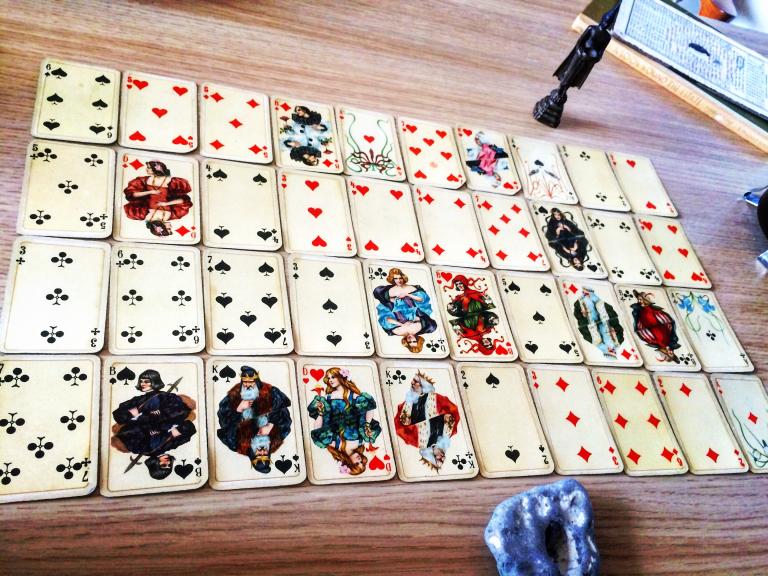
Otto Tragy Jugend Spielkarten, Ver. Stralsunder Spielkartenfabrik, 1910 (Camelia Elias)
Who is the *I* thinking that I’m thinking?
Not what you think it is. The first card presents itself with this message: The path you take to the self is the wrong one. You’re not what you think you are.
You learn stuff at home, until your father actually opens your eyes by saying NO. Full stop.
‘Oh,’ you think, ‘let me run to the brainy woman,’ but she also says NO. Actually she takes no prisoners. She hems you in at all your painful corners.
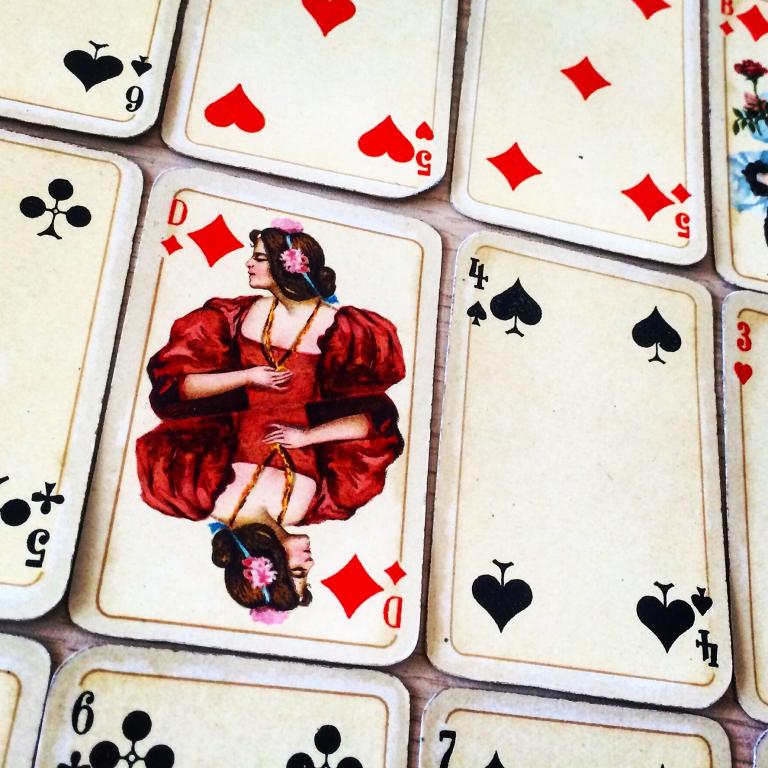
Otto Tragy Jugend Spielkarten, Ver. Stralsunder Spielkartenfabrik, 1910 (Camelia Elias)
But this is good for you. Lots of value in her teaching, your pleasure corners are covered and you start believing in your own brilliance. That is to say, until the diamond crone hands you over to the mean one who says: ‘Not this desk-related notion of the self.’ Full stop.
‘Ah’, you go, glimpsing something about this ‘not this’. Full stop raised to the power of two. This is serious business. The interval unsettles you.
You cry. Your investigations amount to little when you realize your dependency on others and what they think. It’s your body against the world. Full stop.
You inhale. You exhale. Who are you between the 1 and the 7?
After the last full stop, the many that come into the picture are redundant.
What does that tell you about yourself? And the others ‘dropped off’ the big picture? And what picture is that?
Chop wood and carry water.
The Ace of Clubs followed by the 7 Clubs – the first and the last in the suit – tell you that whatever is comprised in between the 1 and the 7 is a whole lot of nothing.
You can’t in all honesty see what’s between the 1 and the 7. There’s only empty space. You can guess. But that would rest entirely on yet another set of abstractions. Not reality.
The ‘better’ fortuneteller
The point is that we are the better fortunetellers if we’re not afraid of ‘a whole lot of nothing’ in between our words.
We’re the better fortunetellers when we don’t hold any promises of revelation of truth, of accurate ‘this will come’ simply because ‘only I know what the cards mean, I read it on the internet – but this I don’t tell anybody’ – or because ‘I imagine I have vampire blood, or gypsy blood, or Jewish blood, or Sumerian blood, or psychic blood,’ ad nauseam – ‘but this I tell, all according to what framing I’m after.’
You are not what you think you are. Hallelujah.
♠
Stay in the loop. Read like the Devil.
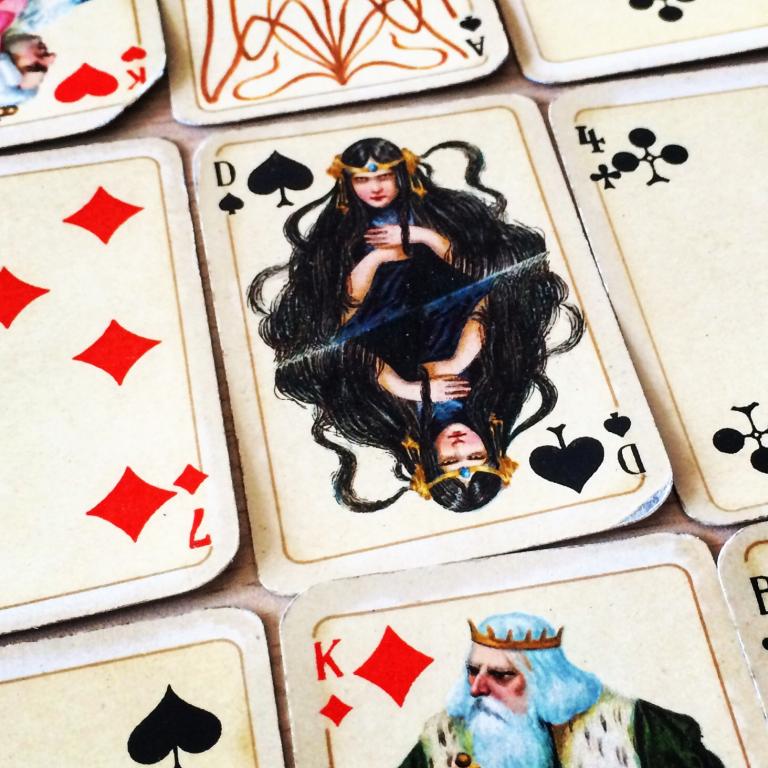
Otto Tragy Jugend Spielkarten, Ver. Stralsunder Spielkartenfabrik, 1910 (Camelia Elias)
Previous Post
June 5, 2017
Tree City Witch: The Queen of Swords & Instructions For Your Exorcism
Next Post

June 12, 2017 The Other Side of the Hedge: Practical Idolatry
Browse Our Archives
Select a Category A Lakeside Hearth Adventures in Wortcunning Alone In Her Presence Arts, Crafts & Cooking Birthing Hereditary Witchcraft Book of Blackbirds Book Reviews Born-Again Witch Cauldron, Sword, Spear, & Stone Cermony and Liturgy Columns Community Dandelion Seeds Dear Jasmine Druid Thoughts Editor's Picks Everyday Pagan Family & Household Practice Family Traditions Full Frontal Magic Gateway Goddess Guest Articles Happily Heathen Health and Wellness Hearth of Hellenism Heathen Woman Hills of the Horizon History Holidays Horse Goddesses Interfaith Interviews Irish-American Witchcraft Jewish Witch Lamp & Labyrinth Letters from Midgard Literature, Media, Film, Music Loop of Brighid Love, Sex & Relationships Magic or Magick Making Light Naturalistic Traditions Nature News Outside The Circle Pantheisticon Politics Prayers, Poems, Blessings & Stories Queer Femme Mystic Queer of Swords Recipes Ritual and Practice Science and Research Seekers and Guides Seeking the Grail Socially Responsible Magic Spear of Athena Star Made Witch Syncretic Electric Technology The Blooming Staff The Busy Witch The Cartomancer The Crow's Nest The Dance of Pagan Recovery The Hearth of Hellenism The Lady's Quill The Other Side of the Hedge The Path of She The Rantin' Raven The Witches Next Door The Zen Pagan Theology, Ethics, Philosophy Tree City Witch Urban Earthwitch Wayfaring Woman Witch on Fire Wyrd Words
Select a Month January 2026 March 2025 December 2024 June 2024 April 2024 March 2024 January 2024 December 2023 November 2023 October 2023 August 2023 July 2023 May 2023 April 2023 March 2023 February 2023 January 2023 December 2022 November 2022 October 2022 September 2022 August 2022 July 2022 June 2022 May 2022 March 2022 February 2022 January 2022 December 2021 November 2021 October 2021 September 2021 August 2021 July 2021 June 2021 May 2021 April 2021 March 2021 February 2021 January 2021 December 2020 November 2020 October 2020 September 2020 August 2020 July 2020 June 2020 May 2020 April 2020 March 2020 February 2020 January 2020 December 2019 November 2019 October 2019 September 2019 August 2019 July 2019 June 2019 May 2019 April 2019 March 2019 February 2019 January 2019 December 2018 November 2018 October 2018 September 2018 August 2018 July 2018 June 2018 May 2018 April 2018 March 2018 February 2018 January 2018 December 2017 November 2017 October 2017 September 2017 August 2017 July 2017 June 2017 May 2017 April 2017 March 2017 February 2017 January 2017 December 2016 November 2016 October 2016 September 2016 August 2016 July 2016 June 2016 May 2016 April 2016 March 2016 February 2016 January 2016 December 2015 November 2015 October 2015 September 2015 August 2015 July 2015 June 2015 May 2015 April 2015 March 2015 February 2015 January 2015 December 2014 November 2014 October 2014 September 2014 August 2014 July 2014 June 2014 May 2014 April 2014 March 2014 February 2014 January 2014 December 2013 November 2013 October 2013 September 2013 August 2013 July 2013 June 2013 May 2013 April 2013 March 2013 February 2013 January 2013 December 2012 November 2012 October 2012 September 2012 August 2012 July 2012 June 2012 May 2012 April 2012 March 2012 February 2012 January 2012
Follow Us!
TAKE THE
Religious Wisdom Quiz
Who leaped for joy after being healed at the Temple gate (by Peter, in Jesus' name)?
Select your answer to see how you score.
A Pharisee A blind man A lame man A rich man
Related posts from Agora
The Balancing Path: Why and How to Use...

The Other Side of the Hedge: Animal Wisdom
The Other Side of the Hedge: The Formula...
The Other Side of the Hedge: Dignity for...
TRENDING AT PATHEOS Pagan

I was recently chatting with someone on Instagram. She asked me what...

While there are many people who share their results, the end of...

On July 23, I saw Christopher Nolan's The Odyssey which is Homer’s...

As I write this two big events have just finished up. One...

Restoring the Watershed of Divine Love
Perhaps cooperation is not something we manufacture through legislation, ideology, or moral...

Many UUs don’t pray because of bad experiences in a previous religion,...
view all Pagan blogs
Ad-Free & Subscriber Log-In Subscription Support
- About Us
- 2026 Calendar
- Videos
- Podcasts
- Library of World Religions
- Faith In Media Tracker
- Advertise With Us
- Write for Us
- Privacy Policy
- Terms of Service
- Do Not Sell My Data
- Contact Us
- Radiant Digital
- Manage Newsletter Subscriptions
- Unsubscribe From Notifications
- Sitemap
Copyright 2008-2026, Patheos. All rights reserved.
Subscription Support Ad-Free & Subscriber Log-In
Follow Patheos