
BuddhistCatholicContemplativeEvangelicalGeneral ChristianHinduJewishLatter-day SaintMuslimNew VisionsProgressive Christian
Beliefs
- Buddhist
- Catholic
- Contemplative
- Evangelical
- General Christian
- Hindu
- Jewish
- Latter-day Saint
- More Voices
- Muslim
- New Visions
- Pagan
- Progressive Christian
Topics
- Religion News
- Food and Religion
- Sports and Religion
- Religious Art
- Religious Music and Entertainment
- Religious Events
- History and Religion
- Style and Religion
- Politics and Religion
- Women in Religion
- Recreation Outdoors and Religion
- Business Finance and Religion
- Careers Workplace and Religion
- Education and Religion
- Family Parenting and Religion
- Health Fitness and Religion
- Home and Religion
- Relationships and Religion
- Technology and Religion
- Travel and Religion
Columnists
- Buddhist Columnists
- Business Finance and Religion Columnists
- Careers Workplace and Religion Columnists
- Catholic Columnists
- Contemplative Columnists
- Education and Religion Columnists
- Evangelists Columnists
- Family Parenting and Religion Columnists
- General Christian Columnists
- Health Fitness and Religion Columnists
- Hindu Columnists
- History and Religion Columnists
- Home and Religion Columnists
- Jewish Columnists
- More Voices Columnists
- Latter Day Columnists
- Muslim Columnists
- New Visions Columnists
- Nonreligious Columnists
- Pagan Columnists
- Politics and Religion Columnists
- Progressive Columnists
- Recreation Outdoors and Religion Columnists
- Relationships and Religion Columnists
- Religion News Columnists
- Religious Art Columnists
- Religious Events Columnists
- Religious Music and Entertainment Columnists
- Sports and Religion Columnists
- Style and Religion Columnists
- Technology and Religion Columnists
- Travel and Religion Columnists
- Women in Religion Columnists
Resource Library
- 2026 Calendar
- Library of World Religions
- The 100 Most Holy Places on Earth
- Patheos Answers
- Podcasts
- Videos
- Faith Leaders Database
- Anglican Episcopalian
- Bahai
- Baptist
- Buddhism
- Christianity
- Confucianism
- Eastern Orthodoxy
- Hinduism
- Holiness and Pentecostal
- ISKCON
- Islam
- Judaism
- Lutheran
- Methodist
- The Church of Jesus Christ of Latter-day Saints
- New Age
- Paganism
- Presbytarian and Reformed
- Protestantism
- Religion Behind the Scenes
- Roman Catholic
- Scientology
- Shia Islam
- Sikhism
- Sufism
- Sunni Islam
- Taoism
- Zen
- See all religions
Research Tools
 Ad-Free & Subscriber Log-In Subscription Support
Ad-Free & Subscriber Log-In Subscription Support
Follow Patheos 

- Trending:
- Forgiveness
- |
- Marriage
- |
- Consciousness
- |
- Death Penalty
- |
- Election
- |
- Halloween

- Home
- Pagan
- Queer Femme Mystic: Why Queer Femmes Make Incredible Witches
Queer Femme Mystic: Why Queer Femmes Make Incredible Witches
Last updated on: May 6, 2017 at 1:35 am by Shannon Weber
Queer Femme Mystic: Why Queer Femmes Make Incredible Witches 2017-05-06T01:35:36+00:00 Shannon Weber
Patheos Explore the world's faith through different perspectives on religion and spirituality! Patheos has the views of the prevalent religions and spiritualities of the world.
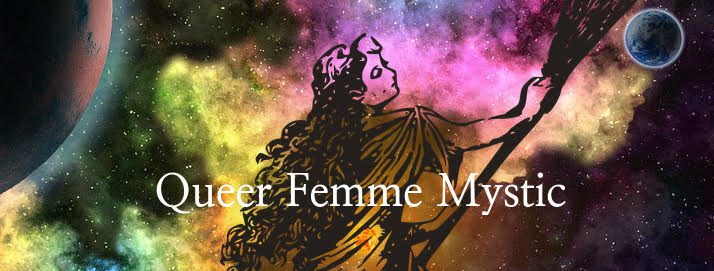
In the past few years there has been increased attention to the renaissance of witches and witchcraft in popular culture: witches in film, witches in fashion, and witches fighting back against the dystopian Trump regime.
This resurgence has also been felt in LGBTQ communities. As a queer femme witch, I have witnessed queer femme communities becoming progressively vocal and embracing elements of witchcraft, brujería, and other magic(k)al ancestral practices. This makes a lot of sense. You could say that queer femmes, for a number of reasons, make for incredible witches.
Why do I say this? Because queer femmes exist at the intersections of identities that are marginalized based on sexuality and gender presentation, and also race, class, gender identity, dis/ability, body size, and so on. This outsider status, along with a yearning to experience our femininities as seen and valued, offers a special vantage point from which to approach the study of witchcraft, the divine feminine, and the reclamation of personal power.
In terms of femininity, both queer femmes and female witches have long been understood to be transgressing “proper” notions of gender and sexuality. In large part due to the devaluation of femininity relative to masculinity in larger culture, femininity is also often devalued even within queer and feminist communities.
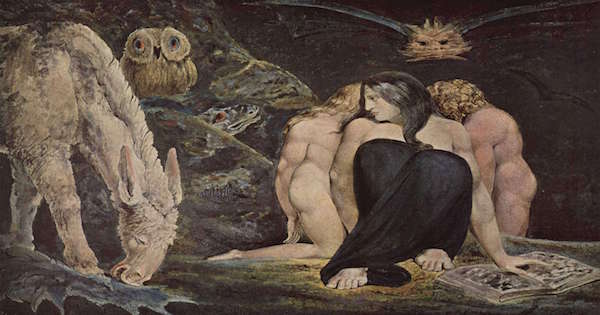
“The Night of Enitharmon’s Joy” (Triple Hecate) by William Blake. From WikiMedia.
That’s why it’s even more important, then, for me as a queer femme witch to assert my embrace of the wild and sacred feminine outside the confines of compulsory heterosexuality, to embody sexual wholeness, and to reject bodily shaming. My queer femme witchiness involves reaching for the highest heights of self-knowledge and personal transformation despite what dominant society has to say about it, a feat that both queer people and witches are particularly skilled in. As a queer femme witch, my sacred femininity is not for the male gaze. My queer femme witchiness embraces a progressive politics of compassion, empathy, and respect for the earth and its life, especially that which has been cast out and scapegoated as “other.”
Embracing my identity as a queer femme, as well as a witch, is about living my life on my own terms, challenging assumptions about both femininity and queerness, and reveling in the joyous mystery of my own path.
In addition, for femme witches and healers of color, the historical legacies of enslavement, genocide, and colonization have exponentially multiplied the extent to which their bodies have been targeted by church- and state-based violence. Tapping into their own magic(k)al power is an act of resistance to these systems. VICE editor and contributor Moira Donovan, writing about the insights she took away from her interview with writer, activist, and bisexual trans Latina bruja Mey Rude, wrote, “It’s intimidating to be a trans woman of color in public, and the tools and rituals of witchcraft make [Rude] feel like she’s just as formidable as the culture that would threaten her.”
The queer femme witches I reached out to echoed some similar sentiments about finding and channeling their power.
“A lot of my queer femme connections to being a witch began as part of a way of connecting to the feminine divine that was so absent from my Judeo-Christian upbringing,” said Crystal DeCell, a white queer femme witch living in Bloomington, Indiana. “It grew more connected to my sexuality because my first real group witchcraft experience was at a women’s college … [and I had] the sudden realization that queer witchcraft was not only okay, but beautiful and powerful.”
For DeCell, finding a community of queer witches helped her embrace both identities, and in the process, she added, “my queerness and my witchiness were almost allowed to be interchangeable.”
Mel Michelle, who identifies as a “Black queer femme feminist pedagogue and artist shaped by the creative magic of Gulf Coast bayou Catholicism and queer feminist spiritual engagements,” also spoke to this fluidity between queer femme and witch identities.
“The way I perform my femme [gender] mirror[s] the ways I access and perform my magic,” she explained. “My magic is femme, sensual, sensory, and radical, in a shape shifting package that can move through the world in forms unknown, until they are known.”
Lisa Maren Stein, an Eclectic Wiccan energy healer and intersex/transgender lesbian woman, told me that she came to Wicca via the Metropolitan Community Church in San Francisco, which she began attending as an alternative to the evangelical church that told her she must “pray the gay (and gender issues) away.”
“One of the draws of earth traditions is its equal inclusion of the Divine Feminine,” Stein said. “[Femininity] is [treated as] an equal and not a reject, as it is in evangelical Christianity.”
Queer femmes also provide much-needed wisdom about expanding and evolving how witchcraft and the divine feminine are viewed in the present day.
“I struggled with the trio of Maiden-Mother-Crone that was standard in Gardnerian witchcraft, where I started out, because it was presented as a natural progression and it still felt limiting and proscriptive,” reflected Sara, a white queer femme atheist witch living in Toronto. “As I learned more about Wicca … and came to see it as a constructed, very modern, set of traditions, the binaries around gender and the compulsory heterosexuality that I was rejecting in my own life were no more necessary than in my [spiritual] metaphors…”
Sara continued, “I wanted images of women who weren’t paired up with some equal-but-opposite male figure — or who weren’t paired up at all. I wanted to feel a close connection to the planet and its seasons without resorting to a maternal metaphor for the earth or myself. I have nothing against motherhood … but I didn’t want to be one.”
Sara’s insights about the need for expanding our understanding of the sacred feminine is important not only for those who don’t see themselves in the mother role, but for all queer people whose sex may not be reproductive, cisgender women who are infertile but do not fit into the crone life stage, and transgender women, who have often been so cruelly excluded by Dianic covens in particular.
Queer femme witchcraft reminds us of the ways that magic(k)al practices can represent important and empowering sources of comfort, affirmation, and hope for marginalized people, in particular women and non-binary people. Misha, a “white, queer, working-class, disabled, survivor, femme witch and community herbalist and organizer living in Massachusetts,” as they put it, explained to me that they became interested in witchcraft from an early age, but that abuse and trauma caused them to “harde[n] [themself] against [their] own sense of power.”
“I rediscovered herbalism in my early twenties because I was too poor for health insurance and doctors,” Misha recounted. “[A]s I found my own sense of queer, femme, working class power, my feeling of being a witch came back. I spin magic through trusting my intuition, love of nature and herbal medicine, makeup, sexuality, exploring shadows, bathing in oceans and swimming holes and moonlight, and queer femmeness.”
“I gain magical strength and wisdom from my resilience in surviving trauma, forming community and love with other queer femme witches, and being invested in being a community organizer and herbalist,” they said.
In a similar vein to Misha, Toronto-based writer, artist, and witch Clementine Morrigan weighed in, “Femme and witchcraft are both forms of trauma magic for me. They are how I take my body back from violence, how I move through the world navigating violence and loving my life anyway.”
“Both are poetry, are ways of seeing, moving, being,” they said. “Femme is the altar on which I surrender my trauma, the cauldron in which I mix my resistance. Magic is the soul of my femmeness, the soil its roots grasp.”
Through Crystal, Mel, Lisa, Sara, Misha, and Clementine’s fierce femme queerness and witchy resiliency, their lives are concrete examples of the rich complexity of the embodied divine feminine. These stories of bold life transformations and quests for self-knowledge are foundational to what it means to be a queer femme and illuminate just why queer femmes make for such incredible witches.
Previous Post
May 5, 2017
The Crow's Nest: Appalachian Granny Women Reviving a Tradition
Next Post
May 7, 2017 Book Of Blackbirds: A Witch's Tale
Browse Our Archives
Select a Category A Lakeside Hearth Adventures in Wortcunning Alone In Her Presence Arts, Crafts & Cooking Birthing Hereditary Witchcraft Book of Blackbirds Book Reviews Born-Again Witch Cauldron, Sword, Spear, & Stone Cermony and Liturgy Columns Community Dandelion Seeds Dear Jasmine Druid Thoughts Editor's Picks Everyday Pagan Family & Household Practice Family Traditions Full Frontal Magic Gateway Goddess Guest Articles Happily Heathen Health and Wellness Hearth of Hellenism Heathen Woman Hills of the Horizon History Holidays Horse Goddesses Interfaith Interviews Irish-American Witchcraft Jewish Witch Lamp & Labyrinth Letters from Midgard Literature, Media, Film, Music Loop of Brighid Love, Sex & Relationships Magic or Magick Making Light Naturalistic Traditions Nature News Outside The Circle Pantheisticon Politics Prayers, Poems, Blessings & Stories Queer Femme Mystic Queer of Swords Recipes Ritual and Practice Science and Research Seekers and Guides Seeking the Grail Socially Responsible Magic Spear of Athena Star Made Witch Syncretic Electric Technology The Blooming Staff The Busy Witch The Cartomancer The Crow's Nest The Dance of Pagan Recovery The Hearth of Hellenism The Lady's Quill The Other Side of the Hedge The Path of She The Rantin' Raven The Witches Next Door The Zen Pagan Theology, Ethics, Philosophy Tree City Witch Urban Earthwitch Wayfaring Woman Witch on Fire Wyrd Words
Select a Month January 2026 March 2025 December 2024 June 2024 April 2024 March 2024 January 2024 December 2023 November 2023 October 2023 August 2023 July 2023 May 2023 April 2023 March 2023 February 2023 January 2023 December 2022 November 2022 October 2022 September 2022 August 2022 July 2022 June 2022 May 2022 March 2022 February 2022 January 2022 December 2021 November 2021 October 2021 September 2021 August 2021 July 2021 June 2021 May 2021 April 2021 March 2021 February 2021 January 2021 December 2020 November 2020 October 2020 September 2020 August 2020 July 2020 June 2020 May 2020 April 2020 March 2020 February 2020 January 2020 December 2019 November 2019 October 2019 September 2019 August 2019 July 2019 June 2019 May 2019 April 2019 March 2019 February 2019 January 2019 December 2018 November 2018 October 2018 September 2018 August 2018 July 2018 June 2018 May 2018 April 2018 March 2018 February 2018 January 2018 December 2017 November 2017 October 2017 September 2017 August 2017 July 2017 June 2017 May 2017 April 2017 March 2017 February 2017 January 2017 December 2016 November 2016 October 2016 September 2016 August 2016 July 2016 June 2016 May 2016 April 2016 March 2016 February 2016 January 2016 December 2015 November 2015 October 2015 September 2015 August 2015 July 2015 June 2015 May 2015 April 2015 March 2015 February 2015 January 2015 December 2014 November 2014 October 2014 September 2014 August 2014 July 2014 June 2014 May 2014 April 2014 March 2014 February 2014 January 2014 December 2013 November 2013 October 2013 September 2013 August 2013 July 2013 June 2013 May 2013 April 2013 March 2013 February 2013 January 2013 December 2012 November 2012 October 2012 September 2012 August 2012 July 2012 June 2012 May 2012 April 2012 March 2012 February 2012 January 2012
Follow Us!
TAKE THE
Religious Wisdom Quiz
What Roman road was Paul traveling when he encountered Jesus?
Select your answer to see how you score.
Corinthian Way Roman Forum Road Damascus Road Jericho Road
Related posts from Agora

Simple Witchery: To Keep Silent

Simple Witchery: Leaning On The Four Pillars


Simple Witchery: Resistance and Resilience in Hard Times
TRENDING AT PATHEOS Pagan

I was recently chatting with someone on Instagram. She asked me what...

While there are many people who share their results, the end of...

On July 23, I saw Christopher Nolan's The Odyssey which is Homer’s...

As I write this two big events have just finished up. One...

Restoring the Watershed of Divine Love
Perhaps cooperation is not something we manufacture through legislation, ideology, or moral...

Many UUs don’t pray because of bad experiences in a previous religion,...
view all Pagan blogs
Ad-Free & Subscriber Log-In Subscription Support
- About Us
- 2026 Calendar
- Videos
- Podcasts
- Library of World Religions
- Faith In Media Tracker
- Advertise With Us
- Write for Us
- Privacy Policy
- Terms of Service
- Do Not Sell My Data
- Contact Us
- Radiant Digital
- Manage Newsletter Subscriptions
- Unsubscribe From Notifications
- Sitemap
Copyright 2008-2026, Patheos. All rights reserved.
Subscription Support Ad-Free & Subscriber Log-In
Follow Patheos