
BuddhistCatholicContemplativeEvangelicalGeneral ChristianHinduJewishLatter-day SaintMuslimNew VisionsProgressive Christian
Beliefs
- Buddhist
- Catholic
- Contemplative
- Evangelical
- General Christian
- Hindu
- Jewish
- Latter-day Saint
- More Voices
- Muslim
- New Visions
- Pagan
- Progressive Christian
Topics
- Religion News
- Food and Religion
- Sports and Religion
- Religious Art
- Religious Music and Entertainment
- Religious Events
- History and Religion
- Style and Religion
- Politics and Religion
- Women in Religion
- Recreation Outdoors and Religion
- Business Finance and Religion
- Careers Workplace and Religion
- Education and Religion
- Family Parenting and Religion
- Health Fitness and Religion
- Home and Religion
- Relationships and Religion
- Technology and Religion
- Travel and Religion
Columnists
- Buddhist Columnists
- Business Finance and Religion Columnists
- Careers Workplace and Religion Columnists
- Catholic Columnists
- Contemplative Columnists
- Education and Religion Columnists
- Evangelists Columnists
- Family Parenting and Religion Columnists
- General Christian Columnists
- Health Fitness and Religion Columnists
- Hindu Columnists
- History and Religion Columnists
- Home and Religion Columnists
- Jewish Columnists
- More Voices Columnists
- Latter Day Columnists
- Muslim Columnists
- New Visions Columnists
- Nonreligious Columnists
- Pagan Columnists
- Politics and Religion Columnists
- Progressive Columnists
- Recreation Outdoors and Religion Columnists
- Relationships and Religion Columnists
- Religion News Columnists
- Religious Art Columnists
- Religious Events Columnists
- Religious Music and Entertainment Columnists
- Sports and Religion Columnists
- Style and Religion Columnists
- Technology and Religion Columnists
- Travel and Religion Columnists
- Women in Religion Columnists
Resource Library
- 2026 Calendar
- Library of World Religions
- The 100 Most Holy Places on Earth
- Patheos Answers
- Podcasts
- Videos
- Faith Leaders Database
- Anglican Episcopalian
- Bahai
- Baptist
- Buddhism
- Christianity
- Confucianism
- Eastern Orthodoxy
- Hinduism
- Holiness and Pentecostal
- ISKCON
- Islam
- Judaism
- Lutheran
- Methodist
- The Church of Jesus Christ of Latter-day Saints
- New Age
- Paganism
- Presbytarian and Reformed
- Protestantism
- Religion Behind the Scenes
- Roman Catholic
- Scientology
- Shia Islam
- Sikhism
- Sufism
- Sunni Islam
- Taoism
- Zen
- See all religions
Research Tools
 Ad-Free & Subscriber Log-In Subscription Support
Ad-Free & Subscriber Log-In Subscription Support
Follow Patheos 

- Trending:
- Forgiveness
- |
- Marriage
- |
- Consciousness
- |
- Death Penalty
- |
- Election
- |
- Halloween

- Home
- Pagan
- Hills of the Horizon: The Past is Another Country
Hills of the Horizon: The Past is Another Country
Last updated on: May 28, 2017 at 4:55 pm by Kiya Nicoll
Hills of the Horizon: The Past is Another Country 2017-05-28T16:55:17+00:00 Kiya Nicoll
Patheos Explore the world's faith through different perspectives on religion and spirituality! Patheos has the views of the prevalent religions and spiritualities of the world.
One of the standing problems of reconstruction is this notion of trying to figure out what would have happened with the religion in question had other forces not intervened. This is not an actually solvable problem; any extrapolation is going to be someone making some stuff up, and it will not resemble a natural evolution. Dealing with the cognitive dissonance from this is one of the essentialities of reconstructionist religion.
(My go-to example on “You cannot predict how a religion would have evolved” is part and parcel of my own heritage. Imagine, if you would, a person interested in reconstructing Puritan religion from colonial Massachusetts. There is a grand wealth of data on this, rituals and beliefs and liturgies. That person might well make a lot of progress on that, and try to figure out how to update that stuff for the modern day. But then they’d run aground on the fact that those Congregational churches evolved into the Unitarian Universalist Association and the United Church of Christ. Hence my occasional joke that I have returned to the religion of my ancestors.)
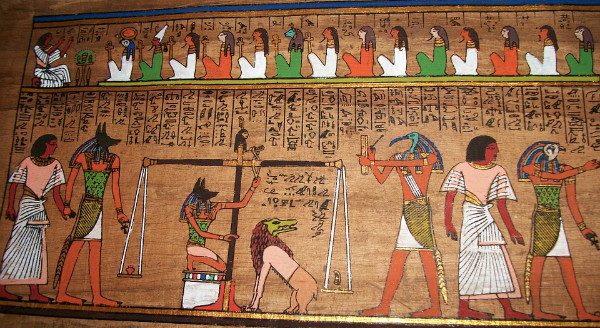
Picture by KathleenPirroArts via Pixabay. CC0 License.
Over the course of Egyptian history, the idea of accessibility to religious texts and rituals shifted and transformed. The divisions were always complex and class-based, but notably more porous than they appeared on the surface. Even if the temples were usually closed to the common people, many of the priests only worked a few months out of the year, and had other jobs the rest of the time, which might well include sharing their knowledge. The scribal jobs and the formal magicians were probably the day jobs of people who worked a shift as priests.
So there was this idea called the “democratization of the afterlife”, originally formulated as the notion that only the king, and later the royal elites, had access to the afterlife in Egyptian theology, and that this over time filtered out to the rest of the community. There are various reasons that this is implausible as a full explanation, but it was certainly the case that over time the display of royal iconography and images became more acceptable. Further, as literacy became more common, more people could make use of those texts.
The mere job of priest, moreover, was a part of the process of transformation. Strictly speaking, according to the theology, only the king could perform rituals, as the son of the sun. In reality, the rituals in the temples not only required teams of priests to perform, but also were conducted in multiple locations simultaneously. The king’s power to connect the divine world with the mortal one was delegated out to those priests, who did the work of maintaining those temples on the vast majority of occasions. For their troubles, meanwhile, almost all of the portrayals of the rituals on temple walls were pictures of the king.
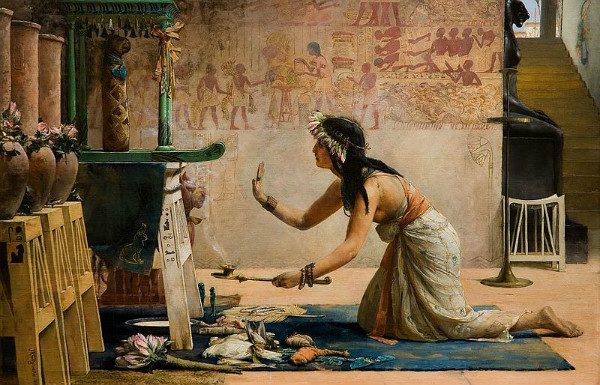
“The Obsequies of an Egyptian Cat” by John Reinhard Weguelin. From WikiMedia.
The Amarna period disrupted these patterns substantially, and attempted to establish a near-monotheism in which the king was the only true ritualist. Unsurprisingly, Akhenaten’s Egyptian theology did not long survive him. In the aftermath of the Amarna disruption, traditional Egyptian forms returned to the artistic world – but additional illustrations appeared as well, such as the journey of the night barque through the body of Nut. These feminine mysteries were not new ideas in Egyptian thought, but their portrayals suddenly emerged, as if in reaction to and denial of the sun-soaked night-denying Amarna theology. Akhenaten’s apparent fear of the dark brought forth the blossoming of acknowledgement of the night.
By the time Egypt was an occupied territory, the priests and the kingship had a very uneasy relationship. The Ptolemies sought to largely allow the native religion to continue its ritual work, in the hopes of keeping the nation peaceful. However, the priests did not always approve of the current kings, and one of the ways that this may have manifested was the well-preserved late ritual of the investiture of the Sacred Falcon. In this ceremony from Edfu, the yearly re-crowning of the king as an incarnation of Heru (Horus) included an oracle rejecting every human who came before it seeking the crown. Every priest and official who presented himself as a possible representative of Heru on earth was turned away, and eventually the office was bestowed upon an actual hawk raised on the temple grounds. There are many ways of understanding this ritual, but one of them is certainly as an act of resistance to a government that dismissed some aspects of Egyptian religion as no more than primitive animal cults.
Each of these disruptions and transformations (and many others unstated) make any certain statement about the natural evolution of ancient religion questionable. Does the democratization process make for a sort of decentralised small-community or home practice, in the end, or does the symbolism of the divinised state reassert itself to become dominant once more? Does a human ever embody governance, or is that whole question for the birds? What pieces of theology do we emphasise in the response to massive social traumas? What things get set aside, or change, or become more exclusive, or less?
None of these questions have answers.
We always have to decide for ourselves.
Next Post

May 29, 2017 The Other Side of the Hedge: How to Build Your Magical Altar
Browse Our Archives
Select a Category A Lakeside Hearth Adventures in Wortcunning Alone In Her Presence Arts, Crafts & Cooking Birthing Hereditary Witchcraft Book of Blackbirds Book Reviews Born-Again Witch Cauldron, Sword, Spear, & Stone Cermony and Liturgy Columns Community Dandelion Seeds Dear Jasmine Druid Thoughts Editor's Picks Everyday Pagan Family & Household Practice Family Traditions Full Frontal Magic Gateway Goddess Guest Articles Happily Heathen Health and Wellness Hearth of Hellenism Heathen Woman Hills of the Horizon History Holidays Horse Goddesses Interfaith Interviews Irish-American Witchcraft Jewish Witch Lamp & Labyrinth Letters from Midgard Literature, Media, Film, Music Loop of Brighid Love, Sex & Relationships Magic or Magick Making Light Naturalistic Traditions Nature News Outside The Circle Pantheisticon Politics Prayers, Poems, Blessings & Stories Queer Femme Mystic Queer of Swords Recipes Ritual and Practice Science and Research Seekers and Guides Seeking the Grail Socially Responsible Magic Spear of Athena Star Made Witch Syncretic Electric Technology The Blooming Staff The Busy Witch The Cartomancer The Crow's Nest The Dance of Pagan Recovery The Hearth of Hellenism The Lady's Quill The Other Side of the Hedge The Path of She The Rantin' Raven The Witches Next Door The Zen Pagan Theology, Ethics, Philosophy Tree City Witch Urban Earthwitch Wayfaring Woman Witch on Fire Wyrd Words
Select a Month January 2026 March 2025 December 2024 June 2024 April 2024 March 2024 January 2024 December 2023 November 2023 October 2023 August 2023 July 2023 May 2023 April 2023 March 2023 February 2023 January 2023 December 2022 November 2022 October 2022 September 2022 August 2022 July 2022 June 2022 May 2022 March 2022 February 2022 January 2022 December 2021 November 2021 October 2021 September 2021 August 2021 July 2021 June 2021 May 2021 April 2021 March 2021 February 2021 January 2021 December 2020 November 2020 October 2020 September 2020 August 2020 July 2020 June 2020 May 2020 April 2020 March 2020 February 2020 January 2020 December 2019 November 2019 October 2019 September 2019 August 2019 July 2019 June 2019 May 2019 April 2019 March 2019 February 2019 January 2019 December 2018 November 2018 October 2018 September 2018 August 2018 July 2018 June 2018 May 2018 April 2018 March 2018 February 2018 January 2018 December 2017 November 2017 October 2017 September 2017 August 2017 July 2017 June 2017 May 2017 April 2017 March 2017 February 2017 January 2017 December 2016 November 2016 October 2016 September 2016 August 2016 July 2016 June 2016 May 2016 April 2016 March 2016 February 2016 January 2016 December 2015 November 2015 October 2015 September 2015 August 2015 July 2015 June 2015 May 2015 April 2015 March 2015 February 2015 January 2015 December 2014 November 2014 October 2014 September 2014 August 2014 July 2014 June 2014 May 2014 April 2014 March 2014 February 2014 January 2014 December 2013 November 2013 October 2013 September 2013 August 2013 July 2013 June 2013 May 2013 April 2013 March 2013 February 2013 January 2013 December 2012 November 2012 October 2012 September 2012 August 2012 July 2012 June 2012 May 2012 April 2012 March 2012 February 2012 January 2012
Follow Us!
TAKE THE
Religious Wisdom Quiz
What did God use to lead the Israelites by day?
Select your answer to see how you score.
A pillar of fire An angel A pillar of cloud A trumpet
Related posts from Agora

Simple Witchery: To Keep Silent

Simple Witchery: Leaning On The Four Pillars

Pergamum Unfurled: Magic with the Greek Gods (Book...

Pergamum Unfurled: Cunning Words (Review)
TRENDING AT PATHEOS Pagan

I was recently chatting with someone on Instagram. She asked me what...

While there are many people who share their results, the end of...

On July 23, I saw Christopher Nolan's The Odyssey which is Homer’s...

As I write this two big events have just finished up. One...

Restoring the Watershed of Divine Love
Perhaps cooperation is not something we manufacture through legislation, ideology, or moral...

Many UUs don’t pray because of bad experiences in a previous religion,...
view all Pagan blogs
Ad-Free & Subscriber Log-In Subscription Support
- About Us
- 2026 Calendar
- Videos
- Podcasts
- Library of World Religions
- Faith In Media Tracker
- Advertise With Us
- Write for Us
- Privacy Policy
- Terms of Service
- Do Not Sell My Data
- Contact Us
- Radiant Digital
- Manage Newsletter Subscriptions
- Unsubscribe From Notifications
- Sitemap
Copyright 2008-2026, Patheos. All rights reserved.
Subscription Support Ad-Free & Subscriber Log-In
Follow Patheos