
BuddhistCatholicContemplativeEvangelicalGeneral ChristianHinduJewishLatter-day SaintMuslimNew VisionsProgressive Christian
Beliefs
- Buddhist
- Catholic
- Contemplative
- Evangelical
- General Christian
- Hindu
- Jewish
- Latter-day Saint
- More Voices
- Muslim
- New Visions
- Pagan
- Progressive Christian
Topics
- Religion News
- Food and Religion
- Sports and Religion
- Religious Art
- Religious Music and Entertainment
- Religious Events
- History and Religion
- Style and Religion
- Politics and Religion
- Women in Religion
- Recreation Outdoors and Religion
- Business Finance and Religion
- Careers Workplace and Religion
- Education and Religion
- Family Parenting and Religion
- Health Fitness and Religion
- Home and Religion
- Relationships and Religion
- Technology and Religion
- Travel and Religion
Columnists
- Buddhist Columnists
- Business Finance and Religion Columnists
- Careers Workplace and Religion Columnists
- Catholic Columnists
- Contemplative Columnists
- Education and Religion Columnists
- Evangelists Columnists
- Family Parenting and Religion Columnists
- General Christian Columnists
- Health Fitness and Religion Columnists
- Hindu Columnists
- History and Religion Columnists
- Home and Religion Columnists
- Jewish Columnists
- More Voices Columnists
- Latter Day Columnists
- Muslim Columnists
- New Visions Columnists
- Nonreligious Columnists
- Pagan Columnists
- Politics and Religion Columnists
- Progressive Columnists
- Recreation Outdoors and Religion Columnists
- Relationships and Religion Columnists
- Religion News Columnists
- Religious Art Columnists
- Religious Events Columnists
- Religious Music and Entertainment Columnists
- Sports and Religion Columnists
- Style and Religion Columnists
- Technology and Religion Columnists
- Travel and Religion Columnists
- Women in Religion Columnists
Resource Library
- 2026 Calendar
- Library of World Religions
- The 100 Most Holy Places on Earth
- Patheos Answers
- Podcasts
- Videos
- Faith Leaders Database
- Anglican Episcopalian
- Bahai
- Baptist
- Buddhism
- Christianity
- Confucianism
- Eastern Orthodoxy
- Hinduism
- Holiness and Pentecostal
- ISKCON
- Islam
- Judaism
- Lutheran
- Methodist
- The Church of Jesus Christ of Latter-day Saints
- New Age
- Paganism
- Presbytarian and Reformed
- Protestantism
- Religion Behind the Scenes
- Roman Catholic
- Scientology
- Shia Islam
- Sikhism
- Sufism
- Sunni Islam
- Taoism
- Zen
- See all religions
Research Tools
 Ad-Free & Subscriber Log-In Subscription Support
Ad-Free & Subscriber Log-In Subscription Support
Follow Patheos 

- Trending:
- Forgiveness
- |
- Marriage
- |
- Consciousness
- |
- Death Penalty
- |
- Election
- |
- Halloween

- Home
- Pagan
- The Cartomancer: So what? On the tyranny of inheritance
The Cartomancer: So what? On the tyranny of inheritance
Last updated on: May 9, 2017 at 11:35 pm by Camelia Elias
The Cartomancer: So what? On the tyranny of inheritance 2017-05-09T23:35:31+00:00 Camelia Elias
Patheos Explore the world's faith through different perspectives on religion and spirituality! Patheos has the views of the prevalent religions and spiritualities of the world.
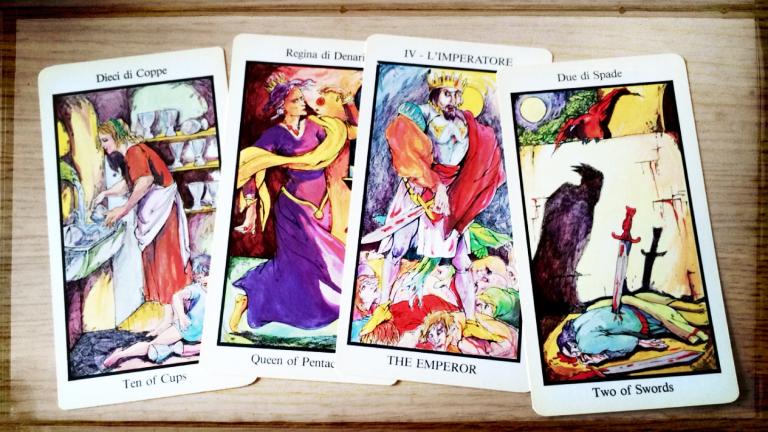
Elisabetta Cassari, Solleone Tarot, 1983 (Photo: Camelia Elias)
As someone in the business of serving, I like to observe psychodynamics among people in the art of self-development.
I’m particularly interested in the triggers around re-calibrating inherited patterns.
For instance, it’s common knowledge now that there’s such a thing as inherited behavior patterns…
… like the recognition that if your father was a bully, chances are that you’ll be fighting with the demon of aggression too, both in your childhood as well as in your adult life.
If your mother divorced five times, chances are that you’ll also fight with the demon of instability in relationships.
If your grandfather was a gambler, chances are that you will also fight with the demon of scattered finances.
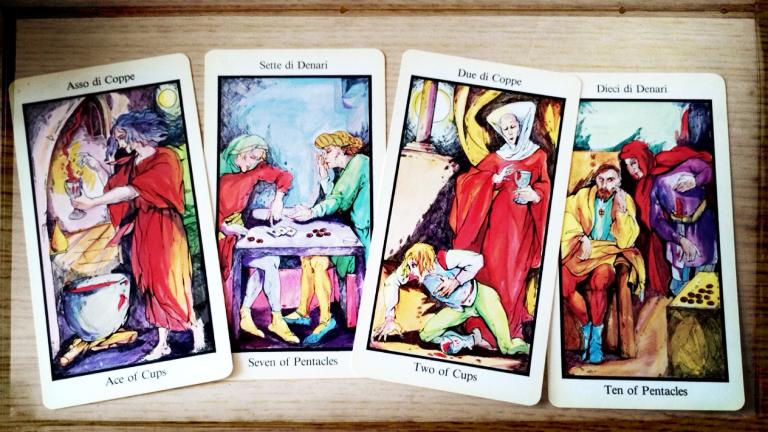
Elisabetta Cassari, Solleone Tarot, 1983 (Photo: Camelia Elias)
The business of self-development is often about bringing to awareness such patterns, and investigating into their nature.
But what exactly do inherited patterns have anything to do with you?
This is a very good question, and one that springs immediately from the work of identifying what is wrong, when it went wrong, and why it went wrong.
What is often not stretched beyond is the more interesting question of, ‘so what’?
The question of ‘so what,’ is often dodged because it forces you to ask the question of ‘why?’
‘Why do I project? Why do I fill my head with the past (injustice, insolence, indifference, etc)? Why do I fill my head with fear or desire about a future I don’t know?’
‘If my father or my mother passed on to me their demons and shortcomings, why do I have to repeat what they did?’
‘So what if they were wrestling with demons? Their demons are not my demons.’
You’ll be hard pressed to find a reference point for your family’s demons actually also being yours. They are not, and will never be.
They CAN be, however, if your process of investigating into your inherited patterns of behavior ends on a note of blaming and then relegating.
You can get very good at describing so-called toxic and destructive inherited patterns. You can even outline these patterns in a tone of surprising astonishment, whenever you discover as yet undetected aspects of these patterns’ manifestation, for instance the idea that your mother’s emotional instability may be due to self-infatuation and narcissism.
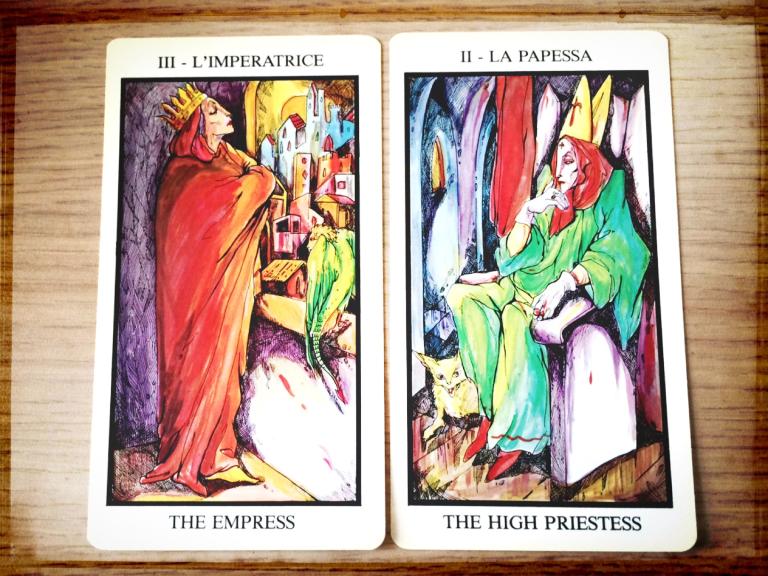
Elisabetta Cassari, Solleone Tarot, 1983 (Photo: Camelia Elias)
You can ask yourself:
‘How much of these inherited patterns inform my life, as I take a look at it and see that I also have a problem with love, money, shame and guilt, or whatever other concept in vogue that happens to come to my mind?’
What I’m interested in is what people do with this identification: ‘I also… (experienced the trauma of abuse, of not being seen, of not being taken seriously, etc).
Try posting something related to inherited patterns in the social media, take a step back and then watch how many join the discussion, responding to what you say with ‘I also…’
The question that begs itself is, however, this one:
So what?
Try to observe how many, if ever a single one, who upon acting on the relatable story, actually takes it further, and perhaps says, ‘I also… but, so what?’
As in, ‘I also suffer from this, but so what? At the end of the day, if my father had a money problem, and I also have a money problem, I can actually change that by simply saying ‘no’ to temptation.’
You don’t go and book a trip to Paris, when you can’t even afford a pack of 10 tins of beans that you can stash in your kitchen for hard times – because, hey, you’ve inherited this fear around scarcity, and the trip to Paris is there to validate your self-worth.
The point is this:
There is inheritance, and then there’s the tyranny of inheritance.
Consider how many times you relish relating to people’ stories and their experiences as they mirror yours. All fine. This is how we function, by learning from our experiences and those of others.
Now consider also how many times you never stretch what you relate to, or the relatable story, to a level that’s actually liberating.
Saying to yourself, ‘I also… but so what?’ is very easy. It requires no self-development course that will teach you a special method for how to deal with what you’ve inherited, because all it takes is two words: ‘So what?’ (or maybe three, if your inherited demon is anger, ‘so fucking what?’
To make it more interesting, you can take your cards, and ask them:
What demons have I inherited from my family, and how do I repeat destructive patterns?
Take a close look at the cards. See if you identify anything familiar to you. Then take a look at the cards from some distance, and say: ‘So fucking what’?
You are what you see yourself as, not what you see your parents as, whom you can always conveniently blame.
As Philip Larkin put it: ‘You parents fuck you up.’ So fucking what?
You are what you dwell on. You are the words you use to describe what you dwell on.
Do you prioritize the list that describes just how many bad habits you’ve inherited, or do you take the high road to self-liberation: ‘This list is a goddamn long list, but so what?’
‘So what?’
… is a magic phrase that disrupts all behavioral patterns, whether inherited, familiar, or self-made.
‘If you can name it, you have power of it,’ they say, and they are right. If you can name what you suddenly see is not useful in your life, you have power over it.
But how do you use this power?
Don’t prioritize accord (I also…)
Prioritize action (I also… but I can choose not to…)
♠
NEW COURSE:
THE LENORMAND CARDS FROM A TO Z: In depth foundation course.
Registration opens soon. Join The Art of Reading to be notified.
Previous Post

May 7, 2017
The Other Side of the Hedge: Summon Yourself
Next Post
May 15, 2017 The Other Side of the Hedge: Everyday Magic
Browse Our Archives
Select a Category A Lakeside Hearth Adventures in Wortcunning Alone In Her Presence Arts, Crafts & Cooking Birthing Hereditary Witchcraft Book of Blackbirds Book Reviews Born-Again Witch Cauldron, Sword, Spear, & Stone Cermony and Liturgy Columns Community Dandelion Seeds Dear Jasmine Druid Thoughts Editor's Picks Everyday Pagan Family & Household Practice Family Traditions Full Frontal Magic Gateway Goddess Guest Articles Happily Heathen Health and Wellness Hearth of Hellenism Heathen Woman Hills of the Horizon History Holidays Horse Goddesses Interfaith Interviews Irish-American Witchcraft Jewish Witch Lamp & Labyrinth Letters from Midgard Literature, Media, Film, Music Loop of Brighid Love, Sex & Relationships Magic or Magick Making Light Naturalistic Traditions Nature News Outside The Circle Pantheisticon Politics Prayers, Poems, Blessings & Stories Queer Femme Mystic Queer of Swords Recipes Ritual and Practice Science and Research Seekers and Guides Seeking the Grail Socially Responsible Magic Spear of Athena Star Made Witch Syncretic Electric Technology The Blooming Staff The Busy Witch The Cartomancer The Crow's Nest The Dance of Pagan Recovery The Hearth of Hellenism The Lady's Quill The Other Side of the Hedge The Path of She The Rantin' Raven The Witches Next Door The Zen Pagan Theology, Ethics, Philosophy Tree City Witch Urban Earthwitch Wayfaring Woman Witch on Fire Wyrd Words
Select a Month January 2026 March 2025 December 2024 June 2024 April 2024 March 2024 January 2024 December 2023 November 2023 October 2023 August 2023 July 2023 May 2023 April 2023 March 2023 February 2023 January 2023 December 2022 November 2022 October 2022 September 2022 August 2022 July 2022 June 2022 May 2022 March 2022 February 2022 January 2022 December 2021 November 2021 October 2021 September 2021 August 2021 July 2021 June 2021 May 2021 April 2021 March 2021 February 2021 January 2021 December 2020 November 2020 October 2020 September 2020 August 2020 July 2020 June 2020 May 2020 April 2020 March 2020 February 2020 January 2020 December 2019 November 2019 October 2019 September 2019 August 2019 July 2019 June 2019 May 2019 April 2019 March 2019 February 2019 January 2019 December 2018 November 2018 October 2018 September 2018 August 2018 July 2018 June 2018 May 2018 April 2018 March 2018 February 2018 January 2018 December 2017 November 2017 October 2017 September 2017 August 2017 July 2017 June 2017 May 2017 April 2017 March 2017 February 2017 January 2017 December 2016 November 2016 October 2016 September 2016 August 2016 July 2016 June 2016 May 2016 April 2016 March 2016 February 2016 January 2016 December 2015 November 2015 October 2015 September 2015 August 2015 July 2015 June 2015 May 2015 April 2015 March 2015 February 2015 January 2015 December 2014 November 2014 October 2014 September 2014 August 2014 July 2014 June 2014 May 2014 April 2014 March 2014 February 2014 January 2014 December 2013 November 2013 October 2013 September 2013 August 2013 July 2013 June 2013 May 2013 April 2013 March 2013 February 2013 January 2013 December 2012 November 2012 October 2012 September 2012 August 2012 July 2012 June 2012 May 2012 April 2012 March 2012 February 2012 January 2012
Follow Us!
TAKE THE
Religious Wisdom Quiz
Which Christian principle is shown by the story of the widow's mite?
Select your answer to see how you score.
Generosity from the heart Give to be seen Give only if rich Never give
Related posts from Agora

Simple Witchery: Right Relation - Holding the Space...

The Other Side of the Hedge: Animal Wisdom
The Other Side of the Hedge: The Formula...
The Other Side of the Hedge: Dignity for...
TRENDING AT PATHEOS Pagan

I was recently chatting with someone on Instagram. She asked me what...

While there are many people who share their results, the end of...

On July 23, I saw Christopher Nolan's The Odyssey which is Homer’s...

As I write this two big events have just finished up. One...

Restoring the Watershed of Divine Love
Perhaps cooperation is not something we manufacture through legislation, ideology, or moral...

Many UUs don’t pray because of bad experiences in a previous religion,...
view all Pagan blogs
Ad-Free & Subscriber Log-In Subscription Support
- About Us
- 2026 Calendar
- Videos
- Podcasts
- Library of World Religions
- Faith In Media Tracker
- Advertise With Us
- Write for Us
- Privacy Policy
- Terms of Service
- Do Not Sell My Data
- Contact Us
- Radiant Digital
- Manage Newsletter Subscriptions
- Unsubscribe From Notifications
- Sitemap
Copyright 2008-2026, Patheos. All rights reserved.
Subscription Support Ad-Free & Subscriber Log-In
Follow Patheos