
BuddhistCatholicContemplativeEvangelicalGeneral ChristianHinduJewishLatter-day SaintMuslimNew VisionsProgressive Christian
Beliefs
- Buddhist
- Catholic
- Contemplative
- Evangelical
- General Christian
- Hindu
- Jewish
- Latter-day Saint
- More Voices
- Muslim
- New Visions
- Pagan
- Progressive Christian
Topics
- Religion News
- Food and Religion
- Sports and Religion
- Religious Art
- Religious Music and Entertainment
- Religious Events
- History and Religion
- Style and Religion
- Politics and Religion
- Women in Religion
- Recreation Outdoors and Religion
- Business Finance and Religion
- Careers Workplace and Religion
- Education and Religion
- Family Parenting and Religion
- Health Fitness and Religion
- Home and Religion
- Relationships and Religion
- Technology and Religion
- Travel and Religion
Columnists
- Buddhist Columnists
- Business Finance and Religion Columnists
- Careers Workplace and Religion Columnists
- Catholic Columnists
- Contemplative Columnists
- Education and Religion Columnists
- Evangelists Columnists
- Family Parenting and Religion Columnists
- General Christian Columnists
- Health Fitness and Religion Columnists
- Hindu Columnists
- History and Religion Columnists
- Home and Religion Columnists
- Jewish Columnists
- More Voices Columnists
- Latter Day Columnists
- Muslim Columnists
- New Visions Columnists
- Nonreligious Columnists
- Pagan Columnists
- Politics and Religion Columnists
- Progressive Columnists
- Recreation Outdoors and Religion Columnists
- Relationships and Religion Columnists
- Religion News Columnists
- Religious Art Columnists
- Religious Events Columnists
- Religious Music and Entertainment Columnists
- Sports and Religion Columnists
- Style and Religion Columnists
- Technology and Religion Columnists
- Travel and Religion Columnists
- Women in Religion Columnists
Resource Library
- 2026 Calendar
- Library of World Religions
- The 100 Most Holy Places on Earth
- Patheos Answers
- Podcasts
- Videos
- Faith Leaders Database
- Anglican Episcopalian
- Bahai
- Baptist
- Buddhism
- Christianity
- Confucianism
- Eastern Orthodoxy
- Hinduism
- Holiness and Pentecostal
- ISKCON
- Islam
- Judaism
- Lutheran
- Methodist
- The Church of Jesus Christ of Latter-day Saints
- New Age
- Paganism
- Presbytarian and Reformed
- Protestantism
- Religion Behind the Scenes
- Roman Catholic
- Scientology
- Shia Islam
- Sikhism
- Sufism
- Sunni Islam
- Taoism
- Zen
- See all religions
Research Tools
 Ad-Free & Subscriber Log-In Subscription Support
Ad-Free & Subscriber Log-In Subscription Support
Follow Patheos 

- Trending:
- Forgiveness
- |
- Marriage
- |
- Consciousness
- |
- Death Penalty
- |
- Election
- |
- Halloween

- Home
- Pagan
- Everyday Pagan: The 8 Things I Learned from “D’Aulaires’ Book of Greek Myths”
Everyday Pagan: The 8 Things I Learned from “D’Aulaires’ Book of Greek Myths”
Last updated on: June 21, 2017 at 9:50 pm by Andrea Gustafson
Everyday Pagan: The 8 Things I Learned from “D’Aulaires’ Book of Greek Myths” 2017-06-21T21:50:30+00:00 Andrea Gustafson
Patheos Explore the world's faith through different perspectives on religion and spirituality! Patheos has the views of the prevalent religions and spiritualities of the world.
My mom got me D’Aulaires’ Book of Greek Myths when I was a kid. She was excited to get it for me. Up until that point I didn’t know what myths were so I was felt neutral about the gift. But she was insistent it was a Good book, I and thought that was interesting because she’d never been excited about one of my books before. So I gave it a try and was immediately hooked. I read it and re-read it. Sometimes I’d just flip through and study the glorious artwork. I kept coming back to it. Recently I bought a new copy and came back to it yet again. Until I reread it I didn’t realize that the love of mythology and the Greek Gods that it gave me were fundamental in my becoming a Pagan.
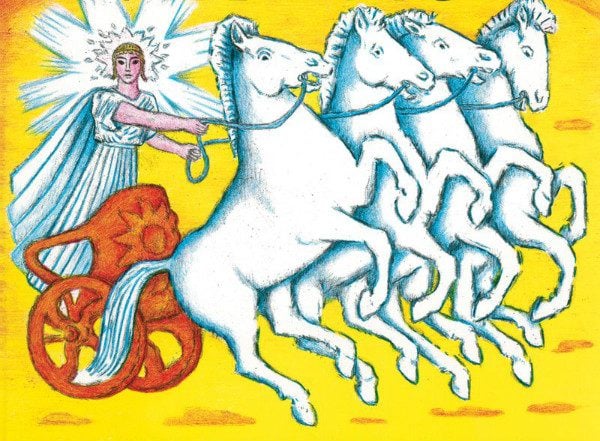
Close up of the book’s iconic cover.
Here are 8 things the fabulous D’Aulaires’ Book of Greek Myths taught me:
1. A creation story that was consistent with science
I was raised Christian, but even young me thought the bible creation story didn’t make any sense. I asked my mom “How was the world created in just 7 days when the dinosaurs lived for thousands of years before humans?”
In the Greek creation story I learned from the book, the earth was created in darkness and that the combination/union of the universe/sky (Uranus) with planet earth (Gaia) was the genesis for creating the first living beings (Titans). Later, earth’s second husband, the waters of the world (Pontus), brought all plants, animals, and humans into existence. The creation of earth and life from the universe and the fact of all plant, animal, and human life originally coming from the oceans are both scientifically correct. I might not have made that connection as a child but instinctively I liked the Greek store more because it actually made sense. It set the stage for my later search for a religion that wasn’t antithetical to science.
2. Recognition of the Gods by their symbols
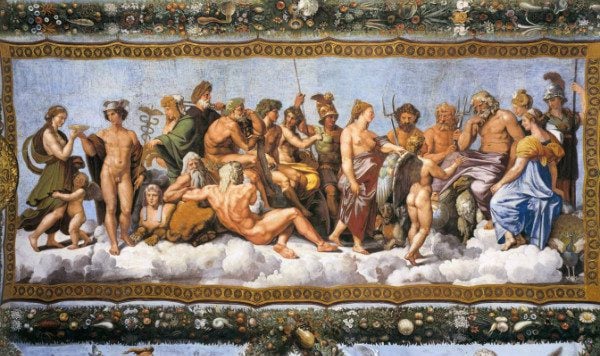
Towards the beginning of the book there is a drawing of 13 Gods in Olympus. Though the picture isn’t labeled with their names, they are clearly recognizable from their symbols. Now when I look at images of ancient Greek statuary or pottery, I frequently known which God is pictured by their symbol and I gained this skill from D’Aulaires’.
No matter how different artists envision the Gods their symbols become their ID cards, clueing you in to their name and attributes. For example, Hermes is sometimes depicted as an mature man with a beard and sometimes he is pictured as a beardless youth. However, if you see winged sandals, a winged cap, or a caduceus you immediately recognize his identity. This gave me the foundation of knowledge about the Gods that has served me well as the Pagan. I honestly don’t know if I would have found Paganism without reading this book.
3. Hubris
In an ancient Greek context, hubris is thinking you are better than the Gods. A non-thiestic interpretation would be having dangerous overconfidence or foolish pride. The theme of hubris showed up frequently enough in these myths that even young Andrea learned that thinking yourself better than the Gods was a BAD idea and would usually lead to harsh consequences. It included the stories of Arachne (turned into a spider), Niobe (children killed), Marsyas (skinned alive), and Bellerophon (crippled and shunned by Gods and men for life).
Learning an ethical concept like hubris early in life from these examples of others instead of having to suffer through the consequences of dangerous overconfidence or unwarranted pride yourself can only be a good thing.
4. The sacred cycle of seasons
Before reading this, I of course knew of the 4 seasons. However their link and relation to each other in an ongoing cycle was not clear to me until I read the myth of Demeter and Persephone. The story of events in the God’s lives causing the seasons. The joy of spring, the productivity of summer, the loss in fall and the grief of winter… This idea of the sacred cycle of seasons is a foundational Pagan concept that I first learned from D’Aulaires’.
5. Don’t ask for things unless you understand their possible consequences
There are a number of the included myths that contain stories of Gods and mortals suffering the consequences of having something they asked for not turn out they way they expected. Stories such as Helios and Phaethon, Eos and Tithonus, Zeus and Semele, and King Midas’s golden touch all contain such consequences.
In the story of Eos and Tithonus the dawn Goddess Eos falls in love with the mortal Tithonus and asks for him to live forever so she may be with him. He lives forever but does not stay forever young so shrinks down as he ages until he becomes a shrunken cricket that Eos is forced to hide away. Eos’s sister, the moon, Selene, learns from her sister’s ill-thought-through request. When she falls in love with the mortal Endymion, she asks that he always stay just as he is when she first saw him, asleep next to his flock. Her request is granted and because she thought to ask for him to stay forever young, they go on to have many children together. As these characters learned to be careful what they ask for, I learned the lesson as well.
6. Respect everyone
Respect, especially respect of strangers, is another virtual extolled in the myths. The hero Jason met Hera, disguised as a crone, who wanted to cross a flooded river. Without any thought to reward, because it was the right thing to do, Jason volunteered to carry her across. Though she became heavier and heavier as they crossed, he persevered and got her across the river.
You never known who is a God in disguise so treat everyone with respect.
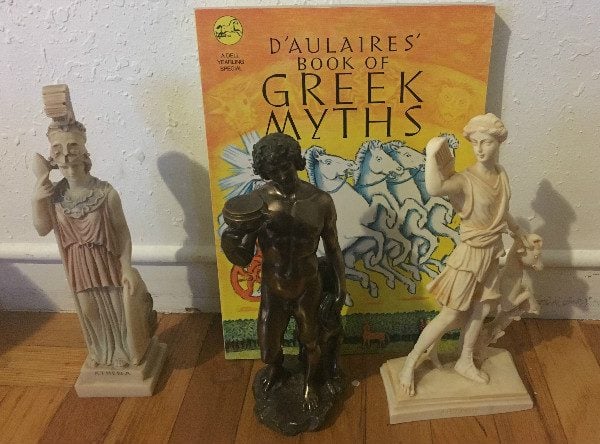
Oh the legacy of D’Aulaires’! (From left to right: Athena, Dionysus, and Artemis)
7. Gods frequently come to earth and interact with mortals
This was a radical idea for a Christian kid who had learned that the God of the bible did not come to earth and thus distant. Someone that was hard to known because of the distant relationship. You had to take His existence on faith since he didn’t act directly on the world.
The Greek Gods, however, were much more knowable. They could wear human faces. They had likes and dislikes, and a physical body that looked a certain way. They were more like people you weren’t afraid to talk to or ask for help from.
8. The end is not the end
The book’s last paragraph states that the rule of the Olympians ended with nothing left but broken temples and statues. This left me unaccountably sad. The Gods, that I had just come to know and love through the vivid stories and imagines, were now dead. I thought about their crumbling temples and the unfairness of the Gods no longer being honored many times growing up. Other books certainly didn’t leave me feeling this way.
When I found Paganism, years later, and realized that the Gods were indeed still being worshiped and were not forgotten I was so happy. My old friends were not dead after all!
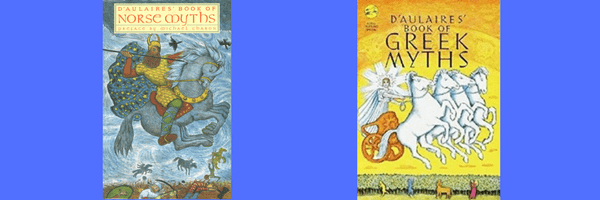
Go, (yes, right now) and buy this book for yourself. Even better, buy it for the kids in your life. I promise that you won’t be disappointed.
I’m also sure I’m not the only one that was influenced by D’Aulaires Greek Myths or D’Aulaires Norse Myths. Please share your experiences of these books in the comments.
D’Aulaires’ Book of Greek Myths
Previous Post

May 24, 2017
Lamp & Labyrinth: A Mystics Perception of Subjective Reality
Next Post
May 28, 2017 Hills of the Horizon: The Past is Another Country
Browse Our Archives
Select a Category A Lakeside Hearth Adventures in Wortcunning Alone In Her Presence Arts, Crafts & Cooking Birthing Hereditary Witchcraft Book of Blackbirds Book Reviews Born-Again Witch Cauldron, Sword, Spear, & Stone Cermony and Liturgy Columns Community Dandelion Seeds Dear Jasmine Druid Thoughts Editor's Picks Everyday Pagan Family & Household Practice Family Traditions Full Frontal Magic Gateway Goddess Guest Articles Happily Heathen Health and Wellness Hearth of Hellenism Heathen Woman Hills of the Horizon History Holidays Horse Goddesses Interfaith Interviews Irish-American Witchcraft Jewish Witch Lamp & Labyrinth Letters from Midgard Literature, Media, Film, Music Loop of Brighid Love, Sex & Relationships Magic or Magick Making Light Naturalistic Traditions Nature News Outside The Circle Pantheisticon Politics Prayers, Poems, Blessings & Stories Queer Femme Mystic Queer of Swords Recipes Ritual and Practice Science and Research Seekers and Guides Seeking the Grail Socially Responsible Magic Spear of Athena Star Made Witch Syncretic Electric Technology The Blooming Staff The Busy Witch The Cartomancer The Crow's Nest The Dance of Pagan Recovery The Hearth of Hellenism The Lady's Quill The Other Side of the Hedge The Path of She The Rantin' Raven The Witches Next Door The Zen Pagan Theology, Ethics, Philosophy Tree City Witch Urban Earthwitch Wayfaring Woman Witch on Fire Wyrd Words
Select a Month January 2026 March 2025 December 2024 June 2024 April 2024 March 2024 January 2024 December 2023 November 2023 October 2023 August 2023 July 2023 May 2023 April 2023 March 2023 February 2023 January 2023 December 2022 November 2022 October 2022 September 2022 August 2022 July 2022 June 2022 May 2022 March 2022 February 2022 January 2022 December 2021 November 2021 October 2021 September 2021 August 2021 July 2021 June 2021 May 2021 April 2021 March 2021 February 2021 January 2021 December 2020 November 2020 October 2020 September 2020 August 2020 July 2020 June 2020 May 2020 April 2020 March 2020 February 2020 January 2020 December 2019 November 2019 October 2019 September 2019 August 2019 July 2019 June 2019 May 2019 April 2019 March 2019 February 2019 January 2019 December 2018 November 2018 October 2018 September 2018 August 2018 July 2018 June 2018 May 2018 April 2018 March 2018 February 2018 January 2018 December 2017 November 2017 October 2017 September 2017 August 2017 July 2017 June 2017 May 2017 April 2017 March 2017 February 2017 January 2017 December 2016 November 2016 October 2016 September 2016 August 2016 July 2016 June 2016 May 2016 April 2016 March 2016 February 2016 January 2016 December 2015 November 2015 October 2015 September 2015 August 2015 July 2015 June 2015 May 2015 April 2015 March 2015 February 2015 January 2015 December 2014 November 2014 October 2014 September 2014 August 2014 July 2014 June 2014 May 2014 April 2014 March 2014 February 2014 January 2014 December 2013 November 2013 October 2013 September 2013 August 2013 July 2013 June 2013 May 2013 April 2013 March 2013 February 2013 January 2013 December 2012 November 2012 October 2012 September 2012 August 2012 July 2012 June 2012 May 2012 April 2012 March 2012 February 2012 January 2012
Follow Us!
TAKE THE
Religious Wisdom Quiz
Who leaped for joy after being healed at the Temple gate (by Peter, in Jesus' name)?
Select your answer to see how you score.
A Pharisee A blind man A lame man A rich man
Related posts from Agora

Simple Witchery: To Keep Silent

Simple Witchery: Leaning On The Four Pillars

Pergamum Unfurled: Magic with the Greek Gods (Book...

Pergamum Unfurled: Cunning Words (Review)
TRENDING AT PATHEOS Pagan

I was recently chatting with someone on Instagram. She asked me what...

While there are many people who share their results, the end of...

On July 23, I saw Christopher Nolan's The Odyssey which is Homer’s...

As I write this two big events have just finished up. One...

Restoring the Watershed of Divine Love
Perhaps cooperation is not something we manufacture through legislation, ideology, or moral...

Many UUs don’t pray because of bad experiences in a previous religion,...
view all Pagan blogs
Ad-Free & Subscriber Log-In Subscription Support
- About Us
- 2026 Calendar
- Videos
- Podcasts
- Library of World Religions
- Faith In Media Tracker
- Advertise With Us
- Write for Us
- Privacy Policy
- Terms of Service
- Do Not Sell My Data
- Contact Us
- Radiant Digital
- Manage Newsletter Subscriptions
- Unsubscribe From Notifications
- Sitemap
Copyright 2008-2026, Patheos. All rights reserved.
Subscription Support Ad-Free & Subscriber Log-In
Follow Patheos