
BuddhistCatholicContemplativeEvangelicalGeneral ChristianHinduJewishLatter-day SaintMuslimNew VisionsProgressive Christian
Beliefs
- Buddhist
- Catholic
- Contemplative
- Evangelical
- General Christian
- Hindu
- Jewish
- Latter-day Saint
- More Voices
- Muslim
- New Visions
- Pagan
- Progressive Christian
Topics
- Religion News
- Food and Religion
- Sports and Religion
- Religious Art
- Religious Music and Entertainment
- Religious Events
- History and Religion
- Style and Religion
- Politics and Religion
- Women in Religion
- Recreation Outdoors and Religion
- Business Finance and Religion
- Careers Workplace and Religion
- Education and Religion
- Family Parenting and Religion
- Health Fitness and Religion
- Home and Religion
- Relationships and Religion
- Technology and Religion
- Travel and Religion
Columnists
- Buddhist Columnists
- Business Finance and Religion Columnists
- Careers Workplace and Religion Columnists
- Catholic Columnists
- Contemplative Columnists
- Education and Religion Columnists
- Evangelists Columnists
- Family Parenting and Religion Columnists
- General Christian Columnists
- Health Fitness and Religion Columnists
- Hindu Columnists
- History and Religion Columnists
- Home and Religion Columnists
- Jewish Columnists
- More Voices Columnists
- Latter Day Columnists
- Muslim Columnists
- New Visions Columnists
- Nonreligious Columnists
- Pagan Columnists
- Politics and Religion Columnists
- Progressive Columnists
- Recreation Outdoors and Religion Columnists
- Relationships and Religion Columnists
- Religion News Columnists
- Religious Art Columnists
- Religious Events Columnists
- Religious Music and Entertainment Columnists
- Sports and Religion Columnists
- Style and Religion Columnists
- Technology and Religion Columnists
- Travel and Religion Columnists
- Women in Religion Columnists
Resource Library
- 2026 Calendar
- Library of World Religions
- The 100 Most Holy Places on Earth
- Patheos Answers
- Podcasts
- Videos
- Faith Leaders Database
- Anglican Episcopalian
- Bahai
- Baptist
- Buddhism
- Christianity
- Confucianism
- Eastern Orthodoxy
- Hinduism
- Holiness and Pentecostal
- ISKCON
- Islam
- Judaism
- Lutheran
- Methodist
- The Church of Jesus Christ of Latter-day Saints
- New Age
- Paganism
- Presbytarian and Reformed
- Protestantism
- Religion Behind the Scenes
- Roman Catholic
- Scientology
- Shia Islam
- Sikhism
- Sufism
- Sunni Islam
- Taoism
- Zen
- See all religions
Research Tools
 Ad-Free & Subscriber Log-In Subscription Support
Ad-Free & Subscriber Log-In Subscription Support
Follow Patheos 

- Trending:
- Forgiveness
- |
- Marriage
- |
- Consciousness
- |
- Death Penalty
- |
- Election
- |
- Halloween

- Home
- Pagan
- Irish-American Witchcraft: Winter Court Wisdom
Irish-American Witchcraft: Winter Court Wisdom
Last updated on: February 7, 2017 at 1:14 pm by Morgan Daimler
Irish-American Witchcraft: Winter Court Wisdom 2017-02-07T13:14:00+00:00 Morgan Daimler
Patheos Explore the world's faith through different perspectives on religion and spirituality! Patheos has the views of the prevalent religions and spiritualities of the world.
We are moving into what is usually the coldest part of winter in my area, right before spring starts to noticeably thaw the world around me. From one perspective we might say this is when the Cailleach Bheur, the Goddess often associated with the storms of winter in Scotland, is most active before she goes to her rest on Là na Caillich [the Cailleach’s Day; March 25th]. From another point of view we might say that this is when the Winter Court¹ of the fairies holds sway. As I watch the snow fall, and think about these things, I find myself contemplating the wisdom I have learned from the darker Fey.

Winter Scene / M Daimler 2015
Myth and Mysticism
There are, of course, the more formal tenets and guidelines of the religions I practice including Druidism that shape my ethical and practical beliefs. In that context I look a lot at the older Irish wisdom texts like the Audacht Morainn [Testament of Morann] and Tecosca Cormaic [the Instructions of Cormac] because they contain some good guidelines to live by. I also have ethics defined by the witchcraft I practice, which are based more on what can be gleaned from myth and folklore dealing with the Good Neighbors. Looking at these stories and advice from the myths is very helpful to me in forming a system of ethics that I feel is inline with my spiritual beliefs and also more generally provides ideas for right-living, that is for living in right relationship with the world around me.
However my spirituality has always been as much about mysticism as it is about study, which I think befits anyone who uses a Reconstructionist methodology² – we need to have our feet firmly on the ground while our heads are lifted into the skies, as it were. For me the mysticism aspect plays out in the way that I use spiritual techniques to connect to my Gods and to other spirits; often these connections provide levels of communication. Sometimes this plays out in dreams, other times in more direct methods like meditation, but the ultimate point is that it makes me feel like I am actively engaging with the Powers that I honor. It also sometimes offers me the opportunity to gain new insight or wisdom into situations or life in general that I have found invaluable.
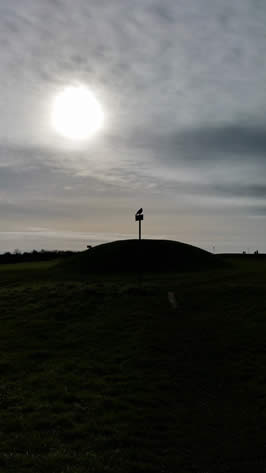
A crow perched on sign near the Mound of Hostages, Teamhair, Ireland / Copyright M Daimler 2016
Listening to Messages
Since we are in the midst of winter, the time that is ruled over by the more dangerous Otherworldly beings, and I am finding myself thinking of some of the pieces of wisdom they have taught me over the years I thought perhaps I would share some of them here. Naturally some of these will be truisms but I have found them important and profound. These little tidbits conveyed in different experiences are things that have stayed with me and grown to shape how I interact both with other people and with spirits.
- Nothing’s nature is truly set, all things can be either fierce or gentle. – this was told to me by someone who might be termed a guide. I was struggling with an ingrained view of spirits as either good or bad, at the time, and this came in a larger context of a discussion about the way that even beings that seem meek can fight to defend themselves and even beings that seem aggressive can be kind. It ended up changing my entire view on things, and breaking me out of an either/or mindset.
- External beauty is an illusion, trust the beauty inside a thing if you would use that as a judge – we see a lot of emphasis in stories on physical beauty as a reflection of inner goodness, and I honestly expected the Fey Folk to have a similar opinion on the subject, but for what its worth in my own personal gnosis I was told that external appearances are fluid and untrustworthy. Only the qualities within can or perhaps should be used as a measure. This dovetailed with something else I’d gotten in a separate experience, that I shouldn’t use human standards of beauty, ability, or character as a measure for anything else. It basically boiled down to ‘humans aren’t the measuring stick for all sentient beings‘.
- Good manners are the line between earning blessing and earning grief. – This one applies to every interaction we have I think, but especially in the context of the Other Crowd. Being polite is at the least the best way to begin interactions. Often enough with the Fey Folk politeness will gain a better outcome even in a difficult situation than rudeness, while rudeness has consequences.
- Nothing comes without a cost – This was advice given to me in the context of being careful not to assume that something which looked good and beneficial to me didn’t have any hidden catch to it. Effectively the fairy version of always read the fine print, but I’ve found it a good motto to live by. With rare exceptions Gods, spirits, humans, they all expect something in return for something. Knowing that means not (hopefully) making any bad bargains or accidently writing any metaphorical blank checks. It may sound cynical but truly it isn’t it just means knowing that everything has a value and I need to know going into a situation what that value means to me, what I am willing to pay for something. Or not, as the case may be.
- Always know the measure of your own strength – This falls into the good advice given in a dream category, but it has served me well in life. It’s probably not surprising that this advice would come from the darker Fey, I suppose, but the key in dealing with dangerous spirits is to know your own limits and abilities and exactly how far you can push before you need to call in help, whatever that means to you. Don’t overestimate yourself, obviously, but don’t underestimate yourself either. Know what you can do and how much. It’s no guarantee that you won’t still get into situations you aren’t prepared for or that are beyond you, but it means you’ll recognize those situations when they happen and be better prepared to deal with them.
These are only a few of the things I’ve learned over the years from the Winter Court, messages I’ve taken and incorporated into my practice. Some of these may seem obvious or like common sense, but receiving these in the context of spiritual experiences, of dreams or meditations, has been impactful. It offers me a way to feel more deeply connected to my religion but also for these ideas to be more than just ideas because they aren’t something I read somewhere but things that I believe were directly communicated.
Endnotes:
- I tend to use the term ‘Winter court’ as a modern euphemism for the more malicious or dangerous Other Crowd, and ‘Summer Court’ for the more benevolent. The older terms would be Unseelie and Seelie courts; these are Scottish names and not found originally in Ireland but I have found them useful in quickly defining whether a being generally means harm or not. The older words have a lot of connotations that are lost in English which is why I have come to prefer the seasonal terms. That said, nothing with Themselves is written in stone and the Summer court is as capable of harm as the Winter is capable of kindness. There is a lot of fluidity between the two and often what is labeled as what is entirely a matter of perspective. (back)
- For a better explanation of the way this concept works in CR specifically I recommend reading the article ‘Aisling, Ársaíocht, agus Agallamh: A Modern CR Triad‘ by Erynn Rowan Laurie. (back)

Click here to like
Patheos Pagan on Facebook.

Click here to like
the Agora on Facebook
Irish-American Witchcraft is published bi-monthly on Tuesdays here on the Agora. Subscribe via RSS or e-mail!
Please use the links to the right to keep on top of activities here on the Agora as well as across the entire Patheos Pagan channel.
Previous Post

February 6, 2017
Seeking the Grail: Overcoming the Old Wound and the Hero's Final Test
Next Post
February 8, 2017 The Cartomancer: Full Circle, Magic Circle
Browse Our Archives
Select a Category A Lakeside Hearth Adventures in Wortcunning Alone In Her Presence Arts, Crafts & Cooking Birthing Hereditary Witchcraft Book of Blackbirds Book Reviews Born-Again Witch Cauldron, Sword, Spear, & Stone Cermony and Liturgy Columns Community Dandelion Seeds Dear Jasmine Druid Thoughts Editor's Picks Everyday Pagan Family & Household Practice Family Traditions Full Frontal Magic Gateway Goddess Guest Articles Happily Heathen Health and Wellness Hearth of Hellenism Heathen Woman Hills of the Horizon History Holidays Horse Goddesses Interfaith Interviews Irish-American Witchcraft Jewish Witch Lamp & Labyrinth Letters from Midgard Literature, Media, Film, Music Loop of Brighid Love, Sex & Relationships Magic or Magick Making Light Naturalistic Traditions Nature News Outside The Circle Pantheisticon Politics Prayers, Poems, Blessings & Stories Queer Femme Mystic Queer of Swords Recipes Ritual and Practice Science and Research Seekers and Guides Seeking the Grail Socially Responsible Magic Spear of Athena Star Made Witch Syncretic Electric Technology The Blooming Staff The Busy Witch The Cartomancer The Crow's Nest The Dance of Pagan Recovery The Hearth of Hellenism The Lady's Quill The Other Side of the Hedge The Path of She The Rantin' Raven The Witches Next Door The Zen Pagan Theology, Ethics, Philosophy Tree City Witch Urban Earthwitch Wayfaring Woman Witch on Fire Wyrd Words
Select a Month January 2026 March 2025 December 2024 June 2024 April 2024 March 2024 January 2024 December 2023 November 2023 October 2023 August 2023 July 2023 May 2023 April 2023 March 2023 February 2023 January 2023 December 2022 November 2022 October 2022 September 2022 August 2022 July 2022 June 2022 May 2022 March 2022 February 2022 January 2022 December 2021 November 2021 October 2021 September 2021 August 2021 July 2021 June 2021 May 2021 April 2021 March 2021 February 2021 January 2021 December 2020 November 2020 October 2020 September 2020 August 2020 July 2020 June 2020 May 2020 April 2020 March 2020 February 2020 January 2020 December 2019 November 2019 October 2019 September 2019 August 2019 July 2019 June 2019 May 2019 April 2019 March 2019 February 2019 January 2019 December 2018 November 2018 October 2018 September 2018 August 2018 July 2018 June 2018 May 2018 April 2018 March 2018 February 2018 January 2018 December 2017 November 2017 October 2017 September 2017 August 2017 July 2017 June 2017 May 2017 April 2017 March 2017 February 2017 January 2017 December 2016 November 2016 October 2016 September 2016 August 2016 July 2016 June 2016 May 2016 April 2016 March 2016 February 2016 January 2016 December 2015 November 2015 October 2015 September 2015 August 2015 July 2015 June 2015 May 2015 April 2015 March 2015 February 2015 January 2015 December 2014 November 2014 October 2014 September 2014 August 2014 July 2014 June 2014 May 2014 April 2014 March 2014 February 2014 January 2014 December 2013 November 2013 October 2013 September 2013 August 2013 July 2013 June 2013 May 2013 April 2013 March 2013 February 2013 January 2013 December 2012 November 2012 October 2012 September 2012 August 2012 July 2012 June 2012 May 2012 April 2012 March 2012 February 2012 January 2012
Follow Us!
TAKE THE
Religious Wisdom Quiz
What does "Pentateuch" mean in Greek?
Select your answer to see how you score.
First law Book of peace Five scrolls Stories of heroes
Related posts from Agora

Irish-American Witchcraft: Top 5 Favourite Fairy Fiction Series

Irish-American Witchcraft: Why the Roots of Your Fairy...
Irish-American Witchcraft: Fairies, Hoaxes, Gaffs, and Quest for...

Irish-American Witchcraft: Fairies and Modern Technology
TRENDING AT PATHEOS Pagan

I was recently chatting with someone on Instagram. She asked me what...

While there are many people who share their results, the end of...

On July 23, I saw Christopher Nolan's The Odyssey which is Homer’s...

As I write this two big events have just finished up. One...

Restoring the Watershed of Divine Love
Perhaps cooperation is not something we manufacture through legislation, ideology, or moral...

Many UUs don’t pray because of bad experiences in a previous religion,...
view all Pagan blogs
Ad-Free & Subscriber Log-In Subscription Support
- About Us
- 2026 Calendar
- Videos
- Podcasts
- Library of World Religions
- Faith In Media Tracker
- Advertise With Us
- Write for Us
- Privacy Policy
- Terms of Service
- Do Not Sell My Data
- Contact Us
- Radiant Digital
- Manage Newsletter Subscriptions
- Unsubscribe From Notifications
- Sitemap
Copyright 2008-2026, Patheos. All rights reserved.
Subscription Support Ad-Free & Subscriber Log-In
Follow Patheos