
BuddhistCatholicContemplativeEvangelicalGeneral ChristianHinduJewishLatter-day SaintMuslimNew VisionsProgressive Christian
Beliefs
- Buddhist
- Catholic
- Contemplative
- Evangelical
- General Christian
- Hindu
- Jewish
- Latter-day Saint
- More Voices
- Muslim
- New Visions
- Pagan
- Progressive Christian
Topics
- Religion News
- Food and Religion
- Sports and Religion
- Religious Art
- Religious Music and Entertainment
- Religious Events
- History and Religion
- Style and Religion
- Politics and Religion
- Women in Religion
- Recreation Outdoors and Religion
- Business Finance and Religion
- Careers Workplace and Religion
- Education and Religion
- Family Parenting and Religion
- Health Fitness and Religion
- Home and Religion
- Relationships and Religion
- Technology and Religion
- Travel and Religion
Columnists
- Buddhist Columnists
- Business Finance and Religion Columnists
- Careers Workplace and Religion Columnists
- Catholic Columnists
- Contemplative Columnists
- Education and Religion Columnists
- Evangelists Columnists
- Family Parenting and Religion Columnists
- General Christian Columnists
- Health Fitness and Religion Columnists
- Hindu Columnists
- History and Religion Columnists
- Home and Religion Columnists
- Jewish Columnists
- More Voices Columnists
- Latter Day Columnists
- Muslim Columnists
- New Visions Columnists
- Nonreligious Columnists
- Pagan Columnists
- Politics and Religion Columnists
- Progressive Columnists
- Recreation Outdoors and Religion Columnists
- Relationships and Religion Columnists
- Religion News Columnists
- Religious Art Columnists
- Religious Events Columnists
- Religious Music and Entertainment Columnists
- Sports and Religion Columnists
- Style and Religion Columnists
- Technology and Religion Columnists
- Travel and Religion Columnists
- Women in Religion Columnists
Resource Library
- 2026 Calendar
- Library of World Religions
- The 100 Most Holy Places on Earth
- Patheos Answers
- Podcasts
- Videos
- Faith Leaders Database
- Anglican Episcopalian
- Bahai
- Baptist
- Buddhism
- Christianity
- Confucianism
- Eastern Orthodoxy
- Hinduism
- Holiness and Pentecostal
- ISKCON
- Islam
- Judaism
- Lutheran
- Methodist
- The Church of Jesus Christ of Latter-day Saints
- New Age
- Paganism
- Presbytarian and Reformed
- Protestantism
- Religion Behind the Scenes
- Roman Catholic
- Scientology
- Shia Islam
- Sikhism
- Sufism
- Sunni Islam
- Taoism
- Zen
- See all religions
Research Tools
 Ad-Free & Subscriber Log-In Subscription Support
Ad-Free & Subscriber Log-In Subscription Support
Follow Patheos 

- Trending:
- Forgiveness
- |
- Marriage
- |
- Consciousness
- |
- Death Penalty
- |
- Election
- |
- Halloween

- Home
- Pagan
- Outside the Circle: The Dark, Dreich Days Of Auld Reekie
Outside the Circle: The Dark, Dreich Days Of Auld Reekie
Last updated on: January 12, 2017 at 5:38 pm by Danette Wilson
Outside the Circle: The Dark, Dreich Days Of Auld Reekie 2017-01-12T17:38:49+00:00 Danette Wilson
Patheos Explore the world's faith through different perspectives on religion and spirituality! Patheos has the views of the prevalent religions and spiritualities of the world.
There’s nothing like coming face to face with the smell of a dungeon and the torture devices that were used in the past to extract a confession of Witchcraft from screaming souls to let you know that the freedoms we take for granted today are a far cry from those the people of the 16th and 17th century had.
Witch Hunt Capital of the World
In the 1600s, Edinburgh was the torture and witch hunt capital of the world. Even someone pointing at you and calling you a witch in the marketplace was pretty much a death sentence. The conviction process was sadistic and long.
It started with the walking of the witches, where suspects were made to walk or crawl back and forth continuously in front of the Cathedral for days. Stopping even for a second was an admission of guilt. If this test was passed, then the subjects hands and feet were bound, and they were thrown into the city sewerage ditch to sink into the waste and excrement. If by some miracle the victim did not drown, then they were taken to the castle and burned alive.
Torture
Although the use of torture to extract a confession was illegal in England, Ireland and Wales, it was permitted in Scotland.
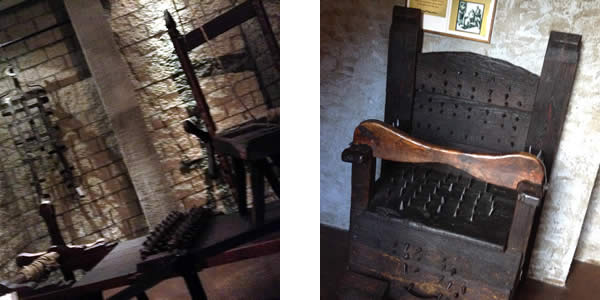
Implements of torture / Danette Wilson
In Scotland, thumb screws and leg crushers were also used. Another, more public and informal type of trial was ‘swimming’ the accused to prove their guilt. The victim’s right thumb would be tied to their left big toe and they would be thrown into a nearby pond or river. If they sank, they were innocent, if they floated, they had been rejected by the water as a servant of the devil.
Edinburgh Castle played a key role in the trial and execution of condemned witches, and an estimated 300 were put to death on the castle’s esplanade. One such figure was Agnes Finnie, an Edinburgh shopkeeper who was charged with 20 counts of witchcraft and sorcery, including placing “so frightful a disease on Beatrix Nisbet, for some other trifling offense, that she lost the use of her tongue”. Arrested in 1644, Agnes was found guilty of witchcraft and held in the castle’s dungeon. After strangulation, her body was burned on the esplanade.

Edinburgh Castle seen from the roof of the National Museum of Scotland / Kim Traynor – CC BY-SA 3.0 / Wikimedia Commons
The Accused
Between 1479 and 1722, thousands were accused of witchcraft and were burned alive in Edinburgh. One 1576 record of the execution of Bessie Dunlop states she was burned at Castle Hill for being a member of a coven of eight women and four men, and for receiving herbs from the Queen of the Faeries.
A series of records from 1595 tell of a woman named Alison Balfour who confessed to witchcraft under torture, recanted and was burned alive. Her family met equally gruesome ends simply because they were family members. Balfour’s husband, an eighty-one-year-old man, was pressed under 700 pounds of iron bars. Her son’s legs were destroyed by a torture device, developed by the Scots, called the Boot. Made of iron or wood, the Boot was fastened on the leg and wedges were driven in between the Boot and leg by blows from a mallet. After each blow a question was put to the victim, and the ordeal was continued until he gave the information or fainted. Balfour’s 7-year-old daughter was tortured with thumbscrews. Even the house servant was implicated, tortured and burned at the stake.
Another entry in this ancient record book shows the sheriff of Caithness killing two witches based on the complaint of one William Montgomery. It seems Mr. Montgomery was plagued by cats and blamed the two unlucky women for cursing him with their unwanted presence.
The Story of Agnes Sampson
One of Edinburgh’s most infamous ghost stories involves a well-respected woman of high society named Agnes Sampson who was tortured, tried, and convicted of witchcraft by Scotland’s King James VI in 1592.
Under torture, Agnes suffered the humiliation of being stripped naked and having every hair shaved from her body. She was burned with ropes pulled across her face and bare breasts. Agnes was made to wear a witches bridle which pierced her cheeks and tongue with sharp spikes and was fastened by spiked iron spikes to the wall of her cell. This sadistic torture was intended to bring forth a confession. There is no doubt that this torture succeeded in bringing about the required result in virtually all cases as in this one. Agnes confessed to working with other witches to conjure up a storm in order to sink a ship carrying King James of Denmark.
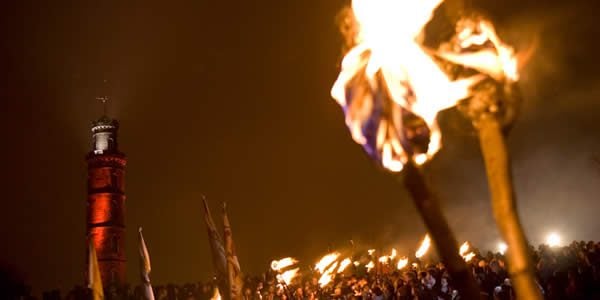
The Fire Festival procession on Calton Hill / Andrewyuill – CC BY-SA 3.0 / Wikimedia Commons
The Queen of Scottish Witches
Isobel Gowdie, the renowned “Queen of Scottish Witches”, was a young Scottish housewife who was tried for witchcraft in 1662. Her detailed confession, apparently achieved without the use of torture, relates her fifteen years of involvement with the Devil, and offers one of the most detailed looks at European witchcraft folklore at the end of the era of witch-hunts.
According to her story, she had initially encountered Satan at the church at Auldearne, and made a pact with him, beginning with her renunciation of Christianity. The Devil placed his mark on her shoulder, sucked some of her blood, and re-baptized her with it, giving her a new name, Janet. She confessed her new faith while placing one hand on her head and one on the bottom of her foot.
In her four separate confessions given over a six-week period, she claimed to have flown through the air to her coven meetings (a group of 13 that would later become standard fare in witchcraft accounts), slaying any Christians she passed unless they were able to bless themselves first. The Devil himself would attend their Sabbats and would whip them if they had displeased him in some way.
Gowdie also claimed to have been entertained regularly by the King and Queen of the Fairies, in the land of the elves “under the hills”, which she entered through various mounds and caverns. It was the fairies who taught her to fly by climbing beanstocks and cornstraws and shouting, “Horse and Hattock, in the Devil’s name!” She also claimed to have the ability to transform herself at will into an animal such as hare or a cat, and to be able to affect the weather.
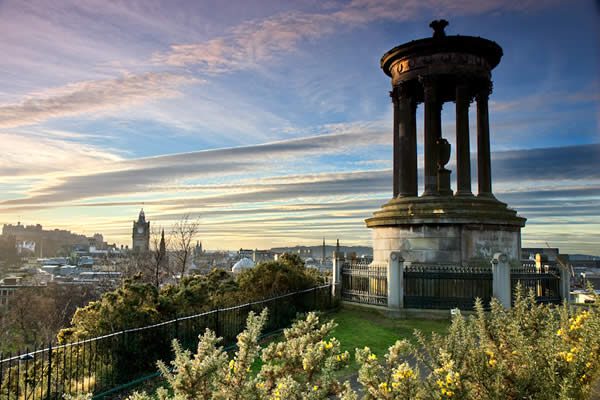
View over Edinburgh, with the Dugald Stewart Monument in the foreground / Andrewyuill – CC BY-SA 3.0 / Wikimedia Commons

Click here to like
Patheos Pagan on Facebook.

Click here to like
the Agora on Facebook
Outside the Circle is published twice monthly on Thursdays on Agora. Subscribe via RSS or e-mail!
Please use the links to the right to keep on top of activities here on the Agora as well as across the entire Patheos Pagan channel.
Previous Post
January 11, 2017
The Cartomancer: Spirit Personalities
Next Post

January 13, 2017 Happily Heathen: Missing Your Gods? Maybe You've Left Them
Browse Our Archives
Select a Category A Lakeside Hearth Adventures in Wortcunning Alone In Her Presence Arts, Crafts & Cooking Birthing Hereditary Witchcraft Book of Blackbirds Book Reviews Born-Again Witch Cauldron, Sword, Spear, & Stone Cermony and Liturgy Columns Community Dandelion Seeds Dear Jasmine Druid Thoughts Editor's Picks Everyday Pagan Family & Household Practice Family Traditions Full Frontal Magic Gateway Goddess Guest Articles Happily Heathen Health and Wellness Hearth of Hellenism Heathen Woman Hills of the Horizon History Holidays Horse Goddesses Interfaith Interviews Irish-American Witchcraft Jewish Witch Lamp & Labyrinth Letters from Midgard Literature, Media, Film, Music Loop of Brighid Love, Sex & Relationships Magic or Magick Making Light Naturalistic Traditions Nature News Outside The Circle Pantheisticon Politics Prayers, Poems, Blessings & Stories Queer Femme Mystic Queer of Swords Recipes Ritual and Practice Science and Research Seekers and Guides Seeking the Grail Socially Responsible Magic Spear of Athena Star Made Witch Syncretic Electric Technology The Blooming Staff The Busy Witch The Cartomancer The Crow's Nest The Dance of Pagan Recovery The Hearth of Hellenism The Lady's Quill The Other Side of the Hedge The Path of She The Rantin' Raven The Witches Next Door The Zen Pagan Theology, Ethics, Philosophy Tree City Witch Urban Earthwitch Wayfaring Woman Witch on Fire Wyrd Words
Select a Month January 2026 March 2025 December 2024 June 2024 April 2024 March 2024 January 2024 December 2023 November 2023 October 2023 August 2023 July 2023 May 2023 April 2023 March 2023 February 2023 January 2023 December 2022 November 2022 October 2022 September 2022 August 2022 July 2022 June 2022 May 2022 March 2022 February 2022 January 2022 December 2021 November 2021 October 2021 September 2021 August 2021 July 2021 June 2021 May 2021 April 2021 March 2021 February 2021 January 2021 December 2020 November 2020 October 2020 September 2020 August 2020 July 2020 June 2020 May 2020 April 2020 March 2020 February 2020 January 2020 December 2019 November 2019 October 2019 September 2019 August 2019 July 2019 June 2019 May 2019 April 2019 March 2019 February 2019 January 2019 December 2018 November 2018 October 2018 September 2018 August 2018 July 2018 June 2018 May 2018 April 2018 March 2018 February 2018 January 2018 December 2017 November 2017 October 2017 September 2017 August 2017 July 2017 June 2017 May 2017 April 2017 March 2017 February 2017 January 2017 December 2016 November 2016 October 2016 September 2016 August 2016 July 2016 June 2016 May 2016 April 2016 March 2016 February 2016 January 2016 December 2015 November 2015 October 2015 September 2015 August 2015 July 2015 June 2015 May 2015 April 2015 March 2015 February 2015 January 2015 December 2014 November 2014 October 2014 September 2014 August 2014 July 2014 June 2014 May 2014 April 2014 March 2014 February 2014 January 2014 December 2013 November 2013 October 2013 September 2013 August 2013 July 2013 June 2013 May 2013 April 2013 March 2013 February 2013 January 2013 December 2012 November 2012 October 2012 September 2012 August 2012 July 2012 June 2012 May 2012 April 2012 March 2012 February 2012 January 2012
Follow Us!
TAKE THE
Religious Wisdom Quiz
What king wrote many proverbs and built a great temple?
Select your answer to see how you score.
Hezekiah David Saul Solomon
Related posts from Agora

Simple Witchery: To Keep Silent

Simple Witchery: Leaning On The Four Pillars


Simple Witchery: Resistance and Resilience in Hard Times
TRENDING AT PATHEOS Pagan

I was recently chatting with someone on Instagram. She asked me what...

While there are many people who share their results, the end of...

On July 23, I saw Christopher Nolan's The Odyssey which is Homer’s...

As I write this two big events have just finished up. One...

Restoring the Watershed of Divine Love
Perhaps cooperation is not something we manufacture through legislation, ideology, or moral...

Many UUs don’t pray because of bad experiences in a previous religion,...
view all Pagan blogs
Ad-Free & Subscriber Log-In Subscription Support
- About Us
- 2026 Calendar
- Videos
- Podcasts
- Library of World Religions
- Faith In Media Tracker
- Advertise With Us
- Write for Us
- Privacy Policy
- Terms of Service
- Do Not Sell My Data
- Contact Us
- Radiant Digital
- Manage Newsletter Subscriptions
- Unsubscribe From Notifications
- Sitemap
Copyright 2008-2026, Patheos. All rights reserved.
Subscription Support Ad-Free & Subscriber Log-In
Follow Patheos