
BuddhistCatholicContemplativeEvangelicalGeneral ChristianHinduJewishLatter-day SaintMuslimNew VisionsProgressive Christian
Beliefs
- Buddhist
- Catholic
- Contemplative
- Evangelical
- General Christian
- Hindu
- Jewish
- Latter-day Saint
- More Voices
- Muslim
- New Visions
- Pagan
- Progressive Christian
Topics
- Religion News
- Food and Religion
- Sports and Religion
- Religious Art
- Religious Music and Entertainment
- Religious Events
- History and Religion
- Style and Religion
- Politics and Religion
- Women in Religion
- Recreation Outdoors and Religion
- Business Finance and Religion
- Careers Workplace and Religion
- Education and Religion
- Family Parenting and Religion
- Health Fitness and Religion
- Home and Religion
- Relationships and Religion
- Technology and Religion
- Travel and Religion
Columnists
- Buddhist Columnists
- Business Finance and Religion Columnists
- Careers Workplace and Religion Columnists
- Catholic Columnists
- Contemplative Columnists
- Education and Religion Columnists
- Evangelists Columnists
- Family Parenting and Religion Columnists
- General Christian Columnists
- Health Fitness and Religion Columnists
- Hindu Columnists
- History and Religion Columnists
- Home and Religion Columnists
- Jewish Columnists
- More Voices Columnists
- Latter Day Columnists
- Muslim Columnists
- New Visions Columnists
- Nonreligious Columnists
- Pagan Columnists
- Politics and Religion Columnists
- Progressive Columnists
- Recreation Outdoors and Religion Columnists
- Relationships and Religion Columnists
- Religion News Columnists
- Religious Art Columnists
- Religious Events Columnists
- Religious Music and Entertainment Columnists
- Sports and Religion Columnists
- Style and Religion Columnists
- Technology and Religion Columnists
- Travel and Religion Columnists
- Women in Religion Columnists
Resource Library
- 2026 Calendar
- Library of World Religions
- The 100 Most Holy Places on Earth
- Patheos Answers
- Podcasts
- Videos
- Faith Leaders Database
- Anglican Episcopalian
- Bahai
- Baptist
- Buddhism
- Christianity
- Confucianism
- Eastern Orthodoxy
- Hinduism
- Holiness and Pentecostal
- ISKCON
- Islam
- Judaism
- Lutheran
- Methodist
- The Church of Jesus Christ of Latter-day Saints
- New Age
- Paganism
- Presbytarian and Reformed
- Protestantism
- Religion Behind the Scenes
- Roman Catholic
- Scientology
- Shia Islam
- Sikhism
- Sufism
- Sunni Islam
- Taoism
- Zen
- See all religions
Research Tools
 Ad-Free & Subscriber Log-In Subscription Support
Ad-Free & Subscriber Log-In Subscription Support
Follow Patheos 

- Trending:
- Forgiveness
- |
- Marriage
- |
- Consciousness
- |
- Death Penalty
- |
- Election
- |
- Halloween

- Home
- Pagan
- Hills of the Horizon: Heart of the Creator
Hills of the Horizon: Heart of the Creator
Last updated on: March 29, 2017 at 1:51 pm by Kiya Nicoll
Hills of the Horizon: Heart of the Creator 2017-03-29T13:51:19+00:00 Kiya Nicoll
Patheos Explore the world's faith through different perspectives on religion and spirituality! Patheos has the views of the prevalent religions and spiritualities of the world.
Once, when I was very young, I was paging through a book, and saw in it a line drawing of Khnum, potter god and creator, as he crafted body and soul on his wheel. I remember thinking of how kind he looked, and how friendly.
When I got older, I was sure it had been in the Dover edition of the Budge translation of The Book of the Dead, snagged off my father’s shelves as I did every so often, but I looked through it over and over again, and I never found that drawing. It was as if it had vanished entirely from the only place I could think it might have been.
I wonder sometimes what it was I saw, and where. But I’ve often said, in the years since I became Kemetic, that Khnum was the first god I ever loved.
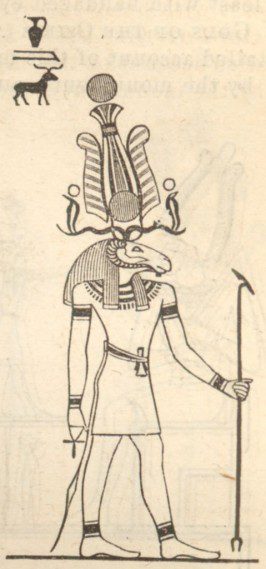
Originally published in “Handbook for Traveling, pt.1 Lower Egypt, with the Fayum and the peninsula of Sinai”, by Karl Baedeker, Leipsic, 1885. p. 129., distributed from Travelers in the Middle East Archive (TIMEA)
Khnum is, like all Egyptian deities, a god of many nuances, and linked into the cycles of (re-)creation. He guarded the gates to the underworld through which the Nile emerged, and thus was responsible for releasing the flood. Upon his wheel he made the bodies of kings, and their kau to match, out of Nile silt, and I once came across a scrap of story (modern or ancient I don’t know) that said he set a wheel in the uterus, so that others might do the same. A myth has him as the sole male attendant at a birth, among a company of midwifing goddesses. Some stories name him as the father of Ra, and others place him as one of the guardians of the sun barque on its night journey.
He is a creator.
I would say that being a creator is one of the primary traits of a god of Egypt. Not just in the sense of creating the cosmos, though a large number of the Powers are credited with that in one form or another, but in the sense that things must be brought into being, maintained, upheld, and this is the role of a god. (And here is a clue as to the complex nuances around Set, who went through cycles of honor and vilification; he creates change, and change in a heavily traditional, very ordered society is essentially the same as destruction. Which is not the same as uncreation – which he vehemently opposes – but it is still not an easy thing to bear.)
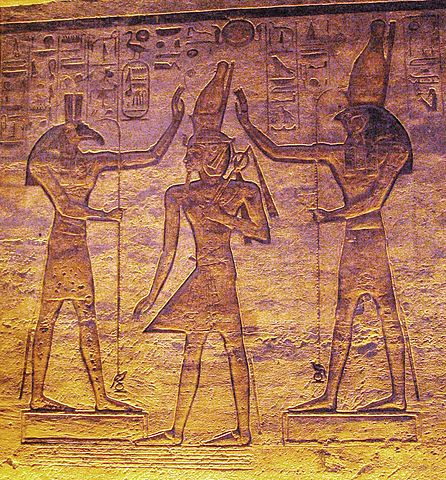
The gods Seth (left) and Horus (right) adoring Ramesses in the small temple at Abu Simbel, Chip Dawes, public domain
I do love these images of Set and Heru, though, the ones that show the two of them crowning or supporting the king: the change, the individual might, that Set embodies, balanced off against the continuity and collective potency of rulership and the polity that rests within Heru. There are others in the same genre, the two of them binding together plants or otherwise linking and balancing supposed opposing forces or regionally distinct icons.
The gods, the ancient Egyptians believed, were fed upon ma’at. And ma’at is a complicated concept, difficult to translate: the one-word translations for it include truth, and justice, and balance, and order, and harmony, and law. But ma’at was their food, sustaining them, nurturing them, and human offering of ma’at enabled the cycles of reciprocity that maintained the condition under which ma’at could be found.
And ma’at was established, maintained, and flowed forth from the moment of creation. It is coterminous with the act of creation, and the act of re-creation, of returning to the beginning, is a process of creating, restoring, and promoting ma’at.
There are times that everything seems too much. There’s a lot of that lately.
But I keep coming back around to re-creation. Not just every dawn, though every dawn is the archetypal re-creation in Egyptian thought.
But the urge to create, to make the world, to reshape the world towards justice/order/truth/harmony/that ineffable thing that one points at and says, “That, there, that ineffable thing is what feeds the divine”, that’s a guiding holiness.
Gods make worlds.
Go and do likewise.
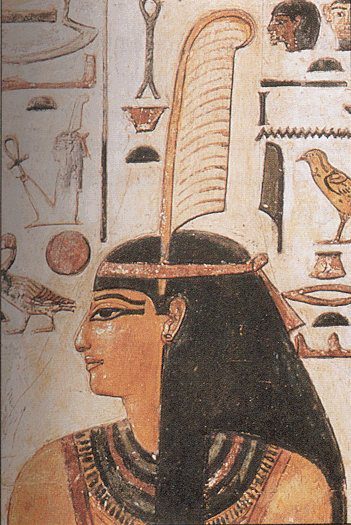
Ma’at, Public Domain

Click here to like
Patheos Pagan on Facebook.

Click here to like
the Agora on Facebook
Hills of the Horizon is published monthly on the 29th here on the Agora. You can subscribe by RSS or via e-mail.
Please use the links to the right to keep on top of activities here on the Agora as well as across the entire Patheos Pagan channel.
Previous Post

January 28, 2017
Brigid and the Making of Vows
Next Post

January 31, 2017 Book of Blackbirds: Fluffy Bunny Thoughts
Browse Our Archives
Select a Category A Lakeside Hearth Adventures in Wortcunning Alone In Her Presence Arts, Crafts & Cooking Birthing Hereditary Witchcraft Book of Blackbirds Book Reviews Born-Again Witch Cauldron, Sword, Spear, & Stone Cermony and Liturgy Columns Community Dandelion Seeds Dear Jasmine Druid Thoughts Editor's Picks Everyday Pagan Family & Household Practice Family Traditions Full Frontal Magic Gateway Goddess Guest Articles Happily Heathen Health and Wellness Hearth of Hellenism Heathen Woman Hills of the Horizon History Holidays Horse Goddesses Interfaith Interviews Irish-American Witchcraft Jewish Witch Lamp & Labyrinth Letters from Midgard Literature, Media, Film, Music Loop of Brighid Love, Sex & Relationships Magic or Magick Making Light Naturalistic Traditions Nature News Outside The Circle Pantheisticon Politics Prayers, Poems, Blessings & Stories Queer Femme Mystic Queer of Swords Recipes Ritual and Practice Science and Research Seekers and Guides Seeking the Grail Socially Responsible Magic Spear of Athena Star Made Witch Syncretic Electric Technology The Blooming Staff The Busy Witch The Cartomancer The Crow's Nest The Dance of Pagan Recovery The Hearth of Hellenism The Lady's Quill The Other Side of the Hedge The Path of She The Rantin' Raven The Witches Next Door The Zen Pagan Theology, Ethics, Philosophy Tree City Witch Urban Earthwitch Wayfaring Woman Witch on Fire Wyrd Words
Select a Month January 2026 March 2025 December 2024 June 2024 April 2024 March 2024 January 2024 December 2023 November 2023 October 2023 August 2023 July 2023 May 2023 April 2023 March 2023 February 2023 January 2023 December 2022 November 2022 October 2022 September 2022 August 2022 July 2022 June 2022 May 2022 March 2022 February 2022 January 2022 December 2021 November 2021 October 2021 September 2021 August 2021 July 2021 June 2021 May 2021 April 2021 March 2021 February 2021 January 2021 December 2020 November 2020 October 2020 September 2020 August 2020 July 2020 June 2020 May 2020 April 2020 March 2020 February 2020 January 2020 December 2019 November 2019 October 2019 September 2019 August 2019 July 2019 June 2019 May 2019 April 2019 March 2019 February 2019 January 2019 December 2018 November 2018 October 2018 September 2018 August 2018 July 2018 June 2018 May 2018 April 2018 March 2018 February 2018 January 2018 December 2017 November 2017 October 2017 September 2017 August 2017 July 2017 June 2017 May 2017 April 2017 March 2017 February 2017 January 2017 December 2016 November 2016 October 2016 September 2016 August 2016 July 2016 June 2016 May 2016 April 2016 March 2016 February 2016 January 2016 December 2015 November 2015 October 2015 September 2015 August 2015 July 2015 June 2015 May 2015 April 2015 March 2015 February 2015 January 2015 December 2014 November 2014 October 2014 September 2014 August 2014 July 2014 June 2014 May 2014 April 2014 March 2014 February 2014 January 2014 December 2013 November 2013 October 2013 September 2013 August 2013 July 2013 June 2013 May 2013 April 2013 March 2013 February 2013 January 2013 December 2012 November 2012 October 2012 September 2012 August 2012 July 2012 June 2012 May 2012 April 2012 March 2012 February 2012 January 2012
Follow Us!
TAKE THE
Religious Wisdom Quiz
What did Esther risk by approaching the king without being summoned?
Select your answer to see how you score.
Her reputation Her life Her fortune Her citizenship
Related posts from Agora

The Other Side of the Hedge: Animal Wisdom
The Other Side of the Hedge: The Formula...
The Other Side of the Hedge: Dignity for...
The Other Side of the Hedge: The Future...
TRENDING AT PATHEOS Pagan

I was recently chatting with someone on Instagram. She asked me what...

While there are many people who share their results, the end of...

On July 23, I saw Christopher Nolan's The Odyssey which is Homer’s...

As I write this two big events have just finished up. One...

Restoring the Watershed of Divine Love
Perhaps cooperation is not something we manufacture through legislation, ideology, or moral...

Many UUs don’t pray because of bad experiences in a previous religion,...
view all Pagan blogs
Ad-Free & Subscriber Log-In Subscription Support
- About Us
- 2026 Calendar
- Videos
- Podcasts
- Library of World Religions
- Faith In Media Tracker
- Advertise With Us
- Write for Us
- Privacy Policy
- Terms of Service
- Do Not Sell My Data
- Contact Us
- Radiant Digital
- Manage Newsletter Subscriptions
- Unsubscribe From Notifications
- Sitemap
Copyright 2008-2026, Patheos. All rights reserved.
Subscription Support Ad-Free & Subscriber Log-In
Follow Patheos