
BuddhistCatholicContemplativeEvangelicalGeneral ChristianHinduJewishLatter-day SaintMuslimNew VisionsProgressive Christian
Beliefs
- Buddhist
- Catholic
- Contemplative
- Evangelical
- General Christian
- Hindu
- Jewish
- Latter-day Saint
- More Voices
- Muslim
- New Visions
- Pagan
- Progressive Christian
Topics
- Religion News
- Food and Religion
- Sports and Religion
- Religious Art
- Religious Music and Entertainment
- Religious Events
- History and Religion
- Style and Religion
- Politics and Religion
- Women in Religion
- Recreation Outdoors and Religion
- Business Finance and Religion
- Careers Workplace and Religion
- Education and Religion
- Family Parenting and Religion
- Health Fitness and Religion
- Home and Religion
- Relationships and Religion
- Technology and Religion
- Travel and Religion
Columnists
- Buddhist Columnists
- Business Finance and Religion Columnists
- Careers Workplace and Religion Columnists
- Catholic Columnists
- Contemplative Columnists
- Education and Religion Columnists
- Evangelists Columnists
- Family Parenting and Religion Columnists
- General Christian Columnists
- Health Fitness and Religion Columnists
- Hindu Columnists
- History and Religion Columnists
- Home and Religion Columnists
- Jewish Columnists
- More Voices Columnists
- Latter Day Columnists
- Muslim Columnists
- New Visions Columnists
- Nonreligious Columnists
- Pagan Columnists
- Politics and Religion Columnists
- Progressive Columnists
- Recreation Outdoors and Religion Columnists
- Relationships and Religion Columnists
- Religion News Columnists
- Religious Art Columnists
- Religious Events Columnists
- Religious Music and Entertainment Columnists
- Sports and Religion Columnists
- Style and Religion Columnists
- Technology and Religion Columnists
- Travel and Religion Columnists
- Women in Religion Columnists
Resource Library
- 2026 Calendar
- Library of World Religions
- The 100 Most Holy Places on Earth
- Patheos Answers
- Podcasts
- Videos
- Faith Leaders Database
- Anglican Episcopalian
- Bahai
- Baptist
- Buddhism
- Christianity
- Confucianism
- Eastern Orthodoxy
- Hinduism
- Holiness and Pentecostal
- ISKCON
- Islam
- Judaism
- Lutheran
- Methodist
- The Church of Jesus Christ of Latter-day Saints
- New Age
- Paganism
- Presbytarian and Reformed
- Protestantism
- Religion Behind the Scenes
- Roman Catholic
- Scientology
- Shia Islam
- Sikhism
- Sufism
- Sunni Islam
- Taoism
- Zen
- See all religions
Research Tools
 Ad-Free & Subscriber Log-In Subscription Support
Ad-Free & Subscriber Log-In Subscription Support
Follow Patheos 

- Trending:
- Forgiveness
- |
- Marriage
- |
- Consciousness
- |
- Death Penalty
- |
- Election
- |
- Halloween

- Home
- Pagan
- The Blooming Staff: Crowley Didn’t Burn Hot Enough
The Blooming Staff: Crowley Didn’t Burn Hot Enough
Last updated on: February 14, 2017 at 12:33 pm by Nicholas Laccetti
The Blooming Staff: Crowley Didn’t Burn Hot Enough 2017-02-14T12:33:33+00:00 Nicholas Laccetti
Patheos Explore the world's faith through different perspectives on religion and spirituality! Patheos has the views of the prevalent religions and spiritualities of the world.
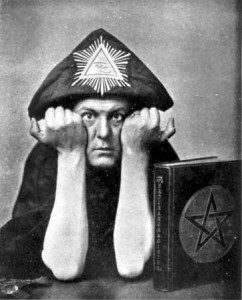
Uncle Al in theory and practice.
In a previous column, I described the links between an early work of Aleister Crowey’s, White Stains, and the Decadent movement of the late nineteenth-century. Indeed, there are many connections between Crowley’s early poetry and social milieu and literary Decadence. Many people would probably consider Crowley the epitome of a fin de siècle Decadent figure: the Great Beast, the Wickedest Man in the World, writer of erotic poetry and practitioner of strange magicks, translator of Baudelaire, disciple of Swinburne and unveiler of the tomb of Oscar Wilde. Yet there are also areas in which Crowley’s work and philosophy are not at all Decadent, according to the notion of Decadence meant by the literary term.
Hargrave Jennings: A Source of Crowley’s Sex Magick
Crowley’s understanding of sex and sex magic is one of these areas. Crowley, of course, received his early magical training in the Hermetic Order of the Golden Dawn—but, although sometimes a controversial issue, it is generally agreed that the classical version of the Order did not contain any form of sex magical teachings, either in theory or in practice. Crowley developed his ideas about sex through personal inclination, reaction to his puritanical Victorian Protestant upbringing, and his later involvement with Ordo Templi Orientis.

A modern cover of a book by Hargrave Jennings, epitomizing his usual topic: phallic worship.
Crowley was also heavily indebted to the curious work of Hargrave Jennings, an esoteric philosopher and scholar of religion who is considered a saint in Crowley’s Ecclesia Gnostica Catholica. Jennings’ The Rosicrucians, Their Rites and Mysteries is included on the A∴A∴ reading list. As Tau Apiryon explains,
The theory of Rosicrucianism set forth in The Rosicrucians revolves around a belief that all religions originated in the primitive worship of the principle of Light or Fire as the animating force of the universe, which is represented by the sun in the heavens and by the phallus in the physical world.
Many of Jennings’ ideas on sexuality, Rosicrucianism, and phallic worship made their way into Crowley’s Thelemic religious system, overlaid with Golden Dawn-inspired Egyptian Godforms and Neo-Buddhist philosophical ideas. Anyone even remotely acquainted with Thelemic doctrine or the Creed of Ecclesia Gnostica Catholica can see the resemblance between Jennings’ explication of phallicism and Crowley’s cosmology: the notion of the sun as the primary object of cult worship, and the phallus as “the sole viceregent of the Sun upon Earth,” the representative of the “creative and life-giving Fire as it manifests itself in living beings who dwell on the surface of this planet.”
Helena and Tau Apiryon are careful to note that it is not exactly the literal, physical penis that is meant by the use of “Phalle” in rituals like the Gnostic Mass and the Star Ruby: “the name ‘PHALLUS’ or ‘PHALLE’ should not be confused with the word ‘penis,’ although the penis does serve as an ancient, yet imperfect, symbol for the PHALLUS.”
According to them, phallicism in this usage “does not refer to penis-worship, but to the worship of the Generative Power—a Power which dwells in sexually mature individuals of both sexes.” This idea is verified in Jocelyn Godwin’s account of Jennings in The Theosophical Enlightenment, who, according to Godwin, used the term “phallicism” to refer to the worship of both the cosmic phallus and the yoni of female polarity. Godwin concludes,
[Jennings’] theory of sexual symbolism as the place where all religions and mythologies unite has the natural corollary that human sexual intercourse, along with the parts of the body concerned, is nothing shameful or indecent, but a replication in the microcosm of the macrocosmic act. (Godwin, 272)
Again, the parallels here with Thelemic doctrine should be obvious: the sex act as a microcosmic image of the primary macrocosmic act, described by Crowley as the interplay of Nuit and Hadit, the constant copulation of the Star-Goddess of infinite space with no circumference with the infinitely concentrated point—an ecstatic cosmogonic act which produces manifest reality. As Crowley rhapsodizes in Liber Aleph: “All is a never ending Play of Love wherein our Lady Nuit and her Lord Hadit rejoice.”
Helena and Tau Apiryon conclude their discussion of the CHAOS article of the Creed of Ecclesia Gnostica Catholica by quoting a line of Crowley’s cited by Israel Regardie in his The Eye in the Triangle: “When you have proved that God is merely a name for the sex instinct, it appears to me not far to the perception that the sex instinct is God.” It is likely that Hargrave Jennings would agree.
Univocal Phallicism vs. Analogical Mysticism
Of course, mainstream scholars and occult historians, such as A.E. Waite, wholly rejected Jennings’ theories, either because of their questionable historicity, or out of a sense of Victorian “decency.” Even with the caveat that phallicism of this sort does not refer to simple “penis-worship” but a more sophisticated understanding of the cosmic generative power, Jennings and Crowley elevate human sexuality to a degree of importance that is very different than the understanding of sexuality professed by mainstream Christianity and other exoteric religions.
Theologically speaking, Jennings and Crowley’s phallicism can be categorized as a univocal understanding of language and ontology. Univocity of being refers to the concept that words describing the properties of God mean the same thing when applied to created objects such as people or things, even if the degree meant is vastly different. In other words, if I describe my cat Laylah as good, this is the exact same sort of goodness as I mean when I describe God as good—it’s just that God is good to a much higher degree than my cat (Laylah might disagree with this assessment).
Phallicism proposes that the constant sexual interplay of polarized cosmic forces—Nuit and Hadit, to use Crowley’s terms—produces manifest reality, and that this interplay is sexual in the same sense as intercourse between two human beings is sexual—just to a vastly different degree. This is why the Sun, the solar representative of this interplay, is worthy of adoration, and why the phallus, or the generative power “which dwells in sexually mature individuals of both sexes,” is the “vicegerent of the Sun upon Earth.” This is also why physical sex magick is an integral part of Crowley’s program for personal spiritual attainment, and why he can make seemingly bizarre statements such as “The industrial use of Semen will revolutionize human society” (diary entry 8 August 1923).
Or, to quote a contemporary source on the Thelemic system, David Shoemaker–in his *Living Thelema–*proclaims that “the divine and the ecstatic are one“; the practice of sex magick is described as a “gradual process … of identifying sexual ecstasy with divinity itself and, conversely, identifying divinity with ecstasy” (ch. 14).
Of course, the univocity of being is a doctrinal truth for many late medieval nominalist thinkers, and is usually adhered to by Calvinist Protestant theologians—which might account for its ready acceptance by a figure like Crowley, who grew up in a thoroughly Calvinist religious context.
Yet it is not the traditional doctrine of many forms of mystical Christianity, especially of the Roman Catholic, Eastern Orthodox, or Anglo-Catholic varieties. These traditions instead emphasize the analogy of being—the notion that when I say my cat is good, it is only an analogous statement to the statement that God is “good.” In other words, God’s goodness is not only a matter of degree; since God is transcendent, human concepts like goodness can only ever analogously apply to God, and the opposite statement—God is not good—must be equally true. This is the basis for the negative theology of thinkers like Pseudo-Dionysius the Areopagite, whose The Mystical Theology lies in the background of a vast amount of medieval and modern Christian mystical thinking.
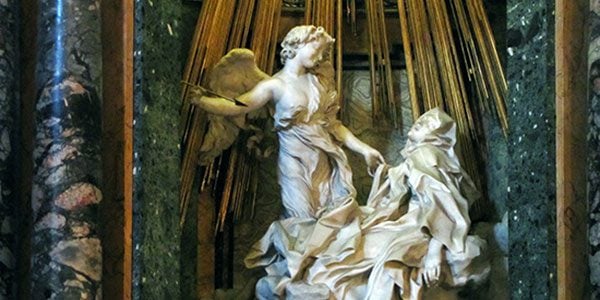
The Ecstasy of Saint Teresa, a sculpture by Gian Lorenzo Bernini.
Sacred sexuality is a core element in the spirituality of many Christian mystics, stemming from an allegorical reading of the Biblical Song of Songs as a description of the mystical marriage between the Bridegroom, Jesus Christ, and the Bride, the Church or the soul of the individual Christian. Figures like St. Teresa of Ávila experienced this union in highly physical, even sexual forms, as a kind of religious ecstasy. Examples of this phenomenon could (and do!) fill whole tomes with rhapsodic language just as orgasmic as the richly sensual verses of The Book of the Law.
But the distinction between analogy of being and univocity of being is very important, in order to avoid reductive conflations of different religious and mystical traditions (a sadly common mistake among many in the occult community). The ecstasy of a Christian mystic experiencing union with God finds a valuable analogy—the symbol par excellence, really—in the example of human sexual union. But it is not the same thing. This is not a matter of degree, but a matter of kind—the ecstasy of a mystic is a different kind of ecstasy altogether from human sexuality, which serves as an analogy that must eventually be transcended.
Sexuality and Decadence
What does all of this have to do with the Decadent Movement? There is a “critical difference” between human sexuality and divine union, and for Christians this is a necessary truth to understand. As queer theologian Elizabeth Stuart explains, human sexuality cannot hold “the divine without remainder.” For all of their exquisite failures, the Decadents understood this truth, and Crowley did not. The Decadent obsession with sexuality always included an air of decay, an “exquisite appreciation of pain, exquisite thrills of anguish, exquisite adoration of suffering … a double ‘passion,’ the sentiment of repentant yearning and the sentiment of rebellious sin,” to use the words of Lionel Johnson. The Decadent careened from the brothel to the confessional, from the music hall to morning Mass. Johnson’s “To a Passionist” dramatizes the Decadent spiritual dilemma in poetic form:
Clad in a vestment wrought with passion-flowers;
Celebrant of one Passion ; called by name
Passionist: is thy world, one world with ours?
Thine, a like heart? Thy very soul, the same?Thou pleadest an eternal sorrow: we
Praise the still changing beauty of this earth.
Passionate good and evil, thou dost see:
Our eyes behold the dreams of death and birth …Canst thou be right? Is thine the very truth?
Stands then our life in so forlorn a state?
Nay, but thou wrongest us: thou wrong’st our youth,
Who dost our happiness compassionate.And yet! and yet! O royal Calvary!
Whence divine sorrow triumphed through years past:
Could ages bow before mere memory?
Those passion-flowers must blossom, to the last.
Many Decadents, even those who identified in ways we would today label queer or kinky, converted to strict forms of Roman or Anglo-Catholicism, a phenomenon documented by Ellis Hanson in his groundbreaking study, Decadence and Catholicism. This is because “Decadent writing is often a literature of Christian conversion, but a conversion that never ends, a continual flux of religious sensations and insights alternating with pangs of profanity and doubt” (10). The religious Decadent “oscillated between extremes of shame and grace, sexual indulgence and extreme piety, re-enacting his conversion over and over again in a Christian narrative of sin and redemption” (12). Decadents found Catholicism to be “the odd disruption, the hysterical symptom, the mystical effusion, the medieval spectacle, the last hope of paganism, in an age of Victorian puritanism, Enlightenment rationalism, and bourgeois materialism … [the Decadents] found in the Church a volatile eroticism that was not necessarily an affront to Catholic belief” (Hanson, 26).
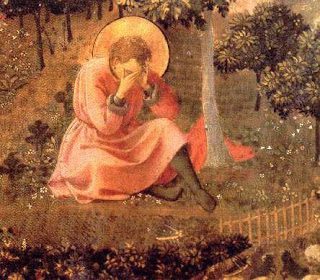
Oscillating between extremes of shame and grace: St. Augustine under the pear tree.
Karmen MacKendrick, in her work Counterpleasures, also describes such a “volatile eroticism” in the context of Catholic belief through her examination of the late ancient ascetic movement, which she compares to modern-day BDSM and the literary work of the Marquis de Sade. In her essay “Carthage Didn’t Burn Hot Enough,” a queer theological reading of St. Augustine of Hippo’s Confessions, MacKendrick explains that Augustine did not convert to Christianity in order to escape erotic love, but because human erotic love wasn’t hot enough. One metaphor used by Augustine was that, while, say, a strip-tease given by a human being has to come to an end, God’s sensual unveiling continues forever, as even those who have attained the Beatific Vision can never reach complete union with the transcendent, ineffable Godhead. The mystic experiencing divine ecstasy is consumed in a conflagration that never ends.
MacKendrick writes, “Full comprehension—of God or by God—is loss of distinction, fire to the point of melting-into” (216). So far, this has a lot in common with many statements on divine union in Liber AL: “There is the dissolution, and eternal ecstasy in the kisses of Nu” (II.44). Crowley would utilize the techniques of sex magick to achieve such ecstasy. Yet Augustine’s understanding of mystical union is analogical, not univocal—it ultimately must transcend human sexual union, which remains, as the Decadents understood, under a “double passion” of repentant yearning and rebellious sin, not divine fulfillment. For, as MacKendrick explains,
Only God even holds—or, as I suspect, is—the promise of burning that hot, a promise that never precisely defines what it offers, made in the constant uprising of desire. The problem with Carthage [Augustine’s home town, and the site of his early sexual exploits] is not, was never, that it burns. Nor is it that its burning is a distraction from higher pursuits. Carthage simply did not burn hot enough; all of the desires aroused there can be satisfied, and Augustine is not after satisfaction. He would burn with the seraphim, until his very self has been fully, unspeakably, burned out. (217)
A Volatile Eroticism
God is not merely a name for the sex instinct, as Crowley suggested, and the human sex instinct is not God. God transcends all names. At the risk of relying too heavily on clips from HBO’s Decadent new series, The Young Pope, this distinction is succinctly (and amusingly) summarized in a conversation between Jude Law’s Pope and his favorite novelist, who asks how a celibate Catholic priest can live without human sexuality, the subject of all of his novels. The Pope answers that “The wise ones long ago understood the degree to which sex as a source of pleasure is overvalued in our society.” When the novelist quips, “Your Holiness, with a few words you have just razed to the ground three-quarters of my literary production. I’ve almost always written about sex as the motor that drives the world,” the Pope responds, “And you were right—but you don’t write about motors that purr, you write about motors that break down continuously …”
https://www.youtube.com/watch?v=FxsW_BcRrIw
The eros of God is a motor that purrs. The Decadents, like the ancient ascetics, might have guiltily obsessed over sex but they knew that it was a decaying flower, beautiful in its season but destined to decompose. In Oscar Wilde’s “The Young King,” the regal aesthete of the title learns to replace the fleeting pleasures of earthly luxuries—mired as they are with decay and sin—with the transcendent pleasures of heavenly virtue, which are altogether beautiful in a way that could never be matched by the former.
The Decadents did likewise with human sexuality; Crowley did not. While the Decadents came to an analogical understanding of eros—which required accepting a transcendent, theistic notion of Deity—Crowley remained with a one-track understanding of union. To declare that “There is no god but man” is not only to diminish God, but to relegate man to lesser pleasures and consummations. And the Decadent does not settle for anything but the highest of ecstasies.
—
If you enjoyed this article, check out my new personal blog, The Light Invisible, for more pieces on Christian esotericism.

Click here to like
Patheos Pagan on Facebook.

Click here to like
the Agora on Facebook
The Blooming Staff is published on twice monthly on Tuesdays here on the Agora; follow it via RSS or e-mail!
Please use the links to the right to keep on top of activities here on the Agora as well as across the entire Patheos Pagan channel.
Literature, Media, Film, Music
Previous Post

January 23, 2017
Star Made Witch: Creative Potion Making
Next Post
January 25, 2017 The Cartomancer: Tarot for Dreams
Browse Our Archives
Select a Category A Lakeside Hearth Adventures in Wortcunning Alone In Her Presence Arts, Crafts & Cooking Birthing Hereditary Witchcraft Book of Blackbirds Book Reviews Born-Again Witch Cauldron, Sword, Spear, & Stone Cermony and Liturgy Columns Community Dandelion Seeds Dear Jasmine Druid Thoughts Editor's Picks Everyday Pagan Family & Household Practice Family Traditions Full Frontal Magic Gateway Goddess Guest Articles Happily Heathen Health and Wellness Hearth of Hellenism Heathen Woman Hills of the Horizon History Holidays Horse Goddesses Interfaith Interviews Irish-American Witchcraft Jewish Witch Lamp & Labyrinth Letters from Midgard Literature, Media, Film, Music Loop of Brighid Love, Sex & Relationships Magic or Magick Making Light Naturalistic Traditions Nature News Outside The Circle Pantheisticon Politics Prayers, Poems, Blessings & Stories Queer Femme Mystic Queer of Swords Recipes Ritual and Practice Science and Research Seekers and Guides Seeking the Grail Socially Responsible Magic Spear of Athena Star Made Witch Syncretic Electric Technology The Blooming Staff The Busy Witch The Cartomancer The Crow's Nest The Dance of Pagan Recovery The Hearth of Hellenism The Lady's Quill The Other Side of the Hedge The Path of She The Rantin' Raven The Witches Next Door The Zen Pagan Theology, Ethics, Philosophy Tree City Witch Urban Earthwitch Wayfaring Woman Witch on Fire Wyrd Words
Select a Month January 2026 March 2025 December 2024 June 2024 April 2024 March 2024 January 2024 December 2023 November 2023 October 2023 August 2023 July 2023 May 2023 April 2023 March 2023 February 2023 January 2023 December 2022 November 2022 October 2022 September 2022 August 2022 July 2022 June 2022 May 2022 March 2022 February 2022 January 2022 December 2021 November 2021 October 2021 September 2021 August 2021 July 2021 June 2021 May 2021 April 2021 March 2021 February 2021 January 2021 December 2020 November 2020 October 2020 September 2020 August 2020 July 2020 June 2020 May 2020 April 2020 March 2020 February 2020 January 2020 December 2019 November 2019 October 2019 September 2019 August 2019 July 2019 June 2019 May 2019 April 2019 March 2019 February 2019 January 2019 December 2018 November 2018 October 2018 September 2018 August 2018 July 2018 June 2018 May 2018 April 2018 March 2018 February 2018 January 2018 December 2017 November 2017 October 2017 September 2017 August 2017 July 2017 June 2017 May 2017 April 2017 March 2017 February 2017 January 2017 December 2016 November 2016 October 2016 September 2016 August 2016 July 2016 June 2016 May 2016 April 2016 March 2016 February 2016 January 2016 December 2015 November 2015 October 2015 September 2015 August 2015 July 2015 June 2015 May 2015 April 2015 March 2015 February 2015 January 2015 December 2014 November 2014 October 2014 September 2014 August 2014 July 2014 June 2014 May 2014 April 2014 March 2014 February 2014 January 2014 December 2013 November 2013 October 2013 September 2013 August 2013 July 2013 June 2013 May 2013 April 2013 March 2013 February 2013 January 2013 December 2012 November 2012 October 2012 September 2012 August 2012 July 2012 June 2012 May 2012 April 2012 March 2012 February 2012 January 2012
Follow Us!
TAKE THE
Religious Wisdom Quiz
"I am the Alpha and the Omega, the ____ and the End,” says the Lord God.
Select your answer to see how you score.
Light Beginning Eternal Truth
Related posts from Agora


Of Light & Shadow: Spider as an Animal...
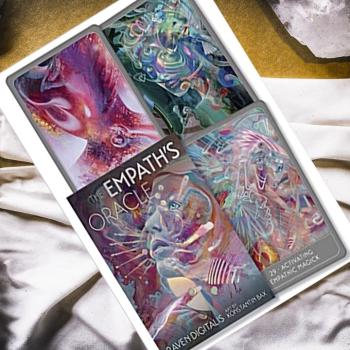
The Corner Crone: The Empath’s Oracle by Raven...
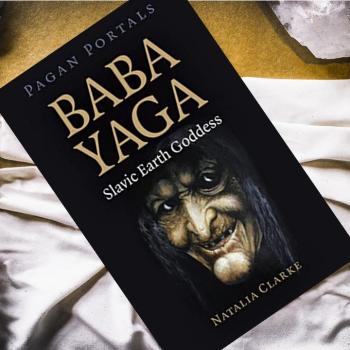
Phoenix Rising: “Baba Yaga: Slavic Earth Goddess” (Book...
TRENDING AT PATHEOS Pagan

I was recently chatting with someone on Instagram. She asked me what...

While there are many people who share their results, the end of...

On July 23, I saw Christopher Nolan's The Odyssey which is Homer’s...

As I write this two big events have just finished up. One...

Restoring the Watershed of Divine Love
Perhaps cooperation is not something we manufacture through legislation, ideology, or moral...

Many UUs don’t pray because of bad experiences in a previous religion,...
view all Pagan blogs
Ad-Free & Subscriber Log-In Subscription Support
- About Us
- 2026 Calendar
- Videos
- Podcasts
- Library of World Religions
- Faith In Media Tracker
- Advertise With Us
- Write for Us
- Privacy Policy
- Terms of Service
- Do Not Sell My Data
- Contact Us
- Radiant Digital
- Manage Newsletter Subscriptions
- Unsubscribe From Notifications
- Sitemap
Copyright 2008-2026, Patheos. All rights reserved.
Subscription Support Ad-Free & Subscriber Log-In
Follow Patheos