
BuddhistCatholicContemplativeEvangelicalGeneral ChristianHinduJewishLatter-day SaintMuslimNew VisionsProgressive Christian
Beliefs
- Buddhist
- Catholic
- Contemplative
- Evangelical
- General Christian
- Hindu
- Jewish
- Latter-day Saint
- More Voices
- Muslim
- New Visions
- Pagan
- Progressive Christian
Topics
- Religion News
- Food and Religion
- Sports and Religion
- Religious Art
- Religious Music and Entertainment
- Religious Events
- History and Religion
- Style and Religion
- Politics and Religion
- Women in Religion
- Recreation Outdoors and Religion
- Business Finance and Religion
- Careers Workplace and Religion
- Education and Religion
- Family Parenting and Religion
- Health Fitness and Religion
- Home and Religion
- Relationships and Religion
- Technology and Religion
- Travel and Religion
Columnists
- Buddhist Columnists
- Business Finance and Religion Columnists
- Careers Workplace and Religion Columnists
- Catholic Columnists
- Contemplative Columnists
- Education and Religion Columnists
- Evangelists Columnists
- Family Parenting and Religion Columnists
- General Christian Columnists
- Health Fitness and Religion Columnists
- Hindu Columnists
- History and Religion Columnists
- Home and Religion Columnists
- Jewish Columnists
- More Voices Columnists
- Latter Day Columnists
- Muslim Columnists
- New Visions Columnists
- Nonreligious Columnists
- Pagan Columnists
- Politics and Religion Columnists
- Progressive Columnists
- Recreation Outdoors and Religion Columnists
- Relationships and Religion Columnists
- Religion News Columnists
- Religious Art Columnists
- Religious Events Columnists
- Religious Music and Entertainment Columnists
- Sports and Religion Columnists
- Style and Religion Columnists
- Technology and Religion Columnists
- Travel and Religion Columnists
- Women in Religion Columnists
Resource Library
- 2026 Calendar
- Library of World Religions
- The 100 Most Holy Places on Earth
- Patheos Answers
- Podcasts
- Videos
- Faith Leaders Database
- Anglican Episcopalian
- Bahai
- Baptist
- Buddhism
- Christianity
- Confucianism
- Eastern Orthodoxy
- Hinduism
- Holiness and Pentecostal
- ISKCON
- Islam
- Judaism
- Lutheran
- Methodist
- The Church of Jesus Christ of Latter-day Saints
- New Age
- Paganism
- Presbytarian and Reformed
- Protestantism
- Religion Behind the Scenes
- Roman Catholic
- Scientology
- Shia Islam
- Sikhism
- Sufism
- Sunni Islam
- Taoism
- Zen
- See all religions
Research Tools
 Ad-Free & Subscriber Log-In Subscription Support
Ad-Free & Subscriber Log-In Subscription Support
Follow Patheos 

- Trending:
- Forgiveness
- |
- Marriage
- |
- Consciousness
- |
- Death Penalty
- |
- Election
- |
- Halloween

- Home
- Pagan
- Happily Heathen: Know Your Lore – Why Freyr Won Gerd
Happily Heathen: Know Your Lore – Why Freyr Won Gerd
Last updated on: December 9, 2016 at 1:48 pm by Cara Freyasdaughter
Happily Heathen: Know Your Lore – Why Freyr Won Gerd 2016-12-09T13:48:22+00:00 Cara Freyasdaughter
Patheos Explore the world's faith through different perspectives on religion and spirituality! Patheos has the views of the prevalent religions and spiritualities of the world.
As a polytheist, I’ve found that they are many challenges involved with being a woman dedicated to Freyr. One of my biggest issues with Him, and one of the reasons it took me so long to come back to Him, was the myth of how He won his jotun wife, Gerda. It’s a fascinating story told in the form of an old-fashioned narrative ballad (unlike most of the surviving tales), and at first glance it doesn’t really portray Him in a very positive light.
The story, the Skirnismal (from the Poetic Edda), goes like this:
The Introduction
One day, Freyr decides to sit on Hlidskjalf from where he could see all of the things that were happening in all of the Nine Worlds. He sees a beautiful jotun maiden with flashing white arms (“her arms shine, and from them all air and see take light”—Larrington trans.) walking from her father’s home to her garden. He falls violently in love with her, and starts moping.
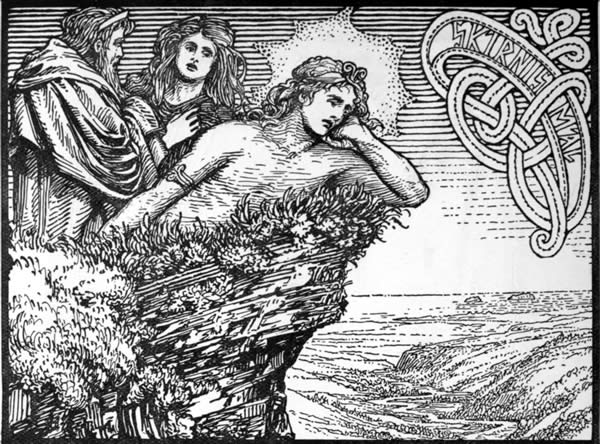
“The Lovesickness of Frey” (1908) / W.G. Collingwood – Public Domain / Wikimedia Commons
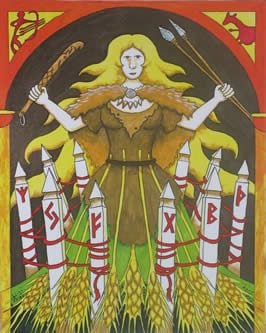
Gerd / Thorskegga / deviantart.com
Njord and Skadi notice that he appears angry, and ask his friend/servant Skirnir to go find out why. He explains that he sat on Odin’s chair and saw Gerd, the female that he loves, but he is upset because he knows that “of all of the gods and all the elves, no one wishes that we should be together”. Skirnir offers to go woo Gerd for him, but only if he gives Skirnir the horse that leaps through fire and the sword that fights by itself. Freyr agrees, and gives Skirnir his horse and sword. Skirnir leaves as soon as it is dark.
Skirnir arrives at Gerd’s home but is met with three barking dogs and a shepherd standing on a mound nearby. He asks the shepherd how he should get in to talk with Gerd. The shepherd says that he’ll never be able to, so why bother trying? Skirnir says that he can’t just sit there sobbing about it—he has to try.
Gerd, for her part, hears the commotion outside and asks her handmaiden to see what’s going on. She describes Skirnir, and Gerd tells her to let Skirnir in so she can offer her visitor some mead. She is worried, however, than he is her brother’s killer (no context is given for this comment, unfortunately).
The Meeting
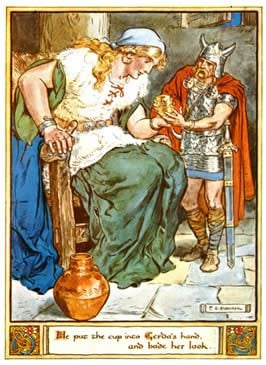
Skirnir woos Gerd / Charles E. Brock
Skirnir comes in. Gerd asks him what race he is (elf, or Aesir, or Vanir) and why he has come to see her. He doesn’t explain who he is, but he says that he is neither elf nor a member of the Aesir or Vanir, and he starts off attempting to woo forthwith. First he offers her eleven golden apples (or some of Idunn’s apples, depending on the translation) if she will say that Freyr “is not the most loathsome man alive”. She says that her desires will not be bought and that she will never settle down with Freyr.
Skirnir then offers what must ostensibly be Draupnir, Odin’s golden arm-ring that drops eight identical rings every nine nights. She replies that she will not accept it; she has all of the gold she needs here in her father’s hall.
Skirnir then shows her Freyr’s sword, and threatens to cut off her head. Again, she is unswayed, saying “coercion I shall never endure at any man’s desire”, and that her father would kill him if he tried.
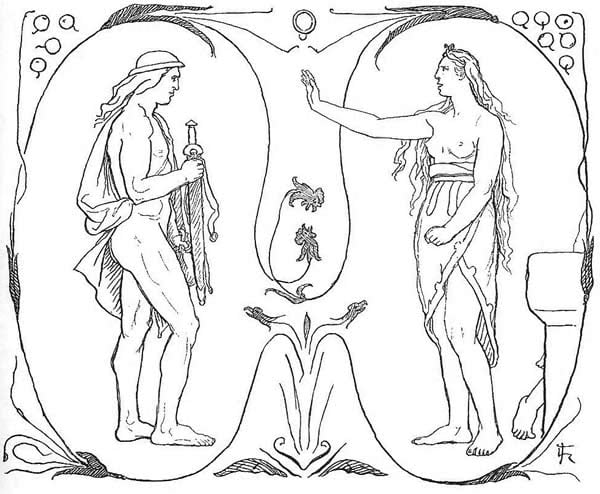
Gerðr refuses Skírnir’s offer of eleven golden apples and the ring gift as illustrated (1895) / Lorenz Frølich – Public Domain / Wikimedia Commons
The Threats
Finally, Skirnir threatens to use his “taming wand” on her, and lists a long, creative, and detailed set of curses that he will give her. This last part threatens her with everything a woman DOESN’T want: to become a spectacle (or completely ignored); to have her money, independence, and social status taken away; to be so filled with unbearable lust that she will debase her self in front of an ugly giant; and to made to be a beggar at the gate of Hel with only goat’s piss to drink. (I know it’s my heart’s desire to avoid having all of this happen to me, anyway.) He ends his tirade with this curse:
“I write thee a charm and three runes therewith,
Longing and madness and lust;
But what I have writ I may yet unwrite
If I find a need therefor.”(Stanza 37; Bellows translation)
At this, Gerd changes her mind and offers him a glass of the ancient mead, saying that she never thought she would love a Vanir. Before he leaves, Gerd agrees to meet Freyr in nine nights at sheltered a grove of trees that they both know, called Barri.
As soon as he returns, Freyr demands to know the result of his quest. Skirnir tells him that Gerd will meet him in nine days. Freyr, appalled, says that he can barely stand waiting one night without her, much less nine nights.
The End*.*
About Last Night…

Freyr, by Deb at Deb’s Den / Photo by the author
You can probably see how this myth does not portray Freyr in a good light. Here he is, a virile fertility god associated with peace and kingship, who had to resort to some really nasty coercive techniques to get a jotun maiden to marry him. Carolyne Larrington, in her article about the desire and gender dynamics in the Skirnismal, called “What Does Woman Want?” gets to the heart of it: “Few critics have faced squarely the problem offered by a poem which asks its audience to accept and to identify with a hero who coerces a woman into having sex with him.” (4) Granted, it wasn’t Freyr doing the actual coercing, but that doesn’t really absolve Him. No matter how you slice it, it’s coercion.
The Archetypal Analysis
In the archetypal viewpoint, most of these specific details don’t matter. Freyr, as a fertility god and the God of the sun, summer, and “good seasons” represents the coming of Spring. Gerd, associated as she is with frost-giants, protected in her father’s house and unwilling to change her situation represents the cold, hard ground of winter. Skirnir’s “wooing” is really just an increasingly aggressive reminder that Spring will come. Freyr is the inexorable coming of Spring, in every possible way that it can come.
The Polytheist Analysis
The polytheist analysis, however, focuses very specifically on these details. These details can really help us understand more about the Gods we honor. So when I, as a feminist polytheist dedicant of Freyr read the gnarly details of this myth, I run headlong into a rather painful wall of cognitive dissonance. My choices are to either to a) find a way to make it work within my worldview, or b) start looking or a new God to honor.
Filling in the Gaps
When I come to myths like these, I often use a Myth Embodiment exercise to make sense of it all. My previous group, the Vanic Conspiracy, being filled as it was with several feminists who also had initially balked at working with Freyr, did a myth embodiment for the Skirnismal several years ago.
First, as Larrington points out, Gerd’s voice is almost non-existent in the poem. One of the great things a myth embodiment can do is to fill in for those characters who are silent. Let’s try to see this myth from her perspective, shall we?
Gerd is a jotun woman, a Lady of her Hall, who, as far as we know, is living quite contentedly in her father’s lands. She has plenty of money, handmaids to help care for her, and a father who will protect her. As far as we know, all of her wants and needs are being met. Out of the blue, some unidentifiable male comes leaping over her hall’s flaming walls wishing to speak with her (and possibly killing her brother in the process). She offers him the mead, as is customary for a guest, but instead he immediately starts negotiating for her hand in marriage to a leader of an enemy tribe. He insults her by offering her gold (as if she could be bought!) and threatening to behead her. She appears annoyed—but not truly threatened—by this. Seeing that he is losing this battle, he threatens to “tame her” using his taming wand, offending her even further.
(Who wants to be tamed by a taming wand? Seriously. I mean, with prior consent, maybe. But still.)
In the VC’s embodiment, We debated this next section for a while before coming up with one possible solution: Gerd is a jotun. Jotun culture is something like Klingon culture—strength and self-reliance are valued above all things. Jotuns are not terribly bound up by sensitive human-like morals and conscience; they want to know if you can destroy or trick your enemies and protect your land. Gerd, at her father’s house, is completely protected and taken care of (or so she thought). Therefore, anyone who sought her hand in marriage would have to prove that he was at least as much of a bad-ass as her father. She is unaffected by the gold and the sword that fights by itself, but She respects the power of the magic that Skirnir threatens to wield against her. She doesn’t have any protection against that. So, in her mind, Skirnir (and by proxy, Freyr) have proven his strength and might, and therefore his right to take her to Freyr to be his wife.
It’s a mostly convincing argument, but it still leaves me a tad uneasy. Which is where my actual experiences with Freyr come in to play.
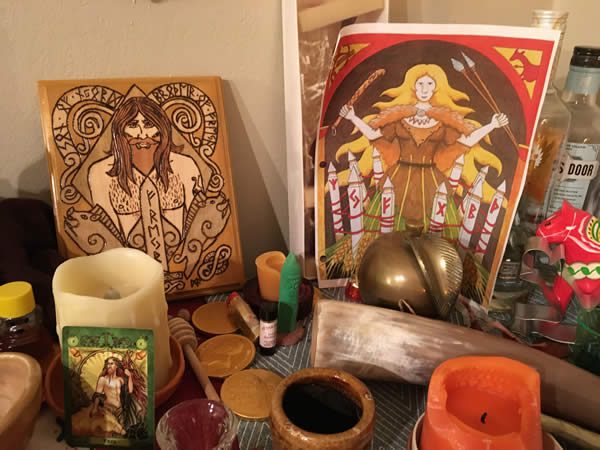
The author’s Gerd and Freyr altar / Photo by the author
My Personal Experience Narrative
Luckily, my actual experiences with Freyr have been of a very loving and comforting deity, not a creepy and coercive one. Unlike His sister, Freya, He is a more introverted being who brings stability, fecundity, and emotional sensitivity along with the His passion. As in this myth, He mopes. He feels longing. In my experience, He is unaware of the power of His presence and is horrified that He sometimes overwhelms His followers accidentally. He is, in many ways, the softer, gentler version of Freya, a description that fits in well with his Viking Age priests, who were also said to be “unmanly” (ergi). Unlike Freya, he descends. Many of us modern worshipers see Him as going “into the Mound” (as do several prosperous kings of old named Frodi). This usually happens sometime after the Fall Equinox. He arises again in the Spring.
This all is not to say that He can’t also be extremely pushy. As in the archetypal analysis, he is the inexorable coming of Spring, as a number of my Freyr-devoted friends have pointed out. He IS the energy that forces crocuses to sprout through the snow and bloom, that makes leeks grow strong and wide and tall in February, and reminds the animals that it’s time to start getting it on. That is his energy, and, like that energy, He can be very overwhelming. However, it is nothing like the creepy coercion that Skirnir threatens Gerd with. In my interactions with Her, few though they’ve been, my sense is that She is fine where She is and that She loves Him very much. In fact, She seems to provide a nice counterbalance for his energy and sensitivity, and She keeps the Hall running while he is away.
Long story short, myths don’t always portray the Gods accurately. However, Knowing Your Lore is a great place to start.
Works cited:
- Larolyne Larrington. “What Does Woman Want?” Mær und munr in Skírnismál*. From A Handbook to Eddic Poetry: Myths and Legends of Early Scandinavia, ed. Larrington, Judy Quinn, and Brittany Schorn. Cambridge University Press: 2016.
- Henry Adams Bellows. The Poetic Edda. 1936.

Click here to like
Patheos Pagan on Facebook.

Click here to like
the Agora on Facebook
Happily Heathen is posted on alternate Fridays here at the Agora. Subscribe by RSS or e-mail!
Please use the links to the right to keep on top of activities here on the Agora as well as across the entire Patheos Pagan channel.
Previous Post

December 8, 2016
Outside the Circle: The Dark Lords Of Yule And Misrule
Next Post

December 10, 2016 The Path of She: Four Transformational Lessons for the Winter Season
Browse Our Archives
Select a Category A Lakeside Hearth Adventures in Wortcunning Alone In Her Presence Arts, Crafts & Cooking Birthing Hereditary Witchcraft Book of Blackbirds Book Reviews Born-Again Witch Cauldron, Sword, Spear, & Stone Cermony and Liturgy Columns Community Dandelion Seeds Dear Jasmine Druid Thoughts Editor's Picks Everyday Pagan Family & Household Practice Family Traditions Full Frontal Magic Gateway Goddess Guest Articles Happily Heathen Health and Wellness Hearth of Hellenism Heathen Woman Hills of the Horizon History Holidays Horse Goddesses Interfaith Interviews Irish-American Witchcraft Jewish Witch Lamp & Labyrinth Letters from Midgard Literature, Media, Film, Music Loop of Brighid Love, Sex & Relationships Magic or Magick Making Light Naturalistic Traditions Nature News Outside The Circle Pantheisticon Politics Prayers, Poems, Blessings & Stories Queer Femme Mystic Queer of Swords Recipes Ritual and Practice Science and Research Seekers and Guides Seeking the Grail Socially Responsible Magic Spear of Athena Star Made Witch Syncretic Electric Technology The Blooming Staff The Busy Witch The Cartomancer The Crow's Nest The Dance of Pagan Recovery The Hearth of Hellenism The Lady's Quill The Other Side of the Hedge The Path of She The Rantin' Raven The Witches Next Door The Zen Pagan Theology, Ethics, Philosophy Tree City Witch Urban Earthwitch Wayfaring Woman Witch on Fire Wyrd Words
Select a Month January 2026 March 2025 December 2024 June 2024 April 2024 March 2024 January 2024 December 2023 November 2023 October 2023 August 2023 July 2023 May 2023 April 2023 March 2023 February 2023 January 2023 December 2022 November 2022 October 2022 September 2022 August 2022 July 2022 June 2022 May 2022 March 2022 February 2022 January 2022 December 2021 November 2021 October 2021 September 2021 August 2021 July 2021 June 2021 May 2021 April 2021 March 2021 February 2021 January 2021 December 2020 November 2020 October 2020 September 2020 August 2020 July 2020 June 2020 May 2020 April 2020 March 2020 February 2020 January 2020 December 2019 November 2019 October 2019 September 2019 August 2019 July 2019 June 2019 May 2019 April 2019 March 2019 February 2019 January 2019 December 2018 November 2018 October 2018 September 2018 August 2018 July 2018 June 2018 May 2018 April 2018 March 2018 February 2018 January 2018 December 2017 November 2017 October 2017 September 2017 August 2017 July 2017 June 2017 May 2017 April 2017 March 2017 February 2017 January 2017 December 2016 November 2016 October 2016 September 2016 August 2016 July 2016 June 2016 May 2016 April 2016 March 2016 February 2016 January 2016 December 2015 November 2015 October 2015 September 2015 August 2015 July 2015 June 2015 May 2015 April 2015 March 2015 February 2015 January 2015 December 2014 November 2014 October 2014 September 2014 August 2014 July 2014 June 2014 May 2014 April 2014 March 2014 February 2014 January 2014 December 2013 November 2013 October 2013 September 2013 August 2013 July 2013 June 2013 May 2013 April 2013 March 2013 February 2013 January 2013 December 2012 November 2012 October 2012 September 2012 August 2012 July 2012 June 2012 May 2012 April 2012 March 2012 February 2012 January 2012
Follow Us!
TAKE THE
Religious Wisdom Quiz
What does "Lo-debar" mean in Hebrew?
Select your answer to see how you score.
The chosen city Valley of rest The Lord’s land No pasture
Related posts from Agora

Simple Witchery: To Keep Silent

Simple Witchery: Leaning On The Four Pillars

Pergamum Unfurled: Magic with the Greek Gods (Book...

Pergamum Unfurled: Cunning Words (Review)
TRENDING AT PATHEOS Pagan

I was recently chatting with someone on Instagram. She asked me what...

While there are many people who share their results, the end of...

On July 23, I saw Christopher Nolan's The Odyssey which is Homer’s...

As I write this two big events have just finished up. One...

Restoring the Watershed of Divine Love
Perhaps cooperation is not something we manufacture through legislation, ideology, or moral...

Many UUs don’t pray because of bad experiences in a previous religion,...
view all Pagan blogs
Ad-Free & Subscriber Log-In Subscription Support
- About Us
- 2026 Calendar
- Videos
- Podcasts
- Library of World Religions
- Faith In Media Tracker
- Advertise With Us
- Write for Us
- Privacy Policy
- Terms of Service
- Do Not Sell My Data
- Contact Us
- Radiant Digital
- Manage Newsletter Subscriptions
- Unsubscribe From Notifications
- Sitemap
Copyright 2008-2026, Patheos. All rights reserved.
Subscription Support Ad-Free & Subscriber Log-In
Follow Patheos