
BuddhistCatholicContemplativeEvangelicalGeneral ChristianHinduJewishLatter-day SaintMuslimNew VisionsProgressive Christian
Beliefs
- Buddhist
- Catholic
- Contemplative
- Evangelical
- General Christian
- Hindu
- Jewish
- Latter-day Saint
- More Voices
- Muslim
- New Visions
- Pagan
- Progressive Christian
Topics
- Religion News
- Food and Religion
- Sports and Religion
- Religious Art
- Religious Music and Entertainment
- Religious Events
- History and Religion
- Style and Religion
- Politics and Religion
- Women in Religion
- Recreation Outdoors and Religion
- Business Finance and Religion
- Careers Workplace and Religion
- Education and Religion
- Family Parenting and Religion
- Health Fitness and Religion
- Home and Religion
- Relationships and Religion
- Technology and Religion
- Travel and Religion
Columnists
- Buddhist Columnists
- Business Finance and Religion Columnists
- Careers Workplace and Religion Columnists
- Catholic Columnists
- Contemplative Columnists
- Education and Religion Columnists
- Evangelists Columnists
- Family Parenting and Religion Columnists
- General Christian Columnists
- Health Fitness and Religion Columnists
- Hindu Columnists
- History and Religion Columnists
- Home and Religion Columnists
- Jewish Columnists
- More Voices Columnists
- Latter Day Columnists
- Muslim Columnists
- New Visions Columnists
- Nonreligious Columnists
- Pagan Columnists
- Politics and Religion Columnists
- Progressive Columnists
- Recreation Outdoors and Religion Columnists
- Relationships and Religion Columnists
- Religion News Columnists
- Religious Art Columnists
- Religious Events Columnists
- Religious Music and Entertainment Columnists
- Sports and Religion Columnists
- Style and Religion Columnists
- Technology and Religion Columnists
- Travel and Religion Columnists
- Women in Religion Columnists
Resource Library
- 2026 Calendar
- Library of World Religions
- The 100 Most Holy Places on Earth
- Patheos Answers
- Podcasts
- Videos
- Faith Leaders Database
- Anglican Episcopalian
- Bahai
- Baptist
- Buddhism
- Christianity
- Confucianism
- Eastern Orthodoxy
- Hinduism
- Holiness and Pentecostal
- ISKCON
- Islam
- Judaism
- Lutheran
- Methodist
- The Church of Jesus Christ of Latter-day Saints
- New Age
- Paganism
- Presbytarian and Reformed
- Protestantism
- Religion Behind the Scenes
- Roman Catholic
- Scientology
- Shia Islam
- Sikhism
- Sufism
- Sunni Islam
- Taoism
- Zen
- See all religions
Research Tools
 Ad-Free & Subscriber Log-In Subscription Support
Ad-Free & Subscriber Log-In Subscription Support
Follow Patheos 

- Trending:
- Forgiveness
- |
- Marriage
- |
- Consciousness
- |
- Death Penalty
- |
- Election
- |
- Halloween

- Home
- Pagan
- Outside the Circle: Evil Spirits Of New Year
Outside the Circle: Evil Spirits Of New Year
Last updated on: December 22, 2016 at 8:39 pm by Danette Wilson
Outside the Circle: Evil Spirits Of New Year 2016-12-22T20:39:48+00:00 Danette Wilson
Patheos Explore the world's faith through different perspectives on religion and spirituality! Patheos has the views of the prevalent religions and spiritualities of the world.
Aah, that stroke of Midnight, and everything is afire as we embrace the New Year ahead. Besides getting sloppy drunk and kissing everybody in the room at the stroke of midnight, celebrants throughout the ages have observed numerous lesser-known New Year’s customs and superstitions. Many of the superstitions associated with the event bear the common theme that activities engaged in on that day set the pattern for the year to come. Others have to do with warding off evil spirits or attracting luck.

New Year fireworks over Copenhagen / Stig Nygaard, CC BY 2.0 / Wikimedia Commons
Nian
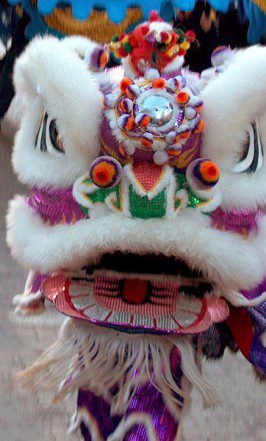
Detail of Chinese Lion Dance Costume in February 2003 / Drhaggis – CC BY-SA 3.0 / Wikimedia Commons
According to tales and legends, the beginning of the Chinese New Year started with a mythical beast called the Nian. Nian would eat villagers, especially children. One year, all the villagers decided to go hide from the beast. An old man appeared before the villagers went into hiding and said that he’s going to stay the night, and decided to get revenge on the Nian. All the villagers thought he was insane. The old man put red papers up and set off firecrackers. The day after, the villagers came back to their town to see that nothing was destroyed. They assumed that the old man was a deity who came to save them. The villagers then understood that the Nian was afraid of the color red and loud noises. When the New Year was about to come, the villagers would wear red clothes, hang red lanterns, and red spring scrolls on windows and doors. People also used firecrackers to frighten away the Nian. From then on, Nian never came to the village again. The Nian was eventually captured by Hongjun Laozu, an ancient Taoist monk. The Nian became Hongjun Laozu’s mount.
Dragons
The dragon is a popular figure, associated in particular with longevity and wealth. Inside the Chinese New Year costumes will be as many as 50 dancers, all twisting and turning the dragon’s long, silk body and blinking eyes. Since the Chinese believe that evil spirits dislike loud noises, they decorate their houses with plastic firecrackers in order to ward off any bad luck that the spirits might bring.
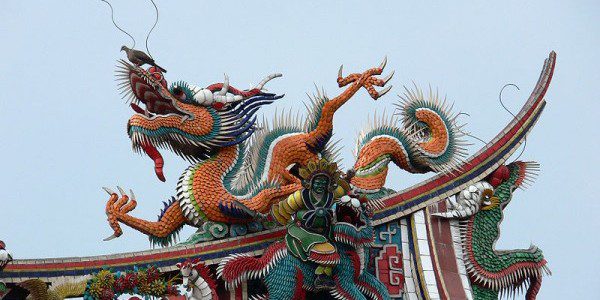
Dragon sculpture on top of Longshan Temple, Taipei, Taiwan / WikiLaurent – Own work – CC BY-SA 3.0 / Wikimedia Commons
Hogmany
In Scotland, where the celebration is called “Hogmany” (derived from a type of oat cake which was traditionally given to children on New Year’s Eve), it is believed that there cannot be a New Year until the Old Year has gone. Since the Old Year is considered evil and must be banished, an effigy of Death is paraded around the town or city and is then buried, drowned or burned. This dummy may be made of straw, twigs or rags and is known as the “Auld Wife.” In some villages, barrels of tar are set alight and rolled through the streets. Thus, the Old Year is burned-up and the New Year allowed to enter. Preparations for the New Year include the cleaning of houses, believed to be an ancient purification ritual. In years gone by, burning juniper bushes would be carried through the home to remove any lurking germs and diseases. The traditional New Year meal consisted of Haggis, shortbread, scones, oat cakes, cheese, whiskey, wine and New Year black buns. The first person to rise in the morning would take the “Het Pint,” a spiced ale, to those family members who were still in bed.
One of the traditions is “first-footing.” Shortly after midnight on New Year’s eve, neighbors pay visits to each other and impart New Year’s wishes. Traditionally, First foots used to bring along a gift of coal for the fire, or shortbread. It is considered especially lucky if a tall, dark, and handsome man is the first to enter your house after the new year is rung in.
Jack Straw
In Hungary effigies of a scapegoat known as “Jack Straw” are burned. These effigies represent the evils and misfortunes of the past year. “Jack Straw” is carried around the village before being committed to the flames.
Bleigiessen
New Year’s Eve in Germany is a rather quiet affair compared to many other nations. It is a time for family gatherings and parties tend to be low-key, consisting of relatives and close friends. At midnight, a toast is customarily made with champagne or Sekt and everyone says, “Prosit Neujahr!. Often, there are firework displays which people usually watch from the windows of their homes. One popular custom is Bleigiessen, where a candle is lit and small chunks of lead are melted in a spoon held over the candle. The molten lead is then quickly dropped into cold water, whereupon it hardens almost immediately. Each person then tries to determine what he or she “sees” in the hardened lead figure in an attempt to tell the future from the shape which forms. Often, the lead figure is held up to the candle or other light in order to better discern the shape from the shadow which it casts. A heart or ring means a wedding…a ship foretells of a journey…a pig signifies plenty of food. Today, Silvesterblei kits may be purchased from most German department stores, complete with lead nuggets, a spoon and a list of possible shapes and their meanings.
Ogoh-Ogoh
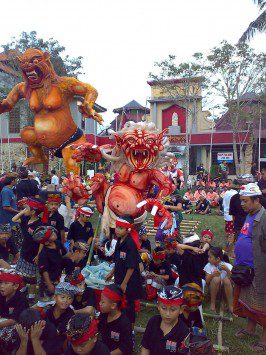
Ubud, 2008 / Jack Merridew – Own work, Public Domain / Wikimedia Commons
On Bali giant ogoh-ogoh monsters lurk beneath the palm trees. Sporting elongated fangs, bulging eyes and wild, scary hair, these 15-to-20-foot papier-mâché effigies are perhaps the most important part of Nyepi, the Balinese New Year.
In the month leading up to Nyepi Day, neighboring villages compete to build the scariest, most disgusting-looking ogoh-ogoh imaginable. The monsters symbolize evil spirits that surround daily life.
You might see a colossal green-skinned demon battling a red devil that burst from the demon’s own torso. One ogoh-ogoh may sport the head of a dragon with foot-long fangs and spiked bracelets. Another may have its fanged mouth open and claws raised, as if ready to devour passersby.
Ogoh-Ogohs are paraded through villages. As gamelan musicians pound out a beat on traditional metal xylophones and gongs, spectators are encouraged to stomp their feet, beat on drums and scream as loudly as humanly possible. It’s all part of a carnival-like exorcism aimed at driving the evil spirits away.
Guoduo
Tibetans like to start off the new calendar year with a fresh start. To this end, they celebrate the Driving-off-the-Evil-Spirits festival every 29th day of the last Tibetan Month. The biggest celebration takes place at the Potala Palace in Lhasa, with smaller celebrations taking place in monasteries throughout Tibet.
The festival is known as Guoduo in the Tibetan language, since that word means “driving out evil spirits.” The Tibetans believe that driving evil spirits away prepares the way for a more auspicious new year that will bring good weather, great harvests and long life to all.
Lhasa residents begin the day with religious activities, including sacred dancing at the Potala Palace, the center of Tibetan Buddhist society, and formerly the home of the Dalai Lama. Tibetans will then go to Guru Square where they’ll be given food to help drive off the evil spirits. Monasteries throughout the region also host activities, including dancing.
False Face

A Member of the False Face Society / Popular Science Monthly Volume 41, Public Domain / Wikimedia Commons
The Iroquois Midwinter Ceremony is a Native American event related to religious traditions and seasonal change. The history of this and other Native American cultures dates back thousands of years into prehistoric times.
The False Face Society is an Iroquois medicine society whose members are believed to possess the power to scare off the evil spirits that cause illness. This power resides primarily in the masks they wear, which are carved out of the wood of a living tree and have deep-set slits for eyes and large noses that often extend across the forehead with a spiny ridge or crease. The society holds its most important annual meeting in the longhouse during the Midwinter Ceremony, and its members participate in the ceremony’s curing rituals, often reaching into the hot ashes of a fire without burning their hands and rubbing or blowing the ashes on those in need of a cure. Although both men and women can belong to the False Face Society, only men are allowed to wear the society’s frightening masks.

Click here to like
Patheos Pagan on Facebook.

Click here to like
the Agora on Facebook
Outside the Circle is published twice monthly on Thursdays on Agora. Subscribe via RSS or e-mail!
Please use the links to the right to keep on top of activities here on the Agora as well as across the entire Patheos Pagan channel.
Next Post

December 23, 2016 Happily Heathen: The Blot's the Thing
Browse Our Archives
Select a Category A Lakeside Hearth Adventures in Wortcunning Alone In Her Presence Arts, Crafts & Cooking Birthing Hereditary Witchcraft Book of Blackbirds Book Reviews Born-Again Witch Cauldron, Sword, Spear, & Stone Cermony and Liturgy Columns Community Dandelion Seeds Dear Jasmine Druid Thoughts Editor's Picks Everyday Pagan Family & Household Practice Family Traditions Full Frontal Magic Gateway Goddess Guest Articles Happily Heathen Health and Wellness Hearth of Hellenism Heathen Woman Hills of the Horizon History Holidays Horse Goddesses Interfaith Interviews Irish-American Witchcraft Jewish Witch Lamp & Labyrinth Letters from Midgard Literature, Media, Film, Music Loop of Brighid Love, Sex & Relationships Magic or Magick Making Light Naturalistic Traditions Nature News Outside The Circle Pantheisticon Politics Prayers, Poems, Blessings & Stories Queer Femme Mystic Queer of Swords Recipes Ritual and Practice Science and Research Seekers and Guides Seeking the Grail Socially Responsible Magic Spear of Athena Star Made Witch Syncretic Electric Technology The Blooming Staff The Busy Witch The Cartomancer The Crow's Nest The Dance of Pagan Recovery The Hearth of Hellenism The Lady's Quill The Other Side of the Hedge The Path of She The Rantin' Raven The Witches Next Door The Zen Pagan Theology, Ethics, Philosophy Tree City Witch Urban Earthwitch Wayfaring Woman Witch on Fire Wyrd Words
Select a Month January 2026 March 2025 December 2024 June 2024 April 2024 March 2024 January 2024 December 2023 November 2023 October 2023 August 2023 July 2023 May 2023 April 2023 March 2023 February 2023 January 2023 December 2022 November 2022 October 2022 September 2022 August 2022 July 2022 June 2022 May 2022 March 2022 February 2022 January 2022 December 2021 November 2021 October 2021 September 2021 August 2021 July 2021 June 2021 May 2021 April 2021 March 2021 February 2021 January 2021 December 2020 November 2020 October 2020 September 2020 August 2020 July 2020 June 2020 May 2020 April 2020 March 2020 February 2020 January 2020 December 2019 November 2019 October 2019 September 2019 August 2019 July 2019 June 2019 May 2019 April 2019 March 2019 February 2019 January 2019 December 2018 November 2018 October 2018 September 2018 August 2018 July 2018 June 2018 May 2018 April 2018 March 2018 February 2018 January 2018 December 2017 November 2017 October 2017 September 2017 August 2017 July 2017 June 2017 May 2017 April 2017 March 2017 February 2017 January 2017 December 2016 November 2016 October 2016 September 2016 August 2016 July 2016 June 2016 May 2016 April 2016 March 2016 February 2016 January 2016 December 2015 November 2015 October 2015 September 2015 August 2015 July 2015 June 2015 May 2015 April 2015 March 2015 February 2015 January 2015 December 2014 November 2014 October 2014 September 2014 August 2014 July 2014 June 2014 May 2014 April 2014 March 2014 February 2014 January 2014 December 2013 November 2013 October 2013 September 2013 August 2013 July 2013 June 2013 May 2013 April 2013 March 2013 February 2013 January 2013 December 2012 November 2012 October 2012 September 2012 August 2012 July 2012 June 2012 May 2012 April 2012 March 2012 February 2012 January 2012
Follow Us!
TAKE THE
Religious Wisdom Quiz
Who was the only daughter of Jacob mentioned by name in Genesis?
Select your answer to see how you score.
Dinah Judith Sarah Rahab
Related posts from Agora

Simple Witchery: To Keep Silent

Simple Witchery: Leaning On The Four Pillars

Pergamum Unfurled: Magic with the Greek Gods (Book...

Pergamum Unfurled: Cunning Words (Review)
TRENDING AT PATHEOS Pagan

I was recently chatting with someone on Instagram. She asked me what...

While there are many people who share their results, the end of...

On July 23, I saw Christopher Nolan's The Odyssey which is Homer’s...

As I write this two big events have just finished up. One...

Restoring the Watershed of Divine Love
Perhaps cooperation is not something we manufacture through legislation, ideology, or moral...

Many UUs don’t pray because of bad experiences in a previous religion,...
view all Pagan blogs
Ad-Free & Subscriber Log-In Subscription Support
- About Us
- 2026 Calendar
- Videos
- Podcasts
- Library of World Religions
- Faith In Media Tracker
- Advertise With Us
- Write for Us
- Privacy Policy
- Terms of Service
- Do Not Sell My Data
- Contact Us
- Radiant Digital
- Manage Newsletter Subscriptions
- Unsubscribe From Notifications
- Sitemap
Copyright 2008-2026, Patheos. All rights reserved.
Subscription Support Ad-Free & Subscriber Log-In
Follow Patheos