
BuddhistCatholicContemplativeEvangelicalGeneral ChristianHinduJewishLatter-day SaintMuslimNew VisionsProgressive Christian
Beliefs
- Buddhist
- Catholic
- Contemplative
- Evangelical
- General Christian
- Hindu
- Jewish
- Latter-day Saint
- More Voices
- Muslim
- New Visions
- Pagan
- Progressive Christian
Topics
- Religion News
- Food and Religion
- Sports and Religion
- Religious Art
- Religious Music and Entertainment
- Religious Events
- History and Religion
- Style and Religion
- Politics and Religion
- Women in Religion
- Recreation Outdoors and Religion
- Business Finance and Religion
- Careers Workplace and Religion
- Education and Religion
- Family Parenting and Religion
- Health Fitness and Religion
- Home and Religion
- Relationships and Religion
- Technology and Religion
- Travel and Religion
Columnists
- Buddhist Columnists
- Business Finance and Religion Columnists
- Careers Workplace and Religion Columnists
- Catholic Columnists
- Contemplative Columnists
- Education and Religion Columnists
- Evangelists Columnists
- Family Parenting and Religion Columnists
- General Christian Columnists
- Health Fitness and Religion Columnists
- Hindu Columnists
- History and Religion Columnists
- Home and Religion Columnists
- Jewish Columnists
- More Voices Columnists
- Latter Day Columnists
- Muslim Columnists
- New Visions Columnists
- Nonreligious Columnists
- Pagan Columnists
- Politics and Religion Columnists
- Progressive Columnists
- Recreation Outdoors and Religion Columnists
- Relationships and Religion Columnists
- Religion News Columnists
- Religious Art Columnists
- Religious Events Columnists
- Religious Music and Entertainment Columnists
- Sports and Religion Columnists
- Style and Religion Columnists
- Technology and Religion Columnists
- Travel and Religion Columnists
- Women in Religion Columnists
Resource Library
- 2026 Calendar
- Library of World Religions
- The 100 Most Holy Places on Earth
- Patheos Answers
- Podcasts
- Videos
- Faith Leaders Database
- Anglican Episcopalian
- Bahai
- Baptist
- Buddhism
- Christianity
- Confucianism
- Eastern Orthodoxy
- Hinduism
- Holiness and Pentecostal
- ISKCON
- Islam
- Judaism
- Lutheran
- Methodist
- The Church of Jesus Christ of Latter-day Saints
- New Age
- Paganism
- Presbytarian and Reformed
- Protestantism
- Religion Behind the Scenes
- Roman Catholic
- Scientology
- Shia Islam
- Sikhism
- Sufism
- Sunni Islam
- Taoism
- Zen
- See all religions
Research Tools
 Ad-Free & Subscriber Log-In Subscription Support
Ad-Free & Subscriber Log-In Subscription Support
Follow Patheos 

- Trending:
- Forgiveness
- |
- Marriage
- |
- Consciousness
- |
- Death Penalty
- |
- Election
- |
- Halloween

- Home
- Pagan
- The Blooming Staff: Eschatology – The Marker of Christian Occultism
The Blooming Staff: Eschatology – The Marker of Christian Occultism
Last updated on: February 5, 2017 at 10:41 pm by Nicholas Laccetti
The Blooming Staff: Eschatology – The Marker of Christian Occultism 2017-02-05T22:41:32+00:00 Nicholas Laccetti
Patheos Explore the world's faith through different perspectives on religion and spirituality! Patheos has the views of the prevalent religions and spiritualities of the world.

Last Judgement, Fra Angelico, panel painting, 1387 or 1395
As I continue my research into post-Crowley forms of Thelema, Christian theology, and other occult traditions (especially the teachings of the Universal Brotherhood, which Frater Achad led as Mahaguru starting in the early 1930s), one major point of difference has emerged for me between Christian forms of occultism and non-Christian traditions like Thelema: eschatology.
In a word, Christianity — including and especially forms of esoteric Christianity — is deeply concerned with eschatology. Eschatology is the study of the Last Things — not just the “Apocalypse” in a popular or literalist sense (as in, Jesus coming down from heaven on a cloud and instigating a literal war with Satan, a la the Left Behind series), but also human and cosmic destiny. Eschatology is the area of theology that deals with ultimate value and macrocosmic possibility — the created universe, and the human being, transfigured into the form God finally intends for them. Non-Christian, secular forms of eschatology also exist — the full communism of Marxism, for example, or the transcendence of the human in transhumanism.
Yet Thelema, drawing strongly on strands of neo-Buddhism and Hinduism (especially Advaita, non-dualism), doesn’t really have an eschatology. As the Thelemic writer IAO131 explains, drawing especially on Crowley’s entry for Atu XX: The Aeon in The Book of Thoth,
There is certainly no Last Judgment in the philosophy of Thelema. In a sense, one can view the attainment of the Crossing of the Abyss, the destruction of the personality or ego, as the end-times of the ‘self’ and the waking to the Self. Another interpretation of eschatology is the “destruction of the world by fire” (which can also be interpreted in the former sense of the destruction of the self), which Crowley gives symbolically in Atu XX: Aeon of the Tarot. In this other interpretation, the world was ‘destroyed by fire’ with the reception of Liber AL vel Legis in 1904. Crowley writes in The Book of Thoth, “The old card was called The Angel: or, The Last Judgment. It represented an Angel or Messenger blowing a trumpet, attached to which was a flag, bearing the symbol of the Aeon of Osiris… The card therefore represented the destruction of the world by Fire. This was accomplished in the year of the vulgar era 1904, when the fiery god Horus took the place of the airy god Osiris in the East as Hierophant.”
In the former interpretation of Thelemic eschatology, Thelemites believe that the manifest (or “conventional,” to use a frequent term from Buddhism) world must be bypassed so that we can realize the inherent emptiness of all phenomena; the noumenon beyond the Abyss is found to be empty — “not” — as there is no thing-in-itself outside of our illusory perception of it. Once our “veils” are purified and made transparent, our Star is found to be one with the All (“AL” or God); and the All is ultimately found to be empty (“LA” or nothing). This realization also underpins Frater Achad’s discovery of “AL” as the key to the Book of the Law.
As cited in my earlier column on Achad, in qabalistic myth, the Daughter (Malkuth) is married to the Son (Tiphareth) and thereby arouses the force of the Father (Chokmah), raising the Daughter to the Throne of the Mother (Binah). The Thelemic interpretation of this myth is that the aspirant purifies his veils through equilibrating and thereby canceling out all opposites or dualities, reducing himself to Nemo or nothing and through this sacrifice — symbolized in the pouring out of one’s blood into the cup of Babalon — is able to cross the Abyss to the Supernal Triad, thus installing the aspirant’s animal soul of Malkuth on the Throne of Binah.
Mystically, this means that the individual aspirant — for the A.’.A.’. system is a system of individual attainment, even when pursued in a group lineage — has killed his ego-self and become one with the All, which ultimately means becoming Nothing. This Boddhisatva-like being is then able to advance to the grade of Magus (Chokmah) to produce a Word for other, lesser beings in order to assist them in their aspiration to the same attainment. (For more on this process in terms of Thelema, J. Daniel Gunther’s The Angel & the Abyss is an excellent source of information.)
Yet a truly eschatological viewpoint — the essential viewpoint of the Christian mysteries — would have to contest this perspective. The qabalistic myth of the redemption of the Daughter, in eschatological terms, means more than the purification of one’s veils in order to see the Perfect that is already there. Instead, something must be transmuted; something must be changed.
In the case of Christian eschatology — and the eschatology of many occult systems in the West before the infusion of Eastern perspectives that occurred in the late nineteenth century — what had to be transmuted was nothing less than the cosmos itself. The noumenon is not empty in this formation, because (Catholic) Christianity historically holds a philosophically realist perspective. Matter is not an illusion, and phenomenal manifestation is not a conventional viewpoint that needs to be transcended. The alignment of the microcosm with the macrocosm in the completion of the Great Work (the redemption of the Daughter in the qabalistic myth) does not equilibrate to zero.
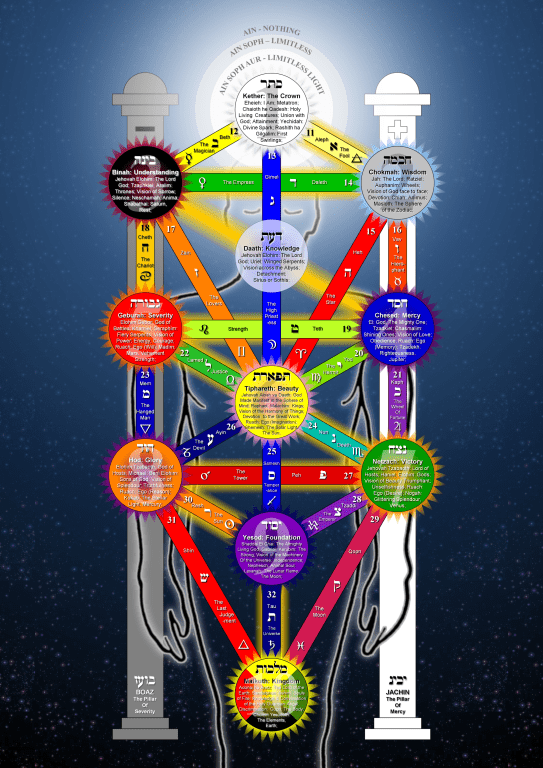
The Tree of Life in Hermetic Qabalah.
As qabalistic commentator Colin Low explains, there tend to be multiple interpretations of the Tree of Life — a “Model A” which states that “the sephira Malkuth represents the whole physical universe; the sephiroth from Yesod to Chesed (the Microprosopus) represent a sentient, self-conscious being; the supernals represent the God of the whole universe, God-in-the-Large” and a “Model B” in which “the Tree of Life is a model of human consciousness; the supernals represent the God within, God-in-the-Small.”
In our discussion here, Christian eschatology and associated forms of occultism tend to utilize the first model, whereas Thelema utilizes the second. This is why Crowley can claim grades of attainment within the supernals, while more Christianized forms of occultism (including the Golden Dawn) tend to suggest that it would be impossible to reach those spheres during terrestrial existence. As Low explains,
Is it possible to experience the supernals in Model A? I would say that it is only possible to experience them at a remove via the paths crossing over the Abyss from Tipheret; that is, as a living, incarnate being my consciousness rises no further up the Pillar of Consciousness than Tiphereth (or Daath), but it is possible to apprehend the supernals via the linking paths.
Eschatologically, then, the raising of Malkuth to the throne of Binah through the arousal of Chokmah — the joining of Wisdom and Understanding — in fact leaves one in Daath, the false sephira of Knowledge. At the peak of attainment, we are left with Manifestation, not emptiness; Manifestation that has transfigured the material cosmos — not just the individual aspirant, but the the whole material cosmos — into the Kingdom of God on earth.
This is the final step of the cosmic process, the Great Initiation begun by Eve when she ate the fruit of the Tree of Knowledge in the Garden. As microcosmic aspirants, reaching this point means that we have become the first fruits of the eschaton, the heralds of the Apocalypse.
Meanwhile, in the latter interpretation of Thelemic eschatology mentioned by IAO131, the macrocosmic potential of orthodox Thelema remains small in scope: the passing of the Aeon of Osiris into the Aeon of Horus. Crowley has replaced the Trump of “Judgement” with the Atu “The Aeon” — a temporally limited formula. Yet the attempts by Achad, Kenneth Grant, and the Maatian adepts to transform the legacy of Thelema tends to coincide with a desire, historically common among Western occultists, to evince a macrcocosmic transformation along with a microcosmic one. (Indeed, it is increasingly clear to me that much of Achad’s doctrinal disagreement with Crowley hinged on his growing interest in macrocosmic eschatology — something I hope to write about at length in the future.)
Instead of purifying the gross matter of the aspirant to allow for the descent of the supernals, the Christian desires the transmutation of all matter to allow for a true and lasting Incarnation. We pass from microcosmic attainment to eschatological transfiguration. This is the secret key of all traditionally Western mysticism and esotericism (at least, prior to the late 19th century). Crowley, meanwhile, clothes Eastern metaphysics — “only the veils must be purified, to reveal the Perfect already within” — in the Rosicrucian language of the West. As Liber AL II.58 proclaims, “Yea! deem not of change: ye shall be as ye are, & not other. Therefore the kings of the earth shall be Kings for ever: the slaves shall serve. There is none that shall be cast down or lifted up: all is ever as it was.”
In the West, meanwhile, from the Book of Revelation to John Dee, from the Martinists to Frater Achad, all will NOT ever be as it was. There will be a New Heaven and a New Earth. The New Jerusalem descends from heaven like a bride adorned for her bridegroom — the Bride’s Reception. The twentieth Trump card is The Last Judgment, not The Aeon. As Achad stirringly writes in the preface to The Anatomy of the Body of God,
In the Name of the True and Living God, let us cease from bloody sacrifice, and start to build a “Living Temple, not made with hands, eternal in the Heavens” — upon Earth.
—
If you enjoyed this article, check out my new personal blog, The Light Invisible, for more pieces on Christian esotericism.

Click here to like
Patheos Pagan on Facebook.

Click here to like
the Agora on Facebook
The Blooming Staff is published on bimonthly on Tuesdays here on the Agora; follow it via RSS or e-mail!
Please use the links to the right to keep on top of activities here on the Agora as well as across the entire Patheos Pagan channel.
Previous Post
October 10, 2016
Book of Blackbirds: The Difference Between Faeries and Elves
Next Post

October 12, 2016 The Cartomancer: Ritual for meeting your ancestors in the simple
Browse Our Archives
Select a Category A Lakeside Hearth Adventures in Wortcunning Alone In Her Presence Arts, Crafts & Cooking Birthing Hereditary Witchcraft Book of Blackbirds Book Reviews Born-Again Witch Cauldron, Sword, Spear, & Stone Cermony and Liturgy Columns Community Dandelion Seeds Dear Jasmine Druid Thoughts Editor's Picks Everyday Pagan Family & Household Practice Family Traditions Full Frontal Magic Gateway Goddess Guest Articles Happily Heathen Health and Wellness Hearth of Hellenism Heathen Woman Hills of the Horizon History Holidays Horse Goddesses Interfaith Interviews Irish-American Witchcraft Jewish Witch Lamp & Labyrinth Letters from Midgard Literature, Media, Film, Music Loop of Brighid Love, Sex & Relationships Magic or Magick Making Light Naturalistic Traditions Nature News Outside The Circle Pantheisticon Politics Prayers, Poems, Blessings & Stories Queer Femme Mystic Queer of Swords Recipes Ritual and Practice Science and Research Seekers and Guides Seeking the Grail Socially Responsible Magic Spear of Athena Star Made Witch Syncretic Electric Technology The Blooming Staff The Busy Witch The Cartomancer The Crow's Nest The Dance of Pagan Recovery The Hearth of Hellenism The Lady's Quill The Other Side of the Hedge The Path of She The Rantin' Raven The Witches Next Door The Zen Pagan Theology, Ethics, Philosophy Tree City Witch Urban Earthwitch Wayfaring Woman Witch on Fire Wyrd Words
Select a Month January 2026 March 2025 December 2024 June 2024 April 2024 March 2024 January 2024 December 2023 November 2023 October 2023 August 2023 July 2023 May 2023 April 2023 March 2023 February 2023 January 2023 December 2022 November 2022 October 2022 September 2022 August 2022 July 2022 June 2022 May 2022 March 2022 February 2022 January 2022 December 2021 November 2021 October 2021 September 2021 August 2021 July 2021 June 2021 May 2021 April 2021 March 2021 February 2021 January 2021 December 2020 November 2020 October 2020 September 2020 August 2020 July 2020 June 2020 May 2020 April 2020 March 2020 February 2020 January 2020 December 2019 November 2019 October 2019 September 2019 August 2019 July 2019 June 2019 May 2019 April 2019 March 2019 February 2019 January 2019 December 2018 November 2018 October 2018 September 2018 August 2018 July 2018 June 2018 May 2018 April 2018 March 2018 February 2018 January 2018 December 2017 November 2017 October 2017 September 2017 August 2017 July 2017 June 2017 May 2017 April 2017 March 2017 February 2017 January 2017 December 2016 November 2016 October 2016 September 2016 August 2016 July 2016 June 2016 May 2016 April 2016 March 2016 February 2016 January 2016 December 2015 November 2015 October 2015 September 2015 August 2015 July 2015 June 2015 May 2015 April 2015 March 2015 February 2015 January 2015 December 2014 November 2014 October 2014 September 2014 August 2014 July 2014 June 2014 May 2014 April 2014 March 2014 February 2014 January 2014 December 2013 November 2013 October 2013 September 2013 August 2013 July 2013 June 2013 May 2013 April 2013 March 2013 February 2013 January 2013 December 2012 November 2012 October 2012 September 2012 August 2012 July 2012 June 2012 May 2012 April 2012 March 2012 February 2012 January 2012
Follow Us!
TAKE THE
Religious Wisdom Quiz
According to 2 Peter, what is the Lord not slow in keeping?
Select your answer to see how you score.
His judgment His mercy His commandments His promise
Related posts from Agora

Simple Witchery: To Keep Silent

Simple Witchery: Leaning On The Four Pillars


Pergamum Unfurled: Magic with the Greek Gods (Book...
TRENDING AT PATHEOS Pagan

I was recently chatting with someone on Instagram. She asked me what...

While there are many people who share their results, the end of...

On July 23, I saw Christopher Nolan's The Odyssey which is Homer’s...

As I write this two big events have just finished up. One...

Restoring the Watershed of Divine Love
Perhaps cooperation is not something we manufacture through legislation, ideology, or moral...

Many UUs don’t pray because of bad experiences in a previous religion,...
view all Pagan blogs
Ad-Free & Subscriber Log-In Subscription Support
- About Us
- 2026 Calendar
- Videos
- Podcasts
- Library of World Religions
- Faith In Media Tracker
- Advertise With Us
- Write for Us
- Privacy Policy
- Terms of Service
- Do Not Sell My Data
- Contact Us
- Radiant Digital
- Manage Newsletter Subscriptions
- Unsubscribe From Notifications
- Sitemap
Copyright 2008-2026, Patheos. All rights reserved.
Subscription Support Ad-Free & Subscriber Log-In
Follow Patheos