
BuddhistCatholicContemplativeEvangelicalGeneral ChristianHinduJewishLatter-day SaintMuslimNew VisionsProgressive Christian
Beliefs
- Buddhist
- Catholic
- Contemplative
- Evangelical
- General Christian
- Hindu
- Jewish
- Latter-day Saint
- More Voices
- Muslim
- New Visions
- Pagan
- Progressive Christian
Topics
- Religion News
- Food and Religion
- Sports and Religion
- Religious Art
- Religious Music and Entertainment
- Religious Events
- History and Religion
- Style and Religion
- Politics and Religion
- Women in Religion
- Recreation Outdoors and Religion
- Business Finance and Religion
- Careers Workplace and Religion
- Education and Religion
- Family Parenting and Religion
- Health Fitness and Religion
- Home and Religion
- Relationships and Religion
- Technology and Religion
- Travel and Religion
Columnists
- Buddhist Columnists
- Business Finance and Religion Columnists
- Careers Workplace and Religion Columnists
- Catholic Columnists
- Contemplative Columnists
- Education and Religion Columnists
- Evangelists Columnists
- Family Parenting and Religion Columnists
- General Christian Columnists
- Health Fitness and Religion Columnists
- Hindu Columnists
- History and Religion Columnists
- Home and Religion Columnists
- Jewish Columnists
- More Voices Columnists
- Latter Day Columnists
- Muslim Columnists
- New Visions Columnists
- Nonreligious Columnists
- Pagan Columnists
- Politics and Religion Columnists
- Progressive Columnists
- Recreation Outdoors and Religion Columnists
- Relationships and Religion Columnists
- Religion News Columnists
- Religious Art Columnists
- Religious Events Columnists
- Religious Music and Entertainment Columnists
- Sports and Religion Columnists
- Style and Religion Columnists
- Technology and Religion Columnists
- Travel and Religion Columnists
- Women in Religion Columnists
Resource Library
- 2026 Calendar
- Library of World Religions
- The 100 Most Holy Places on Earth
- Patheos Answers
- Podcasts
- Videos
- Faith Leaders Database
- Anglican Episcopalian
- Bahai
- Baptist
- Buddhism
- Christianity
- Confucianism
- Eastern Orthodoxy
- Hinduism
- Holiness and Pentecostal
- ISKCON
- Islam
- Judaism
- Lutheran
- Methodist
- The Church of Jesus Christ of Latter-day Saints
- New Age
- Paganism
- Presbytarian and Reformed
- Protestantism
- Religion Behind the Scenes
- Roman Catholic
- Scientology
- Shia Islam
- Sikhism
- Sufism
- Sunni Islam
- Taoism
- Zen
- See all religions
Research Tools
 Ad-Free & Subscriber Log-In Subscription Support
Ad-Free & Subscriber Log-In Subscription Support
Follow Patheos 

- Trending:
- Forgiveness
- |
- Marriage
- |
- Consciousness
- |
- Death Penalty
- |
- Election
- |
- Halloween

- Home
- Pagan
- Outside the Circle: Meet the Dark Shadows of the Autumn Equinox
Outside the Circle: Meet the Dark Shadows of the Autumn Equinox
Last updated on: September 8, 2016 at 1:51 pm by Danette Wilson
Outside the Circle: Meet the Dark Shadows of the Autumn Equinox 2016-09-08T13:51:27+00:00 Danette Wilson
Patheos Explore the world's faith through different perspectives on religion and spirituality! Patheos has the views of the prevalent religions and spiritualities of the world.
The sun sets earlier now. We start to hear the rustle of tree tops, reminding us they’re here.
Yes, the Dark Ones are a presence not felt since last Winter. They are back.
That blessed cool darkness. The woods a deeper dark. The Watchers of the cold months are beckoning. Take notice.
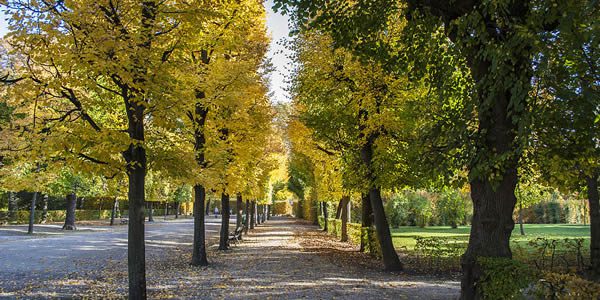
Gardens of Schönbrunn in Autumn / Diana Ringo – Own work – CC BY-SA 3.0 / Wikimedia Commons
This is a sensual time of year. Leaves starting to change, cooler air. Stop and smell the scents. Taste what is growing and in season, ready to be harvested. Hear the birds. The season of the Witch has begun.
When day-time and night-time are equal,
When sun is greatest and least,
The four Lesser Sabbate are summoned,
again Witches gather in feast.Doreen Valiente
Equinox marks the major harvest. Light and darkness stand in balance, equal hours of night and day, but the darkness is gaining, and with it: barren winter. So now, for some lore of the Dark Ones as incoming darkness prevails.
Baobhan Sith
The Baobhan Sith is a particularly evil and dangerous female vampire from the highlands of Scotland. They were supposed to prey on unwary travelers in the glens and mountains. The name suggests a form of Banshee.
The term is Scots Gaelic and means ‘wicked woman fairy’. They appear first as crows or ravens, then as lovely women. Their wails can be heard for miles around.
The ghostly White Women seduce travelers by night with their unearthly beauty and mesmerizing dancing. They engage their victims in a wild, hypnotic dance, and once they reach exhaustion, exsanguinate their partners with their vampiric kiss.
They are wonderful dancers who often dance, completely nude, in the moon’s glow with their deer hooves as feet and they are avid shape-shifters and transform from their humanoid appearance to woodland animals.
Scarecrows
Scarecrows are as old and as mysterious as human nature and have been useful to humans since the mists of early time.
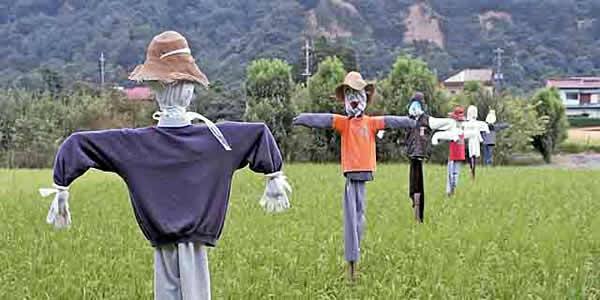
Scarecrows in a rice paddy in Japan / Public Domain / Wikimedia Commons
The Egyptians used the first scarecrows in recorded history to use to protect wheat fields along the Nile River.
Greek farmers in 2,500 B.C. carved wooden scarecrows ugly enough to scare birds away from the vineyards and ensure good harvests. They painted their wooden scarecrows purple and put a club in one hand to scare away the birds and a sickle in the other for a good harvest.
The Romans copied the Greek scarecrow custom and when Roman armies marched through Europe they introduced scarecrows to the people there. Almost simultaneously with the Greeks and Romans, Japanese farmers made scarecrows to protect their rice fields. They made scarecrows called kakashis, shaped like people. They dressed the kakashis in a raincoat and a round straw hat and often added bows and arrows to make them look more threatening.
In Germany, scarecrows were wooden and shaped to look like witches. Witch scarecrows were supposed to hasten the coming of spring. In medieval Britain, young boys and girls were used as live scarecrows or “bird scarers.” They would patrol the fields of crops and scare away birds by waving their arms or throwing stones. In later times, farmers stuffed sacks of straw, made faces of gourds, and leaned the straw man against pole to scare away birds.
In the United States, immigrant farmers made human looking scarecrows called “bootzamon,” which later changed to bogeyman. They were dressed in old clothes with a large red handkerchief around their necks.
There is a belief that they actually move around at night, sneaking through the fields, protecting their owner’s property and watching out for troublemakers.
Blackbirds
We call on them for skill and cunning. They seem to come alive in the Fall and take on a more mystic persona for me, than at any other time of year.
The blackbird has a long magickal history. They usher in the autumn season of magick and change as they perch at the gateway between the worlds. A gatherer, the blackbird is always on the hunt for leftover grain standing in the fields or a bird feeder. They are clever and capable, as well as relentless in the pursuit of its goals.
Dryads
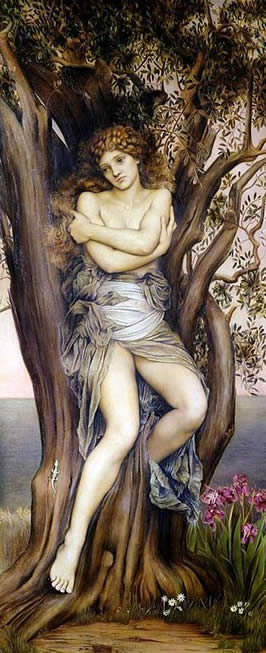
The Dryad / Evelyn De Morgan – Public Domain / Wikimedia Commons
Dryads are spirits of nature (nymphs), who preside over the groves and forests. Each one is born with a certain tree over which they watch. A dryad either lives in a tree, in which case they are called a hamadryad, or close to it. The lives of the dryads are connected with that of the trees; should the tree perish, then they die with it. The dryads themselves will also punish any thoughtless mortal who would somehow injure the trees.
This doesn’t mean they have to remain rooted to the spot and grow bark; they do get to frolic in the forest. Most Dryads are very shy and terribly nervous of straying too far from the safety of their tree.
Dryads are able to move from tree to tree and dance in the forest groves. Unless they are surprised, dryads can disappear by stepping into a tree.
Trows
Known in the Shetland and Orkney Islands, they are also called Night Stealers or Night Creepers.
Squat and misshapen, with wild hair and sallow faces, they are smaller than most humans.
Some tales declared that a trow could pass for a human, although usually old, wizened or deformed, in general they were said to be short, ugly, stunted creatures.
Never seen in daylight, they go out during the hours of darkness to visit, as soon as humans have gone to bed.
Once a household had retired for the night, the trows would enter the building and sit by the glowing fire. Numerous tales recount how the terrified farmer and his wife would lie in bed listening to their unwanted guests scuttling around in the other end of the house.
Trows live inside old burial mounds, or sometimes caves. They hold great feasts and are especially fond of music and dancing. These creatures also kidnap children and leave changelings in their place.
The term is derived from Scandinavian ‘troll’, meaning bewitched.
Spriggans
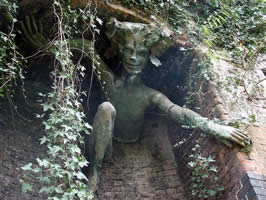
A Spriggan / GFDL/ Wikimedia Commons
Spriggans is the name given to a family of fairies in Cornish folklore, they are closely related to Piksies, but were generally believed to be darker and more dangerous than their mischievous cousins. Whereas Piksies are generally described as being cheerful and fun loving, Spriggans are more spiteful and full of malice, directed at humans in the form of evil tricks.
It was believed that the Spriggans haunted the lonely places such as castle ruins, barrows, certain standing stones and windswept crags. Spriggans were thought to be the source of such misfortunes as blighted crops, bad weather and illness, especially in a time when the mechanics of such things were not fully understood. They were also want to steal small children and replace them with their own kind, a common trait in many of the fairy races of folklore.
In appearance the Spriggans are described as grotesquely ugly with wizened features and crooked skinny bodies. They form part of the fairy bodyguard, ready to dish out summary justice to those who would harm their otherworldly cousins.
Derived from Cornish, meaning ‘spirit’. They are the guardian spirits of sacred sites, and warn that anyone damaging ancient stone circles and holy places will suffer their wrath.
Cailleach
The goddess known as Cailleach in Scotland and parts of Ireland is the embodiment of the dark mother, the harvest goddess, the hag or crone entity. She appears in the late fall, as the earth is dying, and is known as a bringer of storms. She is typically portrayed as a one-eyed old woman with bad teeth and matted hair. Mythologist Joseph Campbell says that in Scotland, she is known as Cailleach Bheur, while along the Irish coast she appears as Cailleach Beare. Her name is varied, depending on the county and region in which she appears.
In Scottish-Gaelic the word cailleach itself means “veiled one” or “old woman”. In some stories, she appears to a hero as a hideous old woman, and when he is kind to her, she turns into a lovely young woman who rewards him for his good deeds. In other stories, she turns into a giant gray boulder at the end of winter, and remains this way until Beltane, when she springs back to life.
Gods of the Dark Forest
The Green Man is the guardian and revealer of mysteries.
He speaks of the mysteries of creation in time, of the hidden sources of inspiration,
and of the dark nothingness out of which we come and to which we return.William Anderson ‘Green Man’
Harvest Lord
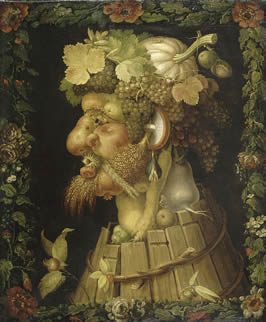
Autumn / Giuseppe Arcimboldo – Public Domain / Wikimedia Commons
He is an ancient symbol of the slain god, the willing sacrifice, the sacred king and seed. He is the Green Man seen in the cycle of nature in the plant kingdom. The Harvest Lord is cut down and his seeds planted into the earth so that life may continue to be abundant. The planted seed nourished beneath the soil becomes the harvested plant at the time of the Autumn Equinox.
Cernunnos
Cernunnos, the Horned God of the Celts and Gauls, the god of fertility, animals and the Underworld, is guardian in this world and the Otherworlds. He is one and the same spirit of vegetation that dies with the end of the harvest. Another aspect of the Green Man and of Herne the Hunter.
Sometimes shown with hair of vegetation. As Lord of the Forests, he was attended by snakes, deer and other animals.
Green Man
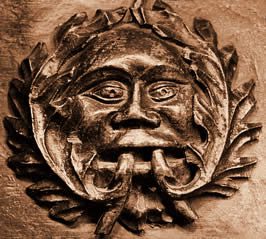
The Ludlow Green Man / CC BY-SA 3.0 / Wikimedia Commons
He brings us wildness with tenderness and strength. Spirit of the forest and the wilderness, like the world of vegetation is rebirth and renewal. He guides and protects us on our journeys into the darkness.
This god of nature is all around us. A mysterious fellow who wears many faces. He is a life force of the woods, the fields, and the spirit of energy and nature. He demands that we look a little deeper at nature and search within to find the connection. No matter where we live, in city, rural area or in between, he is all around us. He’s at the farmer’s market, in the ivy that grows up your apartment building walls, and the tough weeds that crop through cracks n the sidewalk. He’s a link between ourselves and the spiritual side of nature.
Crone
We have entered the time of the Wise women…
The Crone, who laughs aloud and speaks her truth without fear.
She is the Old One who snips away all that is no longer needed or useful.
This is the season of the Grandmother who passes her wisdom to future generations.
Autumn is embracing the season of the Hag, keeper of sacred knowledge and deeper mysteries.
The Gatekeeper who holds open the door to all magical ways.
The amazing Witch with power to bend or shape consciousness as Alchemist who magically transforms ordinary reality…taking us into a quieter time of relaxation, introspection, reflection, release.
It’s the season of the Witch.
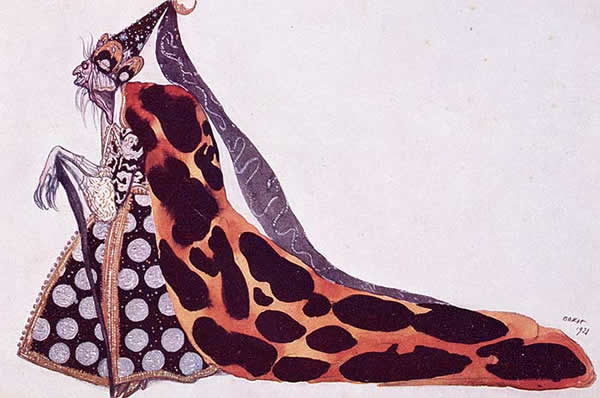
Carabosse (from the ballet, Sleeping Beauty) / Léon Bakst – Public Domain / Wikimedia Commons

Click here to like
Patheos Pagan on Facebook.

Click here to like
the Agora on Facebook
Outside the Circle is published twice monthly on Thursdays on Agora. Subscribe via RSS or e-mail!
Please use the links to the right to keep on top of activities here on the Agora as well as across the entire Patheos Pagan channel.
Previous Post

September 7, 2016
Lamp & Labyrinth: Who's Responsible for Speaking Out Against the AFA


Browse Our Archives
Select a Category A Lakeside Hearth Adventures in Wortcunning Alone In Her Presence Arts, Crafts & Cooking Birthing Hereditary Witchcraft Book of Blackbirds Book Reviews Born-Again Witch Cauldron, Sword, Spear, & Stone Cermony and Liturgy Columns Community Dandelion Seeds Dear Jasmine Druid Thoughts Editor's Picks Everyday Pagan Family & Household Practice Family Traditions Full Frontal Magic Gateway Goddess Guest Articles Happily Heathen Health and Wellness Hearth of Hellenism Heathen Woman Hills of the Horizon History Holidays Horse Goddesses Interfaith Interviews Irish-American Witchcraft Jewish Witch Lamp & Labyrinth Letters from Midgard Literature, Media, Film, Music Loop of Brighid Love, Sex & Relationships Magic or Magick Making Light Naturalistic Traditions Nature News Outside The Circle Pantheisticon Politics Prayers, Poems, Blessings & Stories Queer Femme Mystic Queer of Swords Recipes Ritual and Practice Science and Research Seekers and Guides Seeking the Grail Socially Responsible Magic Spear of Athena Star Made Witch Syncretic Electric Technology The Blooming Staff The Busy Witch The Cartomancer The Crow's Nest The Dance of Pagan Recovery The Hearth of Hellenism The Lady's Quill The Other Side of the Hedge The Path of She The Rantin' Raven The Witches Next Door The Zen Pagan Theology, Ethics, Philosophy Tree City Witch Urban Earthwitch Wayfaring Woman Witch on Fire Wyrd Words
Select a Month January 2026 March 2025 December 2024 June 2024 April 2024 March 2024 January 2024 December 2023 November 2023 October 2023 August 2023 July 2023 May 2023 April 2023 March 2023 February 2023 January 2023 December 2022 November 2022 October 2022 September 2022 August 2022 July 2022 June 2022 May 2022 March 2022 February 2022 January 2022 December 2021 November 2021 October 2021 September 2021 August 2021 July 2021 June 2021 May 2021 April 2021 March 2021 February 2021 January 2021 December 2020 November 2020 October 2020 September 2020 August 2020 July 2020 June 2020 May 2020 April 2020 March 2020 February 2020 January 2020 December 2019 November 2019 October 2019 September 2019 August 2019 July 2019 June 2019 May 2019 April 2019 March 2019 February 2019 January 2019 December 2018 November 2018 October 2018 September 2018 August 2018 July 2018 June 2018 May 2018 April 2018 March 2018 February 2018 January 2018 December 2017 November 2017 October 2017 September 2017 August 2017 July 2017 June 2017 May 2017 April 2017 March 2017 February 2017 January 2017 December 2016 November 2016 October 2016 September 2016 August 2016 July 2016 June 2016 May 2016 April 2016 March 2016 February 2016 January 2016 December 2015 November 2015 October 2015 September 2015 August 2015 July 2015 June 2015 May 2015 April 2015 March 2015 February 2015 January 2015 December 2014 November 2014 October 2014 September 2014 August 2014 July 2014 June 2014 May 2014 April 2014 March 2014 February 2014 January 2014 December 2013 November 2013 October 2013 September 2013 August 2013 July 2013 June 2013 May 2013 April 2013 March 2013 February 2013 January 2013 December 2012 November 2012 October 2012 September 2012 August 2012 July 2012 June 2012 May 2012 April 2012 March 2012 February 2012 January 2012
Follow Us!
TAKE THE
Religious Wisdom Quiz
Which Christian movement is known for "speaking in tongues" and lively worship?
Select your answer to see how you score.
Catholicism Quakerism Presbyterianism Pentecostalism
Related posts from Agora

Simple Witchery: To Keep Silent

Simple Witchery: Leaning On The Four Pillars

Pergamum Unfurled: Magic with the Greek Gods (Book...

Pergamum Unfurled: Cunning Words (Review)
TRENDING AT PATHEOS Pagan

I was recently chatting with someone on Instagram. She asked me what...

While there are many people who share their results, the end of...

On July 23, I saw Christopher Nolan's The Odyssey which is Homer’s...

As I write this two big events have just finished up. One...

Restoring the Watershed of Divine Love
Perhaps cooperation is not something we manufacture through legislation, ideology, or moral...

Many UUs don’t pray because of bad experiences in a previous religion,...
view all Pagan blogs
Ad-Free & Subscriber Log-In Subscription Support
- About Us
- 2026 Calendar
- Videos
- Podcasts
- Library of World Religions
- Faith In Media Tracker
- Advertise With Us
- Write for Us
- Privacy Policy
- Terms of Service
- Do Not Sell My Data
- Contact Us
- Radiant Digital
- Manage Newsletter Subscriptions
- Unsubscribe From Notifications
- Sitemap
Copyright 2008-2026, Patheos. All rights reserved.
Subscription Support Ad-Free & Subscriber Log-In
Follow Patheos