
BuddhistCatholicContemplativeEvangelicalGeneral ChristianHinduJewishLatter-day SaintMuslimNew VisionsProgressive Christian
Beliefs
- Buddhist
- Catholic
- Contemplative
- Evangelical
- General Christian
- Hindu
- Jewish
- Latter-day Saint
- More Voices
- Muslim
- New Visions
- Pagan
- Progressive Christian
Topics
- Religion News
- Food and Religion
- Sports and Religion
- Religious Art
- Religious Music and Entertainment
- Religious Events
- History and Religion
- Style and Religion
- Politics and Religion
- Women in Religion
- Recreation Outdoors and Religion
- Business Finance and Religion
- Careers Workplace and Religion
- Education and Religion
- Family Parenting and Religion
- Health Fitness and Religion
- Home and Religion
- Relationships and Religion
- Technology and Religion
- Travel and Religion
Columnists
- Buddhist Columnists
- Business Finance and Religion Columnists
- Careers Workplace and Religion Columnists
- Catholic Columnists
- Contemplative Columnists
- Education and Religion Columnists
- Evangelists Columnists
- Family Parenting and Religion Columnists
- General Christian Columnists
- Health Fitness and Religion Columnists
- Hindu Columnists
- History and Religion Columnists
- Home and Religion Columnists
- Jewish Columnists
- More Voices Columnists
- Latter Day Columnists
- Muslim Columnists
- New Visions Columnists
- Nonreligious Columnists
- Pagan Columnists
- Politics and Religion Columnists
- Progressive Columnists
- Recreation Outdoors and Religion Columnists
- Relationships and Religion Columnists
- Religion News Columnists
- Religious Art Columnists
- Religious Events Columnists
- Religious Music and Entertainment Columnists
- Sports and Religion Columnists
- Style and Religion Columnists
- Technology and Religion Columnists
- Travel and Religion Columnists
- Women in Religion Columnists
Resource Library
- 2026 Calendar
- Library of World Religions
- The 100 Most Holy Places on Earth
- Patheos Answers
- Podcasts
- Videos
- Faith Leaders Database
- Anglican Episcopalian
- Bahai
- Baptist
- Buddhism
- Christianity
- Confucianism
- Eastern Orthodoxy
- Hinduism
- Holiness and Pentecostal
- ISKCON
- Islam
- Judaism
- Lutheran
- Methodist
- The Church of Jesus Christ of Latter-day Saints
- New Age
- Paganism
- Presbytarian and Reformed
- Protestantism
- Religion Behind the Scenes
- Roman Catholic
- Scientology
- Shia Islam
- Sikhism
- Sufism
- Sunni Islam
- Taoism
- Zen
- See all religions
Research Tools
 Ad-Free & Subscriber Log-In Subscription Support
Ad-Free & Subscriber Log-In Subscription Support
Follow Patheos 

- Trending:
- Forgiveness
- |
- Marriage
- |
- Consciousness
- |
- Death Penalty
- |
- Election
- |
- Halloween

- Home
- Pagan
- Irish-American Witchcraft: Álfatrú – Believing in the Hidden Folk
Irish-American Witchcraft: Álfatrú – Believing in the Hidden Folk
Last updated on: September 6, 2016 at 12:28 pm by Morgan Daimler
Irish-American Witchcraft: Álfatrú – Believing in the Hidden Folk 2016-09-06T12:28:12+00:00 Morgan Daimler
Patheos Explore the world's faith through different perspectives on religion and spirituality! Patheos has the views of the prevalent religions and spiritualities of the world.
Labels are always a fun game to play in Paganism, Polytheism, Heathenry, what-have-you. On the one hand they can be helpful in defining how we see ourselves and what we believe and do – on the other they are only ever a general description and as often as not they divide us instead of bringing us together. I have many labels for myself because my beliefs are complex and layered, and the terms I use may describe what I do, like Druid or Bantuaithech, as much as what I believe, like animist and polytheist. I often tailor what label I use based on who I’m talking to, to some degree: when talking to CRs I use terms like Irish Reconstructionist Polytheist; when talking to neopagans I say witch or Druid; when talking to Heathens I say, well, Heathen usually or seidhrkona. No one label truly describes exactly what I believe or do in its full context so I have no issue having many labels and adding or shedding descriptors when needed. Life evolves and changes and so do I.

Ängsälvor (Swedish ‘Meadow Elves’) by Nils Blommér (1805) / Wikimedia Commons
Within the context of Heathenry I have toyed for a couple years now with the label of “Álfatrú” for myself as a more precise descriptor of my belief system but I was always a bit hesitant for several reasons. Firstly in English the term is reminiscent of a certain sitcom from the 80’s and that association was strong for me. Secondly, when I first started thinking of this I was fairly new to Heathenry and I wasn’t sure if it was an appropriate term in contrast to Ásatrú or if it even read properly, not having any Icelandic at that point.¹ And thirdly, I must confess that when I tried to Google the term (Google-fu for the win) the few hits I got to English language sites came back to things that were rather perplexing to me and very contrary to my own approach.
I also wanted to avoid any confusion or implication that I was approaching all of the Hidden Folk as deities. Certainly there is overlap, and some of the alfar are counted among the Gods, just as many (most) of the Tuatha De Danann are also the aos sidhe, but not all of the aos sidhe are Gods and not all of the alfar or huldufolk are deities either. Its rather its own system in itself and needs to be understood that way, as a complex system instead of looked at as a simple ‘all this’ or ‘all that’. What makes something a God is a question I contemplate often for example here and here and understanding where I’m coming from on this issue and how the huldufolk and aos sidhe fit into things is important. Whether Gods or not-Gods you respect them and the influence they can and do have on your life. You offer to them to create reciprocity, you seek to live in balance with them, you don’t harm or disrespect their places, and – if you practice the sort of witchcraft I do – you seek to learn from them and ally with (some) of them. So I also had a concern about using a term that might read or imply an elevation of the alfar, in general, to deities or imply that I was replacing the Gods with the huldufolk, along the lines of people who use Vanatru to indicate that they primarily worship the Vanic Gods. Although the Hidden Folk are my main focus, my house spirits and landvaettir are not my Gods and I was genuinely concerned about using a term that might accidentally convey this meaning. The actual system itself is more nuanced than most simple terms easily convey. There are alfar who are Gods, and there are alfar who who are not-Gods, and I wasn’t sure if alfatru as a term would work with this understanding or not.
Reading more about the Icelandic perspective on it, just like gaining a better understanding of the Irish, has I think allowed me to understand what the real meaning of álfatrú is in context. Álfatru simply means ‘belief or faith in elves’. Similarly álfatrúar means believer in elves, and expanding that out álfatrúarfólk means people who believe in elves or more literally ‘elves religious people’. Just like many people of all religious beliefs follow the Fairy Faith, many people are Álfatrúarfólk while following different religions. And just like ‘Fairy Faith’ means belief that the fairy folk exist and have power, so it seems does álfatrú and it includes those layers and nuances of meaning, that inclusion of degrees of power and influences from Gods to minor spirits that I was looking for and already believed in. It is not a belief in and of itself that excludes other things but rather something that describes a specific facet or focus of belief and attendant folk practices. Of all the terms beyond ‘Fairy Faith’ this is the most accurate to what I believe and do, although in my case it is my main focus and just as with my Fairy Witchcraft, I do add religious overtones to it. Of course there are Gods I acknowledge as well, but it is the Hidden Folk, the Good People, who are my main focus.
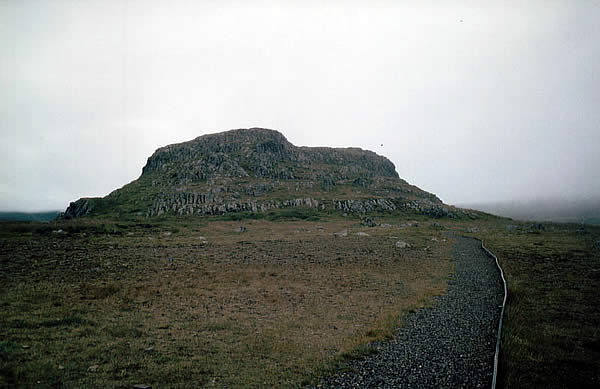
Álfaborg, the castle of the fairies near Borgarfjörður, image by Schorle, licensed under Creative Commons
Belief in and respect of the alfar – ‘álfatrú’ – is a significant thing in Iceland, although one that’s often not well understood by Americans I think. The majority of Icelanders admit to believing in the likely existence of elves, but this belief is the same as most Americans belief in ghosts, that is people won’t rule out the possibility or are open to the idea, rather than firmly believing it. Although some people do believe in them more strongly and more profoundly, putting their faith in the alfar as it were, and some are able to see and interact with them. As in Ireland there is a belief associating the alfar (aka elves) with landmarks including trees and boulders which cannot be interfered with or bad luck and mishaps will ensue. There have been several modern incidents which demonstrate this, including the protesting of road construction that threatened an ‘elf church’ and required a court case and compromise to be reached with the alfar, issues with well drilling, and concerns about the alfar being upset by the idea of a new airport. Often special consultants are brought in who are known to be able to see and speak with the alfar. As with the Irish Fairy Faith, the Icelandic belief in the alfar is not a clear cut or definitive thing but fluid and different from person to person, ranging from superstition to firm belief, from uncertain skepticism to certain faith. It encompasses a variety of expressions and practices as well, from polite respect of places to full offerings and worship.
So, basically, this isn’t something that anyone needs to create or invent as a ‘thing’. It’s not a cleverly made up word, or newly invented term. It’s already a thing and its a term in use in the living culture. It means what Ásatrú means, more or less, but focused on the alfar although it so far lacks any layered overtones of added meaning creating by politics and religious denominations. It is simply a word in a different language for the belief in the Hidden Folk and like Fairy Faith it says as little or as much as we choose to see in it.
I’ve been flirting with the idea of alfatru as a better label for my spirituality than Heathen and certainly than Asatru for a while (at least five years or so) but I was always held back by my own misunderstanding of the term. Realizing what it actually meant – and that it was a real word and not some Americanized thing created out of the same misunderstandings I had been worried about, was a bit of an epiphany for me. Heathen is still a good general term of course, but it lacks the specific; Asatru is one I stopped using years ago precisely because the Aesir are not my main focus and it felt disingenuous to call myself that when most of my beliefs and practices center on the landvaettir and huldufolk (by various names and cultural understandings). Yes it’s an Icelandic term, and my actual beliefs are a mix of Irish, German, Icelandic, general Celtic, and American but for all that Álfatrú is still the single best word to describe my spirituality within a Heathen context.
Do I believe in the alfar? Yes, yes I do. And most of my spirituality centers on my beliefs in the huldufolk (and/or aos sidhe) and the practices associated with those beliefs. So I can call it the Fairy Faith, or creideamh sidhe, in one context, or I can call it Álfatrú in another, but at its core its the same concept and the same general practices just slightly different cultural contexts. So until I find a better word Álfatrú seems to be the most fitting to describe my spirituality from that perspective, something that describes my beliefs and fits in nicely with my wider belief system. In an Irish-American context I use the term Fairy Faith because it conveys precisely a lot of what I believe from that perspective. And both work perfectly within the context of the witchcraft I practice.
- I’m still far from fluent by the way, but I’m working on it. (back)

Click here to like
Patheos Pagan on Facebook.

Click here to like
the Agora on Facebook
Irish-American Witchcraft is published bi-monthly on Tuesdays here on the Agora. Subscribe via RSS or e-mail!
Please use the links to the right to keep on top of activities here on the Agora as well as across the entire Patheos Pagan channel.
Previous Post

September 5, 2016
Seeking the Grail: A Song of Death
Next Post

September 7, 2016 Lamp & Labyrinth: Who's Responsible for Speaking Out Against the AFA
Browse Our Archives
Select a Category A Lakeside Hearth Adventures in Wortcunning Alone In Her Presence Arts, Crafts & Cooking Birthing Hereditary Witchcraft Book of Blackbirds Book Reviews Born-Again Witch Cauldron, Sword, Spear, & Stone Cermony and Liturgy Columns Community Dandelion Seeds Dear Jasmine Druid Thoughts Editor's Picks Everyday Pagan Family & Household Practice Family Traditions Full Frontal Magic Gateway Goddess Guest Articles Happily Heathen Health and Wellness Hearth of Hellenism Heathen Woman Hills of the Horizon History Holidays Horse Goddesses Interfaith Interviews Irish-American Witchcraft Jewish Witch Lamp & Labyrinth Letters from Midgard Literature, Media, Film, Music Loop of Brighid Love, Sex & Relationships Magic or Magick Making Light Naturalistic Traditions Nature News Outside The Circle Pantheisticon Politics Prayers, Poems, Blessings & Stories Queer Femme Mystic Queer of Swords Recipes Ritual and Practice Science and Research Seekers and Guides Seeking the Grail Socially Responsible Magic Spear of Athena Star Made Witch Syncretic Electric Technology The Blooming Staff The Busy Witch The Cartomancer The Crow's Nest The Dance of Pagan Recovery The Hearth of Hellenism The Lady's Quill The Other Side of the Hedge The Path of She The Rantin' Raven The Witches Next Door The Zen Pagan Theology, Ethics, Philosophy Tree City Witch Urban Earthwitch Wayfaring Woman Witch on Fire Wyrd Words
Select a Month January 2026 March 2025 December 2024 June 2024 April 2024 March 2024 January 2024 December 2023 November 2023 October 2023 August 2023 July 2023 May 2023 April 2023 March 2023 February 2023 January 2023 December 2022 November 2022 October 2022 September 2022 August 2022 July 2022 June 2022 May 2022 March 2022 February 2022 January 2022 December 2021 November 2021 October 2021 September 2021 August 2021 July 2021 June 2021 May 2021 April 2021 March 2021 February 2021 January 2021 December 2020 November 2020 October 2020 September 2020 August 2020 July 2020 June 2020 May 2020 April 2020 March 2020 February 2020 January 2020 December 2019 November 2019 October 2019 September 2019 August 2019 July 2019 June 2019 May 2019 April 2019 March 2019 February 2019 January 2019 December 2018 November 2018 October 2018 September 2018 August 2018 July 2018 June 2018 May 2018 April 2018 March 2018 February 2018 January 2018 December 2017 November 2017 October 2017 September 2017 August 2017 July 2017 June 2017 May 2017 April 2017 March 2017 February 2017 January 2017 December 2016 November 2016 October 2016 September 2016 August 2016 July 2016 June 2016 May 2016 April 2016 March 2016 February 2016 January 2016 December 2015 November 2015 October 2015 September 2015 August 2015 July 2015 June 2015 May 2015 April 2015 March 2015 February 2015 January 2015 December 2014 November 2014 October 2014 September 2014 August 2014 July 2014 June 2014 May 2014 April 2014 March 2014 February 2014 January 2014 December 2013 November 2013 October 2013 September 2013 August 2013 July 2013 June 2013 May 2013 April 2013 March 2013 February 2013 January 2013 December 2012 November 2012 October 2012 September 2012 August 2012 July 2012 June 2012 May 2012 April 2012 March 2012 February 2012 January 2012
Follow Us!
TAKE THE
Religious Wisdom Quiz
Who was the youngest friend who rebuked Job and the other friends?
Select your answer to see how you score.
Eliphaz Zophar Bildad Elihu
Related posts from Agora

Simple Witchery: To Keep Silent

Simple Witchery: Leaning On The Four Pillars

Pergamum Unfurled: Magic with the Greek Gods (Book...

Pergamum Unfurled: Cunning Words (Review)
TRENDING AT PATHEOS Pagan

I was recently chatting with someone on Instagram. She asked me what...

While there are many people who share their results, the end of...

On July 23, I saw Christopher Nolan's The Odyssey which is Homer’s...

As I write this two big events have just finished up. One...

Restoring the Watershed of Divine Love
Perhaps cooperation is not something we manufacture through legislation, ideology, or moral...

Many UUs don’t pray because of bad experiences in a previous religion,...
view all Pagan blogs
Ad-Free & Subscriber Log-In Subscription Support
- About Us
- 2026 Calendar
- Videos
- Podcasts
- Library of World Religions
- Faith In Media Tracker
- Advertise With Us
- Write for Us
- Privacy Policy
- Terms of Service
- Do Not Sell My Data
- Contact Us
- Radiant Digital
- Manage Newsletter Subscriptions
- Unsubscribe From Notifications
- Sitemap
Copyright 2008-2026, Patheos. All rights reserved.
Subscription Support Ad-Free & Subscriber Log-In
Follow Patheos