
BuddhistCatholicContemplativeEvangelicalGeneral ChristianHinduJewishLatter-day SaintMuslimNew VisionsProgressive Christian
Beliefs
- Buddhist
- Catholic
- Contemplative
- Evangelical
- General Christian
- Hindu
- Jewish
- Latter-day Saint
- More Voices
- Muslim
- New Visions
- Pagan
- Progressive Christian
Topics
- Religion News
- Food and Religion
- Sports and Religion
- Religious Art
- Religious Music and Entertainment
- Religious Events
- History and Religion
- Style and Religion
- Politics and Religion
- Women in Religion
- Recreation Outdoors and Religion
- Business Finance and Religion
- Careers Workplace and Religion
- Education and Religion
- Family Parenting and Religion
- Health Fitness and Religion
- Home and Religion
- Relationships and Religion
- Technology and Religion
- Travel and Religion
Columnists
- Buddhist Columnists
- Business Finance and Religion Columnists
- Careers Workplace and Religion Columnists
- Catholic Columnists
- Contemplative Columnists
- Education and Religion Columnists
- Evangelists Columnists
- Family Parenting and Religion Columnists
- General Christian Columnists
- Health Fitness and Religion Columnists
- Hindu Columnists
- History and Religion Columnists
- Home and Religion Columnists
- Jewish Columnists
- More Voices Columnists
- Latter Day Columnists
- Muslim Columnists
- New Visions Columnists
- Nonreligious Columnists
- Pagan Columnists
- Politics and Religion Columnists
- Progressive Columnists
- Recreation Outdoors and Religion Columnists
- Relationships and Religion Columnists
- Religion News Columnists
- Religious Art Columnists
- Religious Events Columnists
- Religious Music and Entertainment Columnists
- Sports and Religion Columnists
- Style and Religion Columnists
- Technology and Religion Columnists
- Travel and Religion Columnists
- Women in Religion Columnists
Resource Library
- 2026 Calendar
- Library of World Religions
- The 100 Most Holy Places on Earth
- Patheos Answers
- Podcasts
- Videos
- Faith Leaders Database
- Anglican Episcopalian
- Bahai
- Baptist
- Buddhism
- Christianity
- Confucianism
- Eastern Orthodoxy
- Hinduism
- Holiness and Pentecostal
- ISKCON
- Islam
- Judaism
- Lutheran
- Methodist
- The Church of Jesus Christ of Latter-day Saints
- New Age
- Paganism
- Presbytarian and Reformed
- Protestantism
- Religion Behind the Scenes
- Roman Catholic
- Scientology
- Shia Islam
- Sikhism
- Sufism
- Sunni Islam
- Taoism
- Zen
- See all religions
Research Tools
 Ad-Free & Subscriber Log-In Subscription Support
Ad-Free & Subscriber Log-In Subscription Support
Follow Patheos 

- Trending:
- Forgiveness
- |
- Marriage
- |
- Consciousness
- |
- Death Penalty
- |
- Election
- |
- Halloween

- Home
- Pagan
- Hills of the Horizon: Opet, Autumn, and the Wanderer
Hills of the Horizon: Opet, Autumn, and the Wanderer
Last updated on: September 29, 2016 at 12:35 pm by Kiya Nicoll
Hills of the Horizon: Opet, Autumn, and the Wanderer 2016-09-29T12:35:07+00:00 Kiya Nicoll
Patheos Explore the world's faith through different perspectives on religion and spirituality! Patheos has the views of the prevalent religions and spiritualities of the world.
One of the other cars in the household has the Leslie Fish album “Avalon is Risen” in its CD drive, and has for years; on the occasions I use that vehicle, I wind up listening to it. Leslie Fish is a filk music artist, and a fair few of her songs have pagan content; Avalon is Risen is a collection specifically of pagan music.
One of the songs on the album is “Wanderer” (lyrics here), the refrain to which is:
Always be kind to travelers
Wandering near or far
Always be kind to travelers
You don’t know who they are….

The one-eyed old man in the song (followed by a pair of crows) is not exactly difficult to identify, of course. But a lot of mythologies have this idea: the gods go about in human guise, and one must be careful, and one ought to be generous, because there’s no knowing who that stranger might be.
One of the times I’d been out in that car, my father was visiting, and I came back in humming some of the songs, and decided I’d play a few for him. And, as we tend to do, we got to discussing them, and one of the ones we discussed was “Wanderer.” He pointed out that the sociopolitical environment had changed: that the idea that one has a social obligation to care for the stranger like that depended on a world in which refuges were spaced widely with lawless space between, in which turning someone aside could be a death sentence, condemning them to starvation, or death by exposure, or attack by brigands. He wasn’t sure of the relevance now.
And, there are so many people now. A stranger is no longer notable in the world; the world is brim-full of strangers, most of whom are doing just fine, are just on their way to somewhere that isn’t here. The world is both larger and smaller than it used to be: so full of so many people that one can’t really perceive them all, individually, and smaller, because those strangers aren’t passing between close-knit communities, but isolated households. It’s possible to barely know one’s neighbors, after living in close proximity for years, in ways that would be inconceivable to the ancestors who had customs about taking in strangers.
And, I spent a long time chewing on that. I couldn’t shake the feeling that the idea of that sort of web of hospitality being made obsolete by the changes in the world didn’t sit right. I likewise was uncomfortable with the idea that we could dismiss the possibility that the gods might embody themselves in the stranger and explore the world.
And then I realized the thing I was missing: that there were, certainly, people for whom there were long miles between possible shelters, who knew that hospitality was what would keep them from starvation, who were vulnerable to brigandry if not given shelter.
I realized that the gods walked among the homeless. The roads between hearthfires are not the empty places they once were: they are the same streets that the housed walk.
(And from there it’s a small step to look at who winds up homeless, and why. And, to wonder how often the gods walk there, too, seeing who remembers the old warnings about showing hospitality. How many gods these days are showing up with queer theophanies?)
It’s not often that I can point at something and say, “That, that there, that changed something for me.” But I had that niggling sense that there was space where the gods walked like they always have, in a changed world – a world simultaneously more peopled and more anonymous and isolated than it used to be – and once I had the notion I had to figure out what I was missing.
The weather’s turning towards the cold, now. These are increasingly pressing concerns as the summer fades into cold and damp, and soon the winter winds will start to come.
And, this is the season for Opet.
Opet is an Egyptian state festival; it is a festival for Amun and his consort Mut, and their relationship with the king. This is a tricky thing to translate into the modern day, there not being a divinely appointed state religion to legitimize, but I choose to draw on the ancient biographies of rulers from their tomb walls and see how they justified their reigns, how they said they showed that they were doing it right.
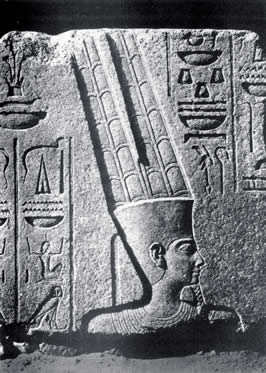
Depiction of Amun in a relief at Karnak (15th century BC) / Public Domain / Wikimedia Commons
There are a lot of these tomb inscriptions, but an excellent summation of their content can be found in the inscription of Nefer-seshem-re, called Sheshi, from the Sixth Dynasty:
I have come from my town;
I have descended from my nome;
I have done justice for its lord;
I have satisfied him with what he loves.
I spoke truly; I did right;
I spoke fairly; I repeated fairly;
I seized the right moment,
so as to stand well with people.
I judged between two so as to content them;
I rescued the weak from one stronger than he
as much as was in my power.
I gave bread to the hungry, clothes [to the naked].
I brought the boatless to land.
I buried him who had no son;
I made a boat for him who lacked one.
I respected my father; I pleased my mother;
I raised their children.
So says he whose nickname is Sheshi.
These are the values that a ruler wishes to exemplify, the presence that he is attempting to validate with the Opet festival.
A few years ago, I started a Kiva team called the Emboatening Crew, and every Opet we go out and we find someone who lacks a boat, and we chip in to make a boat happen. Or some other thing that is in keeping with that ethos of governorship, the state that Opet itself is trying to establish. (It’s not just Kemetics in the crew. We had an influx of Celtic-influenced people who preferred to engage in Embovining. We have also done some Emgoatening, and a variety of other things. Not always organised, but it’s there, and you’re welcome to join. For Opet, or for whatever suits best. We’re under religious groups.)
This year, also, I intend to make a donation to a group focused on homelessness in my local area.
Always be kind to travelers.
You don’t know who they are.

Click here to like
Patheos Pagan on Facebook.

Click here to like
the Agora on Facebook
Hills of the Horizon is published monthly on the 29th here on the Agora. You can subscribe by RSS or via e-mail.
Please use the links to the right to keep on top of activities here on the Agora as well as across the entire Patheos Pagan channel.
Previous Post

September 28, 2016
The Cartomancer: How to Read Cards for the Secret
Next Post

October 2, 2016 Full Frontal Magic: Extended Spellwork and Self-Compassion
Browse Our Archives
Select a Category A Lakeside Hearth Adventures in Wortcunning Alone In Her Presence Arts, Crafts & Cooking Birthing Hereditary Witchcraft Book of Blackbirds Book Reviews Born-Again Witch Cauldron, Sword, Spear, & Stone Cermony and Liturgy Columns Community Dandelion Seeds Dear Jasmine Druid Thoughts Editor's Picks Everyday Pagan Family & Household Practice Family Traditions Full Frontal Magic Gateway Goddess Guest Articles Happily Heathen Health and Wellness Hearth of Hellenism Heathen Woman Hills of the Horizon History Holidays Horse Goddesses Interfaith Interviews Irish-American Witchcraft Jewish Witch Lamp & Labyrinth Letters from Midgard Literature, Media, Film, Music Loop of Brighid Love, Sex & Relationships Magic or Magick Making Light Naturalistic Traditions Nature News Outside The Circle Pantheisticon Politics Prayers, Poems, Blessings & Stories Queer Femme Mystic Queer of Swords Recipes Ritual and Practice Science and Research Seekers and Guides Seeking the Grail Socially Responsible Magic Spear of Athena Star Made Witch Syncretic Electric Technology The Blooming Staff The Busy Witch The Cartomancer The Crow's Nest The Dance of Pagan Recovery The Hearth of Hellenism The Lady's Quill The Other Side of the Hedge The Path of She The Rantin' Raven The Witches Next Door The Zen Pagan Theology, Ethics, Philosophy Tree City Witch Urban Earthwitch Wayfaring Woman Witch on Fire Wyrd Words
Select a Month January 2026 March 2025 December 2024 June 2024 April 2024 March 2024 January 2024 December 2023 November 2023 October 2023 August 2023 July 2023 May 2023 April 2023 March 2023 February 2023 January 2023 December 2022 November 2022 October 2022 September 2022 August 2022 July 2022 June 2022 May 2022 March 2022 February 2022 January 2022 December 2021 November 2021 October 2021 September 2021 August 2021 July 2021 June 2021 May 2021 April 2021 March 2021 February 2021 January 2021 December 2020 November 2020 October 2020 September 2020 August 2020 July 2020 June 2020 May 2020 April 2020 March 2020 February 2020 January 2020 December 2019 November 2019 October 2019 September 2019 August 2019 July 2019 June 2019 May 2019 April 2019 March 2019 February 2019 January 2019 December 2018 November 2018 October 2018 September 2018 August 2018 July 2018 June 2018 May 2018 April 2018 March 2018 February 2018 January 2018 December 2017 November 2017 October 2017 September 2017 August 2017 July 2017 June 2017 May 2017 April 2017 March 2017 February 2017 January 2017 December 2016 November 2016 October 2016 September 2016 August 2016 July 2016 June 2016 May 2016 April 2016 March 2016 February 2016 January 2016 December 2015 November 2015 October 2015 September 2015 August 2015 July 2015 June 2015 May 2015 April 2015 March 2015 February 2015 January 2015 December 2014 November 2014 October 2014 September 2014 August 2014 July 2014 June 2014 May 2014 April 2014 March 2014 February 2014 January 2014 December 2013 November 2013 October 2013 September 2013 August 2013 July 2013 June 2013 May 2013 April 2013 March 2013 February 2013 January 2013 December 2012 November 2012 October 2012 September 2012 August 2012 July 2012 June 2012 May 2012 April 2012 March 2012 February 2012 January 2012
Follow Us!
TAKE THE
Religious Wisdom Quiz
Who led the animals onto the ark?
Select your answer to see how you score.
Isaac Jacob Noah Moses
Related posts from Agora

Simple Witchery: To Keep Silent

Simple Witchery: Leaning On The Four Pillars


Pergamum Unfurled: Magic with the Greek Gods (Book...
TRENDING AT PATHEOS Pagan

I was recently chatting with someone on Instagram. She asked me what...

While there are many people who share their results, the end of...

On July 23, I saw Christopher Nolan's The Odyssey which is Homer’s...

As I write this two big events have just finished up. One...

Restoring the Watershed of Divine Love
Perhaps cooperation is not something we manufacture through legislation, ideology, or moral...

Many UUs don’t pray because of bad experiences in a previous religion,...
view all Pagan blogs
Ad-Free & Subscriber Log-In Subscription Support
- About Us
- 2026 Calendar
- Videos
- Podcasts
- Library of World Religions
- Faith In Media Tracker
- Advertise With Us
- Write for Us
- Privacy Policy
- Terms of Service
- Do Not Sell My Data
- Contact Us
- Radiant Digital
- Manage Newsletter Subscriptions
- Unsubscribe From Notifications
- Sitemap
Copyright 2008-2026, Patheos. All rights reserved.
Subscription Support Ad-Free & Subscriber Log-In
Follow Patheos