
BuddhistCatholicContemplativeEvangelicalGeneral ChristianHinduJewishLatter-day SaintMuslimNew VisionsProgressive Christian
Beliefs
- Buddhist
- Catholic
- Contemplative
- Evangelical
- General Christian
- Hindu
- Jewish
- Latter-day Saint
- More Voices
- Muslim
- New Visions
- Pagan
- Progressive Christian
Topics
- Religion News
- Food and Religion
- Sports and Religion
- Religious Art
- Religious Music and Entertainment
- Religious Events
- History and Religion
- Style and Religion
- Politics and Religion
- Women in Religion
- Recreation Outdoors and Religion
- Business Finance and Religion
- Careers Workplace and Religion
- Education and Religion
- Family Parenting and Religion
- Health Fitness and Religion
- Home and Religion
- Relationships and Religion
- Technology and Religion
- Travel and Religion
Columnists
- Buddhist Columnists
- Business Finance and Religion Columnists
- Careers Workplace and Religion Columnists
- Catholic Columnists
- Contemplative Columnists
- Education and Religion Columnists
- Evangelists Columnists
- Family Parenting and Religion Columnists
- General Christian Columnists
- Health Fitness and Religion Columnists
- Hindu Columnists
- History and Religion Columnists
- Home and Religion Columnists
- Jewish Columnists
- More Voices Columnists
- Latter Day Columnists
- Muslim Columnists
- New Visions Columnists
- Nonreligious Columnists
- Pagan Columnists
- Politics and Religion Columnists
- Progressive Columnists
- Recreation Outdoors and Religion Columnists
- Relationships and Religion Columnists
- Religion News Columnists
- Religious Art Columnists
- Religious Events Columnists
- Religious Music and Entertainment Columnists
- Sports and Religion Columnists
- Style and Religion Columnists
- Technology and Religion Columnists
- Travel and Religion Columnists
- Women in Religion Columnists
Resource Library
- 2026 Calendar
- Library of World Religions
- The 100 Most Holy Places on Earth
- Patheos Answers
- Podcasts
- Videos
- Faith Leaders Database
- Anglican Episcopalian
- Bahai
- Baptist
- Buddhism
- Christianity
- Confucianism
- Eastern Orthodoxy
- Hinduism
- Holiness and Pentecostal
- ISKCON
- Islam
- Judaism
- Lutheran
- Methodist
- The Church of Jesus Christ of Latter-day Saints
- New Age
- Paganism
- Presbytarian and Reformed
- Protestantism
- Religion Behind the Scenes
- Roman Catholic
- Scientology
- Shia Islam
- Sikhism
- Sufism
- Sunni Islam
- Taoism
- Zen
- See all religions
Research Tools
 Ad-Free & Subscriber Log-In Subscription Support
Ad-Free & Subscriber Log-In Subscription Support
Follow Patheos 

- Trending:
- Forgiveness
- |
- Marriage
- |
- Consciousness
- |
- Death Penalty
- |
- Election
- |
- Halloween

- Home
- Pagan
- Happily Heathen: Receiving The Blessings
Happily Heathen: Receiving The Blessings
Last updated on: August 12, 2016 at 5:38 pm by Cara Freyasdaughter
Happily Heathen: Receiving The Blessings 2016-08-12T17:38:00+00:00 Cara Freyasdaughter
Patheos Explore the world's faith through different perspectives on religion and spirituality! Patheos has the views of the prevalent religions and spiritualities of the world.
About once a year or so, a multi-question devotional polytheist meme goes around the blogosphere. I enjoy these because they encourage and inspire me to dig deeper into my own tradition and version of polytheism. Delving through some old posts this week, I came across this question from Galina Krasskova’s 2014 Devotional Polytheist meme:
What does your tradition do to increase the power and flow of blessings?
This one is particularly relevant to me at the moment as I’m in the middle of a 30 Days project dedicated to Njord, Norse deity of fishing, generosity, prosperity, and wisdom. So, how do Heathens ask for and receive blessings? And from whom do we ask them?
The “from whom” part is pretty easy–we ask the Gods, ancestors, or landspirits for Their blessings. The “how” part can get a bit controversial, though.
We Pray
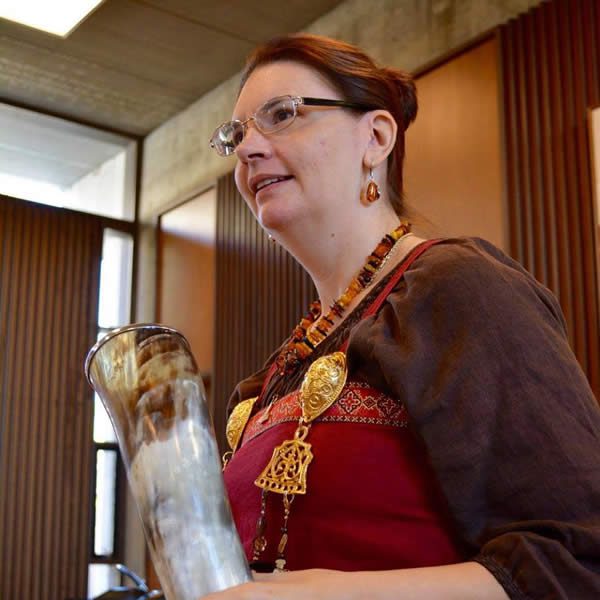
In other words, we explicitly tell the Gods what’s going on in our lives, ask for Their help, and give Them honor. I’ve heard that praying is talking to the Gods and that meditating is listening for their responses. I’ve always considered myself blessed to be part of a spiritual belief system that allows for the fact that the Gods might talk back, in one form or another.
While I consider prayer a natural outflow of my Heathen practice and my relationship with the Gods, ancestors, and landspirits, a certain subset of Heathens have a knee-jerk reaction to anyone even mentioning prayer. It’s one of the more ludicrous attitudes I’ve seen in Heathenry. Usually, the people who I see give this attitude are the tough-guy, we-don’t-bow-to-nobody types. But, come on. Of course we pray. What do you think we’re doing at a blot or sumbel when we honor the Gods, tell them what’s going on, and thank them for their help? I’m not entirely sure what these Heathens do in their practice, but I wouldn’t be surprised if it actually involved something suspiciously similar to praying.
We Galdr
Galdr is the ritual chanting of the runes with the express purpose of invoking their power–to heal, lend strength, draw something to you, whatever. Also, historically, they were used to cast “battle fetters” upon an enemy. (Isn’t that a cool image? I can just see a bunch of crazy Norse women standing directly behind the battle line, chanting and sending out negative magic against their enemies. Celtic types, bring it on!)

The Three Witches by Henry Fuseli / Public Domain / Wikimedia Commons
When I think of galdr, I think usually think of it as something we do as a community on someone’s behalf (like the battlefetters, in a way). For example, if someone has cancer and we as a community want to send healing or strength to that person, we would gather together and galdr for them. That’s not the only way it is used, however. My experience over the years has been that pretty much anything that involves using runes in magical context will likely be augmented with some gadring at some point. As with anything runic-based, the blessings can be seen as coming from the runes themselves, or that the runes are just a vehicle for the blessings that the Gods and ancestors are giving to us.
We Make Bindrunes
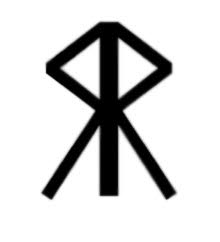
A Bindrune by the Author
Bindrunes are two or more runes, which, when combined, blend the energy of the runes involved. This is a very useful tool, as the runes often need to be used in conjunction with one another to better address your specific need. They also concentrate the power of the runes involved and become a good focal point for your intent. There are a wide variety of theories as to how one should be created; to me, it makes most sense just to combine the relevant runes to tailor them to your specific goal. Other people write out a word in runes and then combine those runes into one bindrune. (I’m not a fan of this approach because it looks messy, and it also seems to me to just be a Norse-ified version of numerology.) Once created, they can be drawn on objects or people, and as I mentioned above, can be combined with galdering.
You have to have a very clear intent while making bindrunes, though. Aside from looking messy, even if you only include two runes into your bindrune, it can easily end up looking like every other bindrune in existence. People who see your bindrune will probably have this type of reaction: “So, er, this is two Raidhos put together, facing each other. Hmm, no, wait–it’s Othala plus Isa. Oh, it’s Tiwaz plus Gebo, you say? My bad.” There’s only so many ways straight lines can combine. Always do your research and be very clear about which meaning you’re aiming for. This is not a time to be sloppy with your magic or spell-casting.
We Ingest the Runes
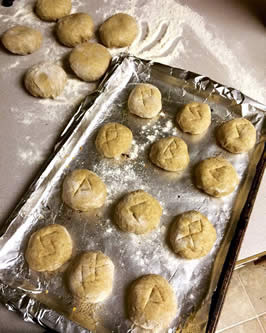
Runic Bread by Katla Hase / Used with permission
Back in the day, this was done by inscribing the runes on some tree bark and then scraping that bark into your mead or food. Personally, I like to use baked goods for this purpose, inscribing runes into the dough and galdring over them. At feasts, sumbels, or blots, people often draw or galdr runes over food and then imbibe it; and some use galdr to infuse the contents of the horn at a blot or sumbel so that those attending can ingest it.
We are Hospitable
I’m not entirely sure if this fits within the scope of the question, but Old Norse and Germanic cultures (as well as many others) had very strict cultural norms around how to be a good guest and how to be a good host, and warned about the consequences that would befall you if you fail at either. I think the reverse is also true; being the generous, good host will earn you the favor of the Gods, and they will give you blessings accordingly. Thus, any blessings you give out while hosting will be returned to you when you yourself are the guest at an event.
Blessings can take many forms and come from many places–sometimes asked for, and sometimes not. There are many places where you can ask for and receive these gifts from the Gods, ancestors, and landspirits. Make sure to claim your share of the blessings by actively participating in this exchange between us and the Heathen powers that be.

Click here to like
Patheos Pagan on Facebook.

Click here to like
the Agora on Facebook
Happily Heathen is posted on alternate Fridays here at the Agora. Subscribe by RSS or e-mail!
Please use the links to the right to keep on top of activities here on the Agora as well as across the entire Patheos Pagan channel.
Previous Post

August 11, 2016
Outside the Circle: Top Ten Magickal Facts about Trees

Browse Our Archives
Select a Category A Lakeside Hearth Adventures in Wortcunning Alone In Her Presence Arts, Crafts & Cooking Birthing Hereditary Witchcraft Book of Blackbirds Book Reviews Born-Again Witch Cauldron, Sword, Spear, & Stone Cermony and Liturgy Columns Community Dandelion Seeds Dear Jasmine Druid Thoughts Editor's Picks Everyday Pagan Family & Household Practice Family Traditions Full Frontal Magic Gateway Goddess Guest Articles Happily Heathen Health and Wellness Hearth of Hellenism Heathen Woman Hills of the Horizon History Holidays Horse Goddesses Interfaith Interviews Irish-American Witchcraft Jewish Witch Lamp & Labyrinth Letters from Midgard Literature, Media, Film, Music Loop of Brighid Love, Sex & Relationships Magic or Magick Making Light Naturalistic Traditions Nature News Outside The Circle Pantheisticon Politics Prayers, Poems, Blessings & Stories Queer Femme Mystic Queer of Swords Recipes Ritual and Practice Science and Research Seekers and Guides Seeking the Grail Socially Responsible Magic Spear of Athena Star Made Witch Syncretic Electric Technology The Blooming Staff The Busy Witch The Cartomancer The Crow's Nest The Dance of Pagan Recovery The Hearth of Hellenism The Lady's Quill The Other Side of the Hedge The Path of She The Rantin' Raven The Witches Next Door The Zen Pagan Theology, Ethics, Philosophy Tree City Witch Urban Earthwitch Wayfaring Woman Witch on Fire Wyrd Words
Select a Month January 2026 March 2025 December 2024 June 2024 April 2024 March 2024 January 2024 December 2023 November 2023 October 2023 August 2023 July 2023 May 2023 April 2023 March 2023 February 2023 January 2023 December 2022 November 2022 October 2022 September 2022 August 2022 July 2022 June 2022 May 2022 March 2022 February 2022 January 2022 December 2021 November 2021 October 2021 September 2021 August 2021 July 2021 June 2021 May 2021 April 2021 March 2021 February 2021 January 2021 December 2020 November 2020 October 2020 September 2020 August 2020 July 2020 June 2020 May 2020 April 2020 March 2020 February 2020 January 2020 December 2019 November 2019 October 2019 September 2019 August 2019 July 2019 June 2019 May 2019 April 2019 March 2019 February 2019 January 2019 December 2018 November 2018 October 2018 September 2018 August 2018 July 2018 June 2018 May 2018 April 2018 March 2018 February 2018 January 2018 December 2017 November 2017 October 2017 September 2017 August 2017 July 2017 June 2017 May 2017 April 2017 March 2017 February 2017 January 2017 December 2016 November 2016 October 2016 September 2016 August 2016 July 2016 June 2016 May 2016 April 2016 March 2016 February 2016 January 2016 December 2015 November 2015 October 2015 September 2015 August 2015 July 2015 June 2015 May 2015 April 2015 March 2015 February 2015 January 2015 December 2014 November 2014 October 2014 September 2014 August 2014 July 2014 June 2014 May 2014 April 2014 March 2014 February 2014 January 2014 December 2013 November 2013 October 2013 September 2013 August 2013 July 2013 June 2013 May 2013 April 2013 March 2013 February 2013 January 2013 December 2012 November 2012 October 2012 September 2012 August 2012 July 2012 June 2012 May 2012 April 2012 March 2012 February 2012 January 2012
Follow Us!
TAKE THE
Religious Wisdom Quiz
Who said, 'Let my people go'?
Select your answer to see how you score.
Moses Elijah Aaron Joshua
Related posts from Agora

Simple Witchery: To Keep Silent

Simple Witchery: Leaning On The Four Pillars

Pergamum Unfurled: Magic with the Greek Gods (Book...

Pergamum Unfurled: Cunning Words (Review)
TRENDING AT PATHEOS Pagan

I was recently chatting with someone on Instagram. She asked me what...

While there are many people who share their results, the end of...

On July 23, I saw Christopher Nolan's The Odyssey which is Homer’s...

As I write this two big events have just finished up. One...

Restoring the Watershed of Divine Love
Perhaps cooperation is not something we manufacture through legislation, ideology, or moral...

Many UUs don’t pray because of bad experiences in a previous religion,...
view all Pagan blogs
Ad-Free & Subscriber Log-In Subscription Support
- About Us
- 2026 Calendar
- Videos
- Podcasts
- Library of World Religions
- Faith In Media Tracker
- Advertise With Us
- Write for Us
- Privacy Policy
- Terms of Service
- Do Not Sell My Data
- Contact Us
- Radiant Digital
- Manage Newsletter Subscriptions
- Unsubscribe From Notifications
- Sitemap
Copyright 2008-2026, Patheos. All rights reserved.
Subscription Support Ad-Free & Subscriber Log-In
Follow Patheos