
BuddhistCatholicContemplativeEvangelicalGeneral ChristianHinduJewishLatter-day SaintMuslimNew VisionsProgressive Christian
Beliefs
- Buddhist
- Catholic
- Contemplative
- Evangelical
- General Christian
- Hindu
- Jewish
- Latter-day Saint
- More Voices
- Muslim
- New Visions
- Pagan
- Progressive Christian
Topics
- Religion News
- Food and Religion
- Sports and Religion
- Religious Art
- Religious Music and Entertainment
- Religious Events
- History and Religion
- Style and Religion
- Politics and Religion
- Women in Religion
- Recreation Outdoors and Religion
- Business Finance and Religion
- Careers Workplace and Religion
- Education and Religion
- Family Parenting and Religion
- Health Fitness and Religion
- Home and Religion
- Relationships and Religion
- Technology and Religion
- Travel and Religion
Columnists
- Buddhist Columnists
- Business Finance and Religion Columnists
- Careers Workplace and Religion Columnists
- Catholic Columnists
- Contemplative Columnists
- Education and Religion Columnists
- Evangelists Columnists
- Family Parenting and Religion Columnists
- General Christian Columnists
- Health Fitness and Religion Columnists
- Hindu Columnists
- History and Religion Columnists
- Home and Religion Columnists
- Jewish Columnists
- More Voices Columnists
- Latter Day Columnists
- Muslim Columnists
- New Visions Columnists
- Nonreligious Columnists
- Pagan Columnists
- Politics and Religion Columnists
- Progressive Columnists
- Recreation Outdoors and Religion Columnists
- Relationships and Religion Columnists
- Religion News Columnists
- Religious Art Columnists
- Religious Events Columnists
- Religious Music and Entertainment Columnists
- Sports and Religion Columnists
- Style and Religion Columnists
- Technology and Religion Columnists
- Travel and Religion Columnists
- Women in Religion Columnists
Resource Library
- 2026 Calendar
- Library of World Religions
- The 100 Most Holy Places on Earth
- Patheos Answers
- Podcasts
- Videos
- Faith Leaders Database
- Anglican Episcopalian
- Bahai
- Baptist
- Buddhism
- Christianity
- Confucianism
- Eastern Orthodoxy
- Hinduism
- Holiness and Pentecostal
- ISKCON
- Islam
- Judaism
- Lutheran
- Methodist
- The Church of Jesus Christ of Latter-day Saints
- New Age
- Paganism
- Presbytarian and Reformed
- Protestantism
- Religion Behind the Scenes
- Roman Catholic
- Scientology
- Shia Islam
- Sikhism
- Sufism
- Sunni Islam
- Taoism
- Zen
- See all religions
Research Tools
 Ad-Free & Subscriber Log-In Subscription Support
Ad-Free & Subscriber Log-In Subscription Support
Follow Patheos 

- Trending:
- Forgiveness
- |
- Marriage
- |
- Consciousness
- |
- Death Penalty
- |
- Election
- |
- Halloween

- Home
- Pagan
- Outside the Circle: Dark Spirits of Lammas
Outside the Circle: Dark Spirits of Lammas
Last updated on: July 28, 2016 at 2:45 pm by Danette Wilson
Outside the Circle: Dark Spirits of Lammas 2016-07-28T14:45:54+00:00 Danette Wilson
Patheos Explore the world's faith through different perspectives on religion and spirituality! Patheos has the views of the prevalent religions and spiritualities of the world.
It is turning darker sooner, slowly, little by little. The lengthening shadows are appearing as a sign that the nights will be winning once again, as the Wheel of the Year turns. As twilight appears it is rife with legends of the darker ones becoming more and more prominent.
The fairies of English and Scottish folklore have been classified in a variety of ways. Two of the most prominent categories, derived from Scottish folklore, are the division into the Seelie Court and the Unseelie Court.
The Unseelie Court
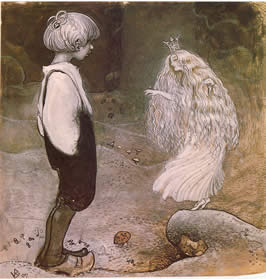
By John Bauer – Illustration of Alfred Smedberg’s The Seven Wishes in Julbocken, 1907, Public Domain via Wikimedia Commons
The Seelie court–“The Shining Throne,” “The Golden Ones,” and “The Summer Court”–are giving way to The Unseelie Court, consisting of the darkly-inclined fairies. They appear at night and are said to assault travelers, often carrying them through the air, beating them, and forcing them to commit such acts as shooting at cattle.
The time of the Seelies has ended, their reign when light appears at Imbolc to Midsummer. But the Unseelie love the dark and are growing stronger until Samhain which is their finest hour. There really is lore to correspond with ghouls and mischief abounding in Autumn. It starts now, with the first Harvest, as darkness quickens upon the air around us.
They are the Faeries that go bump in the night. The Unseelie Court generally dislike humans, and when they play their tricks, they would rather harm than help. Passion conquers love. Dark rules over light. The Unseelie way is passionate and pragmatic. They stand for the principles of constant change and impulsive action and have a reputation for fostering war and madness, despising those weaker than themselves, and valuing freedom and wildness over any chivalric code. The Unseelie see themselves as radical visionaries, bringing about vital change and transformation.
In Norse paganism, Light elves were beautiful creatures and were considered to be “guardian angels”. The god Freyr, was the ruler of Alfheim, the home of the light elves. Light elves were minor gods of nature and fertility; they could help or hinder, humans with their knowledge of magical powers. They also often delivered an inspiration to art or music.
Dark Elves
Dark Elves, the opposite of the Light Elves, resided in Svartálfheim. The Dark Elves hated the sun and it’s sunlight, because if they were touched or exposed to it they would immediately turn into stone. They like to annoy and threaten humans, to the point that nightmares were thought to be produced by the Dark Elves. These Dark Elves would sit on a sleeping person’s chest and whisper bad dreams to haunt the person. These elves could also haunt animals, especially horses.
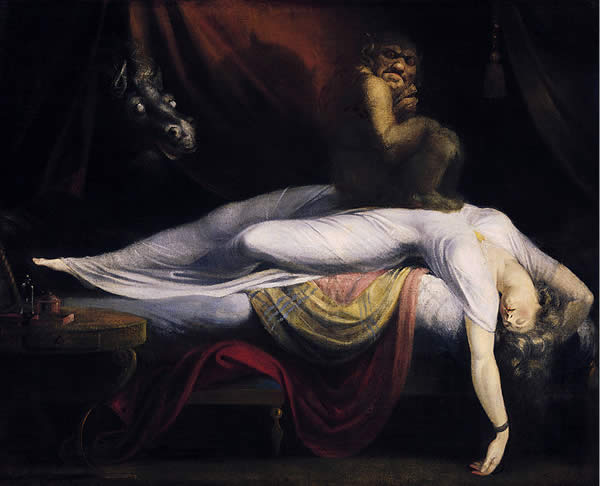
The Nightmare by Henry Fuseli. Public Domain via Wikimedia Commons
The Sidhe
The Sidhe (shee) are considered to be a distinct race, quite separate from human beings yet who have had much contact with mortals over the centuries, and there are many documented testimonies to this. Belief in this race of beings who have powers beyond those of men to move quickly through the air and change their shape at will once played a huge part in the lives of people living in rural Ireland and Scotland.
The sidhe of the subterranean mounds are also seen by the Irish as the descendants of the old agricultural gods of the Earth, (one of the most important being Crom Cruaich, the Crooked One of the Hill). These gods controlled the ripening of the crops and the milk yields of the cattle, therefore offerings had to be given to them regularly. In the Book of Leinster we discover that after their conquest the Tuatha De Danaan took revenge on the sons of Mil by destroying their wheat and the goodness of the milk (the sidhe are notorious for this even today). The sons of Mil were thus forced to make a treaty with them, and ever since that time the people of Ireland have honoured this treaty by leaving offerings of milk and butter to the Good People.
Crom Cruach, the other Wicker man
Crom Cruach was a god of pre-Christian Ireland. According to history he was propitiated with human sacrifice and his worship was ended by Saint Patrick.
He is also referred to as Crom Dubh. The festival for Crom Cruach is called Domhnach Crom Dubh, Crom Dubh Sunday.
The references in the dinsenchas poem in the 12th century to sacrifice in exchange for milk and grain suggest that Crom had a function as fertility god. The description of his image as a gold figure surrounded by twelve stone or bronze figures has been interpreted by some as representing the sun surrounded by the signs of the zodiac, suggesting a function as solar deity
Human sacrifices to the Irish God Crom Dubh were made to ensure a rich harvest and fair weather.
The legend of Crom Cruach is a sinister one. The ancient texts of the Metrical Dindshenchas claim that the people of Ireland worshiped the God by offering up their firstborn child in return for a plentiful harvest in the coming year.
Crom Dubh, the ‘dark, stooped one’ who lived in the underworld throughout winter, emerging on 1st August to claim the ‘first fruits’, in the form of Eithne the corn maiden, and bringing her on his back (hence his stoop) down to the underworld.
He once enjoyed the unreserved worship in Ireland and other Celtic countries, before the church and tribal wars brought about the cultural and ethnic genocide of old Europe.
The Burry Man

The Burry Man and his attendants pause for a photo close to the Forth Bridge; August 2013, South Queensferry by Oliver Benton – Own work, CC BY-SA 4.0 via Wikimedia Commons
The Burry Man is the main figure in an annual ritual that takes place in South Queensferry, near Edinburgh every August. A local man is covered from head to foot in thistle burrs. He is paraded through the town at a snails pace supported by two assistants. He is in the costume for nearly nine hours, often in sweltering heat, and can easily lose nearly fourteen pounds in weight. Able only to drink through a straw, he is sustained by a few wee drams, and lots of water.
The meaning of the ceremony has been lost but could have been to do with seeking good fortune for town or harvest.
Warding off evil Spirits, connecting with nature, and celebrating local identity, to see this would make you think he’s suffering a medieval punishment, but it’s actually a great honour to be selected.
Another suggestion is that the Burry Man is a scapegoat figure, the burrs representing the guilt of the village being collected and driven out.
Odin
It was also in August that the god Odin sacrificed himself on the World Tree to gain knowledge of the runes. He hung there for nine days and nights, staring into the abyss, pierced by a lance and losing one of his eyes in the process.
Blood and Bacchus
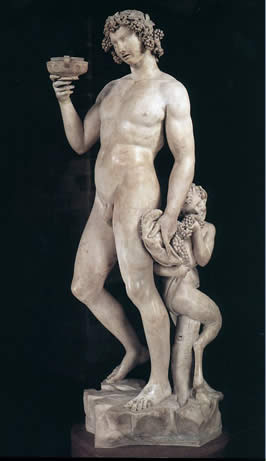
Michelangelo — Bacchus. Museo del Bargello, Florence, Italy. Public Domain via Wikimedia Commons
The grape harvest as well as grain begins at Lughnasa. Whereas bread is viewed as the body of the sacrificed god, wine is his blood. The ancients thought that the state induced by wine was a sacred one.
In the myth of Dionysus (Bacchus), Hera would try to smuggle him as a child, and later in his life drove him insane. His festivals were the Bacchantia, celebrated by those who used alcohol to overcome inhibitions that social conventions would not normally permit. Dionysus was a god that defied social order, broke taboos and customs and gained knowledge through divine madness. He was attracted to the night and dark places.
Scathach
Scathach was a warrior queen whose name meant “The Shadowy One”. She lived in Western Scotland and ran a training academy for young warriors.
A strong and fiercly independent woman who was respected and revered by the warrior society. She is an otherworldy character and her granting of the Gae Bolga to Cuchulainn is strongly reminiscent of the Lady of the Lake granting Excalibur to Arthur. Through her instruction he became the champion for all Ireland while she herself remained famed for her own skills and magic.
Described as a witch and a prophetess, she was titled the Amazon Witch Queen. She knew every art of war and every weapon, every trick and every strategy. She was also a Druidess and mistress of the arts of magic, prophecy and shapeshifting.
Banshees
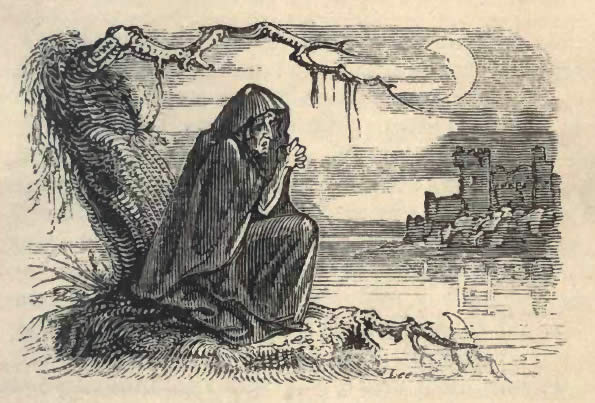
Bunworth Banshee by W.H. Brooke – Public Domain via Wikimedia Commons
Although not always seen, her mourning call is heard, usually at night.
In 1437, King James I of Scotland was approached by an Irish seeress or banshee who foretold his murder at the instigation of the Earl of Atholl. There are records of several human banshees or prophetesses attending the great houses of Ireland and the courts of local Irish kings. In some parts of Leinster, she is referred to as the bean chaointe (keening woman) whose wail can be so piercing that it shatters glass.
She usually wears either a grey, hooded cloak or the winding sheet or grave robe of the unshriven dead. She may also appear as a washer-woman.
Her name is connected to the mythologically-important tumuli or “mounds” that dot the Irish countryside, which are known as síde in Old Irish.
The banshee is often described in Gaelic lore as wearing red or green, usually with long, disheveled hair and is seen as an ugly, frightful hag.
They are said to stand on the branches of trees under the eerie light of a full moon.
§
The Witches of the past learned their magic from the fairies, meeting them in the woodlands and fairy mounds that ordinary people avoided. Given herbs, potions, and the secrets of the Craft. In the woodlands, following a path deep into the heart of the greenwood.

Click here to like
Patheos Pagan on Facebook.

Click here to like
the Agora on Facebook
Outside the Circle is published occasionally on Agora. Subscribe via RSS or e-mail!
Please use the links to the right to keep on top of activities here on the Agora as well as across the entire Patheos Pagan channel.
Previous Post
July 27, 2016
The Cartomancer: Poison Path Cartomancy
Next Post

July 29, 2016 Hills of the Horizon: The Village Games
Browse Our Archives
Select a Category A Lakeside Hearth Adventures in Wortcunning Alone In Her Presence Arts, Crafts & Cooking Birthing Hereditary Witchcraft Book of Blackbirds Book Reviews Born-Again Witch Cauldron, Sword, Spear, & Stone Cermony and Liturgy Columns Community Dandelion Seeds Dear Jasmine Druid Thoughts Editor's Picks Everyday Pagan Family & Household Practice Family Traditions Full Frontal Magic Gateway Goddess Guest Articles Happily Heathen Health and Wellness Hearth of Hellenism Heathen Woman Hills of the Horizon History Holidays Horse Goddesses Interfaith Interviews Irish-American Witchcraft Jewish Witch Lamp & Labyrinth Letters from Midgard Literature, Media, Film, Music Loop of Brighid Love, Sex & Relationships Magic or Magick Making Light Naturalistic Traditions Nature News Outside The Circle Pantheisticon Politics Prayers, Poems, Blessings & Stories Queer Femme Mystic Queer of Swords Recipes Ritual and Practice Science and Research Seekers and Guides Seeking the Grail Socially Responsible Magic Spear of Athena Star Made Witch Syncretic Electric Technology The Blooming Staff The Busy Witch The Cartomancer The Crow's Nest The Dance of Pagan Recovery The Hearth of Hellenism The Lady's Quill The Other Side of the Hedge The Path of She The Rantin' Raven The Witches Next Door The Zen Pagan Theology, Ethics, Philosophy Tree City Witch Urban Earthwitch Wayfaring Woman Witch on Fire Wyrd Words
Select a Month January 2026 March 2025 December 2024 June 2024 April 2024 March 2024 January 2024 December 2023 November 2023 October 2023 August 2023 July 2023 May 2023 April 2023 March 2023 February 2023 January 2023 December 2022 November 2022 October 2022 September 2022 August 2022 July 2022 June 2022 May 2022 March 2022 February 2022 January 2022 December 2021 November 2021 October 2021 September 2021 August 2021 July 2021 June 2021 May 2021 April 2021 March 2021 February 2021 January 2021 December 2020 November 2020 October 2020 September 2020 August 2020 July 2020 June 2020 May 2020 April 2020 March 2020 February 2020 January 2020 December 2019 November 2019 October 2019 September 2019 August 2019 July 2019 June 2019 May 2019 April 2019 March 2019 February 2019 January 2019 December 2018 November 2018 October 2018 September 2018 August 2018 July 2018 June 2018 May 2018 April 2018 March 2018 February 2018 January 2018 December 2017 November 2017 October 2017 September 2017 August 2017 July 2017 June 2017 May 2017 April 2017 March 2017 February 2017 January 2017 December 2016 November 2016 October 2016 September 2016 August 2016 July 2016 June 2016 May 2016 April 2016 March 2016 February 2016 January 2016 December 2015 November 2015 October 2015 September 2015 August 2015 July 2015 June 2015 May 2015 April 2015 March 2015 February 2015 January 2015 December 2014 November 2014 October 2014 September 2014 August 2014 July 2014 June 2014 May 2014 April 2014 March 2014 February 2014 January 2014 December 2013 November 2013 October 2013 September 2013 August 2013 July 2013 June 2013 May 2013 April 2013 March 2013 February 2013 January 2013 December 2012 November 2012 October 2012 September 2012 August 2012 July 2012 June 2012 May 2012 April 2012 March 2012 February 2012 January 2012
Follow Us!
TAKE THE
Religious Wisdom Quiz
What is the main theme of the Parable of the Two Sons?
Select your answer to see how you score.
Obedience is proved by actions Firstborns are favored Repentance is easy Honesty is best
Related posts from Agora

Simple Witchery: To Keep Silent

Simple Witchery: Leaning On The Four Pillars

Pergamum Unfurled: Magic with the Greek Gods (Book...

Pergamum Unfurled: Cunning Words (Review)
TRENDING AT PATHEOS Pagan

I was recently chatting with someone on Instagram. She asked me what...

While there are many people who share their results, the end of...

On July 23, I saw Christopher Nolan's The Odyssey which is Homer’s...

As I write this two big events have just finished up. One...

Restoring the Watershed of Divine Love
Perhaps cooperation is not something we manufacture through legislation, ideology, or moral...

Many UUs don’t pray because of bad experiences in a previous religion,...
view all Pagan blogs
Ad-Free & Subscriber Log-In Subscription Support
- About Us
- 2026 Calendar
- Videos
- Podcasts
- Library of World Religions
- Faith In Media Tracker
- Advertise With Us
- Write for Us
- Privacy Policy
- Terms of Service
- Do Not Sell My Data
- Contact Us
- Radiant Digital
- Manage Newsletter Subscriptions
- Unsubscribe From Notifications
- Sitemap
Copyright 2008-2026, Patheos. All rights reserved.
Subscription Support Ad-Free & Subscriber Log-In
Follow Patheos