
BuddhistCatholicContemplativeEvangelicalGeneral ChristianHinduJewishLatter-day SaintMuslimNew VisionsProgressive Christian
Beliefs
- Buddhist
- Catholic
- Contemplative
- Evangelical
- General Christian
- Hindu
- Jewish
- Latter-day Saint
- More Voices
- Muslim
- New Visions
- Pagan
- Progressive Christian
Topics
- Religion News
- Food and Religion
- Sports and Religion
- Religious Art
- Religious Music and Entertainment
- Religious Events
- History and Religion
- Style and Religion
- Politics and Religion
- Women in Religion
- Recreation Outdoors and Religion
- Business Finance and Religion
- Careers Workplace and Religion
- Education and Religion
- Family Parenting and Religion
- Health Fitness and Religion
- Home and Religion
- Relationships and Religion
- Technology and Religion
- Travel and Religion
Columnists
- Buddhist Columnists
- Business Finance and Religion Columnists
- Careers Workplace and Religion Columnists
- Catholic Columnists
- Contemplative Columnists
- Education and Religion Columnists
- Evangelists Columnists
- Family Parenting and Religion Columnists
- General Christian Columnists
- Health Fitness and Religion Columnists
- Hindu Columnists
- History and Religion Columnists
- Home and Religion Columnists
- Jewish Columnists
- More Voices Columnists
- Latter Day Columnists
- Muslim Columnists
- New Visions Columnists
- Nonreligious Columnists
- Pagan Columnists
- Politics and Religion Columnists
- Progressive Columnists
- Recreation Outdoors and Religion Columnists
- Relationships and Religion Columnists
- Religion News Columnists
- Religious Art Columnists
- Religious Events Columnists
- Religious Music and Entertainment Columnists
- Sports and Religion Columnists
- Style and Religion Columnists
- Technology and Religion Columnists
- Travel and Religion Columnists
- Women in Religion Columnists
Resource Library
- 2026 Calendar
- Library of World Religions
- The 100 Most Holy Places on Earth
- Patheos Answers
- Podcasts
- Videos
- Faith Leaders Database
- Anglican Episcopalian
- Bahai
- Baptist
- Buddhism
- Christianity
- Confucianism
- Eastern Orthodoxy
- Hinduism
- Holiness and Pentecostal
- ISKCON
- Islam
- Judaism
- Lutheran
- Methodist
- The Church of Jesus Christ of Latter-day Saints
- New Age
- Paganism
- Presbytarian and Reformed
- Protestantism
- Religion Behind the Scenes
- Roman Catholic
- Scientology
- Shia Islam
- Sikhism
- Sufism
- Sunni Islam
- Taoism
- Zen
- See all religions
Research Tools
 Ad-Free & Subscriber Log-In Subscription Support
Ad-Free & Subscriber Log-In Subscription Support
Follow Patheos 

- Trending:
- Forgiveness
- |
- Marriage
- |
- Consciousness
- |
- Death Penalty
- |
- Election
- |
- Halloween

- Home
- Pagan
- The Cartomancer: Relax, Your Local Gods can only be Discovered through Foreign Intervention
The Cartomancer: Relax, Your Local Gods can only be Discovered through Foreign Intervention
Last updated on: June 8, 2016 at 3:56 pm by Camelia Elias
The Cartomancer: Relax, Your Local Gods can only be Discovered through Foreign Intervention 2016-06-08T15:56:15+00:00 Camelia Elias
Patheos Explore the world's faith through different perspectives on religion and spirituality! Patheos has the views of the prevalent religions and spiritualities of the world.
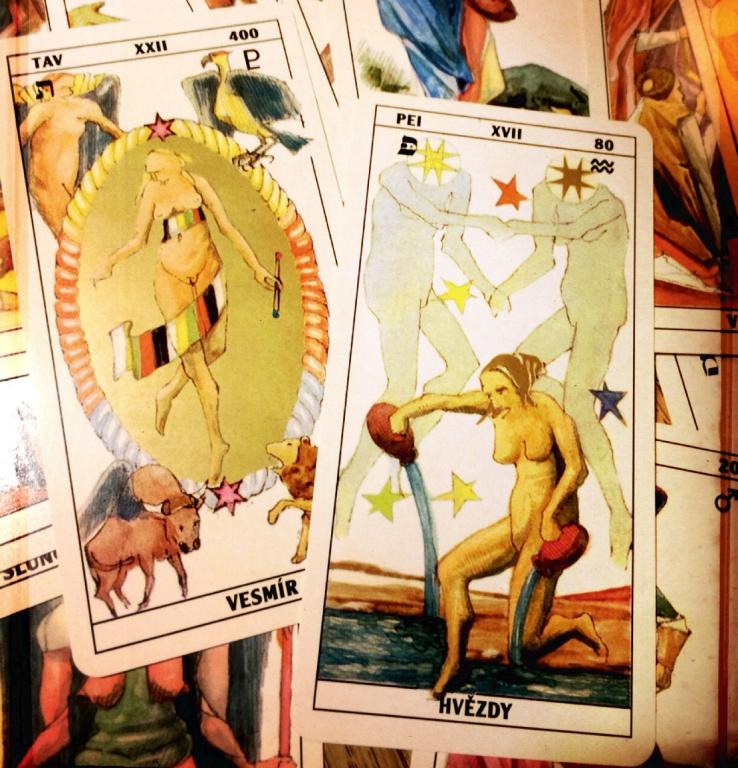
Czech Tarot in the collection of K. Frank Jensen (Photo: Camelia Elias)
These days there’s strong emphasis in the Pagan community on the importance of drawing on local spirits and ancestors, partly also in response to the debates on cultural appropriations and its consequences. Fair enough.
But, when we talk about myths, cosmologies, traditions, and systems of correspondences, such as for instance, this tarot card goes with that Hebrew glyph, or this plant goes with that star, what we’re actually talking about is a refined understanding of local power to the extent that foreign inspiration infuses it, or opens the gate to what is right under our noses, but cannot see.
Norse Gods and Vampires? Get real.
I’m suspicions of all who say: ‘Don’t waste your time with Norse mythology if you come from Romania, as that is not your source to power even though you now live in Denmark’, thus advocating focusing on my own bloodline and whatever else we assume separates us from one another, you know, things like race, age, class, and gender.
Scholars of mythology, however, have long since emphasized the opposite, demonstrating also why, for example, in my case, I can have a much better appreciation of Transylvanian vampires populating the place I was born, not only through local study, but rather, especially through diving into such unlike topics as demons according to Tibetan Buddhism of the Vajrayana school.
It may well be that advocates of the ‘pure’ think that such crossings merely disclose foolishness and frivolity, but the way I see it is that what we call our local gods are in fact always other people’s stories. And by ‘other’ people I mean exactly that, a people whose histories and myths are deeply steeped into something that I, as a Danish/Romanian person, have no clue about. In other words, my discovery of a bloodthirsty lineage that may as well run through my veins can only happen in this cluelessness, in the stories that other people’s myths tell.

Photo: Camelia Elias
Let me give an example. Influential Sanskrit scholar and reputed professor of history of religion, Wendy Doniger, advances the claim that our local treasures can only be discovered in other people’s myths. Our sense of self can only be discovered in the lies that tell the truth – her definition of a myth – formulated by people who are completely ‘Other’ in relation to our perception of ourselves. So it is not our local folks’ opinions that counts, about what we should do, and what we should focus on in our cultures, but rather, other people’s lies that tell our local truth – which a myth always is and does.
In her marvelous book, Other People’s Myths (1988), Doniger has a chapter that begins with telling a famous story about a Rabbi from Cracow. I paraphrase it here in my own voice.
In this story, Rabbi Eisik son of Jekel has a dream. He is told to go to Prague and look under the famous bridge in the city for a treasure. He doesn’t listen the first time around, but when he has the same recurrent dream three times in a row, he decides to listen. He goes to Prague and finds the bridge. The bridge is guarded by officers. What to do? While pondering and walking about, one of the officers approaches him to ask him if he lost anything. The Rabbi decides to come clean and tell him what the actual reason is for his roaming about. To his surprise, the officer says while also laughing his wits out: ‘Old man, you came all this way out here because you had a dream? How stupid is that? Let me tell you something. I also had a dream. In this dream, I was instructed to go to Cracow and find this Rabbi Eisik, son of Jekel. In his house, behind a dusty stove, I was to find a treasure. Can you imagine that? And how stupid would that be of me to go on this pilgrimage and end up knocking on every Jew’s door in the Ghetto to find this Rabbi, when half of the Jews there is all called Eisik, and the other half is called Jekel?’ Rabbi Eisik said nothing but took note. He went home and looked behind his dusty stove. Sure enough he found a treasure that helped him live happily ever after.
At this point in the book, Doniger brings in the Indologist Heinrich Zimmer, who has this to say on this Hasidic tale:
“The real treasure . . . is never far away; it lies buried in the innermost recess of our own home; that is to say, our own being . . . but there is the odd and persistent fact . . . that the one who reveals to us the meaning of our cryptic inner message must be a stranger, of another creed and a foreign race.” (in Doniger, 1988: 138).
Other People’s Heads
What I like about this story, and Doniger’s insistence that we can use other people’s myths to learn about our own local gods is the fact that it reminds me of what I do as a fortuneteller. I’m always in other people’s myths, in other people’s heads.
From within their stories I learn to ‘read’ predicaments, solutions, and the power of swerving. I’m not afraid of cultural appropriation. I appropriate grand style every time I get the chance. For it is always within this very appropriation that I get to find my own local treasures.
The condition, however, is that we must take other people’s myths as face value and without judgment. This requires trust and courage. In Denmark there are many Italian restaurants. Meanwhile not a single one of those has any clue as to what Italian food really is, or that there’s a major difference between spaghetti cooked the Sicilian way and spaghetti cooked the Siena way. The reason for this misunderstanding is a deep fear that the Danish restaurant owners have: They think that if they won’t adjust the Italian cooking to some supposedly Danish-Italian-oriented palate, they will have no customers. So ignorance prevails and no one learns anything. You will eat, for sure, but your experience won’t be mythological.
When I read the cards, I want the other’s story such as it is. I want the treasures that are buried in that story to be all mine, to tell me something about myself that I don’t know. I don’t want adjusted myths. My own advice, if I have one to offer, is likewise an attempt to make the other discover her treasures in my tale. That’s what cultural appropriation is all about.
While Doniger’s book doesn’t state it, the message between her lines is clear: Whatever you do, when in other people’s myths, don’t be a dick.
As my Czech cards also suggest it here, in the bottom row, The Devil, Force, Death: Liberate yourself from the obsessions with what’s yours, from what you try to force on others, and focus on what you can harvest from all the dead, not just your local mortals.

Czech Tarot in the collection of K. Frank Jensen (Photo: Camelia Elias)
The ‘dust to dust dictum’ is not reserved for anyone in particular, but it’s a reminder that there’s shared ground between us, and that our treasures are to be found in another person’s house. When Death calls on us all, it’s not sure that the demons you fear the most are not your best friends already, your psychopomps. Honor your local gods, but don’t forget that the real treasure is with the God you least expect to hear from. Heed attention, and listen to your dreams. They are more honest than you.
♦
Reference: Doniger, Wendy (1988). Other People’s Myths. New York: MacMillan Publishing Company.
♠
More of this, and other cartomantic activities? Stay in the loop.

Click here to like
Patheos Pagan on Facebook.

Click here to like
the Agora on Facebook
The Cartomancer is published bi-monthly on the second and fourth Wednesday here on the Agora. Subscribe via RSS or e-mail!
Please use the links to the right to keep on top of activities here on the Agora as well as across the entire Patheos Pagan channel.
Previous Post

June 7, 2016
Irish-American Witchcraft: The Summer Solstice - Cake for Áine
Next Post

June 9, 2016 The Lady's Quill: Eating Ash and Spitting Fire
Browse Our Archives
Select a Category A Lakeside Hearth Adventures in Wortcunning Alone In Her Presence Arts, Crafts & Cooking Birthing Hereditary Witchcraft Book of Blackbirds Book Reviews Born-Again Witch Cauldron, Sword, Spear, & Stone Cermony and Liturgy Columns Community Dandelion Seeds Dear Jasmine Druid Thoughts Editor's Picks Everyday Pagan Family & Household Practice Family Traditions Full Frontal Magic Gateway Goddess Guest Articles Happily Heathen Health and Wellness Hearth of Hellenism Heathen Woman Hills of the Horizon History Holidays Horse Goddesses Interfaith Interviews Irish-American Witchcraft Jewish Witch Lamp & Labyrinth Letters from Midgard Literature, Media, Film, Music Loop of Brighid Love, Sex & Relationships Magic or Magick Making Light Naturalistic Traditions Nature News Outside The Circle Pantheisticon Politics Prayers, Poems, Blessings & Stories Queer Femme Mystic Queer of Swords Recipes Ritual and Practice Science and Research Seekers and Guides Seeking the Grail Socially Responsible Magic Spear of Athena Star Made Witch Syncretic Electric Technology The Blooming Staff The Busy Witch The Cartomancer The Crow's Nest The Dance of Pagan Recovery The Hearth of Hellenism The Lady's Quill The Other Side of the Hedge The Path of She The Rantin' Raven The Witches Next Door The Zen Pagan Theology, Ethics, Philosophy Tree City Witch Urban Earthwitch Wayfaring Woman Witch on Fire Wyrd Words
Select a Month January 2026 March 2025 December 2024 June 2024 April 2024 March 2024 January 2024 December 2023 November 2023 October 2023 August 2023 July 2023 May 2023 April 2023 March 2023 February 2023 January 2023 December 2022 November 2022 October 2022 September 2022 August 2022 July 2022 June 2022 May 2022 March 2022 February 2022 January 2022 December 2021 November 2021 October 2021 September 2021 August 2021 July 2021 June 2021 May 2021 April 2021 March 2021 February 2021 January 2021 December 2020 November 2020 October 2020 September 2020 August 2020 July 2020 June 2020 May 2020 April 2020 March 2020 February 2020 January 2020 December 2019 November 2019 October 2019 September 2019 August 2019 July 2019 June 2019 May 2019 April 2019 March 2019 February 2019 January 2019 December 2018 November 2018 October 2018 September 2018 August 2018 July 2018 June 2018 May 2018 April 2018 March 2018 February 2018 January 2018 December 2017 November 2017 October 2017 September 2017 August 2017 July 2017 June 2017 May 2017 April 2017 March 2017 February 2017 January 2017 December 2016 November 2016 October 2016 September 2016 August 2016 July 2016 June 2016 May 2016 April 2016 March 2016 February 2016 January 2016 December 2015 November 2015 October 2015 September 2015 August 2015 July 2015 June 2015 May 2015 April 2015 March 2015 February 2015 January 2015 December 2014 November 2014 October 2014 September 2014 August 2014 July 2014 June 2014 May 2014 April 2014 March 2014 February 2014 January 2014 December 2013 November 2013 October 2013 September 2013 August 2013 July 2013 June 2013 May 2013 April 2013 March 2013 February 2013 January 2013 December 2012 November 2012 October 2012 September 2012 August 2012 July 2012 June 2012 May 2012 April 2012 March 2012 February 2012 January 2012
Follow Us!
TAKE THE
Religious Wisdom Quiz
This Gospel alone records seven 'I am' statements from Jesus. Which of these is NOT one of them: the bread of life, the good shepherd, the way and the truth and the life, or the Alpha and Omega?
Select your answer to see how you score.
The way and the truth and the life The Alpha and Omega The bread of life The good shepherd
Related posts from Agora

Simple Witchery: To Keep Silent

Simple Witchery: Leaning On The Four Pillars

Pergamum Unfurled: Magic with the Greek Gods (Book...

Pergamum Unfurled: Cunning Words (Review)
TRENDING AT PATHEOS Pagan

I was recently chatting with someone on Instagram. She asked me what...

While there are many people who share their results, the end of...

On July 23, I saw Christopher Nolan's The Odyssey which is Homer’s...

As I write this two big events have just finished up. One...

Restoring the Watershed of Divine Love
Perhaps cooperation is not something we manufacture through legislation, ideology, or moral...

Many UUs don’t pray because of bad experiences in a previous religion,...
view all Pagan blogs
Ad-Free & Subscriber Log-In Subscription Support
- About Us
- 2026 Calendar
- Videos
- Podcasts
- Library of World Religions
- Faith In Media Tracker
- Advertise With Us
- Write for Us
- Privacy Policy
- Terms of Service
- Do Not Sell My Data
- Contact Us
- Radiant Digital
- Manage Newsletter Subscriptions
- Unsubscribe From Notifications
- Sitemap
Copyright 2008-2026, Patheos. All rights reserved.
Subscription Support Ad-Free & Subscriber Log-In
Follow Patheos